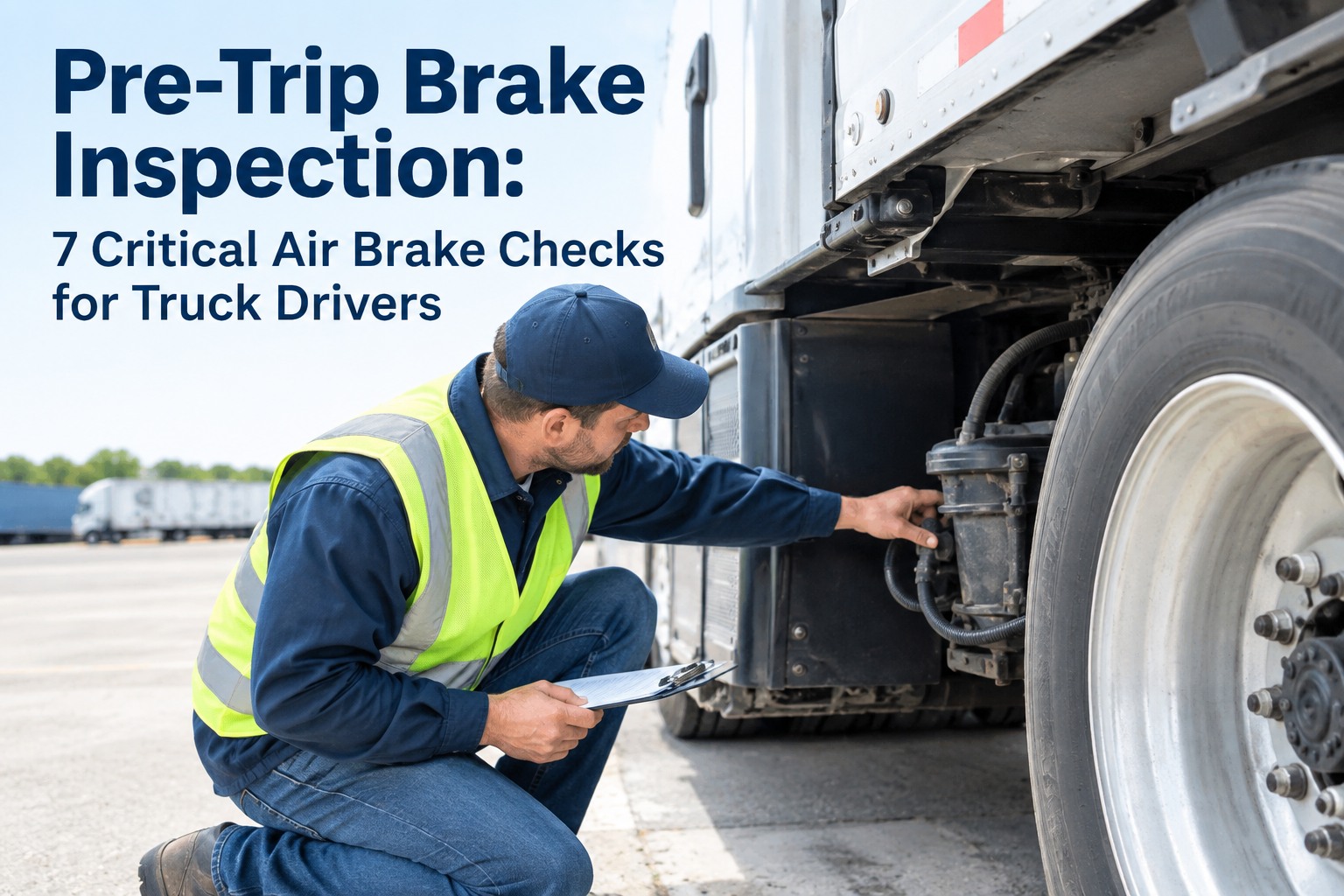
A slow air leak at the gauge today is a stopped truck on the shoulder tomorrow. This checklist puts every pressure target, leak limit and component check in the order a driver actually performs them. Start free and log every brake test digitally.
Leaks · Pressure · Chambers · Slack adjusters
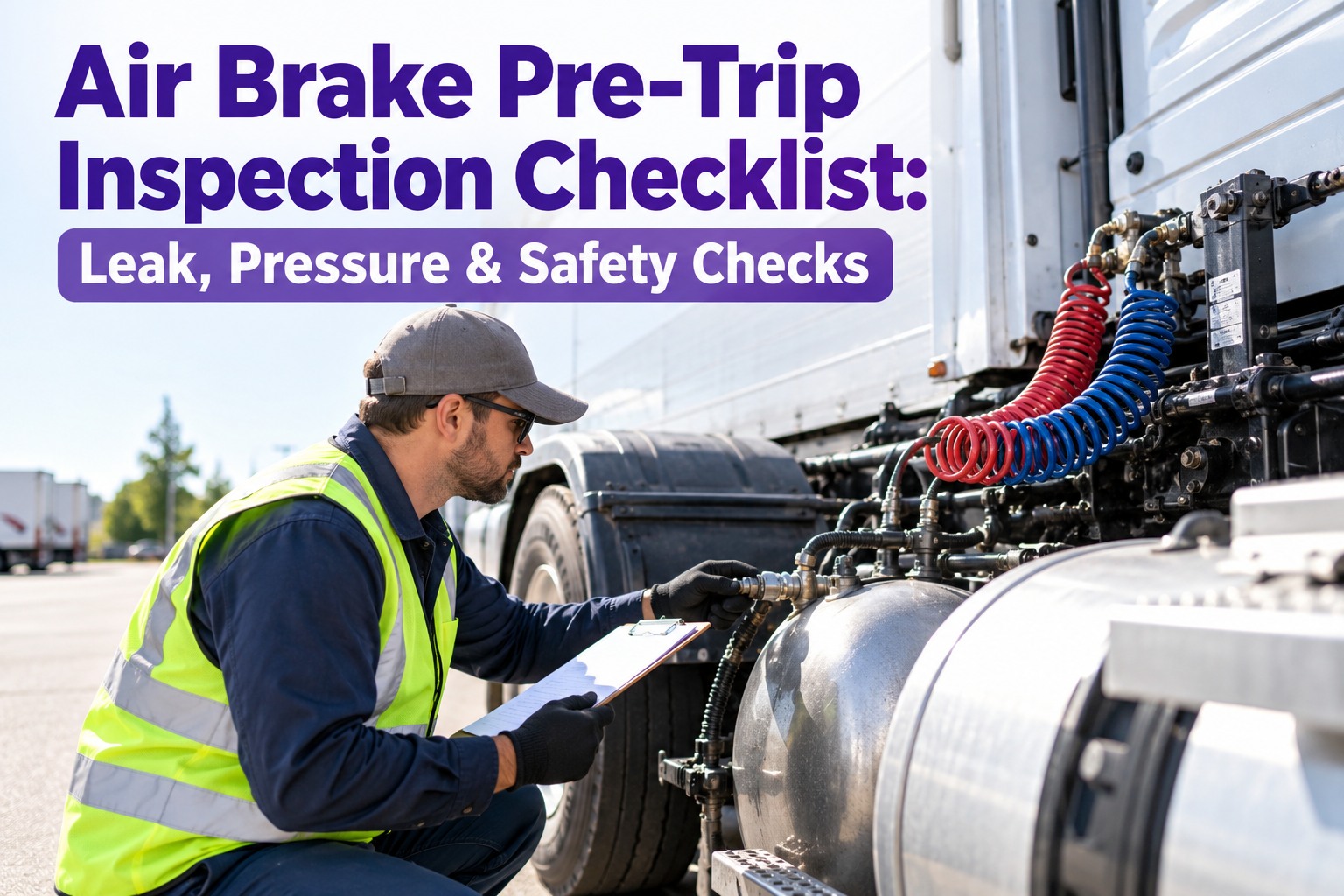
Air Brake Pre-Trip Inspection Checklist: Leak, Pressure & Safety Checks
Our Truck Inspection & Maintenance Management Software puts this test on the driver's phone, records the psi readings and turns any failed check into a brake work order before the truck leaves the yard.
60 psilow air warning must come on at or before this level
~45 sectypical build-up from 85 to 100 psi on dual systems
2 psimaximum static loss per minute, single vehicle
The Pressure Ruler: Every Number You Test Against
Air brake pre-trips are really a series of pressure readings. Here is where each one sits on a 0 to 140 psi gauge.
20-45 psiSpring brakes apply and the parking knob pops out
55-60 psiLow air warning activates
85-100 psiBuild-up target reached within about 45 seconds
100-125 psiGovernor working range: cut-in near 100, cut-out near 125
Values follow common CDL handbook figures and FMVSS 121 practice. Your state manual and your brake manufacturer's specifications take precedence.
Leak Limits: How Much Loss Is Too Much
Fully charge the system, shut off the engine and watch the gauge for one minute. The limit depends on the combination you are running.
TestSingle vehicleCombination (2 units)Combination (3+ units)
Static — brakes released2 psi3 psi5 psi
Applied — pedal held at 90+ psi3 psi4 psi6 psi
Maximum psi loss in one minute. Confirm against your state's current CDL handbook.
The Air Brake Pre-Trip Checklist: 28 Checks in Driving Order
Groups 1 to 3 are the gauge test. Groups 4 to 6 are the walk-around. Group 7 makes sure the result is recorded and acted on.
Pushrod stroke is the check most often skipped. Under 49 CFR 393.47, a clamp-type Type 30 chamber has a readjustment limit of 2 inches, and chambers without a listed limit may not exceed 80 percent of their rated stroke. A stroke that is too long means the brake is out of adjustment, even if it feels firm. Contact our team to schedule stroke checks into your PMs.
Where Air Leaks Hide
If the gauge falls during the leak test, use your ears first and a soap solution second. These are the usual culprits.
Gladhand sealsCracked, flat or missing rubber at the trailer connection.
Brake chambersA torn diaphragm leaks at the clamp ring or breather hole.
Hose chafe pointsLook where hoses rub against the frame, bracket or tire.
Fittings and valvesPush-to-connect and threaded fittings loosen with vibration.
Drain valvesTank drains that do not seat fully after being opened.
Relay and protection valvesSeat wear shows up as a leak only when brakes are applied.
Do Not RollPark the truck and tag it if any of these are true
⊘Low air warning does not come on, or comes on late
⊘Leakage is above the limit in either test
⊘Parking brake knob will not stay out or hold the truck
⊘Pushrod stroke is past the readjustment limit
⊘Cracked drum, broken chamber bracket or missing pushrod
⊘Air hose cut, bulging or leaking at a fitting
How Truck Inspection & Maintenance Management Software Closes the Loop
The pre-trip only protects you if the result reaches the shop. Our software links the driver's test to a work order and keeps the readings on the truck's record, so a creeping leak becomes a pattern you can see.
1Driver testsGuided checks with psi fields
2Defect photoWheel position and leak location
3Work orderOpens on the truck automatically
4Repair verifiedRe-test before release
Brake record, Truck 118 (illustrative)
MonApplied leak test: 5 psi loss. Single unit limit is 3 psi. Truck held; work order opened.Held
TueGladhand seal and chafed hose replaced. Re-test shows 1 psi loss.Cleared
FriPushrod stroke near limit on axle 2. Slack adjuster scheduled at next PM.Watch
Guided pre-tripDrivers follow the same sequence on every truck, with psi readings captured at each step.
Automatic work ordersA failed check goes to the shop with photo, location and truck number.
PM by mileage or dateSlack adjuster, stroke and drum checks come due on schedule.
Audit-ready historyInspection and repair records stay on file for roadside and DOT reviews.
Make Every Brake Test Count
Truck Inspection & Maintenance Management Software gives drivers a guided air brake pre-trip, sends failed checks straight to the shop and keeps the proof on file. Fewer surprises at the scale house and on the road.
Frequently Asked Questions
How do you do an air brake pre-trip inspection?
Check the compressor and belt, build pressure and time it, confirm the governor cut-out, test the low air warning and spring brake pop-out, run the static and applied leak tests, then inspect chambers, slack adjusters, hoses, drums and tanks. The checklist above follows that order.
Start free and run it on a phone.
What is an acceptable air leak rate?
Common CDL guidance allows up to 2 psi per minute static and 3 psi applied for a single vehicle, rising to 3 and 4 psi for a two-unit combination. Check your state manual for the exact figures.
When should the low air warning come on?
At or before 60 psi under FMVSS 121, and some states test at 55 psi. If it activates later than that, or not at all, the truck should not be driven until the warning system is repaired.
Why is pushrod stroke so important?
Excess stroke means the brake is out of adjustment and may not deliver full stopping force when hot. Limits are set in 49 CFR 393.47, and out-of-adjustment brakes are a common roadside violation.
Tested · Recorded · Repaired
Know Your Brakes Before the Road Does
Truck Inspection & Maintenance Management Software makes the air brake pre-trip consistent, documented and connected to repairs.
No credit card required. Free for up to 3 trucks. Built for FMCSA-compliant fleets.