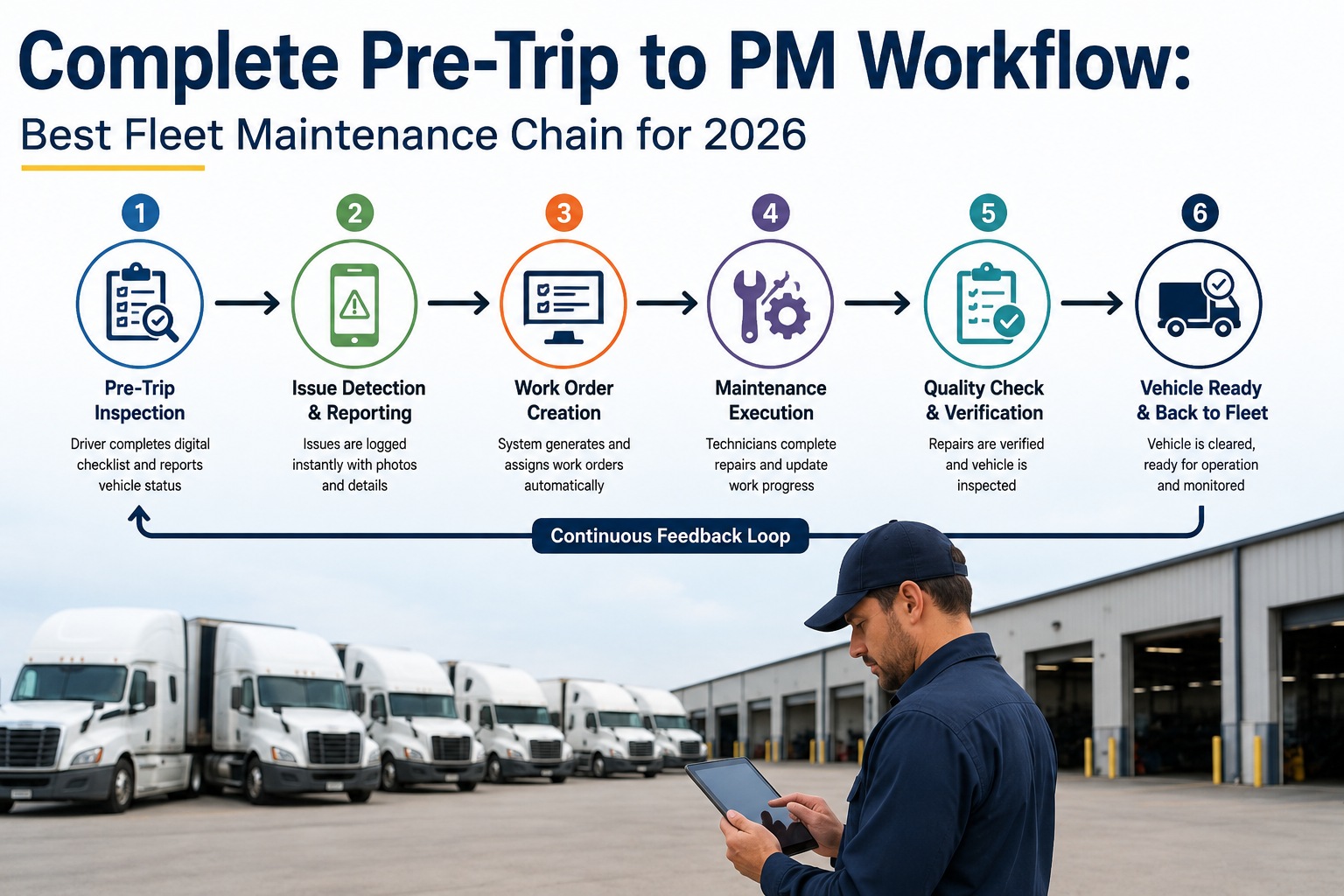
The CDL pre-trip walk-around is only step one. What decides whether a fleet stays safe and running is what happens after the driver finds something — how fast the defect is reported, triaged by severity, turned into a repair, and certified before the truck rolls. This is the full workflow, from the walk-around to the closed work order, and how Truck Inspection & Maintenance Management Software (TIM) runs every stage on one record. Start free and run the whole pre-trip-to-repair loop with TIM.
TIM · Pre-Trip Defect → Report → Repair
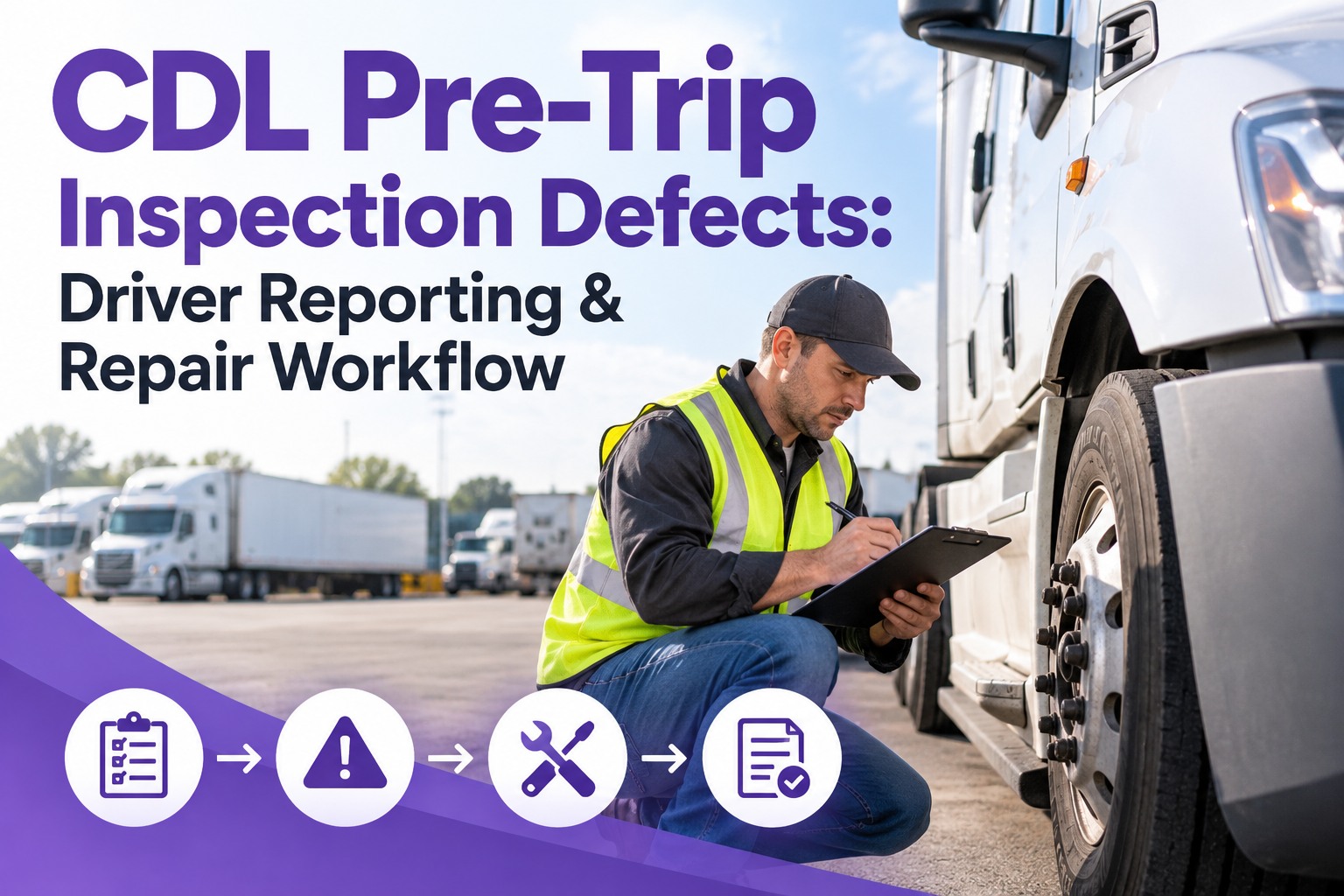
CDL Pre-Trip Inspection Defects: Driver Reporting & Repair Workflow.
A driver finds a cracked air line on the pre-trip — good. But if the report sits on a slip, nobody grades it, and the truck rolls anyway, the inspection did nothing. TIM runs the loop end to end: the pre-trip defect becomes a graded work order, routes to the right technician by severity, and the repair is certified before the vehicle returns to service — on one record, nothing re-typed, nothing missed.
Our promise: every pre-trip defect gets a 4-hour first response — acknowledged, graded, and assigned.
1
record from walk-around to repair
4-hr
first response on every defect
Follow One Defect Through the Workflow
A clean pre-trip defect workflow is a relay of five stages. Done right, the defect moves through all of them without a slip going missing or a truck rolling on an unresolved fault.
1
InspectDriver walks the pre-trip — brakes, tires, lights, steering, coupling — against a set checklist, not from memory.
↓
2
ReportA defect is logged on the spot with a note and a photo — legible, complete, and time-stamped.
↓
3
TriageSeverity decides the path: out-of-service now, fix-before-dispatch, or monitor on the planned queue.
↓
4
RepairThe defect becomes a work order routed to the right technician, with the photo and notes attached.
↓
5
CertifyThe fix is signed off against the original defect — and the next driver reviews and signs before rolling.
Skip any stage and the relay stalls — the defect is only as fast as its slowest handoff. Start free and run all five stages on one record with TIM.
Triage: Not Every Defect Takes the Same Path
The single most important decision in the workflow is what a defect's severity means for the truck. Get this right and urgent faults never roll while minor ones never clog the bay. Three lanes cover it.
OUT OF SERVICE
Failed brakes · bald or flat tire · steering play · coupling defect · no required lamp
Park it. The defect affects safe operation — the truck does not move until it's fixed and certified.
FIX BEFORE DISPATCH
Marginal brake wear · slow air leak · worn belt · a light that's dim but working
Route it to the shop now and resolve before the next run — close before it becomes out-of-service.
MONITOR & PLAN
Minor cosmetic damage · small fluid seep · wear that's early but worth tracking
Log it, watch it, and queue it into planned service before it climbs a lane.
The severity call is what turns a pile of defects into a ranked work list. Contact our team to set severity rules for your fleet.
What a Pre-Trip Actually Covers
A defect can't be reported if it's never looked at. These are the systems a CDL pre-trip walks — the places most reportable defects are found.
◉
Brakes & air systemAir pressure build, leaks, slack adjusters, linings, warning devices.
◉
Tires & wheelsTread depth, inflation, cuts and bulges, lug nuts, rims.
◉
Lights & reflectorsHeadlamps, turn signals, brake lights, markers, reflective tape.
◉
Steering & suspensionFree play, linkage, springs, mounts, shocks.
◉
Coupling & frameFifth wheel, kingpin, safety devices, frame and crossmembers.
◉
Fluids & leaksOil, coolant, fuel and air leaks under and around the truck.
A consistent checklist is what keeps any of these from being skipped on a cold, rushed morning. Start free and give drivers a guided pre-trip checklist with TIM.
Where the Workflow Breaks Down
Almost every unresolved defect traces back to the same few failure points — and each one is a handoff a connected workflow removes.
✕
The report never arrivesA paper slip is lost, skipped, or illegible — so the defect is known to the driver and nobody else.
✕
Nobody grades itWithout a severity call, an out-of-service fault and a cosmetic ding get the same attention — which is often none.
✕
It's re-typed and lostSomeone has to key the defect into a repair system by hand, and in the handoff it's forgotten.
✕
No proof it was fixedThe repair closes in a different place than the report, so nothing certifies the fault was actually resolved.
Close these four gaps and the pre-trip finally does its job — catching faults before they roll. Contact our team to find the gaps in your defect workflow.
COMPLIANCE
The workflow mirrors the federal rules: a driver reports defects affecting safety on the inspection report, the carrier certifies any required repair (or that none was needed) before the vehicle is dispatched, and the next driver reviews and signs before operating — the review-and-sign chain under 49 CFR 396.11 and 396.13. A digital record keeps that chain intact and produces it on demand, instead of scattered across slips and trays.
How TIM Helps
One Record From the Walk-Around to the Certified Repair
TIM isn't a checklist app that hands off to a separate shop tool — the whole relay lives on one record, so the defect a driver reports is the same object the technician closes and the auditor sees.
1Pre-trip defect filed
→
2Graded by severity
→
3Work order routed
→
4Repair certified
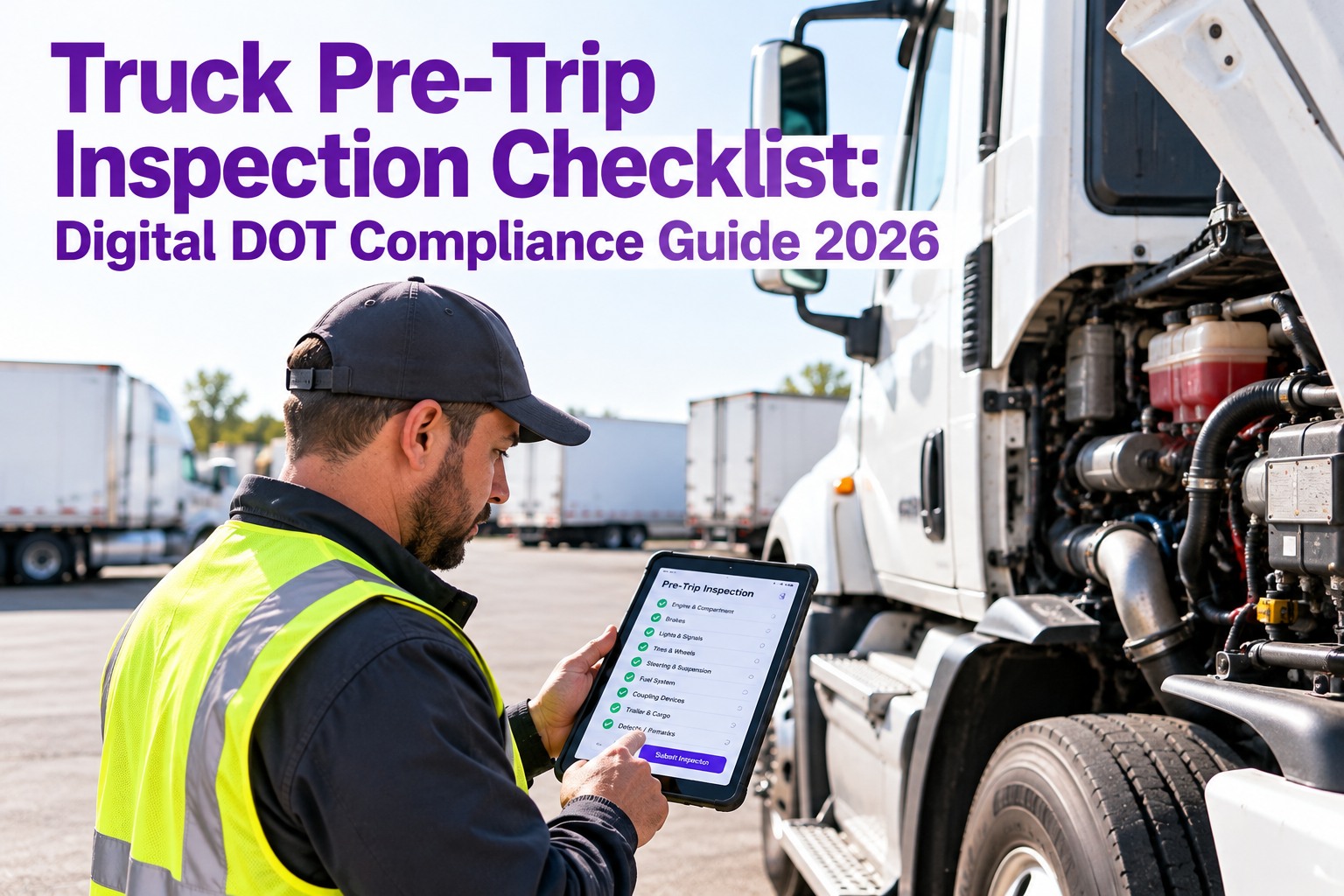
Guided mobile pre-tripDrivers walk a set checklist on a phone, with required items and a photo on every defect.
Defect becomes a work orderA flagged item turns into a work order the moment it's filed — no re-keying, no lost slip.
Severity-based routingOut-of-service faults route now; minor items join the planned queue automatically.
Certified against the defectThe repair closes against the original report, keeping the review-and-sign chain intact.
Photo & notes carriedThe driver's evidence rides with the work order, so the technician never starts from zero.
Per-unit history on fileEvery truck keeps its own defect and repair record — searchable and audit-ready.
Frequently Asked Questions
What has to happen when a driver finds a defect on a pre-trip?
The defect that affects safe operation has to be reported, and the carrier has to repair it — or confirm no repair was needed — before the vehicle is dispatched again. The next driver then reviews that report and signs off before operating. That review-and-sign chain is the heart of the workflow, and it's what an auditor looks for: a reported defect, a certified repair, and a signature before the truck rolled.
Start free and keep the whole chain on one record with TIM.
How do you decide which defects take a truck out of service?
Severity. A defect that affects safe operation — failed brakes, a flat or bald tire, steering play, a coupling fault, a missing required lamp — takes the truck out of service until it's fixed and certified. Marginal issues get resolved before the next dispatch, and minor wear is logged and monitored. The point of triage is that the severity call, not who's loudest, decides what rolls and what parks.
What's the difference between a pre-trip and a post-trip inspection?
Timing and purpose. The pre-trip happens before the run — the driver confirms the truck is safe to operate and catches defects before rolling. The post-trip (DVIR) happens at the end of the day and documents any defect found during operation so it can be repaired before the vehicle is used again. Both feed the same defect-to-repair workflow; the pre-trip is just the first chance to catch a fault.
Does a defect workflow slow drivers down?
No — it usually speeds the walk-around up. A guided checklist on a phone is faster than writing on a pad, and tapping a defect with a photo takes seconds. What it removes is the slow part that comes after: the slip that has to be carried, read, and re-typed. The inspection itself stays the same; the defect just reaches the shop faster and with better evidence.
How does the workflow reduce downtime?
By shrinking the time from a defect being found to it being fixed. When a pre-trip defect becomes a graded work order the moment it's filed, routes to the right technician by severity, and arrives with a photo and notes, the shop starts on the fix instead of re-diagnosing it — and a small fault gets handled before it grows into a roadside breakdown.
Inspect · Report · Triage · Repair · Certify
Turn Every Pre-Trip Defect Into a Closed Repair
The walk-around only pays off if the defect it finds reaches the shop and gets fixed before the truck rolls. Paper loses defects between the cab and the bay; a connected workflow closes the loop. TIM runs the whole relay on one record — reported, graded, routed, and certified — so the only time left between a defect and its repair is the time it takes to turn a wrench.
No credit card required · Free for up to 3 trucks · Guided pre-trip, defect-to-work-order, and certified closure built in