"Small leak under truck" is the DVIR entry that costs fleets the most. It tells the shop nothing about which fluid, where on the truck, how fast it's dripping, or whether the truck can run the route tomorrow. So the mechanic guesses, spends an hour diagnosing, and often the guess is wrong. Meanwhile the driver moves on to another truck, the leak worsens overnight, and the same fleet is paying $1,500+ for a roadside call on a repair that could have been a 30-minute shop fix if it had been reported properly the first time. Leaks are the single defect category where DVIR quality separates good fleets from mediocre ones — because leaks announce themselves early, and every hour between "driver notices it" and "shop repairs it" is downtime the fleet is paying for. The fix isn't longer DVIRs. It's a specific template: fluid identification (color, texture, smell), photograph the source, photograph the ground shot showing puddle size and pattern, then the three-part defect sentence with location, measurement, and condition. This guide walks through the exact leak reporting standard top-decile fleets train drivers on. Sign up free for Truck Inspection & Maintenance today — no credit card required to enable guided leak-reporting workflows on every driver's phone, or contact our team for a printable leak reporting reference card configured to your fleet and fluid types.
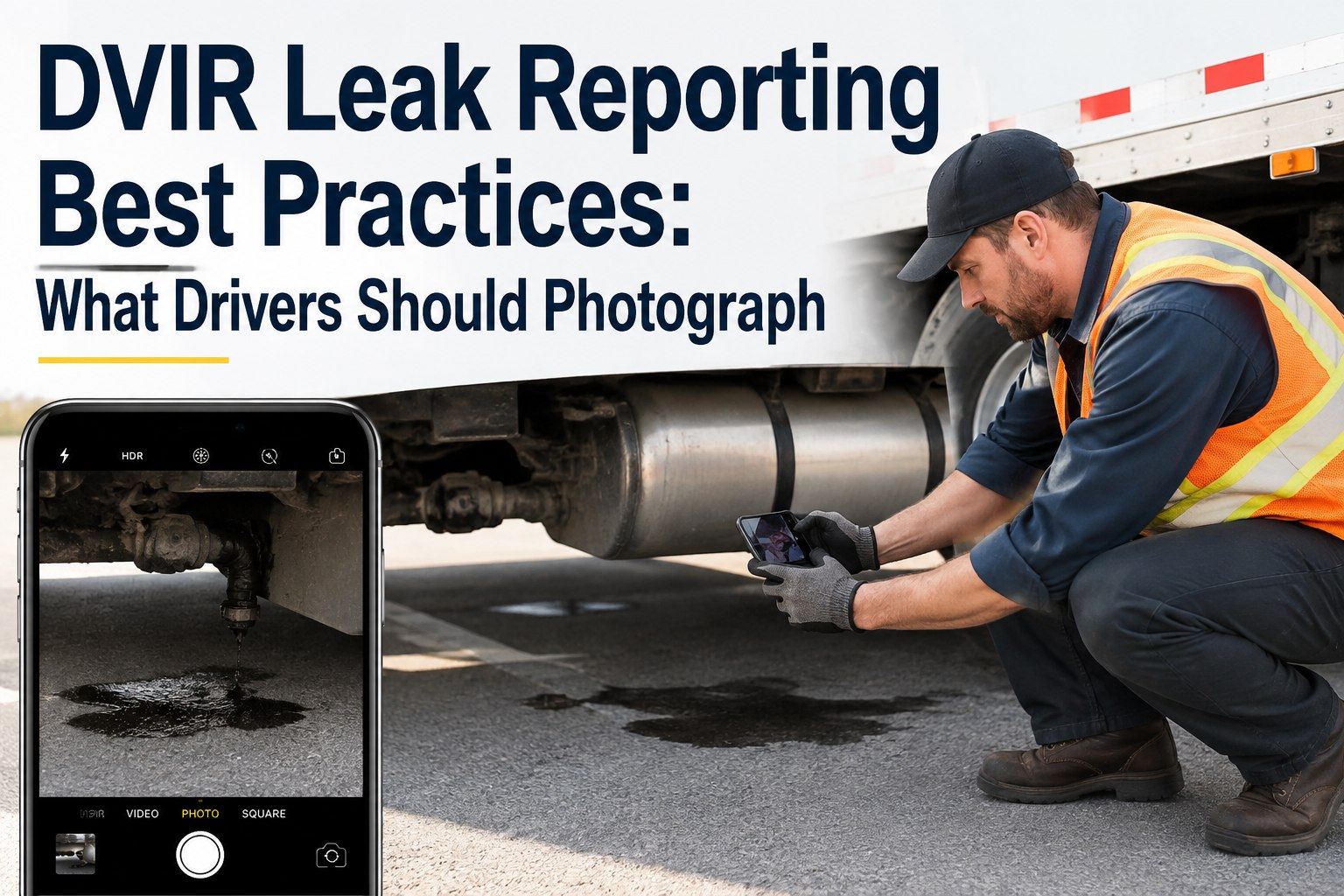
DVIR Leak Reporting Best Practices: What Drivers Should Photograph
The defect category where DVIR quality most changes shop response time. Here's the fluid-identification, photo, and note template that turns "small leak under truck" into a same-day fix.
Why Leak Reporting Is the Weakest Section on Most DVIRs
Drivers write leak defects the way they'd describe a puddle to a friend — quickly and vaguely. The result is a DVIR entry the shop can't triage. Three failure patterns account for almost every bad leak report.
The 4-Photo Leak Report Template
The gold standard for a leak report is four photos plus a three-part sentence. Every leak, every time. Ten seconds each. The template turns a subjective defect into indisputable evidence.
The Fluid Color Identification Chart
Fluid color is the fastest way to narrow down what's leaking. This chart is what drivers should be trained on — laminate it, put it in every truck, or run it in the app. Color + texture + smell + location = 90% of the diagnosis before the mechanic touches the truck.
Leak Severity Ladder — What the Report Should Trigger
Not every leak needs a tow truck. The severity assessment in the DVIR determines what happens next — same-day dispatch, shop appointment, or immediate stop. Drivers need to know the boundaries.
Run guided leak-reporting workflows on every driver's phone
In-app photo prompts for all 4 required shots. Fluid identification chart built into the defect form. Severity ladder enforced with automatic dispatch routing. Complete audit trail per FMCSA §396.11.
Bad Report vs Good Report — Same Leak, Two Outcomes
The same leak, reported two ways, produces two completely different shop responses. The gap between them is the entire ROI of leak reporting training.
The 60-Second Leak Report Workflow
The complete leak report — from noticing the puddle to submitting the DVIR entry — takes 60 seconds if the driver knows the sequence. Faster than a paper walkaround for the same defect, with 10x the actionable information.
Frequently Asked Questions
The gold standard is four photos per leak. First, a close-up of the source — the specific component, gasket, seal, hose, or fitting the leak is coming from, close enough that the mechanic can identify the part without walking back to the truck. Second, a ground shot showing the puddle size and pattern — fresh vs dried edges tell duration, drip pattern (single spot vs streak) tells whether the truck was moving. Third, a context shot showing where on the truck the leak is located — the mechanic needs to walk to the right spot on the first try. Fourth, a photo of the fluid itself — on a rag, on a finger, or in daylight — with a coin or another reference for scale. Color and texture identify the fluid class instantly. All four take about 25 seconds combined and turn a subjective defect into indisputable evidence the shop can act on immediately.
Fluid identification comes down to color, texture, smell, and location — in that order. Engine oil is amber when new and dark brown or black when used, thick and slick with a petroleum smell, typically leaking from valve cover gaskets, oil pans, or main seals. Transmission fluid is bright red when new, darker red or brown when aged, thinner than oil with a sweet petroleum smell, usually from the transmission pan or output seals. Coolant is bright green, orange, pink, yellow, or blue depending on type, feels slimy, has a sweet smell (never taste to identify), and comes from radiators, water pumps, or hoses. Brake fluid is yellow when new and brown when aged, slick with a harsh chemical smell — any brake fluid leak is immediate out-of-service. Diesel fuel is clear to slight amber, thin with a strong diesel smell, and is an ignition hazard requiring immediate stop. DEF is clear and crystallizes white when it dries. Water with no smell or oily feel is usually A/C condensation — normal.
Minor is a slow seep with no active dripping and no puddle on the ground — a damp gasket or wet spot. Log it, monitor daily, schedule shop within a week; truck stays in service. Moderate is an active drip slower than one drop per 5 seconds, with a small puddle under coffee-cup size — schedule shop within 24-48 hours and check fluid level before every dispatch. Major is a steady drip faster than one per 5 seconds or a dinner-plate-size puddle appearing within minutes of parking — shop before next dispatch. Out-of-service is any continuous stream (not drip), any brake fluid loss, any diesel fuel leak (ignition hazard), or any audible air leak below 60 PSI — do not move the truck. The severity assessment in the DVIR is what determines what happens next: same-day dispatch, shop appointment, or immediate stop. Getting this rating wrong is what turns preventable leaks into roadside emergencies. Try the platform free to see severity-based routing enforced.
No — most leaks are not OOS. Minor seeps and moderate drips are documented on the DVIR and scheduled for repair without pulling the truck from service. Certain leak types are always OOS: any brake fluid loss regardless of quantity (brake system failure risk), any diesel fuel leak (ignition hazard requiring immediate stop under CVSA criteria), any audible air brake leak below 60 PSI, and any wheel seal oil leak on a hub (bearing lubrication loss with wheel separation risk). Coolant leaks that empty the reservoir over one shift are functionally OOS because running low on coolant will overheat the engine. The rule is: identify the fluid first, then the rate, then check whether either triggers an OOS threshold. When in doubt, park the truck and call the shop — a wrong "run it" call on an OOS leak turns into a roadside violation, a citation, and potential CSA points that follow the fleet for months.
FMCSA requires DVIR records to be retained for a minimum of 90 days under 49 CFR §396.11(c). Many carriers retain them for 6-12 months for liability protection — DVIRs from months before an accident may be requested as evidence of maintenance practices in litigation. Digital DVIR systems typically retain records indefinitely at no incremental storage cost, which is why they're preferred over paper for any fleet operating in high-litigation regions or hauling higher-risk cargo. The 90-day federal minimum applies to the completed DVIR (driver's report of defects), the mechanic's certification of repair, and the next driver's acknowledgment — all three components of the FMCSA signature chain. Photos attached to a leak report are considered part of the DVIR record and inherit the same retention requirement; digital systems that store photos in the same record survive audit review better than paper systems where photos get separated from the paper form.
The most measurable cost is roadside repair calls that could have been shop repairs. An average roadside call for a leak-triggered failure runs $1,500+ once tow, mobile mechanic labor, parts markup, and downtime are combined — versus roughly $200-400 for the same repair caught early and scheduled into the shop. On a fleet running 200 trucks, if just 10% of leaks currently escalate to roadside from unclear DVIR reporting, that's roughly $150,000-300,000 annually in avoidable emergency spend. The less measurable but larger cost is CSA scoring: a leak that becomes a roadside violation adds points to the fleet's Vehicle Maintenance BASIC that follow it for two years, affecting insurance rates and customer contract eligibility. Digital DVIR systems with photo-verified defect capture reduce leak-related roadside events by roughly 40% within the first year of adoption, primarily by catching moderate leaks before they progress to OOS. Contact our team for an ROI calculation on your fleet size.
That's fine — the driver's job is to report what they see, not diagnose. Photograph the fluid clearly, describe what you observe (color, whether it's oily or watery, whether it smells like anything), and let the shop make the identification from the photos. Never taste a fluid to identify it — coolant is sweet and toxic, brake fluid is corrosive, DEF has ammonia. Never touch fluids with bare skin if you can avoid it — some hydraulic fluids and fuels are skin irritants. If the fluid is completely unknown and you can't safely sample it, describe the location and the puddle characteristics and let the mechanic sample it directly. What matters is that the leak is documented, the location is precise, and the severity is assessed correctly — the specific fluid ID can be confirmed by the shop when the truck arrives. The one exception: if the smell is diesel or the fluid looks like fuel, treat it as an ignition hazard and stop the truck regardless of other identification uncertainty.
Turn "small leak under truck" into a same-day fix — from the driver's phone
Guided photo capture for all 4 required shots. Fluid identification chart in-app. Severity-based dispatch routing. Complete FMCSA §396.11-aligned audit trail with 90-day retention or better. Built for fleets tired of paying $1,500 for repairs that should have cost $300.