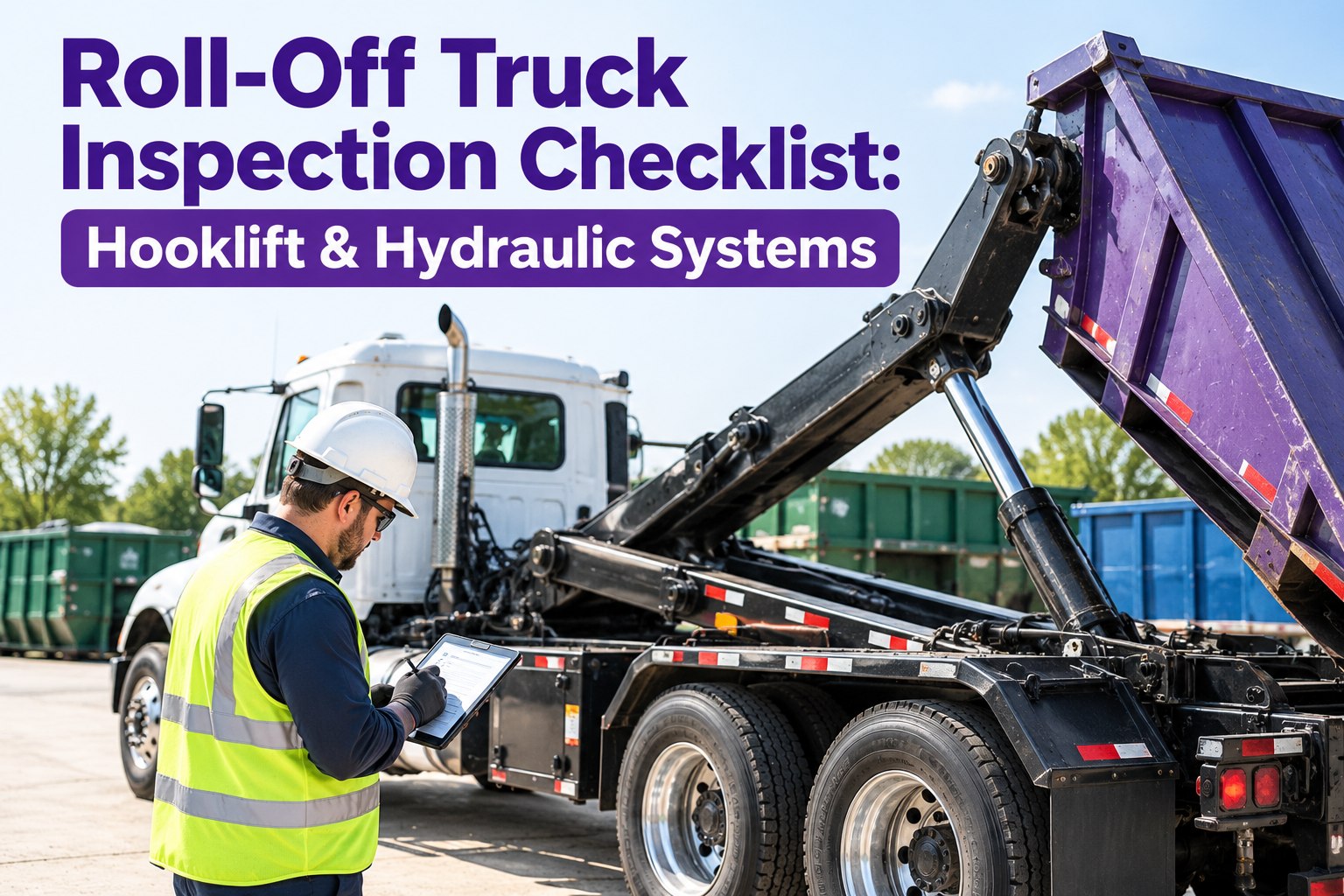
Roll-Off Truck Inspection Checklist: Hooklift & Hydraulic Systems
By Sarah Johnson on October 27, 2026
A roll-off truck lives or dies on one system most pre-trips barely glance at — the hoist. The cable frays a strand at a time, a sheave seizes from a skipped grease point, a cylinder starts to drift, and then a loaded container hangs in the air over a job site. On a roll-off, the hydraulic and lift gear fails before the engine ever does, so that's exactly where the inspection has to be sharpest. Start free and put your roll-off hoist on a real inspection schedule.
Hooklift · Hydraulics · Cable & Lock
Roll-Off Truck Inspection Checklist: Hooklift & Hydraulic Systems
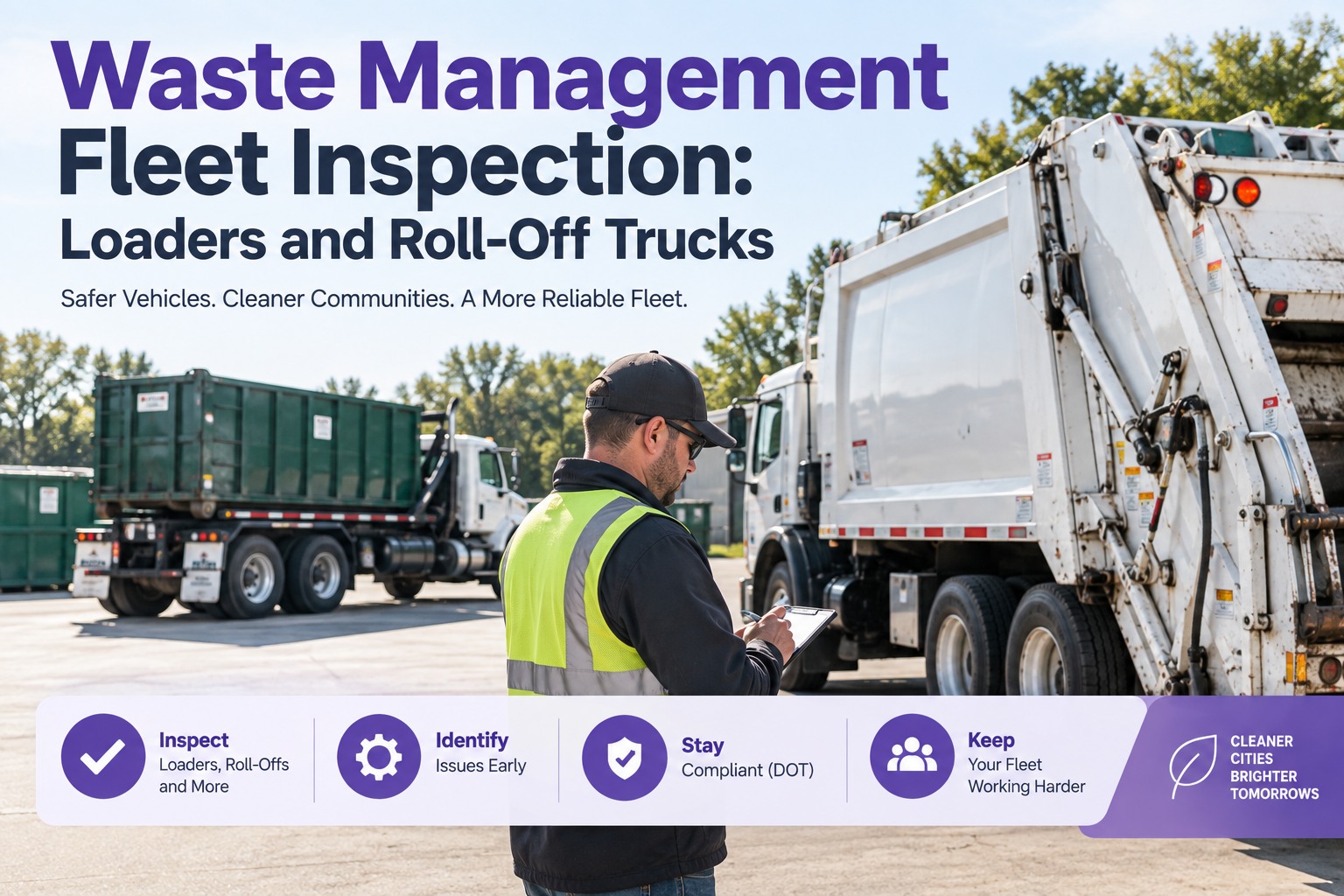
A roll-off carries a second machine on its back — a hydraulic hoist that lifts tons of loaded container every cycle. This checklist walks the lift the way it actually loads: the cable and hook, the cylinders and hoses, the subframe and locks, then the truck under it. Truck Inspection & Maintenance Management Software runs the whole inspection on a phone and turns a frayed cable or a weeping cylinder into a work order before it strands a container — every safety defect assigned within 4 hours.
What Fails First on a Roll-Off — and What It Takes Down
Roll-off breakdowns cluster on the lift gear, and each failure drags something bigger with it. Knowing the chain is what tells you where to look hardest.
CableFray → snapA few broken strands or a flat spot become a parted cable — and a dropped container. Slack on unloading shock-loads it.
SheavesSeize → shearA frozen or rusty sheave or side roller stops turning, chews the cable, and forces the hoist against a dead part.
CylinderWeep → driftA scored rod or weeping seal lets a raised body creep down — the first sign the lift is losing its hold on a load.
PTO / pumpOverload → burnAn undersized or overworked hoist burns the pump and PTO; a rev limiter and a close eye on oil level keep it alive.
Do Not SkipThe Grease & Slack Rule
Two habits prevent most roll-off hoist failures, and both are free. Miss either and the cable pays for it.
◎Grease the shoe, pins, and side rollers weekly — every 40 operating hours. Dry bearings wear from abrasion and heat.
◎Never let the cable run slack on unloading. Slack plus a sudden load is a shock load, and a shock load snaps cable.
The Inspection Checklist — by System
Work it in the order the hoist loads: the cable and hook first, then hydraulics, then what holds the container, then the truck. Tick each item as it's checked — or let the software hold the record and raise a work order on anything that fails.
HOIST & CABLEThe Lift Gear
HYDRAULICSCylinders, Hoses & Pump
SUBFRAME & LOCKSWhat Holds the Container
CHASSIS & DVIRThe Truck Under It
Catch the Hoist Defect Before It Drops a Container
A roll-off's most expensive failures are the quiet ones — a cable losing strands, a cylinder starting to drift — and they're invisible on a paper walkaround. Truck Inspection & Maintenance Management Software runs this system-by-system inspection on a phone, grades every defect by severity, and turns a frayed cable or a seized sheave into a dated work order the moment it's flagged. Every safety defect is acknowledged, graded, and assigned within 4 hours, and the signed, timestamped record meets DOT DVIR requirements without a second form.
What's the most important part of a roll-off inspection?
The hoist system — cable, sheaves, hook, and cylinders — because that's where a roll-off actually fails and where a failure is dangerous. The cable is the first thing to go: inspect it end to end for frays, kinks, broken strands, flat spots, and corrosion, and replace it before it parts, because a broken cable drops a loaded container and takes the truck out of service. Right behind it are the sheaves and side rollers (they seize and chew the cable) and the hydraulic cylinders (a scored rod or weeping seal lets a raised body drift). Those get the hardest look on every check. Start free and track hoist wear on every unit.
02
How often should I grease a roll-off hoist?
Weekly, or every 40 operating hours — whichever comes first. Grease the shoe, the pins, and the side rollers, because without lubrication the bearings and gearing wear far faster from abrasion and heat, and a seized roller is what frays a cable. It's the cheapest maintenance on the truck and it prevents the most expensive failures. A system that schedules the grease interval by operating hours and flags it when it's due is how you keep it from slipping. Book a demo to schedule hoist lubrication by hours.
03
Why do roll-off hoist cables snap?
Two reasons, and both are preventable. The slow one is wear — frays, flat spots, and broken strands that go unnoticed until the cable can't hold the load, which is why every inspection checks it end to end. The sudden one is shock loading: if the cable is allowed to go slack during unloading and then takes the weight suddenly, that shock can break it outright. Keeping tension through the cycle and replacing a worn cable on schedule are what prevent a parted cable and a dropped container. Book a demo to log cable condition over time.
04
Does a digital roll-off inspection cover DOT compliance?
Yes. A roll-off still has to pass the standard DVIR items — brakes, air system, steering, suspension, tires, lights, mirrors — and missed brake or DOT items are exactly what turn into violations, out-of-service orders, and CSA damage. Truck Inspection & Maintenance Management Software captures both the hoist-specific checks and the standard DVIR on one signed, timestamped record that meets DOT requirements, so you're inspecting the lift gear and staying roadworthy in a single pass instead of two. Book a demo to see the DOT-ready inspection record.
Hoist · Hydraulics · Ready
Keep the Lift Gear Sound and the Container Moving
Truck Inspection & Maintenance Management Software runs the full roll-off inspection — hoist and cable, hydraulics, subframe and locks, and the standard DVIR — on a phone, schedules the grease and service intervals by operating hours, and turns any defect into a work order before it strands a container. Every safety defect acknowledged, graded, and assigned within 4 hours, on one DOT-ready record.