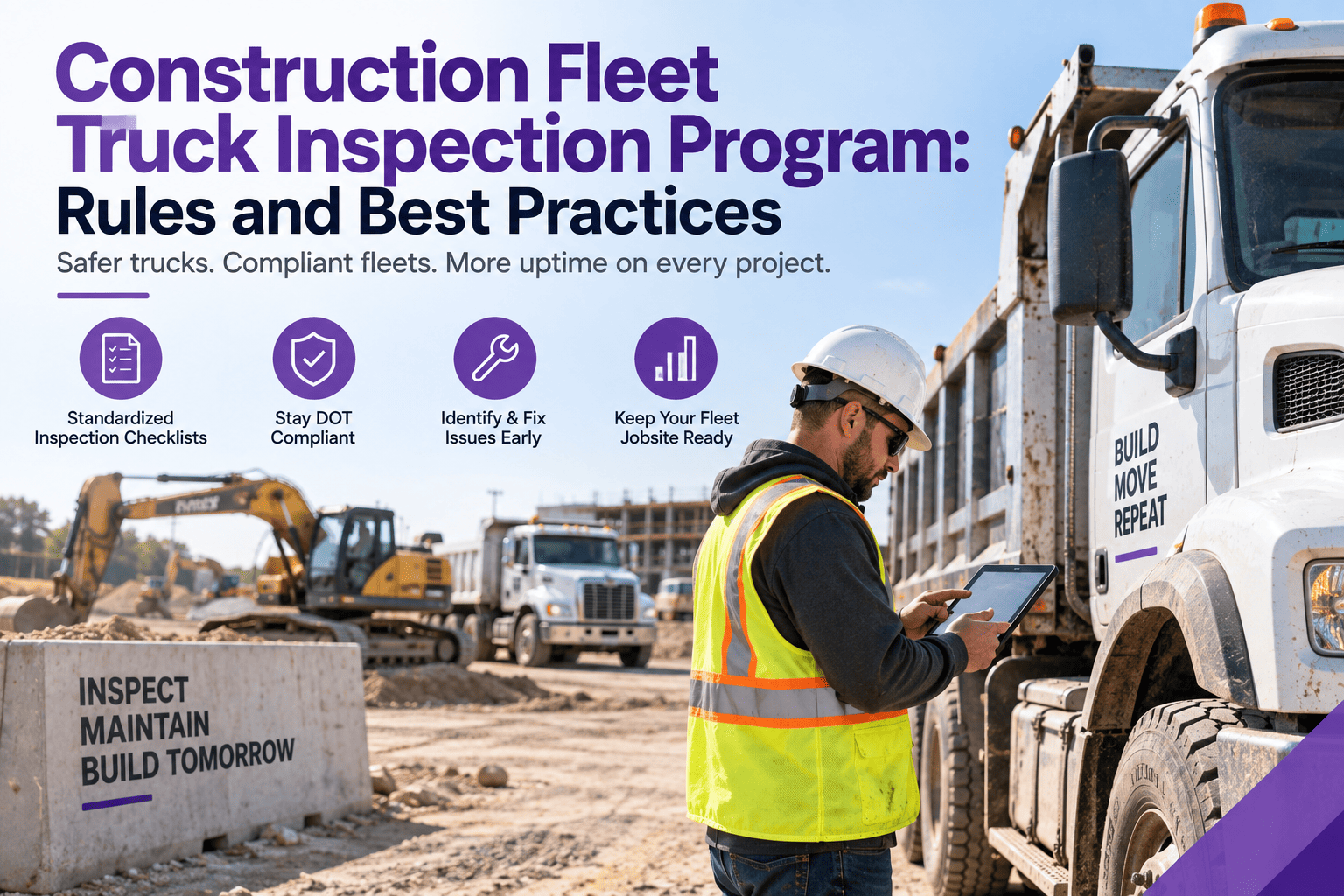
Construction fleet management is fundamentally different from over-the-road trucking. A single operation typically runs four asset categories that each demand entirely different maintenance logic: heavy equipment scheduled by engine hours (excavators, loaders, dozers), on-road trucks scheduled by mileage (haulers, service trucks), trailers and lift equipment scheduled by calendar (DOT trailer inspections, ANSI A92.20 lift certifications), and regulatory-triggered safety inspections (OSHA Subpart CC for cranes, annual generator load-bank testing). Your CMMS has to handle all four trigger types simultaneously per asset, with automatic work order generation off each one. Most fleet platforms — adapted from car fleets or facility maintenance — simply can't.
The 2026 operating reality compounds the complexity. Construction site conditions accelerate component wear at rates that standard OEM intervals don't account for — dust, vibration, full-load duty cycles, water intrusion, and operator turnover all push real-world service intervals 30–50% shorter than the manual recommends. OSHA willful-violation penalties run up to $165,514 per occurrence. A single hydraulic failure at the wrong moment of a concrete pour cascades into project-wide delays measured in days, not hours. And every operator, mechanic, and project manager carries a smartphone that should be the primary inspection device — yet most fleets still chase paper forms that walk away from sites and never make it back to the shop.
This guide is the 2026 construction fleet management playbook: asset-specific PM logic, OSHA-mandated inspection cadences, the offline mobile workflow that actually works in cell dead zones, KPI dashboards, and the implementation framework that delivers $180,000+ annual savings per 50-machine fleet. Start your free trial to deploy construction fleet management across your job sites — live in 10 minutes, free for up to 3 assets.
Construction Fleet Management Best Practices [2026]
Excavators on hours. Trucks on miles. Trailers on calendar. Cranes on OSHA cycles. The 2026 playbook for managing mixed construction fleets — with site-mobile workflows, asset-specific PM logic, and the KPIs that prove it works.
Quick Answer: What Is Construction Fleet Management?
Construction fleet management is the integrated system used to operate, maintain, and track mixed-asset fleets across active job sites. It handles four distinct asset categories with different maintenance logic: heavy equipment scheduled by engine hours (excavators at 250-hour PM intervals, loaders, dozers, cranes), on-road trucks scheduled by mileage (DOT-regulated CMVs, service trucks), trailers and lift equipment scheduled by calendar (DOT trailer annuals, ANSI A92.20 lift certs), and regulatory-triggered safety inspections (OSHA Subpart CC cranes, generator load-bank testing). The 2026 best-practice approach combines mobile digital inspections that work offline in cell dead zones, hour-meter integration via telematics, jobsite-aware asset tracking that follows equipment across site moves, OSHA compliance documentation, and KPI tracking centered on cost per operating hour. Fleets implementing this approach achieve 20-30% maintenance cost reduction and $180,000+ annual savings per 50-machine fleet.
The 4 Asset Categories: Different Logic Each
The fundamental challenge in construction fleet management is that a single operation runs four asset categories that each require completely different maintenance triggers. A unified CMMS must handle all four simultaneously per asset. Contact our sales team to map your fleet against this 4-category framework.
OSHA Regulatory Map for Construction Fleets
Construction fleet compliance spans more regulatory bodies than over-the-road trucking. Every fleet manager should know exactly which standards apply to which equipment category and what the documentation requirements are.
The 7 Construction Fleet Best Practices
These seven practices separate top-performing construction fleet operations from reactive shops. Fleets implementing all seven achieve the 20-30% cost reduction and 95%+ uptime that defines best-in-class operations. Sign up free to deploy all seven practices on one platform.
PM Intervals by Equipment Type
Construction equipment OEMs publish their own service intervals, but construction-site duty cycles routinely shorten those intervals by 30-50%. Here's the 2026 baseline by equipment category — always cross-reference with OEM specs and adjust for site conditions.
| Equipment | PM-A | PM-B | PM-C | Critical Items |
|---|---|---|---|---|
| Excavators | 250 hr | 500 hr | 1,000-2,000 hr | Hydraulics, undercarriage, swing bearing |
| Wheel Loaders | 250 hr | 500 hr | 1,000 hr | Articulation joint, tires, cutting edges |
| Bulldozers | 250 hr | 500 hr | 1,000-2,000 hr | Tracks, sprockets, blade pivot, ripper |
| Articulated Haulers | 250 hr | 500 hr | 1,000 hr | Hoist cylinders, body, oscillating hitch |
| Cranes | Daily (shift) | Monthly | Annual (qualified) | OSHA Subpart CC — 3-tier required |
| Dump Trucks (CMV) | 10,000 mi | 25,000 mi | 50,000 mi / annual | Tipping system, PTO, air brakes, DOT |
| Forklifts | 250 hr | 500 hr | 2,000 hr | OSHA-mandated pre-use, mast/forks |
| Aerial Lifts | Daily check | Monthly | Annual (ANSI A92.20) | Outriggers, boom, load chart, fall protection |
The Most Common Defects (And Why They Fail)
Across thousands of construction equipment inspections, the same failure patterns appear repeatedly. Knowing the top defects helps operators catch them early — before they trigger jobsite shutdowns, OSHA citations, or catastrophic failures.
The 5-Step Implementation Framework
Going from paper-based reactive operations to digital best-practice construction fleet management typically takes 8-12 weeks. Here's the rollout framework most fleets follow. Talk to our sales team for a tailored implementation plan for your fleet size and equipment mix.
Construction Fleet KPIs That Actually Matter
Track these five KPIs monthly. They reveal whether your construction fleet program delivers results or just generates paperwork.
Frequently Asked Questions
Construction fleets run four asset categories with different maintenance logic running simultaneously: heavy equipment on engine hours, on-road trucks on mileage, trailers and lift equipment on calendar, and regulatory-triggered safety inspections. Trucking fleets primarily run mileage-based logic with calendar overlays. Construction also adds OSHA compliance (1926.20, 1926.600, Subpart CC cranes) on top of FMCSA where applicable, requires offline-capable mobile inspections for cell-dead-zone job sites, and tracks cost per operating hour rather than cost per mile. Start your free trial to handle all four asset categories in one platform.
OSHA 29 CFR 1926.600 requires pre-shift inspections of all construction equipment by competent persons. That's daily walk-around inspections per shift, performed by operators. PM service intervals are separate: PM-A every 250 hours, PM-B every 500 hours, PM-C every 1,000-2,000 hours for most heavy equipment. Cranes follow OSHA Subpart CC three-tier inspection (shift/monthly/annual) with qualified-inspector requirements at annual level. Construction-site duty cycles often require shortening these by 30-50% versus OEM recommendations for harsh-environment work.
Job sites routinely have no cell signal — remote construction sites, dense urban high-rises, underground operations, rural infrastructure projects. If the inspection platform requires connectivity to function, operators can't complete inspections, defects can't be reported, and work orders can't be generated. The data piles up uncaptured. Offline-capable platforms let operators complete full inspections (with photos and GPS timestamps) even without signal, syncing automatically when connectivity returns. This is the single make-or-break capability for construction fleet software. Contact our sales team to verify offline capability.
OSHA Subpart CC (Cranes & Derricks in Construction) violations consistently rank in the top construction citations. Specific failures include missing or incomplete pre-shift inspections, missing monthly inspections, missing annual qualified-inspector certifications, and undocumented operator certifications per ASME B30.5. Equipment inspection violations (1926.600/602) follow closely. Willful violations carry penalties up to $165,514 per occurrence. Repeat violations multiply quickly across multi-site operations. Sign up free to deploy OSHA-compliant inspection workflows.
Industry benchmark: $180,000+ annual savings per 50-machine fleet, with payback periods measured in weeks to months — not years. The savings break down across multiple categories: 20-30% maintenance cost reduction from PM compliance and early defect detection, equipment lifecycle extension through structured maintenance, reduced rental expense from better utilization tracking, eliminated OSHA penalty exposure, and labor productivity gains from eliminated paper-form chaos. Smaller fleets see proportional gains. ROI hits within 6-12 months for fleets with 10+ machines.
Software-first deployment runs 8-12 weeks for full operational rollout. Technical setup completes in under 10 minutes. Week 1-2: asset registry and baseline. Week 2-3: inspection templates configured. Week 3-4: PM triggers set up. Week 4-8: pilot deployment on 5-10 assets across 1-2 sites. Week 8-12: full fleet rollout with KPI dashboards active. Operators typically complete first digital inspection in week 1. No multi-month implementation timelines or consulting fees required for modern platforms. Talk to our sales team for a tailored rollout plan.
Deploy the Complete Construction Fleet Playbook
500+ construction fleets run mixed-asset operations on one platform: heavy equipment on hours, trucks on miles, trailers on calendar, cranes on OSHA cycles. Offline mobile inspections at every job site. Photo evidence, GPS timestamps, OSHA-compliant audit trails. $180K+ annual savings per 50-machine fleet — proven across multiple deployments.