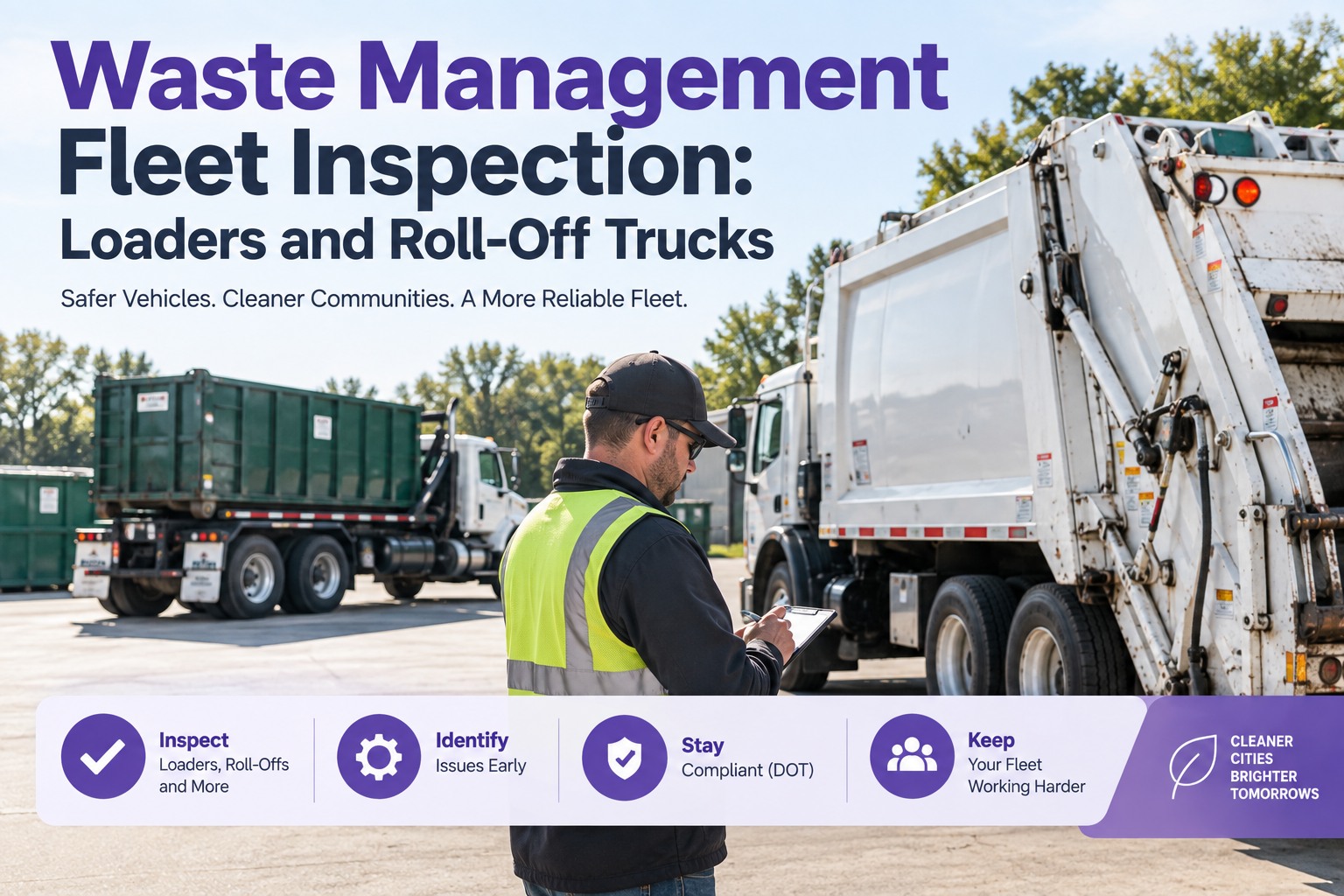
A waste management fleet isn't one kind of truck — it's three, and each one wears out on a completely different schedule. A rear loader on residential routes runs 800–1,200 packer cycles per shift. A side loader on ASL routes cycles its grabber arm every 20 seconds. A roll-off doing construction pickups cycles its winch 8–15 times a day but drags a 60,000-lb container up and down cables that can shred if the sheaves are wrong. Running the same DVIR template on all three is how the body-specific defects — the ones that hurt people and end shifts — never get caught before the truck rolls. This guide is the inspection program that fits the mixed waste fleet. Start free and put body-specific templates on every waste truck in your fleet.
Rear Loader · Side Loader · Roll-Off — Three Bodies, One Program
One Generic DVIR Won't Cover Three Fundamentally Different Refuse Trucks
A rear loader has a packer cylinder that a highway DVIR doesn't know about. A side loader has an automated arm with pinch-point interlocks. A roll-off has a winch cable and container locks. Truck Inspection & Maintenance Management Software runs body-class-aware templates: the rear loader opens with its packer + tailgate + riding-step checklist, the side loader with its grabber + interlock sequence, the roll-off with its winch + hoist + lock check — all writing to one DOT-compliant DVIR record.
800–1,200packer cycles per shift on a rear loader
Every 20 secside loader grabber cycle on ASL routes
30–40%refuse fleet spend that lives in hydraulics
The Three-Body Reality — Why One Template Fails All Three
The three waste-body types share a chassis and a DOT rulebook and almost nothing else. A generic Class-8 DVIR covers brakes, tires, and lights just fine — but it doesn't know a packer blade from a grabber arm, and it doesn't ask the questions that decide whether the truck should leave the yard. The right structure is one master workflow, three body-class templates, all writing to the same DOT-compliant DVIR record. The chassis section stays constant; the body section swaps by class.
Rear Loader
Residential collection
800–1,200packer cycles / shift
Body OEMs Heil, McNeilus, Labrie
Critical zones Packer blade cylinder · tailgate seal + ejector · riding steps & handholds · hopper wear plates · cart tipper
Failure mode that hurts people Rear-riding helper thrown from step, or packer blade engaging with worker in danger zone
Automated Side Loader (ASL)
Automated curbside
Every 20 secgrabber cycle · 800–1,600 lifts / shift
Body OEMs Heil Rapid Rail, McNeilus AutoReach, Labrie Automizer
Critical zones Grabber pads & pins · arm bushings · cylinder seals · pinch-point interlocks · joystick response · slew bearing
Failure mode that hurts people Dropped cart in traffic, or arm cycling with pedestrian in swing zone
Roll-Off
Construction & industrial
8–15hoist cycles / shift · 60,000-lb container loads
Body OEMs Galbreath, Palfinger, Ampliroll
Critical zones Winch cable & sheaves · hoist cylinder + pins · rails & rollers · container locks · safety chains
Failure mode that hurts people Container falling off during transit, or cable snap under a partial lift
Why body-specific matters more here than anywhere Waste has no dedicated federal inspection standard — DOT §396.11 covers the chassis, but ANSI Z245.1 (which OSHA references under the General Duty Clause) is what governs the body equipment. The gap between a generic DVIR and a body-specific one is where the packer-blade injuries, cart drops, and container failures live. A template that asks about a "hopper wear plate" on a truck that has one — and doesn't ask about it on a truck that doesn't — is the difference between compliance theater and a real inspection.
The Cycle-Count Problem — Why Waste Fleets Break Mileage-Based PM
A refuse truck can log 40 miles a day and still put more mechanical stress on its body than a linehaul tractor puts on its chassis in 500 miles. Every packer cycle is a load event. Every grabber lift is a pin, a bushing, and a seal wearing. Every roll-off hoist is a chain of components taking the container weight through cables and pins. Mileage-based PM misses all of it — which is why waste fleets that switched to cycle-count or engine-hour scheduling routinely cut hydraulic-related failures by more than half.
Rear Loader
1,000
packer cycles / shift
Cycle-count PM on packer cylinder + tailgate hinge; mileage barely reflects wear.
Side Loader
1,200
grabber lifts / shift
Cycle-count PM on grabber pads + arm bushings; grease cadence tighter than chassis PM.
Roll-Off
12
hoists / shift · heavy load
Cycle-count PM on cable inspection + hoist pins; each cycle is a full container load event.
Body-Class Templates + Cycle-Count PM on One Platform
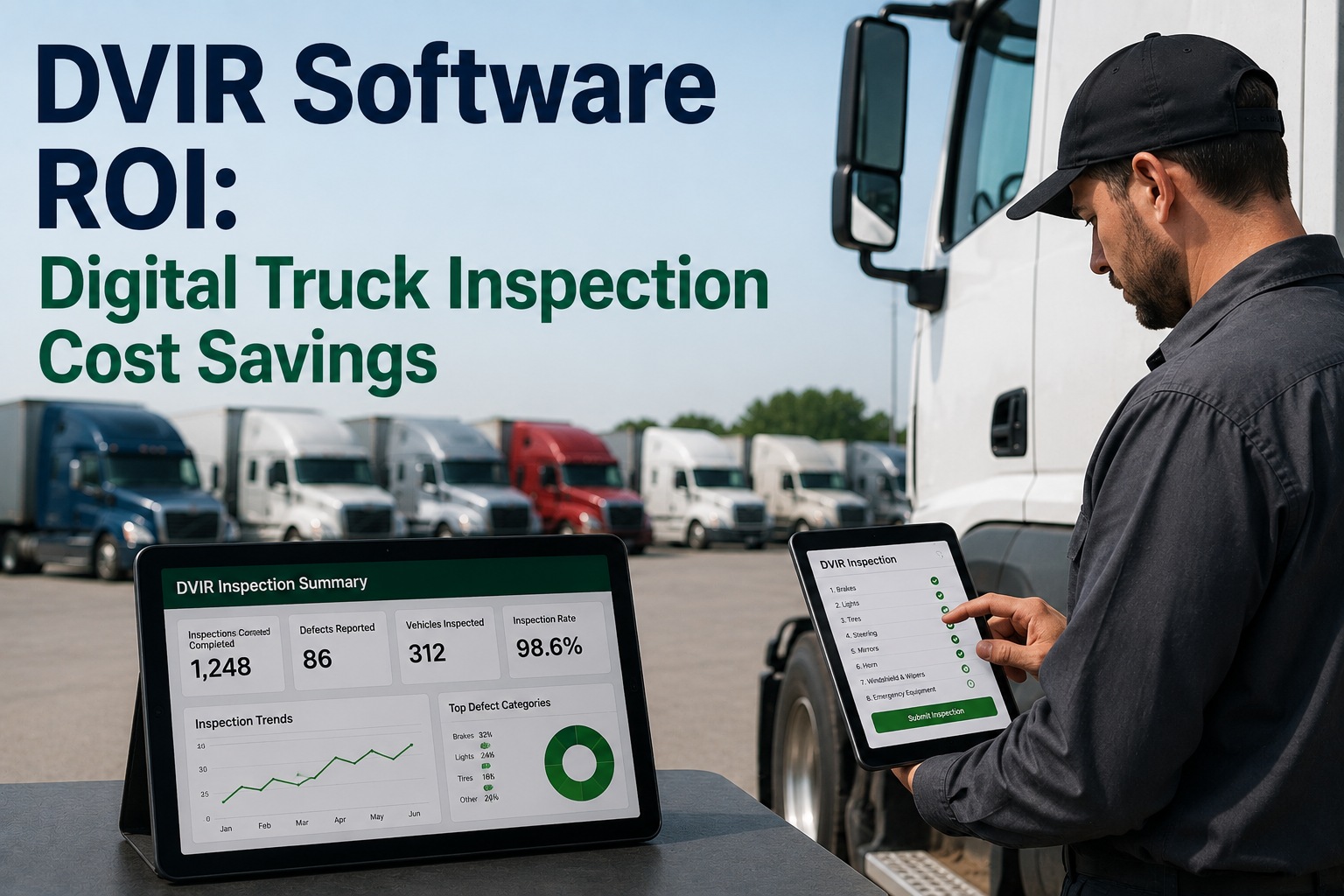
Our software runs the DVIR on the chassis to DOT §396.11 spec, adds a body-class-specific safety checklist for the packer / grabber / hoist system, tracks cycle counts and PTO hours per unit, and auto-generates a work order the moment a checkpoint fails. Fleets that had 30–40% of their maintenance spend disappearing into hydraulics typically cut that meaningfully in the first quarter — mostly by catching the cycle-driven defects before they become mid-route ruptures.
The Four Chain-Starting Defects — Where Waste Injuries Actually Begin
SWANA data and OSHA General Duty investigations consistently trace serious waste-fleet injuries back to a small set of defects that a disciplined pre-route walk would catch. None of them are exotic. All of them are body-specific. Below are the four that show up most often as the first link in an injury chain — with the daily check that stops the chain before it starts.
01
Pinhole hydraulic leak
Where it leads: High-pressure fluid injection — a surgical emergency from a leak the size of a pin.
Daily check: Visual line inspection on packer + grabber + hoist circuits. Cardboard test for suspected leaks — never a hand. Any leak = red tag.
02
Worn step or loose handhold
Where it leads: Rear-loader helper thrown from or slips off the riding step, often while the truck is moving.
Daily check: Step grip and handhold integrity. Enforce ANSI Z245.1 riding rules — no backing while the step is occupied.
03
Failed backup alarm or camera
Where it leads: Reverse-direction pedestrian strike in a residential or dumpster zone — SWANA's top-cited waste-fleet fatality mode.
Daily check: Backup alarm audible at 20 m in reverse. 360° cameras clean and functional. Mirrors clean and adjusted.
04
Packer / grabber interlock bypass
Where it leads: Packer blade or grabber arm cycles with worker in the danger zone.
Daily check: All emergency stops functional. Interlocks not defeated. Manual override protocol confirmed on shift start.
Frequently Asked Questions
Is there a federal standard specifically for waste-truck inspections?
There's no federal checklist mandate specifically for refuse. DOT §396.11 covers the chassis; ANSI Z245.1 covers the body equipment and is enforced through OSHA's General Duty Clause. A compliant program has to cover both — chassis and body — even though only one has an explicit federal DVIR rule.
Start free with the combined DOT + ANSI template.
How does cycle-count PM actually work in a waste fleet?
The PTO or hydraulic controller tracks packer / grabber / hoist activations, the platform pulls the count via telematics or CAN feed, and the PM engine opens a work order on a cycle threshold (say, every 5,000 packer cycles for the cylinder seal). Mileage-based PM alone misses this entirely on refuse duty.
Contact us to see cycle-count PM on your body type.
Do I need a separate app for each body type?
No — one platform with three body-class templates. The driver opens the truck record, the template auto-loads to match the body, the chassis section is common across all three, and the shop sees one unified record for the whole fleet.
Start free and see all three templates on one platform.
What's the biggest driver of hydraulic failure in waste fleets?
Contamination, by a wide margin — around 70% of hydraulic failures trace to particulate or moisture in the fluid, and most of that enters through unfiltered breathers and leaky seals. Cycle-count PM plus quarterly fluid sampling catches the trend before the failure.
Contact support to see the fluid-tracking workflow.
Three Bodies · One Program · Every Cycle Counted
Body-Specific Inspection, Chassis-Compliant DVIR, All on One Platform
Rear loader, side loader, roll-off — each on its own body-class template with cycle-count PM. Chassis section stays DOT-compliant. Every failed checkpoint auto-routed to a work order before the truck rolls.
No credit card required · Free for up to 3 trucks · Built for mixed waste & refuse fleets