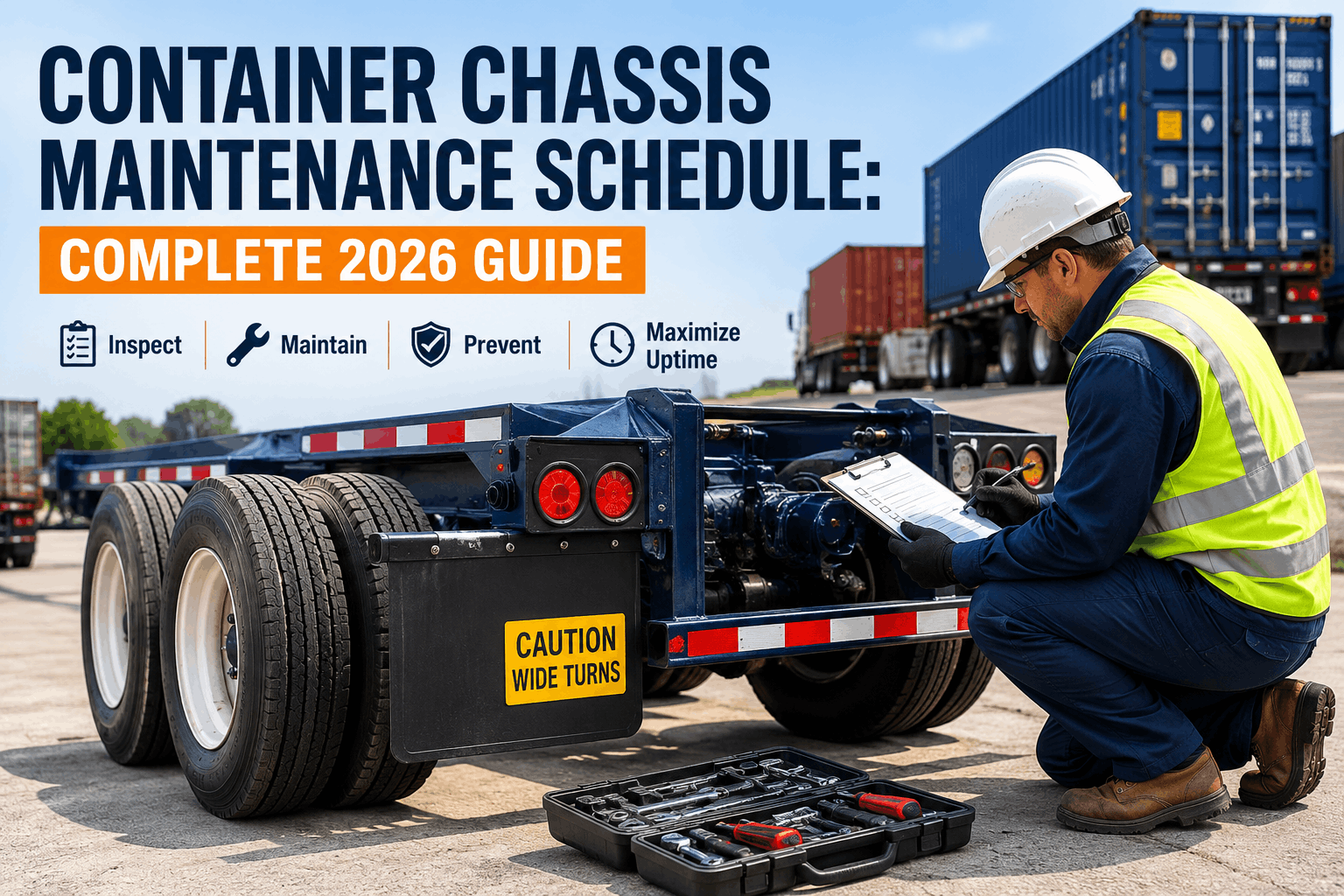
Container chassis maintenance occupies a unique regulatory and operational space that even experienced fleet managers commonly underestimate. Unlike tractors, chassis are governed by a separate FMCSA regulatory framework — Intermodal Equipment Provider (IEP) regulations under 49 CFR Part 385 Subpart D, roadability inspection requirements under §396.100-104, and joint responsibility between the IEP that owns the chassis and the motor carrier that operates it. The maintenance discipline is also different: no engine means no engine-hours triggering PM, no fuel system to maintain, no aftertreatment, no transmission. What remains is a focused set of high-stakes components — brakes, lighting, tires, kingpin and coupling, twist locks securing the container, suspension, and landing gear — where failure modes are immediate and consequential. Brake violations remain the #1 out-of-service category at every CVSA Roadcheck, accounting for 41% of OOS conditions; tire violations are #2 at 21.4%; lighting violations rank third at 12.8%. Every one of these top-cited failure modes happens on chassis.
The 2026 enforcement environment compounds chassis maintenance importance. The eDVIR Final Rule (effective March 23, 2026) explicitly authorizes electronic records for chassis DVIRs under §396.11 just as it does for tractors. The CSA scoring overhaul weights out-of-service violations at 2× severity, meaning chassis OOS events do more CSA damage than they did in 2024. Joint chassis responsibility under IEP rules means motor carriers can be penalized for chassis defects they accepted at pickup — making roadability inspection at hand-off operationally critical, not just regulatory. Industry data: roughly 750,000 intermodal chassis are in active US service, supporting container traffic that has grown 30%+ since 2019. The chassis fleet is aging, with average chassis age exceeding 12 years for many operations, making structured PM more important than for newer equipment. This guide is the complete 2026 container chassis maintenance framework: the 7-system inspection structure, PM service intervals, IEP and roadability compliance, and the digital workflow that turns chassis maintenance into auditable, defensible records.
This guide is the complete container chassis maintenance schedule for 2026: the 7-system inspection framework, PM service intervals by cadence, IEP and roadability compliance under 49 CFR Parts 385 and 396, common failure modes, and the digital workflow that satisfies the joint chassis-motor carrier responsibility model. Start your free trial of our truck inspection and maintenance software to deploy chassis-specific inspection templates across your fleet — live in 10 minutes, free for up to 3 trucks.
Container Chassis Maintenance Schedule: Complete 2026 Guide
Why Chassis Maintenance Is Different
Container chassis aren't just shorter trailers — they operate under a separate regulatory framework with unique components and failure modes. Understanding these differences explains why generic trailer PM templates fail when applied to chassis.
Separate IEP Regulatory Framework
Roadability Inspections Required
No Engine, Aftertreatment, or Drivetrain
Twist Locks Are Safety-Critical
Slider Mechanisms for Multiple Sizes
Aging Fleet Profile
The 7-System Chassis Inspection Framework
Every chassis inspection covers these 7 systems. Each addresses a distinct failure mode and a different category of compliance exposure. Contact our sales team for help deploying chassis inspection templates.
01 Brake System
02 Lighting & Electrical
03 Tires & Wheels
04 Suspension System
05 Kingpin & Coupling
06 Twist Locks & Securement
07 Landing Gear & Slider
The PM Service Intervals — Daily to Annual
Chassis PM follows a tiered cadence aligned with operational and regulatory requirements. Daily inspections catch obvious issues; quarterly comprehensive service catches gradual wear; annual periodic satisfies §396.17.
| Interval | Inspection Scope |
|---|---|
| Daily (pre-trip) | Visual brake check, all lights operational, tire pressure, no leaks, twist lock function |
| Daily (DVIR) | Post-trip defect documentation when found per §396.11 |
| At Interchange | Roadability inspection per §396.100-104 before accepting equipment |
| Weekly | Deeper visual: suspension, kingpin condition, slider operation, landing gear lube |
| Monthly | Brake adjustment measurement, ABS function test, lighting comprehensive check |
| Quarterly | Comprehensive 7-system service, brake adjustment, lubrication, fluid checks |
| Annual (§396.17) | Full Appendix A inspection by qualified inspector — 14 month retention |
For older chassis (12+ years average age in many fleets), monthly and quarterly intervals should be tightened toward more frequent inspection. Brake adjustment drift is the most common chassis problem — monthly measurement is essential for older equipment. Lighting issues escalate quickly: a marker light that's intermittent today is fully failed in 2 weeks. Move suspect components to immediate replacement rather than monitoring across PM cycles.
Roadability & IEP Compliance Framework
Chassis compliance operates under joint responsibility — both the IEP that owns the chassis and the motor carrier that operates it can be cited. Five regulations define the framework.
IEP Registration & Responsibility
Roadability Inspection
DVIR Documentation
Annual Periodic Inspection
Tire Standards
Frequently Asked Questions
Who's responsible for chassis maintenance — the IEP or the motor carrier?
Both — and the distinction matters. Under 49 CFR Part 385 Subpart D, the Intermodal Equipment Provider (IEP) that owns the chassis bears primary responsibility for maintaining it in safe operating condition through systematic preventive maintenance. The IEP must register with FMCSA, document maintenance, and provide chassis in compliant condition. However, under §396.100-104, the motor carrier that accepts the chassis at interchange must perform a roadability inspection and cannot operate equipment with known defects. If a motor carrier accepts a chassis with a defect that should have been caught during roadability inspection, the carrier becomes responsible for that defect — and can be cited even though the IEP failed to maintain. Joint responsibility creates documentation imperatives for both parties: IEPs need PM records; motor carriers need roadability inspection records. Modern platforms support both workflows. Start your free trial to deploy joint-responsibility documentation.
What's the most common chassis defect at roadside inspection?
Brake violations dominate by a wide margin. Brake-related conditions account for approximately 41% of all out-of-service violations at every CVSA International Roadcheck — the #1 OOS category for years running. Specific brake failures on chassis: slack adjuster out of adjustment (most common), brake lining below minimum, brake hose damage or leaks, ABS not functional, and gladhand seal failures producing air leaks. Tires are #2 at 21.4% — typically tread depth below §393.75 minimums, sidewall damage, or improper inflation. Lighting is #3 at 12.8% — burned-out marker lights, brake light failures, signal lights, and corroded connectors. Together these three categories account for over 75% of all OOS conditions, making them the operational priority for chassis maintenance. Brake adjustment cycling monthly, comprehensive lighting check before each dispatch, and tire pressure verification at every pre-trip address the dominant failure modes.
How often do chassis need DOT annual inspection?
Container chassis require annual periodic inspection within 12 months under 49 CFR §396.17 — identical requirement to power units. The inspection must be performed by a qualified inspector under §396.19, covering all 13 categories in Appendix A: brake system, coupling devices, exhaust (n/a for chassis), fuel system (n/a), lighting devices, safe loading, steering (n/a), suspension, frame, tires, wheels and rims, windshield glazing (n/a), and windshield wipers (n/a). Roughly 6 of the 13 Appendix A categories apply to chassis since they lack engines, exhaust, and steering. Inspection records must be retained 14 months under §396.21. Best practice: schedule chassis annual inspections at 11-month intervals rather than at the 12-month maximum, providing buffer time for any repairs and re-inspection before the regulatory deadline. The IEP typically arranges annual inspection, but motor carriers should verify current inspection certificate at roadability check before accepting chassis. Contact our sales team for chassis annual inspection coordination.
What are twist locks and why are they critical?
Twist locks are the mechanical devices on chassis corners that engage with the container's corner castings to secure the container to the chassis. All four corners have twist locks that must lock when the container is loaded and release when unloading. Functional twist locks prevent container detachment during transit — a failure mode with catastrophic potential. A container that disengages from chassis at highway speed can roll, crush vehicles, and produce mass-casualty incidents. Inspection points: handle operates smoothly without binding, lock indicators visible and functional (typically pin protrusion), no excessive play in locked position, all four corners engage simultaneously, and locks resist normal cargo movement. Damaged or worn twist locks must be replaced immediately — there is no acceptable level of degradation for this safety-critical component. Twist lock inspection should be on every chassis pre-trip and verified by the lifting equipment operator at container loading. Modern intermodal chassis often include monitored twist locks with electronic position sensors, but mechanical inspection remains the standard.
Should chassis PM use mileage or calendar intervals?
Calendar intervals dominate chassis PM, with usage-based adjustment for high-utilization equipment. Unlike power units that benefit from mileage + hours + calendar multi-trigger, chassis don't have engines so engine-hour triggers don't apply, and mileage is harder to track reliably (no consistent odometer on most chassis). Standard cadence: daily pre-trip inspection, weekly deeper visual, monthly brake adjustment and lighting check, quarterly comprehensive 7-system service, and annual periodic under §396.17. For high-utilization chassis (containers loaded/unloaded multiple times daily, high-cycle pool operations), monthly intervals tighten to bi-weekly and quarterly service should include detailed wear measurement. For aging chassis (12+ year average fleet age), all intervals tighten. The driver of chassis PM frequency isn't miles driven — it's the cycle count of brake applications, twist lock operations, and slider engagements. Operations with high cycle counts need more frequent service regardless of mileage. Sign up free to track chassis PM by cycle count and calendar.
What's the typical cost of chassis maintenance per year?
Chassis maintenance costs vary significantly by age, utilization, and operating environment but typically run $1,200-$2,500 per chassis annually for routine PM and repair. Major component replacement (suspension components, kingpin, brake overhaul, tire replacement) adds another $1,500-$4,000 in years requiring those services. Annual periodic inspection adds $150-$300. Lighting and electrical repairs total $200-$500 annually for aging chassis. Brake repairs lead at $500-$1,200 per year for older chassis. Compare this to the cost of failures: an OOS violation runs $19,277-$23,048 in penalty plus tow, plus the loss of the operational chassis for the duration, plus the CSA score impact. A single twist lock failure causing container detachment can produce millions in liability. Structured chassis PM at $1,500-$2,500 annually is dramatically cheaper than the alternative outcomes from neglected maintenance. The economics favor structured PM by 5-10× over reactive repair for chassis specifically because of the safety-critical components involved. Talk to our sales team for chassis PM workflow.