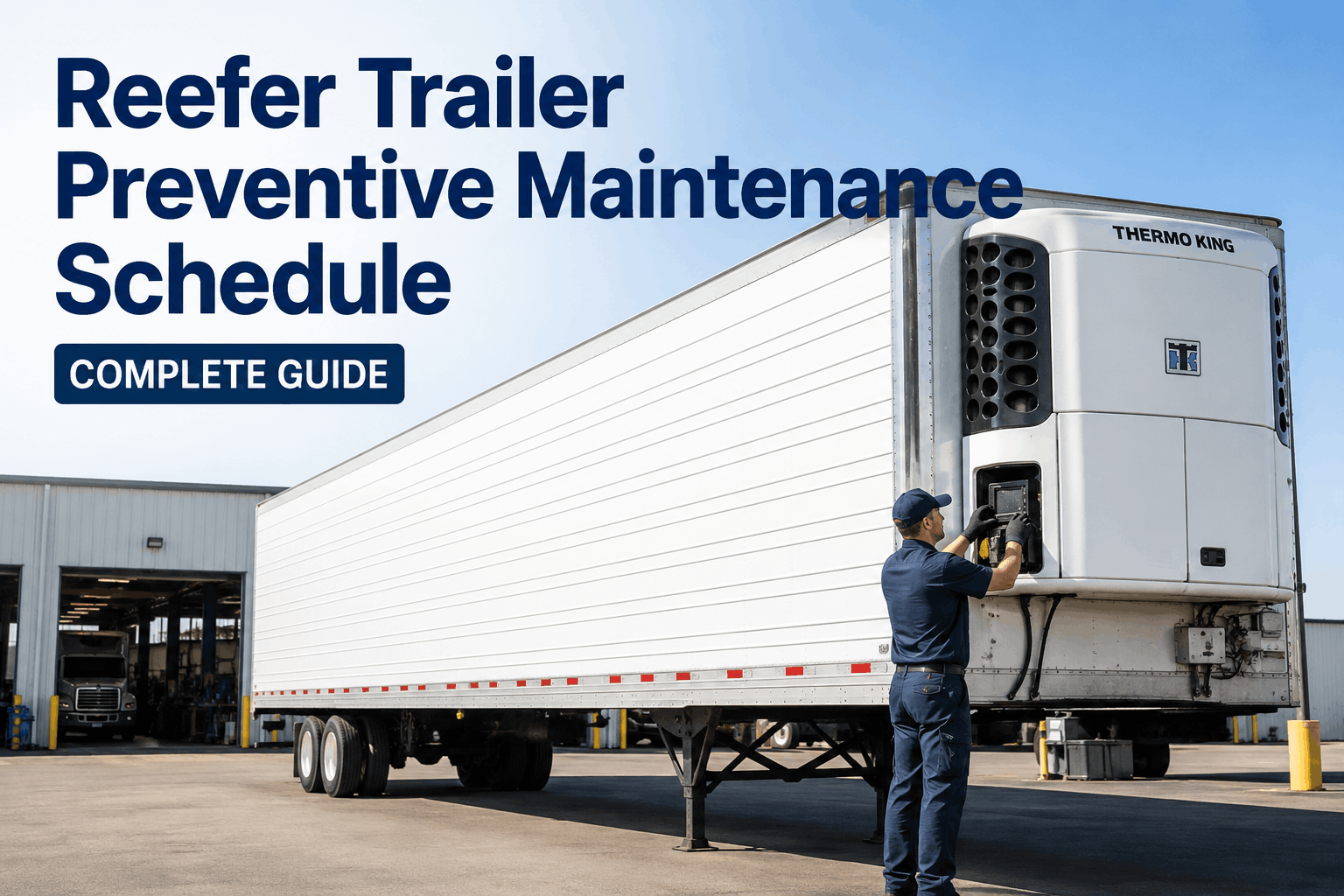
Reefer trailer maintenance occupies a uniquely high-stakes operational space — failure modes that on a dry-van trailer produce inconvenience produce six-figure cargo loss on a refrigerated trailer. A failed compressor on a loaded reefer destroys $50,000-$500,000+ of perishable cargo. A degraded door seal admits humid air that condenses on cold product surfaces, fails FDA temperature targets, and triggers FSMA Sanitary Transportation Rule violations. A microprocessor failure during a multi-day haul leaves the carrier without temperature documentation that FSMA requires retained for 12 months.The financial gravity of reefer breakdowns flips the maintenance economics: where dry-van PM is "good practice," reefer PM is the only economically defensible operating mode. Industry data confirms it — reefer fleets running structured maintenance see breakdown rates 70-85% lower than reactive fleets, with average TRU service life extending from 8-10 years to 12-15 years through disciplined preventive maintenance.
The 2026 regulatory environment compounds reefer maintenance importance. California's CARB Transport Refrigeration Unit rule is mid-implementation: 15% annual phase-out of diesel TRUs through 2029, refrigerant GWP cap at 2,200 (driving the industry transition to R-452A from legacy R-404A), and Tier 4 particulate emission standards for model year 2023+ units. Sixteen additional states have committed to similar rules. FDA's Food Safety Modernization Act Sanitary Transportation Rule (21 CFR Part 1, Subpart O) requires continuous temperature logs, sanitized interiors, and 12-month record retention. The eDVIR Final Rule (effective March 23, 2026) authorizes electronic chassis DVIRs that apply to reefer trailer operations. Telematics-based real-time temperature monitoring through Carrier Lynx Fleet, Thermo King TracKing, or third-party platforms like Coretex and CalAmp has shifted from "nice to have" to "shipper requirement" for most major cold-chain accounts. The carriers that build structured reefer PM programs aligned with this regulatory and operational reality consistently outperform reactive competitors on cost, cargo loss, and customer retention.
This guide is the complete reefer trailer preventive maintenance schedule for 2026: the 7-system inspection framework, Thermo King and Carrier service intervals, FSMA and CARB compliance, refrigerant transition guidance, and the digital workflow that ensures cold-chain integrity through every shipment. Start your free trial of our truck inspection and maintenance software to deploy reefer-specific maintenance workflow — live in 10 minutes, free for up to 3 trucks.
Reefer Trailer Preventive Maintenance Schedule: Complete Guide
Why Reefer Maintenance Is High-Stakes
Reefer trailers fail differently than dry vans. The cargo isn't just delayed — it's destroyed. Understanding the stakes explains why reefer PM economics dramatically favor disciplined preventive over reactive maintenance.
Six-Figure Cargo Loss Risk
FSMA Documentation Requirements
CARB TRU Phase-Out Pressure
Customer Contract Stipulations
Complex Cross-System Failures
Extended Service Life ROI
The 7-System Reefer Maintenance Framework
Every reefer PM covers these 7 systems. Each addresses distinct failure modes and different compliance requirements. Contact our sales team for help deploying reefer maintenance templates.
01 Refrigeration Unit (TRU)
02 Refrigerant & Cooling
03 Air Flow System
04 Doors & Seals
05 Floor & Insulation
06 Electrical & Microprocessor
07 DOT Compliance (Chassis Side)
Service Intervals — Daily to Annual
Reefer PM cadence runs on multi-trigger logic: TRU engine hours, calendar, and cargo cycle counts each drive different inspection points. Here's the comprehensive interval framework.
| Interval | Inspection Scope |
|---|---|
| Daily (pre-trip) | Pull-down test, fluid levels, fault codes, door seals, temperature display |
| Daily (DVIR) | Defects documented per §396.11 and FSMA records |
| Weekly | Belt tension, coil cleanliness visual, air filter check, sanitation |
| Monthly | TRU oil + filter service (Carrier ~1,500 hrs / Thermo King ~3,000 hrs by model) |
| Quarterly | Comprehensive 7-system inspection, refrigerant leak test, software updates |
| Annual | Major service: refrigerant level UV dye test, evaporator/condenser deep clean, full mechanical inspection |
| Annual (§396.17) | DOT periodic inspection — all 13 Appendix A categories by qualified inspector |
TRU engine hours drive reefer PM more than tractor mileage. A reefer that runs continuously at cargo dock accumulates engine hours without trailer movement — and the engine-hours threshold triggers PM regardless of trailer miles. Carrier and Thermo King publish unit-specific hour intervals (Carrier X4 series typically 1,500 engine hours between oil changes; Thermo King Precedent typically 3,000 hours between A-service). Always follow OEM-specified intervals for your specific unit model. Multi-trigger logic (hours + calendar + cargo cycles) catches what hours alone miss for low-utilization units.
Thermo King vs Carrier — Service Considerations
Together Thermo King and Carrier account for 90%+ of the reefer market. Each has distinct service patterns, intervals, and parts ecosystems. Fleets running mixed brands need to know both.
| Attribute | Thermo King | Carrier Transicold |
|---|---|---|
| Current refrigerant | R-452A (standardized 2022) | R-452A (standardized 2022) |
| Common trailer units | Precedent S-Series, e1000 | X4 series, Vector 8600 |
| A-service interval (typical) | ~3,000 engine hours | ~1,500 engine hours |
| Telematics platform | TracKing | Lynx Fleet |
| Electric standby option | e1000 truck unit available | Vector 8600 multi-temp |
| Service network | Extensive dealer network | 200+ NA locations |
| Diagnostic tools | SR-2/SR-3 software | APX / FaultRanger |
Service interval published numbers are starting points — actual interval depends on duty cycle, operating temperature, ambient conditions, and refrigerant load. Multi-temp operations (different zones at different temperatures) increase wear and shorten effective intervals. Continuous operation (vs cycling) accelerates oil degradation. Always pull data from the unit's diagnostic system at service to verify hours accumulated vs interval target. Modern telematics platforms (TracKing, Lynx Fleet) push service alerts based on actual data rather than calendar estimates.
FSMA & CARB Compliance Framework
Reefer operations sit at the intersection of food safety and emissions regulations. Five frameworks define the compliance landscape.
Sanitary Transportation Rule
TRU Phase-Out Rule
Refrigerant Service Certification
Annual Periodic Inspection
DVIR Documentation
Frequently Asked Questions
How often should a reefer trailer be inspected and serviced?
Reefer PM follows a tiered schedule across multiple cadences. Daily pre-trip: pull-down test, fluid levels, fault codes, door seals, temperature display verification. Weekly: belt tension visual, coil cleanliness check, air filter inspection, interior sanitation. Monthly: TRU engine oil and filter service (Carrier X4 typically 1,500 engine hours, Thermo King Precedent typically 3,000 engine hours — follow OEM intervals for your specific unit). Quarterly: comprehensive 7-system inspection, refrigerant leak test with UV dye, software updates, sensor calibration. Annual: major service including refrigerant verification, evaporator/condenser deep cleaning, full mechanical inspection, DOT annual periodic per §396.17. The critical principle: TRU engine hours drive most reefer PM rather than trailer mileage. A reefer that idles continuously at a dock accumulates engine hours without moving — and hours-based PM intervals still apply. Start your free trial for engine-hour-based reefer PM scheduling.
What's the difference between R-452A and R-404A refrigerant?
R-404A was the dominant TRU refrigerant from the 2000s through early 2020s but has a high Global Warming Potential of approximately 3,920. CARB regulations effective Dec 2022 cap new TRU refrigerant at GWP ≤ 2,200, eliminating R-404A from new equipment. R-452A is the current standard with a GWP of 2,140 — 45% lower than R-404A, just under the CARB threshold. Both Thermo King and Carrier standardized on R-452A by 2022. Properties: R-452A is nontoxic, nonflammable (Class A1), and provides similar cooling performance to R-404A at similar pricing. For some Carrier Transicold units, transitioning between refrigerants requires only a software update. Existing R-404A units can continue operating, but new equipment must use R-452A or another sub-2,200 GWP refrigerant. Both refrigerants require EPA Section 609 certified technicians for any service work. Sixteen states beyond California have committed to similar refrigerant rules, making R-452A the de facto US standard.
What does the CARB TRU phase-out mean for my fleet?
California's TRU phase-out is mid-implementation. The schedule: starting December 31, 2024, fleets must phase out 15% of their diesel-powered TRUs annually over seven years until none remain by 2029. Owners and motor carriers must register TRUs with CARB and obtain CARB IDN (Identification Number) labels for each unit. CARB enforcement officers can perform visual inspections and lookups. Facilities greater than 20,000 square feet (refrigerated warehouses, distribution centers, seaports, intermodal railyards) must register with CARB, pay fees every three years, and quarterly report TRU activity. Sixteen additional states have committed to similar regulations. Compliance options: transition to zero-emission TRUs (Thermo King e1000, Carrier Vector electric standby, full electric options), continue with diesel TRUs that meet Tier 4 PM standards (MY 2023+ models), or accept that operations into California will become increasingly restricted. The economic impact: zero-emission TRUs run higher upfront cost but lower operating cost over the unit lifecycle. Contact our sales team for CARB compliance tracking.
How do I keep FSMA temperature records compliant?
FSMA Sanitary Transportation Rule (21 CFR Part 1, Subpart O) requires continuous temperature logs throughout food transport with 12-month record retention. Compliance components: (1) continuous data logging from TRU controller — modern units record at 15-minute intervals minimum; (2) temperature data accessible to shipper/receiver at delivery; (3) records retained for 12 months minimum; (4) trained personnel who understand temperature requirements for specific cargoes; (5) sanitized cargo area between loads per cleanable interior requirement; (6) HACCP principles for hazard identification. Telematics platforms (Carrier Lynx Fleet, Thermo King TracKing, Coretex, CalAmp) automate FSMA compliance by capturing temperature data continuously and pushing alerts on deviation. Manual reefer downloads at end of trip work for compliance but provide no real-time alerting — increasing the risk of discovering temperature deviation only at delivery when cargo is already compromised. Sign up free to coordinate FSMA temperature records with maintenance workflow.
What's the biggest cause of reefer breakdowns?
Three causes dominate. (1) Belt failures — TRU drive belts wear and fail, stopping compressor operation. Inspection at every PM with replacement at first wear sign prevents this. (2) Compressor failures — most expensive single failure mode at $5,000-$10,000+ per replacement. Causes include refrigerant contamination, oil starvation, electrical faults, and overworking from compromised airflow. Structured PM with refrigerant analysis catches developing problems before catastrophic failure. (3) Microprocessor and electrical failures — controllers, sensors, wiring harnesses fail from vibration, moisture, and age. Inspect connectors, verify sensor calibration, and pull diagnostic codes at every PM. Other significant failures: door seal degradation (admits warm air, reduces cooling capacity, accelerates compressor work), defrost issues (ice buildup blocks airflow), and floor damage (water intrusion destroys insulation R-value). The lesson: structured PM addresses all five failure modes preventively. Reactive operation discovers problems at the load — too late.
How much does reefer trailer maintenance cost annually?
Reefer maintenance runs significantly higher than dry-van trailers — typically $3,500-$6,500 per reefer trailer annually for routine PM and minor repairs. Major component replacement (compressor, microprocessor, full TRU rebuild) adds $5,000-$15,000+ in years requiring those services. Annual breakdown: TRU oil and filter service $300-$500 per event (multiple per year); annual refrigerant service $200-$500; comprehensive annual inspection $500-$1,000; belt and small parts replacement $300-$800; sensor and electrical work $200-$600. Compare this to single failure costs: $5,000-$10,000 compressor replacement, $1,500-$3,500 microprocessor, $50,000-$500,000+ cargo loss from any failure causing temperature excursion. The economics overwhelmingly favor structured PM by 10× or more over reactive repair. Add the contract impact (major cold-chain shippers won't work with carriers without documented PM programs) and the cost of structured maintenance is essentially noise compared to the value it preserves. Talk to our sales team for reefer PM ROI modeling.