The Crankshaft Position Sensor (CKP) is the smallest component with the largest job description on your entire diesel engine — it tells the ECU exactly where the crankshaft is at every moment of rotation, providing the primary timing reference for fuel injection, ignition timing, and cam position correlation. Without a clean CKP signal, the engine simply cannot run. And when it fails, it fails in one of the most dangerous ways possible: the truck stalls without warning, often at highway speed, causing total loss of power steering and brake assist within seconds. FMCSA safety data and mechanic communities consistently rank sudden stall from CKP failure as one of the top causes of "unexplained" highway breakdowns and near-miss incidents. The classic P0335 code is textbook — but the failure pattern is more revealing than the code itself. Heat-soak failure (works cold, fails after warmup, restarts fine after cooling) is a dead giveaway that no diagnostic sheet mentions clearly. This guide walks through exactly how to spot the symptoms, decode the OBD-II codes, test the sensor properly before spending on parts, and how Truck Inspection & Maintenance turns intermittent stall complaints into tracked defects before a highway near-miss.
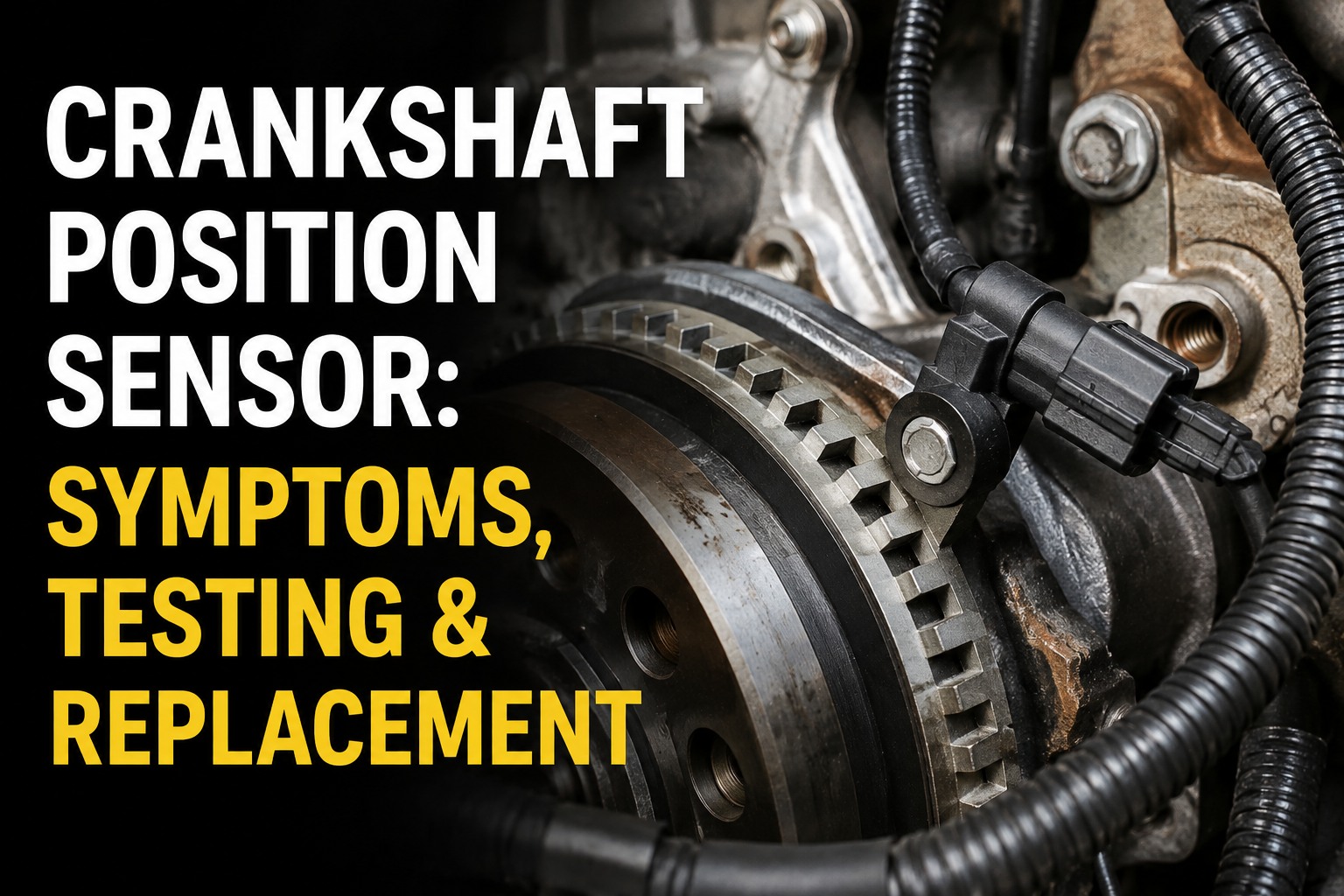
Crankshaft Position Sensor: Symptoms, Testing & Replacement
The smallest sensor with the largest safety impact — when it fails, the truck can stall at 65 mph.
What the CKP Sensor Actually Does
Every combustion event depends on precise timing. The CKP sensor uses a magnetic pickup that reads a toothed reluctor ring attached to the crankshaft. As the crank spins, teeth pass the sensor and generate a square-wave voltage signal — the ECU counts the pulses to know exact position, RPM, and TDC (top dead center) for every cylinder. Every fuel injection event, every emissions calculation, every valve timing adjustment starts with this signal:
The 6 Symptoms — Read Them In Order
CKP failure symptoms tend to appear in a predictable escalation. Recognizing where you are on the ladder tells you how urgent the repair is — and whether the truck is safe to move to the shop under its own power:
Check Engine Light With P0335
The first sign is usually a check engine light. Scan tool shows P0335 or related codes. Truck may still drive normally between events — but the ECU has already detected an unreliable signal.
Long Crank Time on Start
Engine takes 3–5 seconds to catch instead of firing right away. The ECU is struggling to interpret CKP data during cranking. Classic heat-related failure often appears here first — cold starts fine, warm starts drag.
Dead Tachometer at Idle
RPM gauge drops to zero or flickers erratically while engine is running. The ECU is receiving no signal or an invalid signal — even though the engine may still be running on partial data.
Rough Idle & Random Misfires
Engine shakes, hesitates, occasional misfires under load. Fuel injection timing is drifting because the ECU can't trust the CKP signal. May be accompanied by P0300-series misfire codes.
Sudden Stalling at Speed
Engine dies without warning while driving. Instant loss of power steering assist and brake booster vacuum. This is the most dangerous CKP failure mode — pull off the road immediately if the truck restarts.
No-Start Condition
Engine cranks but never fires. ECU gets zero signal from CKP during crank cycle, so it never commands injection or ignition. Truck is undrivable — needs sensor replaced before it moves again.
The Heat-Soak Pattern — The Diagnostic Fingerprint
Here's the single most important pattern in CKP diagnostics that most guides miss: intermittent CKP failure is almost always heat-related. The sensor works cold, fails when hot, and works again after cooling. If your truck matches this pattern, the CKP is the cause even if bench tests pass at room temperature:
Truck Starts & Runs Fine
Morning startup, cold engine — everything works normally. Sensor coil is at rest, magnetic field is strong, signal is clean.
Driving Normally, Some Hiccups
Warm-up complete. Occasional misfires, brief hesitations, maybe a random flicker on the tach. Signal is degrading but usable.
Sudden Stall — Won't Restart
Internal coil expands past tolerance. Signal drops. Engine dies. Cranks but won't fire until cooled off. Textbook heat-soak failure pattern.
The OBD-II Code Cheat Sheet
CKP-related codes cluster in a specific range. Recognizing them quickly saves diagnostic time. Any of these appearing on a scan tool point to CKP or its supporting circuit as the first suspect:
Every "check engine light" complaint belongs on the DVIR — before it becomes a highway stall
A driver mentions "the check engine light came on once and went off." Nobody writes it down. Three weeks later the truck stalls at 65 mph. Truck Inspection & Maintenance turns every dashboard warning, hesitation observation, and intermittent stall into a documented DVIR item — GPS-tagged, timestamped, routed to your shop as a defect work order. Sign up free for up to 3 vehicles.
Test Before You Replace — 4-Step Procedure
Buying a $150 sensor and finding out the problem was a $2 corroded connector is one of the most common mistakes in CKP repair. Here's the proper test procedure — 20 minutes of testing saves hours of wrong-parts frustration:
Visual Inspection First
Look at wiring harness between CKP and ECU. Check for melted insulation near exhaust, chafing against pulleys, or oil saturation. Inspect connector pins for corrosion or bent contacts. Wiring issues cause a large share of "sensor" failures.
Verify Power & Ground
With ignition on, engine off: test connector for 5V or 12V reference (check spec). Ground should read under 100mV to chassis. No power = wiring problem, not sensor. Bad ground = check engine grounds (G104, G105, G106 on Ram diesels).
Scan Live RPM Data
Connect scan tool. Watch RPM during crank — should read 150–250 RPM if signal is valid. Zero RPM during crank confirms no signal. RPM present during crank but engine still won't fire points elsewhere (fuel, injectors).
Hot-Restart Test (Heat-Soak Confirm)
Drive until fully warm. Shut off. Attempt immediate restart. If cranks-no-start hot but starts fine after 30-minute cooldown, the CKP is confirmed even if it tests fine cold. This is the textbook failure pattern.
Real Repair Cost Breakdown
CKP replacement is one of the more variable jobs in diesel repair. Costs depend heavily on truck brand, sensor location, and whether the starter or other components need removal for access:
Parts Only, Easy Access
Aftermarket sensor $20–$75. OEM sensor $50–$150. Basic hand tools. Applies when sensor is bolted to bell housing or block with easy access — 30 minutes DIY.
Standard Shop Repair
OEM sensor + labor at commercial shop. 45–90 minutes labor at $80–$150/hr. Includes proper diagnostics before replacement. Most diesel trucks fall in this range.
Starter Removal / PCM Reflash
Some designs require starter removal for CKP access. Add $150+ labor. TSB software update may be needed (Ram diesel P0335 is a common example) — dealer PCM reflash $150–$300.
Replacement Best Practices
Once you've confirmed it's the sensor, follow these five practices for a repair that actually solves the problem — not one that comes back in 3 months:
Use OEM or Premium Aftermarket
Cheap aftermarket CKP sensors produce weak or incorrect voltage waves. The ECU rejects them and P0335 returns within days. Spend the extra $30–$50 for a genuine sensor.
Inspect & Clean the Connector
Replacing the sensor without cleaning corrosion from the connector guarantees a repeat failure. Use electrical contact cleaner, check locking clip integrity, replace pigtail if damaged.
Check for Applicable TSBs
Some P0335 issues are software-only fixes. Ram/Chrysler diesels commonly have TSBs for heat-related PCM logic. Check for updates before spending on hardware. Dealer scan tool required.
Torque to Spec Exactly
CKP mounting torque matters. Over-torque cracks the housing; under-torque changes the air gap between sensor and reluctor ring. Follow OEM spec — typically 60–100 in-lbs.
Clear Codes & Verify Under Load
After install, clear codes. Test drive 20+ miles including highway and stop-and-go. Get engine fully hot. If P0335 returns during warm operation, the wiring or ECU is next — not another sensor.
Document the Repair
Log sensor part number, install date, test drive results in maintenance records. If problem returns, having this data speeds diagnostics dramatically — and protects against paying twice.
Frequently Asked Questions
Is it safe to drive with a bad crankshaft position sensor?
No — this is one of the few "do not drive" verdicts in diesel repair. A failing CKP can cause the engine to stall without warning at any speed, including on the highway. When a diesel stalls at speed, you lose power steering assist within seconds and brake booster vacuum shortly after. In traffic or on a grade, this creates a genuine safety emergency. Tow the truck if it's throwing an active P0335.
What's the most common cause of P0335?
Failed CKP sensor from thermal stress and age is the #1 cause. Damaged wiring and connectors are a close second — wires melt against exhaust, chafe on pulleys, or soak in engine oil. On Ram diesels, PCM software issues have been documented in TSBs. Always inspect wiring and connectors before assuming the sensor itself is bad — a $2 corroded pin can throw the same code as a $200 sensor.
What's the heat-soak failure pattern?
Cold engine starts and runs fine. As the engine warms to 175–210°F, the internal sensor coil expands past tolerance and signal drops. Engine stalls or won't restart until it cools down (typically 20–30 minutes). Bench testing at room temperature often passes, misleading techs. If your truck matches this cold-works / hot-fails pattern, the CKP is the answer regardless of what static tests show.
How much does crankshaft position sensor replacement cost?
Typical range is $150–$400 professional. Sensor parts run $20–$75 aftermarket or $50–$300 OEM. Labor is 45–90 minutes at $80–$150/hr. Complex jobs requiring starter removal, PCM reflash, or reluctor ring replacement can push costs to $700+. Ram diesel P0335 has documented software TSBs — check for those before spending on hardware. Talk to our team about tracking dashboard warnings.
Can I test the CKP sensor myself?
Yes, and you should before spending on parts. Four-step procedure: visual inspection of wiring and connector, verify 5V/12V power and clean ground with a multimeter, connect scan tool and watch RPM during crank (zero RPM = confirmed no signal), and run a hot-restart test to catch heat-soak failure. Total time about 20 minutes. If all four confirm sensor failure, then replace with confidence.
How does Truck Inspection & Maintenance help catch CKP problems early?
Every check engine light activation, hard-start complaint, tachometer glitch, and unexplained stall belongs on the daily DVIR — captured, timestamped, GPS-tagged, and routed to your shop as a defect work order. A single "truck acted weird once" mention is data; three intermittent complaints in two weeks is a pattern that catches a failing CKP before a highway stall. Sign up free to see the workflow.
An intermittent CKP fault is a highway stall waiting to happen — unless it's logged and fixed.
Every check engine warning, hard start, and dashboard glitch is a data point that either sits in a driver's memory or on a digital DVIR. Truck Inspection & Maintenance captures them GPS-tagged, timestamped, and routed to your shop as defect work orders before the intermittent fault becomes a 65-mph power-loss emergency. Free for up to 3 vehicles with no hardware and no contracts. Set it up in 10 minutes.