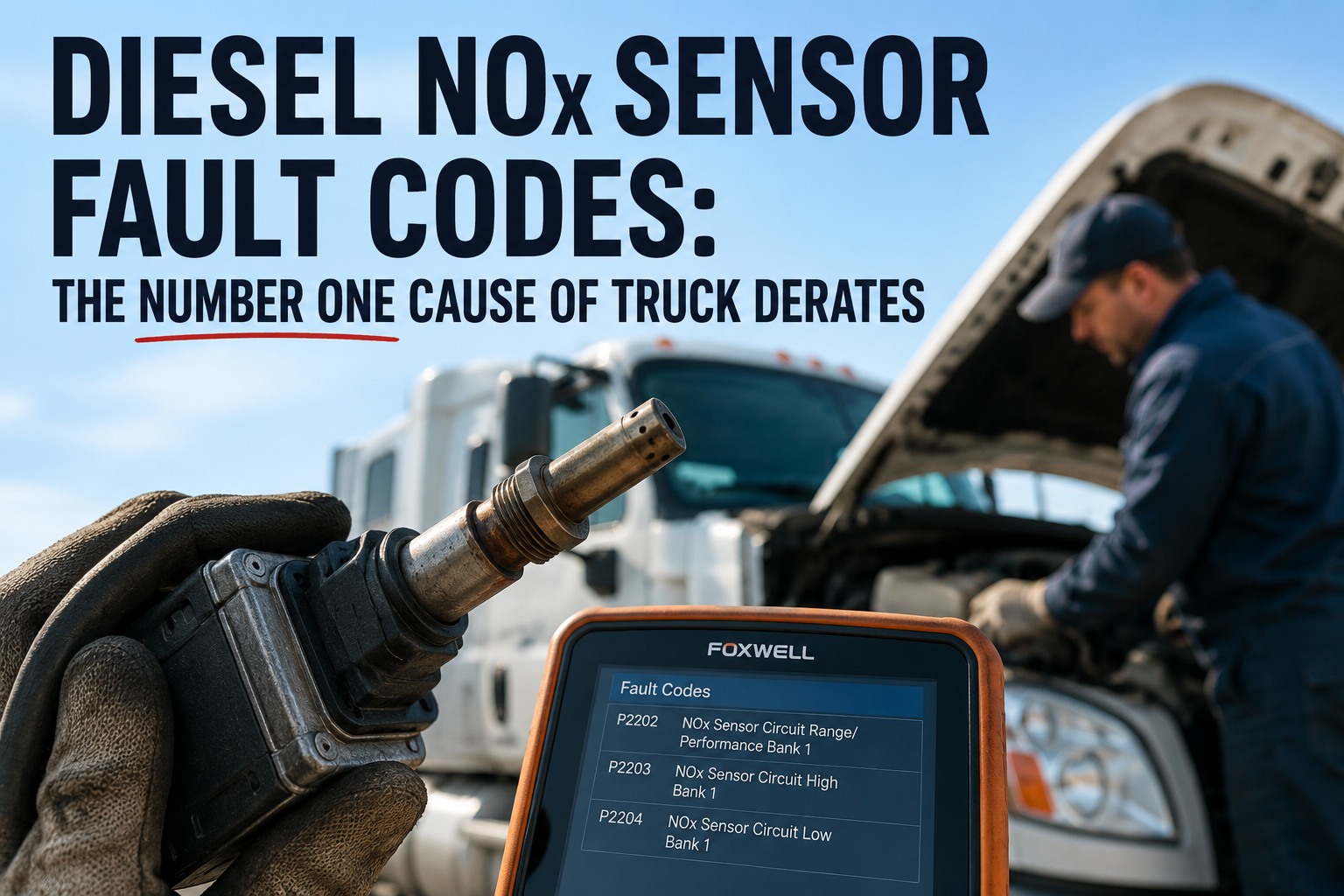
NOx sensor codes are among the most expensive-looking faults a diesel can throw — and among the most misdiagnosed. A driver sees a check-engine light, a DEF warning lamp, and a "service exhaust system" message counting down the miles, and the natural assumption is a failed sensor at $400 to $1,100 a piece. Sometimes that's exactly right. Just as often, the real culprit is a corroded connector, a chafed wire, low battery voltage, or an ECM that just needs a reflash — and a shop that swaps the sensor without checking those hands the customer a bill for a part that was never broken. The trick with NOx codes is reading what the truck is actually telling you before you touch a wrench. Track your SCR system health free. This guide maps how the two-sensor NOx system works, decodes the common code families and what each really points at, walks the live-data diagnostic that pinpoints the bad sensor, and lays out honest repair costs — plus how to keep the derate countdown from ever starting.
Diesel NOx Sensor Fault Codes: Symptoms, Causes & Fix Guide
Before you replace a $1,000 sensor, read what the truck is telling you. A tech's guide to diesel NOx sensor codes — how the two-sensor SCR system works, what each code family actually means, and the live-data test that finds the real fault.
Why NOx Codes Can't Wait
Unlike some emissions faults you can babysit for weeks, a NOx sensor code starts a clock. The ECM enforces a derate countdown, and ignoring it doesn't just risk a fine — it strands the truck.
How the Two-Sensor System Works
Every modern diesel runs two NOx sensors, and understanding their job is the key to reading the codes. One sits upstream of the SCR catalyst, one downstream — and the ECU's entire strategy is built on comparing them.
The Code Families, Decoded
NOx codes look like alphabet soup, but they cluster into a handful of families — and which family you're in tells you whether you're chasing a sensor, a wire, or the catalyst itself. This is where diagnosis starts.
Symptoms You'll See
NOx sensor faults announce themselves through the dash and the way the truck drives, because the ECU has lost the data it needs to run the emissions system correctly.
The MIL, usually paired with a yellow or red DEF/SCR system warning light.
A "service exhaust system" message stepping down the miles toward a 5-mph limit.
Noticeably reduced power as the ECU begins protecting the aftertreatment system.
Lost closed-loop control throws off DEF dosing and combustion efficiency.
Incorrect dosing can burn more diesel exhaust fluid than the truck should need.
In some cases, visible smoke as emissions control falls out of range.
The Live-Data Diagnostic
You can't diagnose a NOx code with a $30 code reader — the fault lives on the CAN bus behind the ECM. With a capable bi-directional scan tool showing live NOx data, though, the truck tells you exactly which sensor is bad. Run it to operating temperature and read the two sensors together.
If the pre-catalyst reading sits at zero, pegs at maximum, or won't change when you blip the throttle, the upstream sensor has failed.
Physically impossible if both work — the catalyst removes NOx, so downstream must be lower. This pattern means a sensor is lying.
If both sensors track correctly but SCR-efficiency or DEF-quality codes remain, the sensors are fine — the catalyst is the problem.
Catch the Drift Before the Countdown
A NOx sensor rarely dies instantly — its readings drift as the ceramic element degrades. Truck Inspection & Maintenance trends live NOx data and SCR-related codes over time, so a sensor reading progressively out of range shows up as a rising line weeks before it triggers a derate — and a truck logging repeated nuisance codes gets flagged before it's stranded on a crawl-home limit.
What Actually Causes NOx Sensor Failure
When the sensor genuinely is the problem, a handful of causes dominate — and knowing them both speeds the diagnosis and points at prevention.
Repairs & What They Cost
Match the fix to the finding and the bill varies widely. The cheap fixes are real and common — which is exactly why you diagnose the wiring and voltage before condemning the sensor.
An OEM calibration update resolves roughly 15% of cases with no parts at all. Always check for a bulletin first.
Clean corrosion, fix a chafed harness, or repair a ground — the fix for voltage and communication codes.
Seal a leak or pipe near the sensor that was causing fresh-air readings.
Bosch, Continental/VDO, or Walker sensor. Note some platforms strongly prefer OE parts to meet ECU parameters.
OEM sensor $400–1,100, labor $150–400 with ECU relearn. Many shops replace both sensors together to avoid a repeat visit.
Keeping the Codes Away
NOx sensors are a wear item, but their life is heavily influenced by what you run through the system and how you catch problems early. A few habits stretch replacement intervals and stop nuisance codes.
Clean, in-spec diesel exhaust fluid is the single biggest factor in sensor longevity — contamination poisons the element fast.
Regular sustained running keeps the SCR working properly and limits the soot buildup that fouls the sensing element.
Check for corrosion and water intrusion at the sensor connectors, especially after winters with heavy road salt.
Watch NOx data over time so a drifting sensor is caught and scheduled before it forces a roadside derate.
Frequently Asked Questions
For a short distance, yes — but not for long, and not safely as a habit. Diesel platforms enforce a derate countdown once the fault persists: the truck typically warns at around 200 miles, then 100, then 55, before forcing a roughly 5-mph crawl-home mode. So you can usually get to a shop, but the clock is running and it ends with a loaded truck stranded. Beyond the derate, driving with a failed sensor means the ECU has lost closed-loop control of DEF dosing, which hurts fuel economy and can cause soot buildup that damages the catalytic converter — turning a sensor bill into a much larger one. Address it promptly. Start a free trial to catch it early.
Use a bi-directional scan tool that shows live NOx data, run the engine to operating temperature, and watch both sensors together. If the upstream reading sits at zero, pegs at maximum, or doesn't change when you blip the throttle, the upstream sensor is bad. If the downstream reads higher than the upstream, that's physically impossible when both are working — the catalyst removes NOx, so downstream must be lower — which means at least one sensor is lying. And if both sensors read normally but SCR-efficiency or DEF-quality codes persist, the sensors are fine and the catalyst itself is the issue. This live comparison is the most reliable diagnostic and it's why a generic $30 reader can't do the job. See live NOx diagnostics.
They live in one of the harshest environments on the truck — constant high exhaust heat, vibration, and a stream of combustion byproducts — so they're a genuine wear item. The most common failure mode is soot and carbon fouling the sensing element over time. Close behind are electrical issues that look like sensor failures but aren't: connector corrosion and water intrusion from road salt and humidity, and wiring harnesses that chafe against brackets and short out. Contaminated or poor-quality DEF is another major accelerant, poisoning the ceramic element and dramatically shortening sensor life. Because several of these are wiring or fluid problems rather than the sensor itself, diagnosis matters before replacement. Start free and monitor sensor health.
Most heavy-duty diesels have two, and replacing only the failed one is a legitimate choice — but test both first, and seriously consider doing both together. The sensors share the same operating environment and age, so if one has failed from soot fouling, contamination, or simple age, the other is usually not far behind. Many technicians replace both upstream and downstream at once specifically to avoid a repeat diagnosis, teardown, and shop visit weeks later, which often costs more in total than doing them together the first time. Also worth noting: some platforms strongly prefer OE-quality sensors because aftermarket units can fail to meet the ECU's parameters and throw codes of their own. Start free and log both sensors.
It depends heavily on what's actually wrong, which is the whole reason to diagnose first. If it's an ECM calibration update — which resolves about 15% of P2200-type cases — the cost is $0 to $150 with no parts. A wiring or connector repair runs $50 to $200, and an exhaust-leak fix $50 to $150. If the sensor genuinely needs replacing, an aftermarket unit (Bosch, Continental/VDO, Walker) plus labor comes to roughly $180 to $450, while an OEM sensor runs $400 to $1,100 with another $150 to $400 in labor and ECU relearn — call it $550 to $1,500 for an OE job, more if you do both sensors. Independent diesel specialists typically run 20 to 30% below dealer rates. The takeaway: a shop quoting a sensor before checking voltage, wiring, and reflash bulletins is skipping the steps that could save you hundreds. Start free and track repair costs.
Don't Replace the Sensor Until the Data Says To
NOx codes are a diagnosis, not an automatic trip to the parts counter. Truck Inspection & Maintenance trends live NOx readings and SCR codes across your fleet, so a drifting sensor is caught weeks before it triggers a derate, nuisance codes are flagged, and every repair and cost is logged so you know what actually fixed it. Catch the drift, find the real fault, and keep the countdown from ever starting.