The Manifold Absolute Pressure sensor is the single most important input the ECM uses to decide how much fuel to inject on each cycle. It measures the pressure inside the intake manifold — reading the boost from the turbocharger, air density from altitude and temperature, and load demand from throttle position — then reports that pressure back to the ECM 100+ times per second. When the MAP sensor drifts, contaminates, or fails outright, the ECM starts commanding the wrong fuel amounts, and everything downstream cascades: rough idle, poor fuel economy, black smoke, hard starts, boost fault codes, DPF regeneration failures, and eventually derate. The good news is that MAP sensor failure is one of the most testable, diagnosable, and cheap-to-fix problems on a modern diesel — a $60–$180 sensor plus 15 minutes of labor when caught early, versus $2,000+ in cascading damage when ignored. This guide walks through how the MAP sensor works, the seven symptoms that flag failure, the specific DTCs to look for, the shop-floor testing procedure with expected values, replacement steps, and the maintenance rhythm that keeps sensors reading true. Track ECM fault codes and sensor health across your fleet on our fleet maintenance platform, or reach out to our support team for a walkthrough.
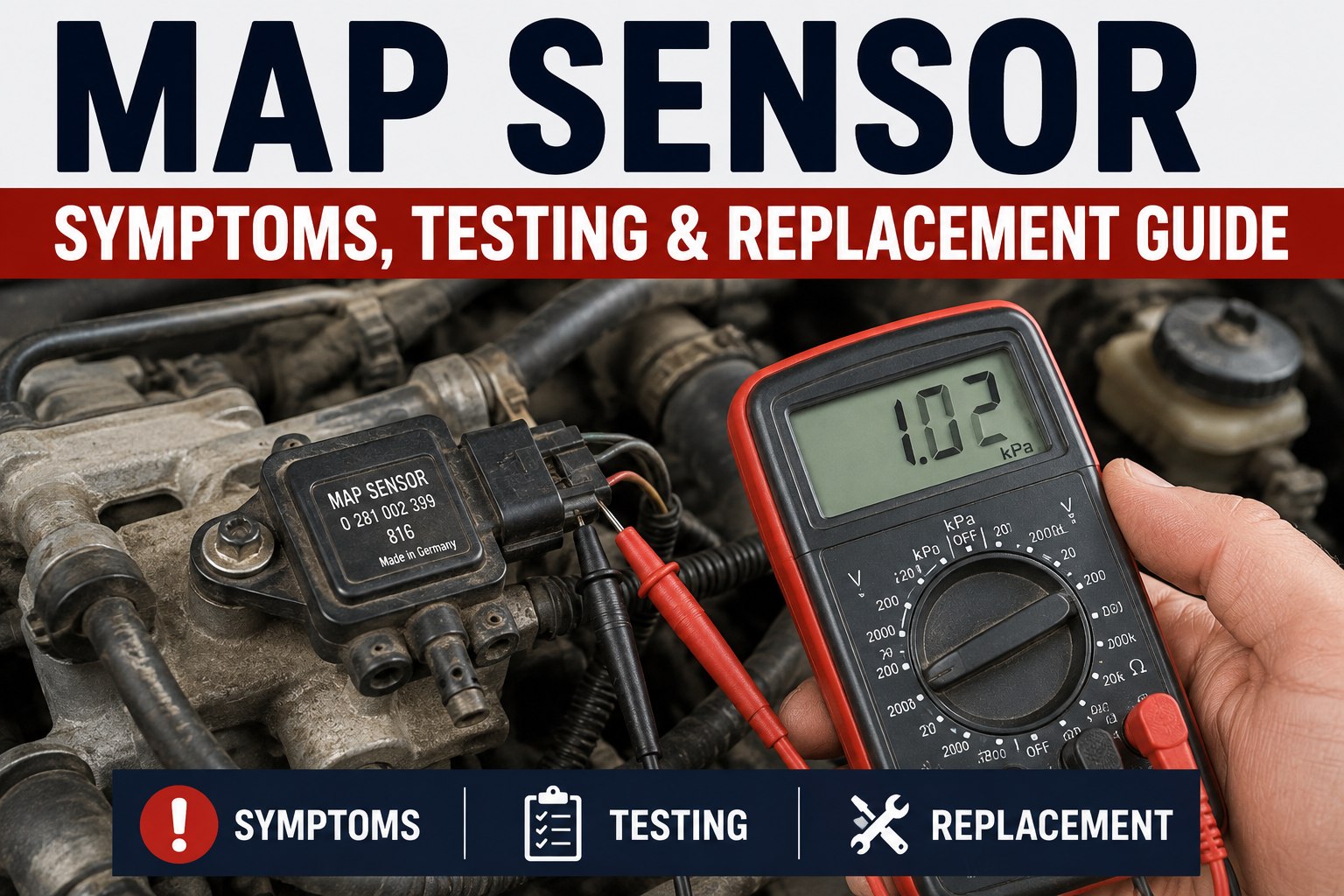
MAP Sensor Symptoms, Testing & Replacement Guide
The one sensor the ECM trusts most for fuel calculation. When it drifts, everything downstream drifts with it — here's how to diagnose it in 15 minutes.
What the MAP Sensor Actually Does
The MAP sensor is the ECM's window into intake manifold pressure. Its output drives every fuel and boost decision the engine makes. Understanding the loop is what makes diagnosis intuitive.
The 7 Symptoms of MAP Sensor Failure
MAP sensors rarely fail catastrophically. They drift, contaminate, or provide slightly-wrong readings that cascade into these seven distinct symptoms — catch any of them and diagnose the sensor first.
The DTCs That Point Directly at MAP Failure
MAP sensor DTCs are specific and diagnosable. When any of these appear on ECM scan, the MAP sensor is the first suspect — not somewhere down the fuel system.
The Shop-Floor Testing Procedure
MAP sensor testing takes 15 minutes with basic tools. Here's the sequence that identifies whether the sensor is bad, the wiring is bad, or the ECM is misinterpreting a valid signal.
Turn ECM codes into work orders automatically
MAP-related fault codes (P0105–P0109, P0234) flagged at the moment they set. Sensor test procedures pushed to the tech's device. Repair history archived per VIN.
The 4 Root Causes of MAP Sensor Failure
MAP sensors don't just wear out — four specific mechanisms account for most failures. Understanding the cause determines whether replacement alone fixes the problem.
Oil & Soot Contamination
Blow-by from worn piston rings pushes oil vapor and soot into the intake. Coats the sensor's pressure port. Signal drifts progressively. Often mistaken for sensor failure when it's actually an engine problem upstream.
Wiring & Connector Corrosion
Vibration, moisture ingress, and heat cycling attack the connector. Green corrosion on pins increases resistance. Signal becomes erratic. Fix the connector — sensor may test fine.
Vacuum Leaks & Cracked Hoses
MAP reads a value that isn't the true manifold pressure because atmosphere is leaking in. Sensor is fine — the piping is broken. Smoke-test the intake system before condemning the sensor.
Sensor Element Failure
The piezoresistive element itself degrades — usually from age, heat, or thermal shock. Signal is stuck, drifts wildly, or reads incorrectly at specific pressure ranges. Only case where replacement definitively fixes the problem.
The Replacement Procedure
Once testing confirms the sensor is bad, replacement is straightforward. Six steps, no special tools, minimal training required.
Repair Cost Breakdown
MAP sensor repair is one of the cheapest fixes on a modern diesel — when caught early. Waiting turns it into a much bigger bill.
Prevention: Keeping MAP Sensors Reading True
MAP sensors last hundreds of thousands of miles when the engine feeding them is healthy. Five practices extend life dramatically.
Address Blow-By at Source
Worn rings and PCV problems push oil vapor into the intake — where it coats the MAP sensor. Fix engine breathing first, MAP contamination stops on its own.
Clean Intake at Each Major PM
Every 100,000 miles, inspect and clean the intake tract including the MAP sensor port. Prevents progressive drift from soot buildup.
Inspect Connectors at Every PM
Dielectric grease on connector pins prevents corrosion. Quick visual check catches wiring issues before they become intermittent driveability problems.
Track MPG Trends
10–20% MPG drop is often the first sign of MAP drift — before any DTC sets. Fleet-wide MPG tracking catches it at the "why is this truck getting worse" stage.
Read Codes Weekly
Pending codes appear before "check engine" activates. Weekly ECM scans across the fleet catch MAP problems in the pending state — talk to our team about automated code monitoring.
Baseline Voltage Values
Record MAP sensor voltage at key-on-engine-off during PM inspection. A drift from historical baseline is diagnostic even without a DTC.
Frequently Asked Questions
The MAP (Manifold Absolute Pressure) sensor measures intake manifold pressure and reports it to the ECM 100+ times per second. The ECM uses this data — combined with RPM, throttle position, and air temperature — to calculate exact fuel injection amounts, timing, and turbocharger vane position on every combustion cycle. Track sensor health per vehicle with our fleet software.
Seven symptoms flag MAP failure: check engine light with codes P0105–P0109, rough idle, 10–20% MPG drop, loss of power, black exhaust smoke, hard starts, and DPF regen failures. A 15-minute test with a multimeter confirms whether the sensor is actually failing or something upstream is causing the symptoms.
A caught-early replacement runs $75–$225 all-in ($60–$180 for the sensor plus 15–30 minutes labor). If wiring damage is found, expect $200–$500. If MAP problems are ignored for months, injector damage and DPF issues can push the total to $1,500–$3,500. Early diagnosis is 5–10x cheaper than neglected.
Short-term yes, but with cost accumulating. Wrong fuel commands damage injectors, clog the DPF, and reduce fuel economy dramatically. Running a diesel with drifting MAP sensor for months typically causes $1,500–$3,500 in downstream damage on top of the original $75 fix. Get it diagnosed same-week — reach out to our team about mobile diagnostics.
Six-step test with a digital multimeter: visual inspection, verify 5V reference, verify ground, read signal at key-on-engine-off (should be 4.4–4.9V near sea level), read signal at idle (should drop to 1.0–1.5V), and read signal under boost (should climb to 3.8–4.5V). Total time: about 15 minutes.
Not often on their own — most "MAP sensor failures" are actually contamination from engine blow-by, connector corrosion, or vacuum leaks. Only about 15% of MAP-related problems are actual sensor element failure. Diagnose the real cause before replacing the sensor — otherwise the problem returns within weeks. Track diagnostic patterns across your fleet on our maintenance platform.
Turn ECM sensor codes into resolved work orders
Automatic fault-code capture from ECM. Pending codes flagged before the check engine light activates. MAP baseline voltage tracked per truck. MPG trend alerts point at sensor drift before DTCs set. Full diagnostic archive by VIN for every repair. Everything a maintenance program needs to catch $75 sensor issues before they become $3,500 cascades.