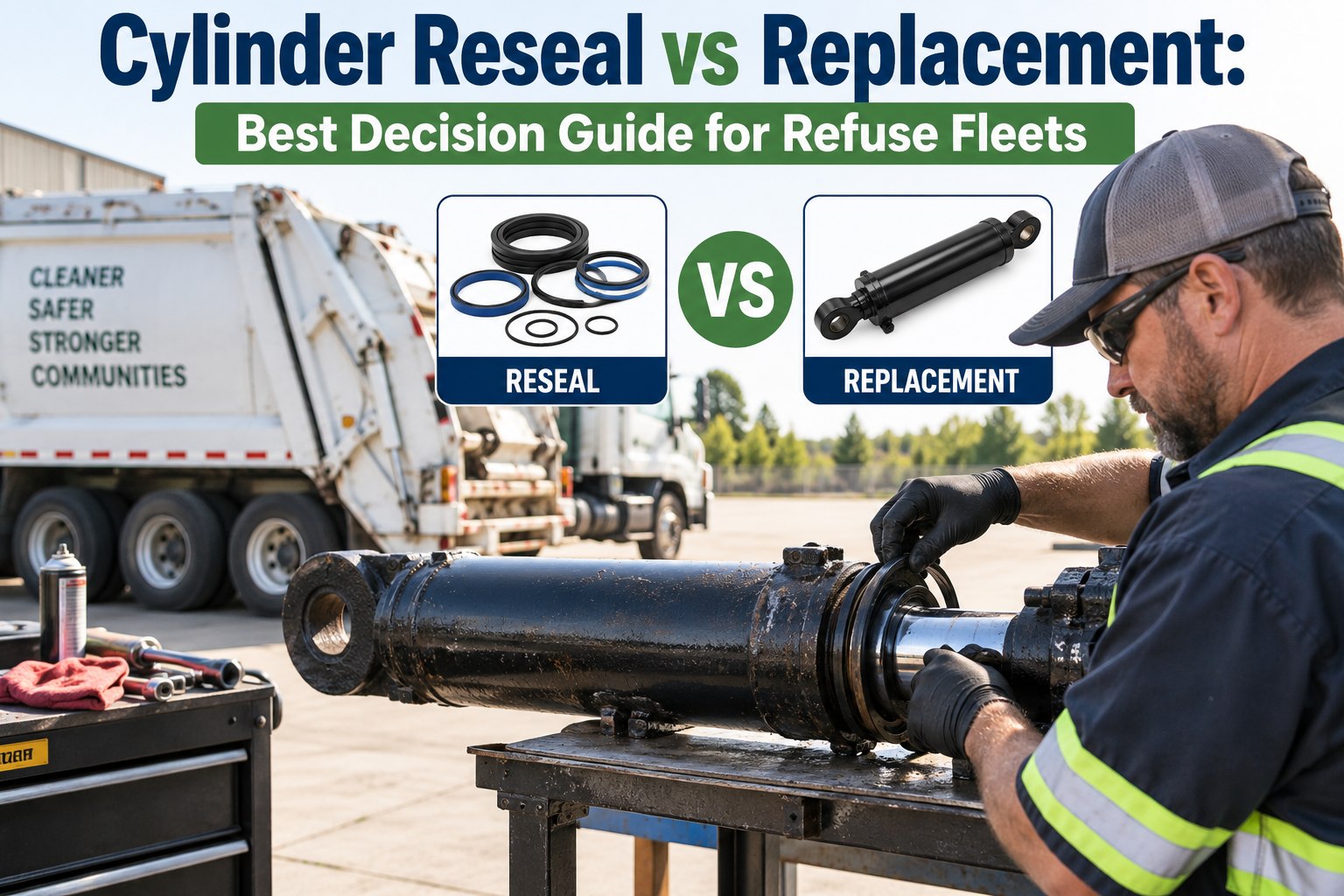
When a packer cylinder leaks, the instinct is to reseal — it's cheaper, right? Only if the rod and bore underneath are clean. Run new seals against a scored rod and they fail again within weeks, because the damaged surface shreds them on every stroke. And you can't know which repair is right until the cylinder is opened — a $400 reseal quote can become a $2,500 job the moment a scored bore appears. This guide gives you the framework refuse fleets use: the condition checks that point to reseal, the ones that point to replace, and the 50% rule that settles the money. Truck Inspection & Maintenance logs each cylinder's failure history so repeat offenders flag for replacement instead of another reseal — start a free trial or contact our team.
Cylinder Reseal vs Replacement: The Decision Guide for Refuse Fleets
A reseal only holds if the rod and bore are clean. The real question isn't cost — it's condition. Here's the framework that makes the call before it makes you.
Why the "Cheaper" Repair Often Isn't
Reseal looks like the obvious budget choice — until you account for what a bad call actually costs. Three numbers reframe the decision:
A simple reseal quote turns into a full rebuild the moment disassembly reveals a scored bore or pitted rod — and you can't get a firm number until the cylinder is open and cleaned.
The industry guide: if the repair costs more than half the price of a new equivalent, replace it. When rod, bore, and bearing work stack up, the gap to a new unit closes fast.
New seals run against a scored rod don't last — the damaged surface shreds them on every stroke. A reseal over hidden damage is money spent to fail again in weeks.
Stop resealing the same cylinder twice. Start a free trial and let each cylinder's repair history flag the repeat offenders.
The Diagnostic — What the Condition Tells You
The decision is driven by the state of the "hard parts" — the rod and the bore. Inspect against these, and the answer usually declares itself:
One criterion can outweigh all the others. Structural damage — a bent rod or a bulging barrel — is a burst risk under pressure; that's an automatic replace no matter how the rest of the checklist scores.
The Decision, in Four Steps
Run any failed cylinder through this sequence and the right path falls out:
Give every cylinder a repair history — so the second failure decides itself, and you replace instead of resealing again.
One system for inspections, PM, and repair tracking gives dispatch, drivers, and the shop a shared record of every cylinder's failures, fluid condition, and reseal count — so a repeat offender flags for replacement and no defect or PM ever slips. Start a free trial or talk to our team.
Frequently Asked Questions
When should I reseal a hydraulic cylinder instead of replacing it?
When the failure is worn or aged seals and the rod and bore underneath are clean — light scratches that polish out or minor bore wear correctable by honing, with parts on hand and the structure sound. A reseal on a clean cylinder is a low-cost, low-risk repair that restores service quickly.
What's the "50% rule" for cylinder repair?
A common industry guide: if the total repair cost exceeds half the price of a new equivalent cylinder, replacement is usually the economical choice. When rod restoration, bore honing, and bearing work stack onto a seal kit, the gap to a new unit narrows fast — and replacement resets the full service life with a warranty.
Why does a reseal sometimes fail within weeks?
Because the seal was a symptom, not the cause. If the rod surface is scored or pitted, new seals run against that damage and get shredded on every stroke. Resealing without addressing the rod just spends money to fail again — the surface has to be rechromed or replaced first, or the cylinder replaced outright.
What conditions make replacement mandatory?
Structural damage: a bent rod, or a cracked, dented, or bulging barrel. These are burst risks under pressure that rarely repair reliably — a bent rod ruins new seals immediately and a damaged barrel can fail catastrophically. One structural finding outweighs the entire rest of the checklist.
Is replacing always slower than rebuilding?
No. A cylinder built to a specific bore, stroke, and pressure often isn't a shelf item, so a replacement can carry a long lead time. If the rebuild scope is bounded and parts are on hand, a rebuild can return the cylinder to service faster than a new unit arrives — lead time is part of the decision, not just price.
How does Truck Inspection & Maintenance help with this decision?
It keeps a per-cylinder repair history — every reseal, the fluid condition, and the failure cause — in one system shared by dispatch, drivers, and the shop. So a cylinder failing a second time flags for replacement instead of another reseal, and the contamination trail that's scoring rods gets addressed upstream. Start a free trial or contact us.
The leak tells you a cylinder failed. The rod and bore tell you how to fix it — and whether "cheaper" is actually cheaper.
Inspect the hard parts, price the full scope against the 50% rule, weigh lead time and failure history — and track every cylinder's repairs in one system so the repeat offenders replace themselves instead of getting resealed a third time.