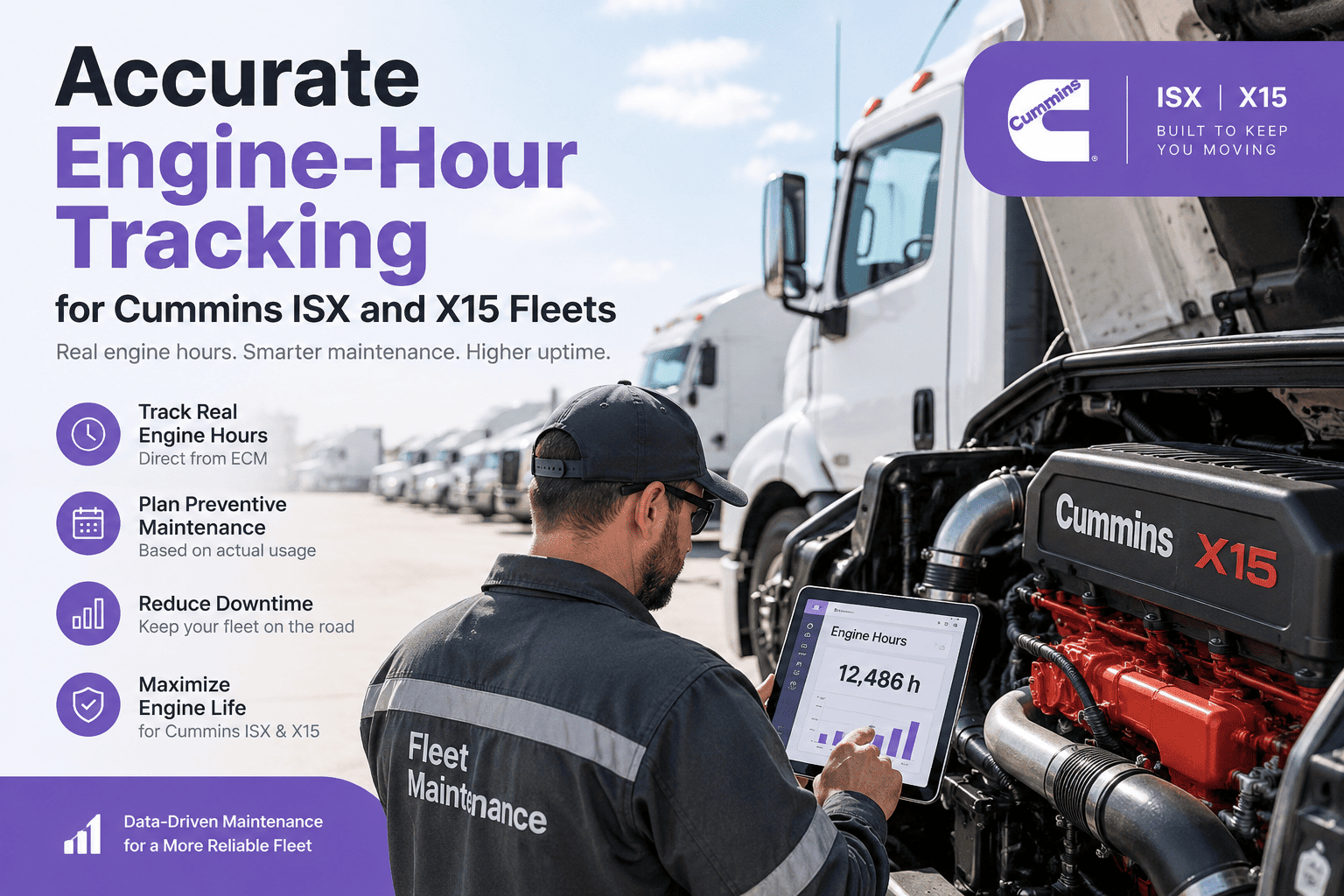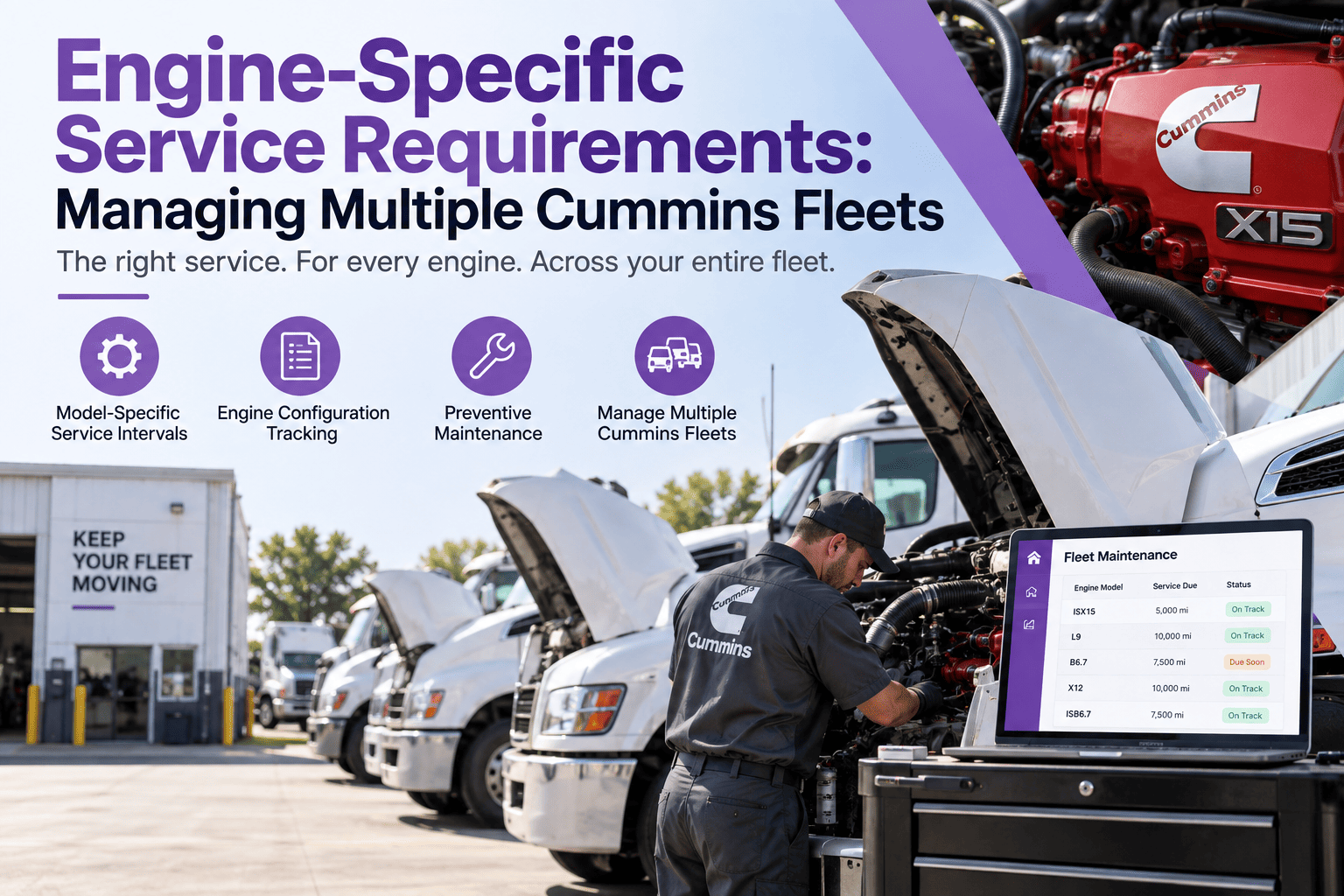
A fleet with 40 Cummins engines is rarely a fleet with 40 identical PM schedules. An EPA 2010 ISX15 running the CM2250 ECM has different oil and DPF intervals than a 2020 X15 on CM2450. A B6.7 medium-duty runs on fuel-economy math with a 350-hour ceiling that overrides the odometer. A legacy pre-2007 ISM without aftertreatment doesn't have any DPF interval at all. Loading all of them into one PM template is the fastest way to over-service the newer engines and miss critical services on the older ones. This guide is the mixed-Cummins-fleet PM structure that fits each engine to its own service math, in one platform. Start free and run engine-specific PM across every Cummins in your fleet.
One Cummins Fleet Isn't One PM Schedule — Every Engine Family Has Its Own Math
Fuel economy drives oil intervals on modern Cummins engines, not miles alone. The 350-hour ceiling on severe-duty overrides the odometer. DPF, DEF, and valve-lash intervals swing across engine families and ECM generations. Truck Inspection & Maintenance Management Software runs an engine-family-aware PM engine — every truck carries its own interval matrix keyed to its engine model, ECM year, and rolling fuel-economy band, all writing to one shop dashboard.
The Cummins Engine Families a Real Fleet Actually Runs
Most mixed-Cummins fleets have three or four active engine families at once — a mix of purchase years and duty-cycle applications that means a linehaul X15 and a yard-tractor B6.7 will never share a service ticket. Below is the working landscape and what makes each family's PM math different.
Older linehaul, vocational, and yard equipment. No aftertreatment interval to track — but shorter oil intervals, mechanical fuel systems on the oldest, and no MPG-based scheduling logic. These trucks are easy to over-service on a modern template.
Introduced the modern aftertreatment stack. Duty-cycle-based oil intervals begin here. DPF cleaning at defined miles, DEF quality tracked daily. Widely still in fleet — a 2011 tractor with 800k miles is still on this family's math.
Single-Module aftertreatment extends DPF cleaning intervals substantially over CM2250. XPI fuel, VGT turbo, higher ECM integration. Oil-drain interval extension possible with premium oil. Different math from ISX15 despite the shared architecture.
Same engine across Freightliner M2, Ford F-650/F-750, International MV, and Kenworth T-series — four chassis, one engine PM strategy. MPG-band-driven intervals with a hard 350-hour ceiling on severe duty. DPF interval near 200,000 mi.
The MPG-Based Duty Cycle Model — What Cummins Actually Schedules Against
Every modern Cummins publishes a duty-cycle table that keys the service interval to rolling fuel economy rather than mileage alone. Fuel economy is a proxy for engine load and combustion cleanliness — a stop-and-go city truck at 4 MPG punishes oil, filters, and aftertreatment far harder than a highway hauler at 7 MPG. Below is the four-band model that drives interval selection on the ISX15, X15, and B6.7.
The Per-Engine PM Interval Matrix — Where Every Family Diverges
The matrix below is the working reference — one row per service item, one column per engine family, so a shop lead can see at a glance where the four families agree and where they diverge. Note how oil, DPF, and DEF intervals swing across families while items like coolant flush stay chemistry-driven and family-independent.
| Service item | Legacy ISM/ISL | ISX15 CM2250 | X15 CM2350/2450 | B6.7 medium-duty |
|---|---|---|---|---|
| Oil & filter (normal duty) | 35,000 mi | 40,000 mi | 50,000 mi | 25,000 mi OR 350 hr |
| Oil & filter (severe duty) | 15,000 mi | 20,000 mi | 25,000 mi | 12,000 mi OR 350 hr |
| Fuel filters (primary + secondary) | 25,000 mi | 40,000 mi | 50,000 mi | 15,000 mi |
| Air filter | Filter-minder | 100,000 mi | 100,000 mi | Filter-minder |
| DPF cleaning | Not applicable | 350,000 mi | 500,000 mi | 200,000 mi |
| DEF quality check | Not applicable | Daily | Daily | Daily |
| Valve lash adjustment | 250,000 mi | 500,000 mi | 500,000 mi / 10,000 hr | 150,000 mi |
| Coolant flush (chemistry) | 4–5 yr | 4–5 yr | 4–5 yr | 4–5 yr |
| Water pump inspection | 250,000 mi | 300,000 mi | 500,000 mi | 150,000 mi |
One Platform, Four Engine Families, Zero Compromise Intervals
Our software runs a per-unit engine record: engine model, ECM year, and rolling MPG band pulled from telematics. Every PM item on that unit carries the interval Cummins publishes for that specific configuration and duty cycle — not a fleet-average compromise. The shop sees one dashboard; the PM engine underneath applies four different interval matrices. Nothing gets over-serviced, nothing gets missed.
The Derate Cascade — What Missing an Interval Actually Costs
Every modern Cummins ECM enforces its own service intervals through a derate sequence. Miss a DPF cleaning and torque drops. Ignore a DEF quality fault and the truck moves to a 5 MPH crawl. The ECM doesn't care whether the shop meant to schedule the service — it cares that the interval was breached. Below is the escalation ladder every mixed-Cummins fleet has to know.
Frequently Asked Questions
Every Cummins on Its Own Interval Matrix, in One Shop Dashboard
Engine model + ECM year + rolling MPG band per unit. Duty-cycle-correct intervals every cycle. No compromise numbers, no over-service on new engines, no missed DPF on old ones.