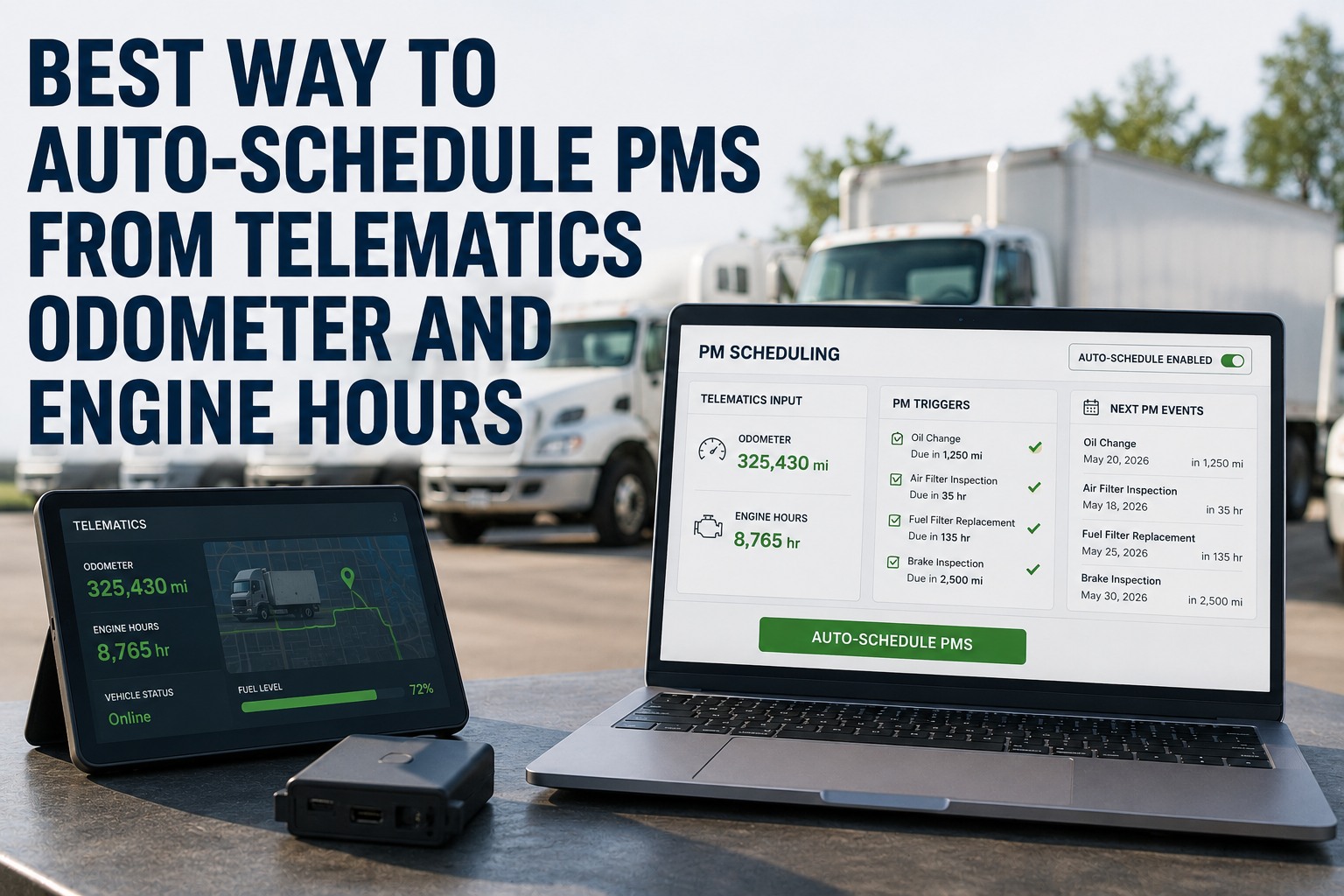
An engine-hour number is only useful if it's accurate — and on Cummins ISX and X15 fleets, "accurate" isn't automatic. The ECM stores several different hour counters (total run hours, idle hours, PTO hours, key-on time), a driver's paper log rounds off, and a telematics gateway that only pulls once a shift can miss an oil-change threshold by a day. Truck Inspection & Maintenance Management Software solves this by ingesting engine hours directly from the J1939 bus at high cadence, reconciling the counter values, and firing the PM the moment the ECM crosses a threshold — not the moment someone finally remembers to update the spreadsheet. This guide is how that pipeline works. Start free and put ECM-accurate engine hours on every Cummins in your fleet.
Cummins ISX · X15 · CM2250/2350/2450 — Live ECM Data Into TIM
The ECM Knows Every Second the Engine Ran — TIM Reads It Directly and Fires PM on Real Hours
A Cummins ECM tracks total engine hours (SPN 247), idle hours, PTO hours, and key-on time as separate counters — but a paper log book only sees one number and rounds it off. Truck Inspection & Maintenance Management Software pulls the real counters from the J1939 bus through your telematics gateway, matches them to the unit record, and advances every hour-based PM trigger the moment the ECM ticks over. Cummins severe-duty 350-hour ceiling enforced automatically; oil-change intervals accurate to the hour, not the day.
SPN 247J1939 total engine hours — the source of truth
350 hrCummins severe-duty ceiling · overrides mileage
H:M:SECM resolution · TIM captures every tick
Three Ways Engine Hours Get Into a Fleet Platform — and Why Only One Is Accurate
Every fleet has a way of tracking engine hours. Not every way is right. The three common sources vary wildly in accuracy, latency, and how many counters they capture. Below is the pathway landscape and how Truck Inspection & Maintenance Management Software prefers each one.
METHOD 01 · BEST
J1939 Bus via Telematics Gateway
The telematics gateway plugs into the diagnostic port, listens on the J1939 CAN bus, and reads SPN 247 (total engine hours) plus PTO, idle, and key-on counters directly from the ECM in H:M:S resolution.
TIM handling: Native ingestion. Every unit's live ECM hour count polled on schedule (typically every 5–15 min), reconciled against the last-known value, PM triggers fire the moment the counter crosses a threshold.
Accuracy: matches ECM exactly · Latency: minutes
METHOD 02 · OK
Handheld OBD-II Reader at Shop
Tech plugs a diagnostic tool into the port during PM. Pulls the same J1939 counters — accurately — but only when the truck is physically in the shop. Between visits, hours drift.
TIM handling: Accepted as an authoritative reading; overwrites the last known value on the unit record and rebaselines the PM math. Good for units without a persistent gateway.
Accuracy: matches ECM at read · Latency: shop visit only
METHOD 03 · LAST RESORT
Manual Log Book Entry
Driver reads the dashboard, writes a whole number on a form, someone types it into the system later. Rounds off, misses idle/PTO breakdown, delayed by hours or days, prone to error.
TIM handling: Accepted as a manual entry with an audit tag. Flagged for review if the value drifts more than expected from prior readings. Fallback only.
Accuracy: ±1 hr typical, whole-number rounding · Latency: hours to days
Why the source matters for PM accuracy A Cummins X15 on severe duty hits its 350-hour oil ceiling in roughly 14 days at a 25-hour week. If TIM is fed by a J1939 gateway, it fires the PM the day the counter crosses 350. If it's fed by a weekly manual log, the truck could be at 358 hours before anyone knows — and on the Cummins duty-cycle warranty framework, that hour-count overrun is what a claim reviewer looks at.
The Four Hour Counters the ECM Actually Stores
"Engine hours" isn't one number on a modern Cummins — it's four separate counters, each tracking a different aspect of engine runtime. A single dashboard readout usually shows only total hours, but the ECM stores all four, and Truck Inspection & Maintenance Management Software pulls each one into the unit record so PM logic can key off the right counter for the right service.
SPN 247
Total Engine Hours
Every hour the engine has been running since manufacture. The primary counter for oil, DPF, valve lash, and any interval keyed to combustion time.
TIM uses this as the primary PM trigger for hour-based intervals.
SPN 235
Idle Engine Hours
Hours accumulated while the engine ran at idle. Cummins uses idle-hour ratio to auto-classify duty cycle severity on newer ECMs.
TIM tracks idle % to auto-adjust MPG-band duty classification.
SPN 248
Total PTO Hours
Hours the engine ran with PTO engaged. Critical for vocational fleets where PTO drive time dominates real engine wear.
TIM uses this for PTO-specific PM (hydraulic pumps, PTO clutch).
Key-on Time
ECM Key-ON Time
Total time the key has been in the ON position, engine running or not. Useful for battery drain analysis and accessory load audits.
TIM logs this for electrical-system PM and battery-load reference.
The Ingestion Flow — From J1939 Bus to TIM PM Trigger
The pipeline from the engine's ECM to a fired work order inside Truck Inspection & Maintenance Management Software runs four stages. Every stage is invisible to the shop once configured — but every stage has to work for the PM to fire on real hours, not stale ones.
STAGE 01
ECM increments SPN 247
Engine runs. ECM increments total-hour counter in H:M:S resolution. Value broadcasts on the J1939 CAN bus continuously.
STAGE 02
Gateway captures
Telematics gateway plugged into diagnostic port reads the broadcast, buffers the reading, pushes to the provider cloud on cell / satellite uplink.
STAGE 03
TIM polls provider API
TIM polls the telematics provider's API on schedule (typically 5–15 min), pulls the latest engine-hour counters for every unit in the fleet, writes to the unit record.
STAGE 04
TIM fires the PM
New counter value compared to PM thresholds on that unit. If any threshold crossed (350-hr ceiling, 500-hr oil, 2,000-hr DPF), work order opens automatically.
Direct J1939 · Four Counters · Automatic PM · One Platform
Truck Inspection & Maintenance Management Software ingests SPN 247, 235, 248, and key-on time from every Cummins in your fleet, reconciles the values, and fires PM work orders the moment the ECM crosses a threshold. Cummins severe-duty 350-hour ceiling never gets missed. Oil, DPF, valve-lash, DEF-filter, and PTO intervals all key off the counter that actually measures their wear.
Four Data-Quality Problems TIM Catches Automatically
Even with a J1939 gateway feeding hours in, engine-hour data has failure modes. A gateway that dropped offline for two days looks like the truck didn't run — but it did. A tech who plugged in an OBD reader and read hours from the wrong bus address returns a garbage value. Truck Inspection & Maintenance Management Software flags each of these before a stale reading becomes a missed PM.
↺
Gateway offline drift
Telematics unit went dark for 48 hours; hour counter jumps 40 hours on next reading. TIM flags the gap and marks the interval as gateway-reconstructed, not live.
↓
Counter goes backward
New reading is lower than the last one — either a wrong-unit read or an ECM reset after a rebuild. TIM blocks the write and prompts for confirmation before overwriting.
⚠
Implausible jump
Truck reads 40 hr more between polls than physically possible. Bad read or wrong bus address. TIM flags for review rather than advancing the PM incorrectly.
⏱
Stale unit alert
Unit hasn't reported new hours in more than the expected polling window. TIM alerts the shop so the gateway can be checked before PM timing drifts.
Frequently Asked Questions
Which telematics gateways does TIM support for J1939 engine hours?
Any J1939-capable gateway that exposes SPN 247 through its provider API — Geotab, Samsara, Motive, Verizon Connect, and most factory OEM systems (Detroit Connect, TruckTech+, OnCommand, Ford Data Services). TIM normalizes across them.
Start free and connect your gateway.
What if my ISX is old and doesn't support J1939?
All Cummins ISX and X15 engines since 2007 use J1939. Pre-2007 ISM/ISX units may run J1587/1708 — TIM accepts those readings via handheld reader or manual entry with the audit tag. Same reconciliation logic applies.
Contact us for legacy engine support.
How often does TIM poll for new hours?
Default is every 15 minutes on live units — enough resolution to catch a threshold crossing before the next shift-end. Some fleets tighten to 5 minutes on severe-duty vocational units where the 350-hour ceiling matters most.
Start free and configure polling per unit.
Can TIM enforce the Cummins 350-hour severe-duty ceiling automatically?
Yes — the ceiling is a hard trigger on the unit's PM record, alongside the mileage threshold. Whichever hits first fires the WO. Fleets on severe-duty rarely hit mileage first, so the ceiling is usually the enforced one.
Contact support to see the 350-hour enforcement.
SPN 247 · SPN 235 · SPN 248 · Key-ON — All in TIM
Every Engine Hour That Actually Happened, in Truck Inspection & Maintenance, Live
Direct J1939 ingestion, four ECM counters, gateway-drift flagged, 350-hour ceiling enforced. Cummins PM schedules fire on the second the ECM crosses a threshold.
No credit card required · Free for up to 3 trucks · Works with your existing telematics gateway