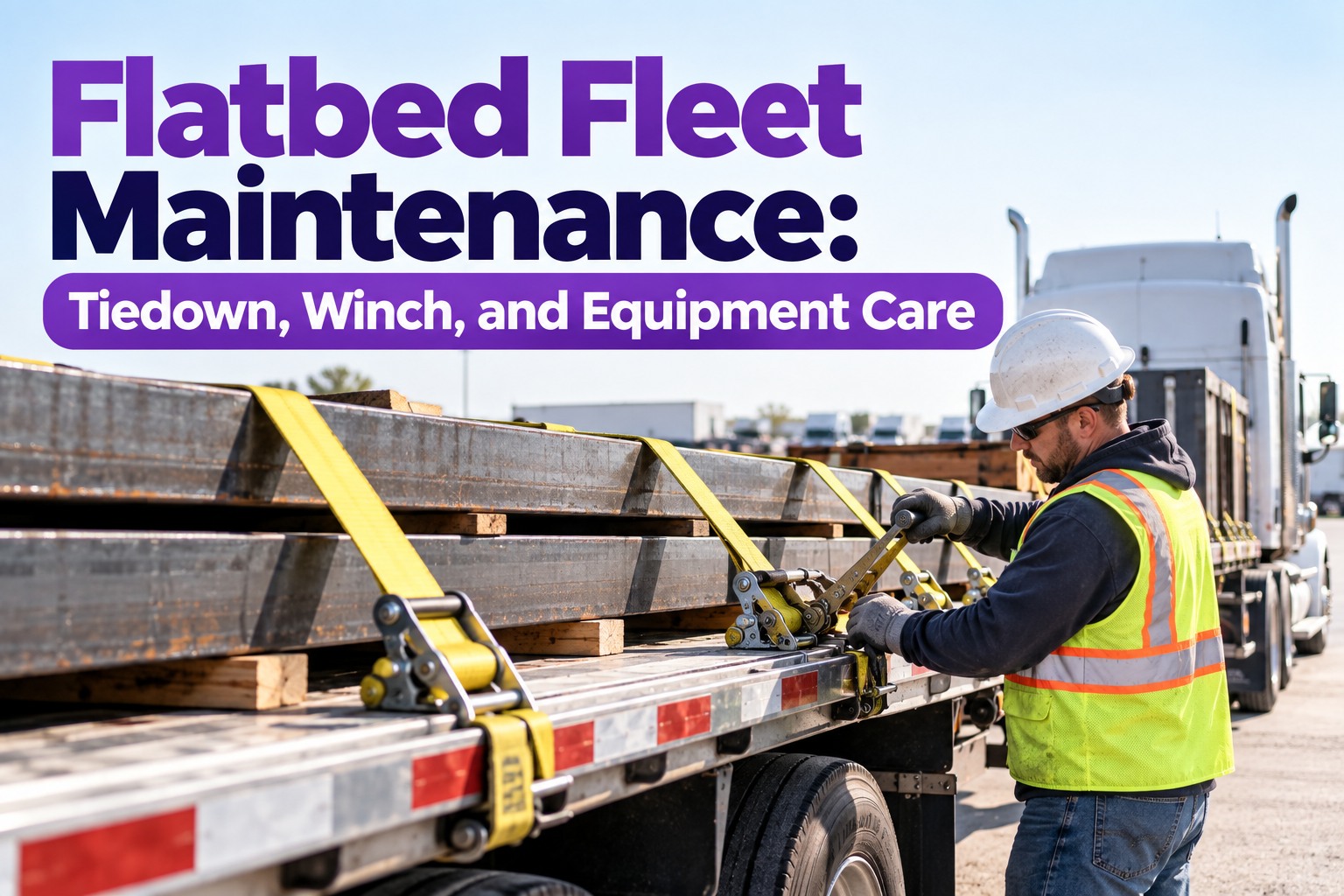
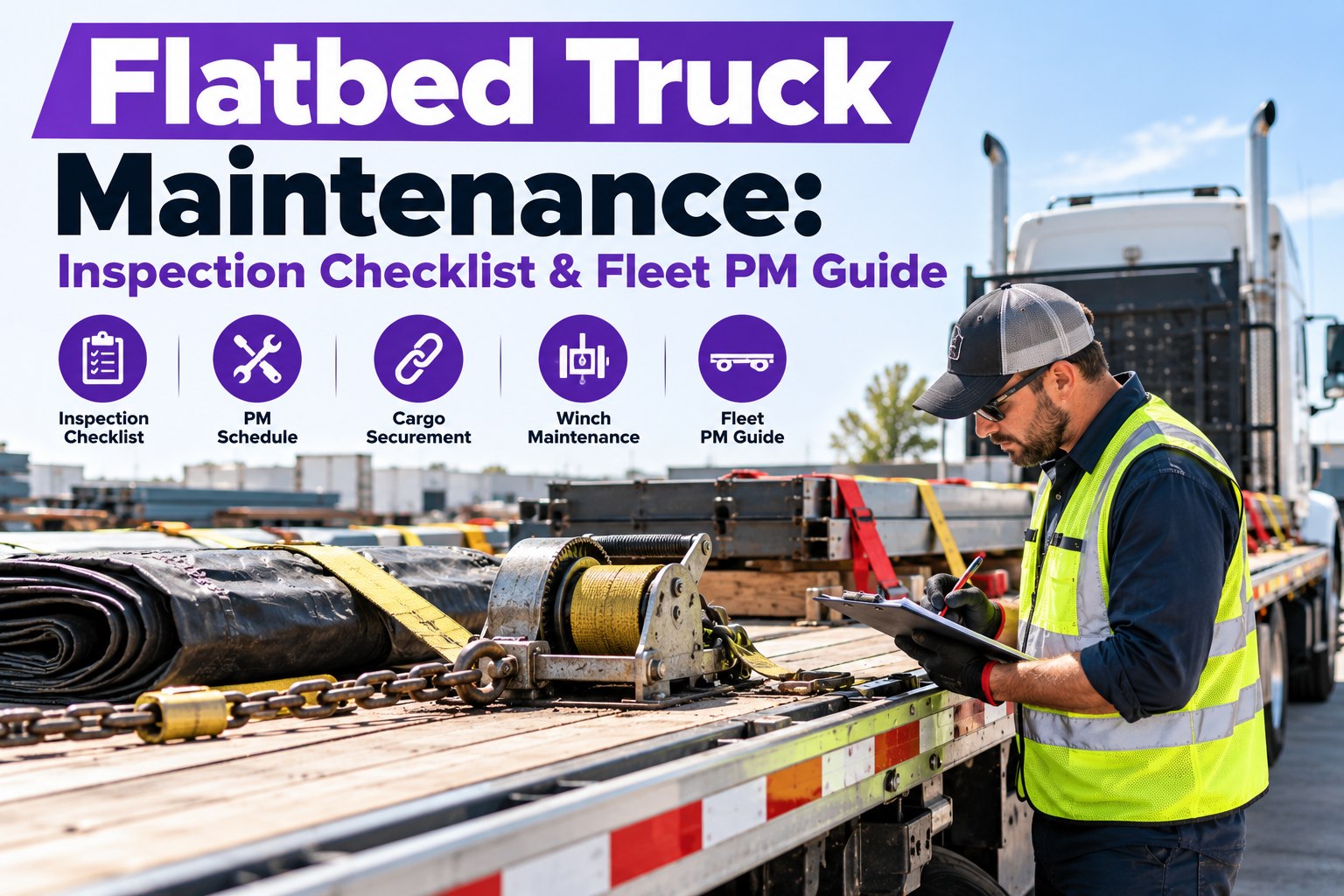
Standard fleet PM looks at the truck — the engine, the brakes, the tires. On a flatbed, that misses the equipment that actually keeps the load on the deck: the straps, chains, binders, and winches holding tens of thousands of pounds against the road. That gear is safety-critical, it wears out faster than anything mechanical, and the moment a strap is cut or a chain link is cracked it has to come off the truck — a rule standard maintenance never checks for. A frayed strap that passes a casual glance is a dropped load waiting to happen. This guide covers the securement math every flatbed runs on, what pulls a tiedown out of service, and how to put that gear on a real maintenance program — with Truck Inspection & Maintenance Management Software (TIM) tracking it. Start free and track every strap, chain, and winch with TIM.
TIM · Flatbed Securement Care
The Load Is Only as Strong as the Strap Holding It Down
A flatbed's real maintenance risk isn't under the hood — it's the securement gear that standard PM ignores. Straps fray, chains stretch, binders seize, winches wear, and a single damaged tiedown has to be pulled the instant it's found. Treat that equipment as a tracked, inspected asset and you stop both the roadside violation and the dropped load. TIM puts tiedowns, winches, and securement hardware on the same inspection and work-order record as the truck — so a flagged strap becomes an action, not a gamble.
Every flagged securement defect gets a first response within 4 hours — acknowledged, graded, and the gear pulled or replaced — not run one more load.
The Securement Math Every Flatbed Runs On
Before the maintenance, the rules the gear has to satisfy. Federal cargo securement sets two hard numbers every flatbed load must meet — and worn or missing gear is what quietly breaks them.
≥ 50%
Aggregate working load limit
The combined working load limit of all tiedowns must be at least half the cargo weight. A 40,000-lb load needs at least 20,000 lb of aggregate WLL — and a strap with a worn-off WLL label counts as zero.
1 + 1
Tiedowns by length
One tiedown per 10 feet, plus one more for each additional 10 feet or part of it. Short heavy articles have their own minimums — the count is the law, not a preference.
Minimum tiedowns by article
≤ 5 ft & ≤ 1,100 lb1 tiedown
≤ 5 ft & over 1,100 lb2 tiedowns
Over 5 ft, up to 10 ft2 tiedowns
Over 10 ft2, then +1 per extra 10 ft
Securement rules summarized from FMCSA cargo-securement requirements for general guidance — confirm the full rules and any commodity-specific requirements against the current regulations.
Every one of those numbers depends on gear that's actually at full rated strength — which is a maintenance question. Contact our team to tie securement checks to your WLL requirements in TIM.
What Pulls a Tiedown Out of Service
Securement gear doesn't fail gracefully — it's rated until it's damaged, then it's worthless. The rule is unforgiving: any visible damage means the device comes off the truck immediately. Here's what to look for, by type.
SYNTHETIC STRAPS & WEBBING
- Cuts, tears, or holes in the webbing
- Burns, melting, or heat glazing
- Knots — they can cut strength by half
- Damaged or pulled stitching
- Worn-off or missing WLL label — counts as zero
CHAINS, BINDERS & HOOKS
- Nicks, gouges, or cracks in links
- Stretched, bent, or twisted links
- Deep pitting or heavy corrosion
- Bent or deformed hooks
- A binder that won't hold or seats wrong
!
Damage means out of service — now, not next load
There's no "it'll hold one more trip" with securement gear. A strap with a cut or a chain with a cracked link is treated as non-functional, and running it is both a violation and a genuine hazard. The whole point of a maintenance program for this gear is to catch the damage in the yard, pull the device, and replace it — before it's holding a load on the highway.
Inspect on the Load's Clock, Not Just the Truck's
Securement gear is checked on a rhythm the engine never sees — tied to the trip and the load, not the odometer. Build the program around these moments.
01
Before the load leavesEvery strap and chain checked against the load's WLL requirement and for damage before the wheels turn.
02
Within the first 50 milesRe-check and re-tension after the load has settled — the interval the rules call for right after departure.
03
At every duty-status changeEach break, fuel stop, or driver change is a re-inspection point for the securement, not just the driver's log.
04
On return, as an assetBack at the yard, gear is inspected as inventory — worn devices retired, the fleet's strap and chain pool kept at strength.
Securement Gear Is an Asset — Track It Like One
Most fleets treat straps and chains as disposable supplies, which is exactly why damaged ones stay in rotation. TIM treats them as tracked assets: each inspection covers the securement gear alongside the truck, a damaged strap or chain becomes a graded work order to pull and replace it, and the whole securement pool is kept visible so you know what's road-ready. The winch, the tracks, and the edge protectors go on the same PM schedule as the deck — nothing load-critical falls off the checklist.
The Flatbed-Specific Gear PM Misses
Beyond the straps and chains, a flatbed carries hardware that standard truck PM never touches — and each piece has its own wear and its own failure mode. A real flatbed program covers all of it.
◉
Winches & winch tracks
The ratchet mechanism, the mandrel, and the sliding track all wear and seize. A winch that won't hold tension is a securement failure in waiting.
▬
Straps & ratchets
Webbing degrades from UV, abrasion, and load cycles; ratchet handles bend and pawls wear. Both are consumables that need a retirement schedule.
⛓
Chains & binders
Links stretch and pit, binders seize or slip. Graded chain has a rated limit that corrosion and deformation quietly erode.
▢
Edge protectors & dunnage
Corner protectors crack and go missing, and without them straps chafe through on a load edge — a slow failure between inspections.
▭
Deck, stakes & rub rails
Rotted decking, bent stake pockets, and damaged rub rails all weaken the anchor points the whole load depends on.
◍
Tarps & hardware
Tarps tear and their straps fail; on protected loads that's cargo damage, and the tarp system is its own inspectable kit.
How TIM Runs It
Truck and Securement Gear on One Program
TIM runs the flatbed the way it actually works — the power unit, the deck, and the securement gear all inspected and maintained on one record, not the truck alone.
Securement on the checklistStraps, chains, binders, and winches inspected alongside the truck — not left off the standard PM.
Damage to work orderA flagged strap or cracked link becomes a graded repair-or-replace order the moment it's found.
Gear as tracked assetsThe strap and chain pool tracked as inventory, so worn devices get retired instead of recirculated.
Winch & deck PMWinches, tracks, decking, and stake pockets on their own PM schedule — the load-critical parts PM misses.
Trip-based inspectionsPre-load, 50-mile, and duty-change checks captured on mobile, tied to the unit.
Audit-ready recordsEvery securement inspection kept per unit, ready for a roadside stop or a compliance review.
Frequently Asked Questions
How many tiedowns does a flatbed load need?
It depends on the length and weight of what you're hauling. An article five feet or shorter and 1,100 pounds or lighter needs one tiedown; the same length over 1,100 pounds needs two. Anything over five feet up to ten feet needs two, and beyond ten feet you add one more tiedown for each additional ten feet or part of it. On top of the count, the combined working load limit of all tiedowns has to be at least half the cargo's weight. Both tests have to pass — the right number of tiedowns and enough aggregate strength — and a device with an unreadable WLL marking counts as zero toward that total.
Start free and tie securement checks to each load with TIM.
What is the working load limit rule?
The aggregate working load limit of all the tiedowns securing a load must be at least 50% of the weight of that load. Working load limit is the rated capacity stamped or labeled on each device — not its breaking strength — and you add up the WLL of every tiedown to get the aggregate. So a 40,000-pound load needs tiedowns totaling at least 20,000 pounds of WLL. The practical maintenance angle is that a strap whose label has worn off, or a chain whose stamp is illegible, is treated as contributing zero to that total, which can quietly put an otherwise-legal load out of compliance.
When does a strap or chain have to be taken out of service?
The instant it shows visible damage. For synthetic straps that means cuts, tears, holes, burns or melting, knots, or damaged stitching — a knot alone can cut a strap's strength roughly in half. For chains and binders it means nicked, gouged, cracked, stretched, or bent links, deep pitting corrosion, bent hooks, or a binder that won't hold properly. There's no grace period and no "one more load" — a damaged tiedown is treated as non-functional, so running it is both a violation and a real hazard. Catching that damage during a yard inspection and pulling the device is exactly what a securement maintenance program is for.
How often do I re-check securement on the road?
The securement has to be inspected within the first 50 miles after the load departs — this is when cargo settles and straps or chains often need re-tensioning — and then again at every change of duty status, such as a break, a fuel stop, or a driver change. Those are the checkpoints where a tiedown that loosened or started to chafe gets caught before it fails. It's a rhythm set by the trip and the load rather than by the truck's odometer, which is why securement inspection belongs on its own cadence alongside the vehicle's regular PM rather than folded into it.
Why track securement gear as an asset instead of a supply?
Because treating straps and chains as disposable supplies is exactly how damaged ones stay in rotation. When each device is tracked as an asset — inspected on a schedule, retired when worn, and counted in a known road-ready pool — you always know what's safe to send out, and a damaged strap gets pulled instead of thrown back in the box for the next driver to grab. It also makes the whole securement kit auditable: winches, tracks, edge protectors, and the strap and chain pool all have records, so a roadside stop or a compliance review is a lookup rather than a scramble. Managing gear this way is the difference between a flatbed program and a pile of straps.
Straps · Chains · Winches · Deck — All Inspected
Maintain the Gear That Holds the Load, Not Just the Truck
A flatbed's biggest maintenance blind spot is the equipment standard PM never looks at — the straps, chains, binders, and winches that keep the load on the deck. That gear is safety-critical, it wears out fast, and a single damaged device has to come off the truck immediately. Inspect it on the load's clock, pull what's damaged, and track the whole pool as assets. TIM puts securement gear on the same record as the truck, so a frayed strap becomes a work order instead of a dropped load.
No credit card required · Free for up to 3 trucks · Securement inspection, gear asset tracking, and winch/deck PM built in