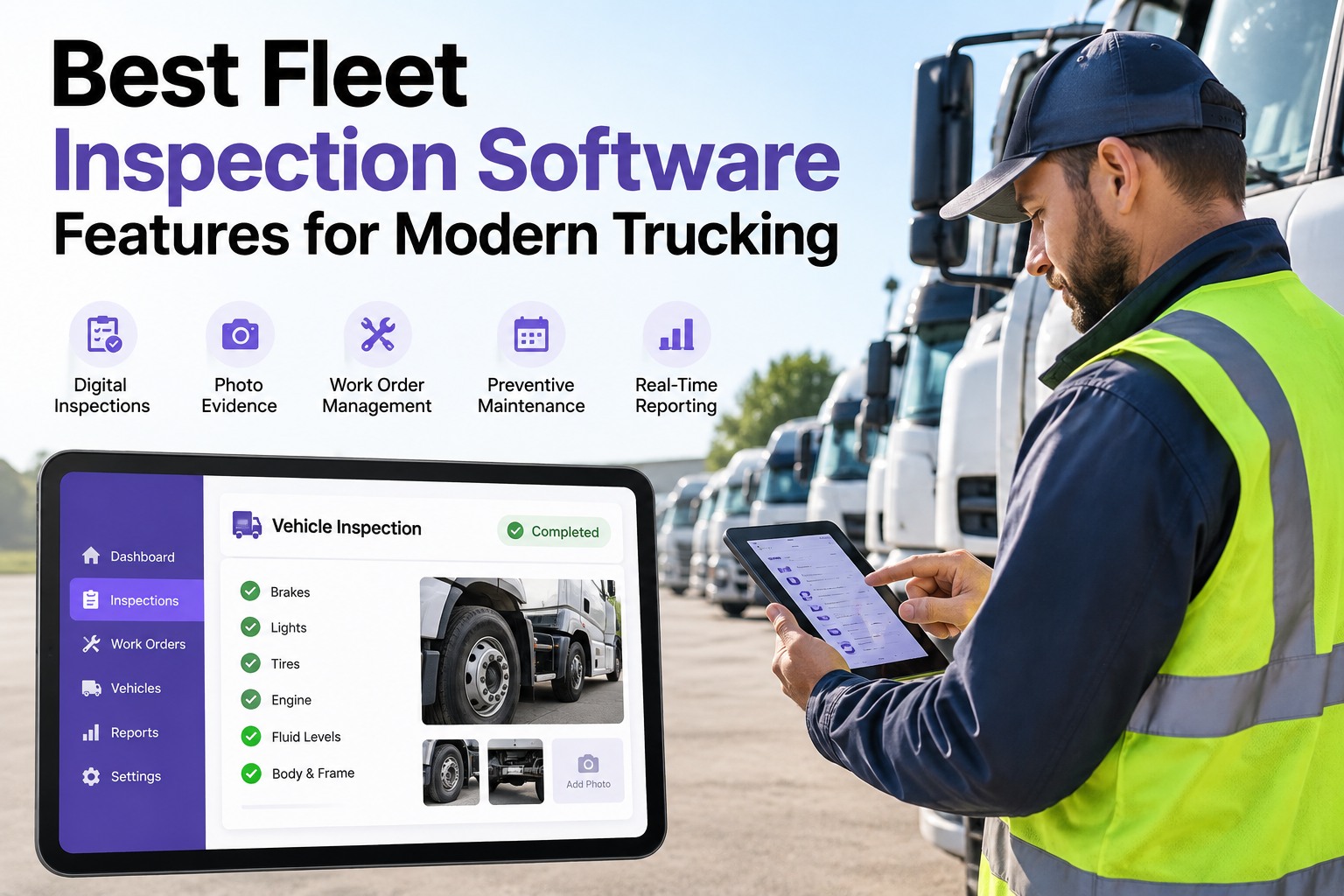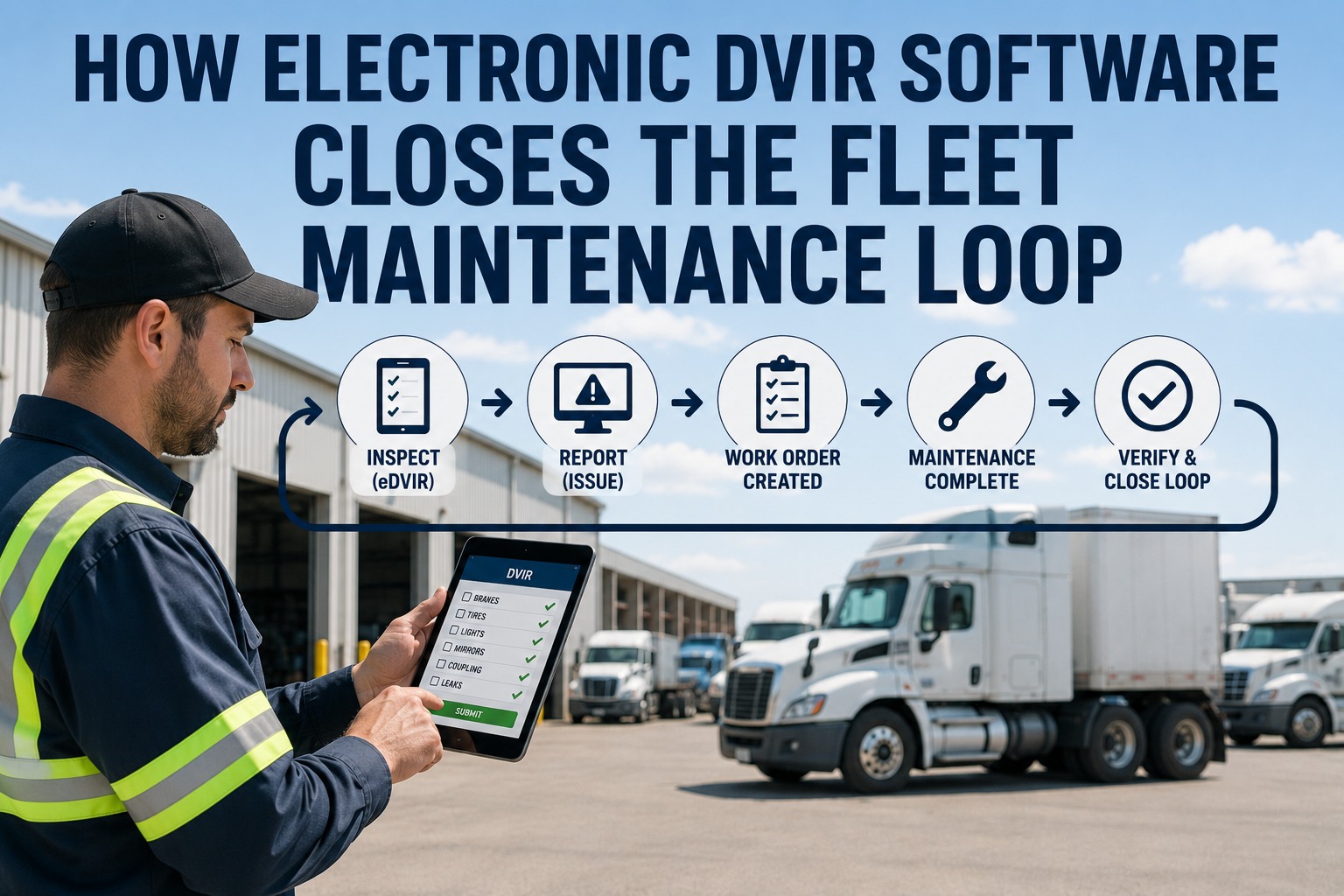
The fleet maintenance software market in 2026 has crossed an inflection point. Over 200 platforms now compete for fleet operators making the paper-to-digital transition or replacing first-generation systems they've outgrown — and most look almost identical during a 30-minute demo. The real differences only surface after signing: hardware requirements that weren't in the quote, auto-renewing 3-year contracts, per-vehicle pricing that escalates sharply at growth thresholds, and feature limitations that force a second subscription six months in. Industry data shows that 52% of fleets operating in the US run 9 vehicles or fewer, yet most enterprise platforms price and configure for fleets 10× that size — leaving small and mid-size operations paying for unused capacity while still lacking the integrated workflow that actually delivers ROI.
Choosing fleet maintenance software is a 3-7 year operational decision with compounding consequences. The right platform delivers 30-40% reductions in total maintenance cost, 47% of deployments hit payback inside 6 months, and 300-500% ROI is documented over 24 months. The wrong platform creates new disconnected systems, locks fleets into multi-year contracts they can't unwind, and produces the same data-drift problems paper had — just with a monthly subscription on top. The difference between these two outcomes isn't the platform's marketing pages — it's whether the 8 operational features that actually drive results are deeply implemented or shallow checkbox items. Fleets that win this evaluation use a structured framework, run real pilots before signing, and verify integration capability with their existing telematics, fuel cards, and accounting systems before committing.
This guide is the 2026 buyer's framework for choosing fleet maintenance software — the 8 must-have features that separate operational platforms from glorified record-keeping apps, pricing benchmarks, the 6-step evaluation process, and the questions to ask every vendor before signing. Start your free trial of our truck inspection and maintenance software to evaluate the platform against this framework — live in 10 minutes, free for up to 3 trucks.
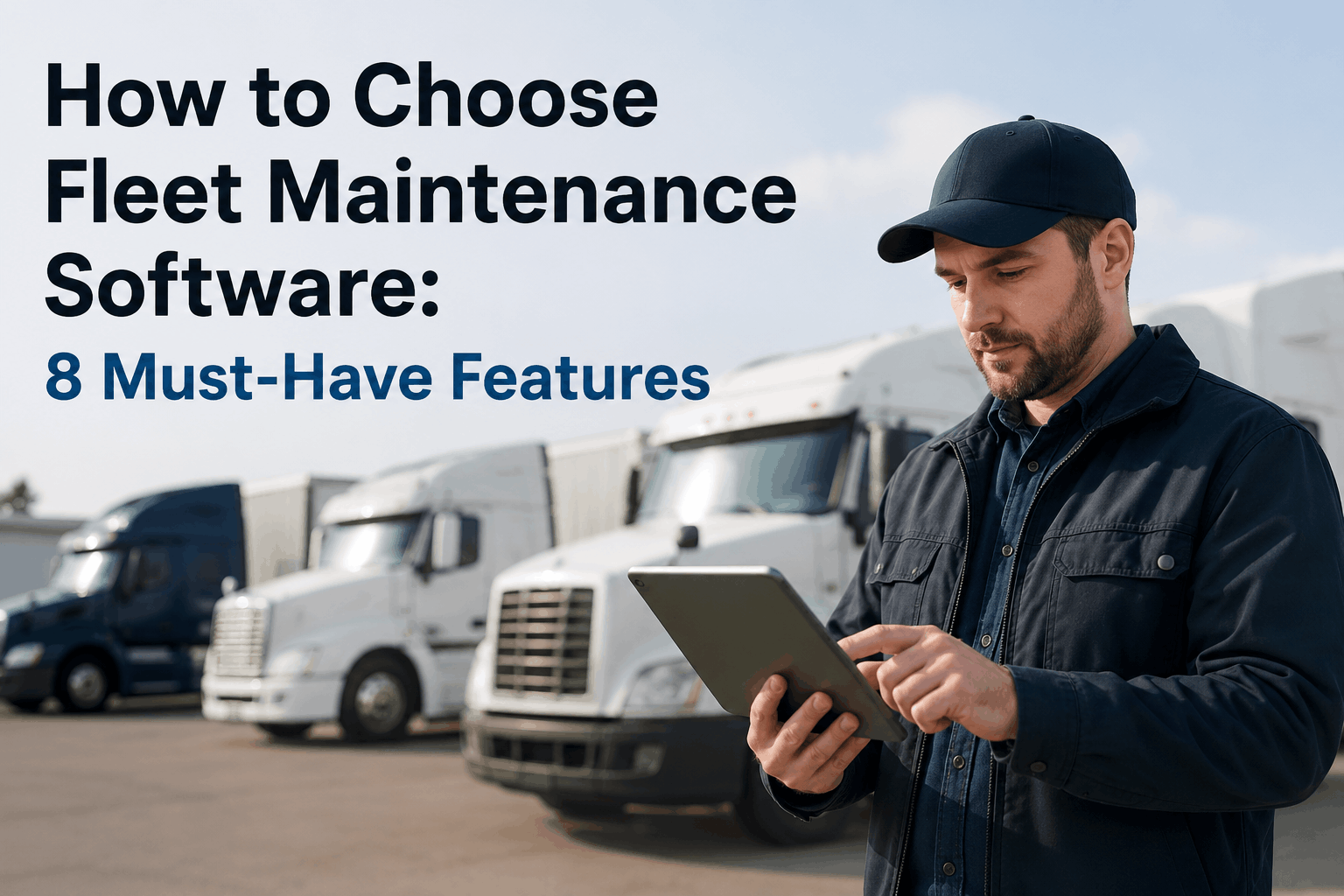
How to Choose Fleet Maintenance Software
The 8 Must-Have Features
Most fleet maintenance platforms claim to do all 8 — but the depth of implementation varies dramatically between platforms that look identical in demos. Use this framework to evaluate every shortlisted vendor. Contact our sales team to evaluate our platform against this framework.
Digital DVIR & Inspection Workflow
FOUNDATIONPM Automation (Multi-Trigger)
WORKFLOWWork Order Management
CORECompliance & Audit-Ready Records
REGULATORYFuel Tracking & MPG Analytics
COST CONTROLParts Inventory Management
OPERATIONSAnalytics & Reporting Dashboards
VISIBILITYIntegrations & Open API
CONNECTEDPricing Benchmarks — What to Expect to Pay
Fleet maintenance software pricing varies significantly by feature depth, fleet size, and contract terms. Here's the 2026 market range — and where hidden costs hide that make the sticker price misleading.
| Tier | Price Range | What's Included |
|---|---|---|
| Entry / Startup | $10-$15/vehicle/mo | Basic DVIR, simple PM, manual work orders |
| Standard | $15-$25/vehicle/mo | Multi-trigger PM, auto WO creation, dashboards, parts |
| Professional | $25-$35/vehicle/mo | Telematics integration, advanced analytics, multi-site |
| Enterprise | $35-$50+/vehicle/mo | Custom workflows, dedicated success, ERP integrations |
| Free Tier (limited) | $0 for 3 vehicles | Full features, no card required — eval before scaling |
Hidden cost watch-outs: per-driver fees stacked on per-vehicle pricing, mandatory hardware purchases ($100-$300/vehicle), setup/onboarding fees (10-15% of first-year subscription), training charges, integration fees with telematics or fuel cards, and per-vehicle pricing that jumps sharply at fleet-size thresholds (the "scaling tax"). The lowest sticker price often produces the highest 3-year total cost of ownership. Always get a written quote covering all categories before signing.
The 4 Platform Archetypes — Match to Your Primary Need
Fleet maintenance platforms cluster into 4 distinct architectures. Picking the wrong category for your dominant operational problem is the most expensive evaluation mistake — verify your primary need before evaluating features.
GPS + Driver Behavior Focus
CMMS / Work Order Depth
FMCSA + CSA Focus
All-in-One (2026 Standard)
The 6-Step Evaluation Framework
Successful platform selection follows a deliberate process. The fleets that get this wrong typically skip Step 4 (real pilot) or Step 5 (3-year total cost) and discover the problems after signing.
Define Operational Requirements
Shortlist 3-5 Platforms
Verify Integrations Early
Run a Real-World Pilot
Calculate 3-Year Total Cost
Confirm Contract Terms Before Signing
Frequently Asked Questions
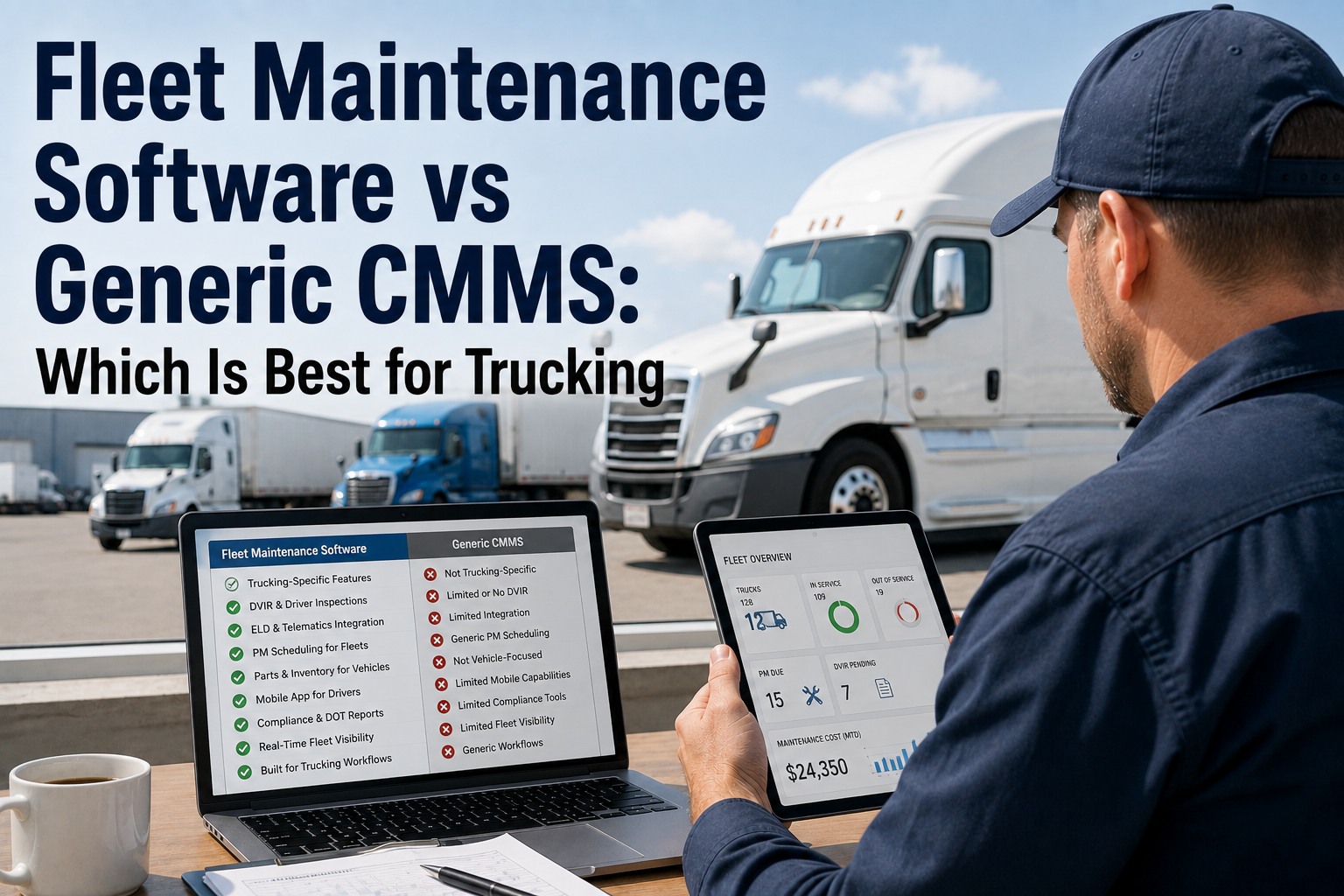
What's the difference between fleet maintenance software and a generic CMMS?
Fleet maintenance software is a specialized subset of CMMS (Computerized Maintenance Management System) purpose-built for vehicle operations. Generic CMMS handles any physical asset — manufacturing equipment, HVAC, buildings — but lacks vehicle-specific workflows: pre-trip inspections per §392.7, DVIR retention per §396.11, FMCSA 3-signature chains, multi-trigger PM (mileage + hours + calendar), telematics integration, fuel card workflows, and IFTA automation. Generic CMMS forces fleet operators to manually shoehorn vehicle workflow into asset templates designed for stationary equipment. Fleet maintenance software has these workflows native. For any fleet operation, the specialized tool wins on time-to-value and compliance fitness. Start your free trial of a fleet-specific maintenance platform.
How long does fleet maintenance software deployment take?
Modern cloud platforms deploy in 10 minutes to first inspection on pilot trucks, with full fleet rollout completing in 4-12 weeks depending on fleet size and integration complexity. The phased timeline: week 1 — platform configured, drivers trained, pilot trucks live with guided pre-trip and DVIR workflows; weeks 2-4 — pilot expanded, defect-to-WO automation activated; weeks 4-8 — fleet-wide rollout, multi-trigger PM activated, telematics integration tested; weeks 8-12 — historical data loaded, dashboards configured, audit workflows finalized. Most fleets see meaningful operational change within 30 days and full ROI by month 6. Enterprise deployments with complex ERP integration may run 3-6 months. Cloud platforms now deploy 10× faster than on-premise CMMS implementations.
How much should fleet maintenance software cost?
2026 pricing benchmarks: entry tier $10-$15 per vehicle per month, standard tier $15-$25, professional tier $25-$35, enterprise $35-$50+. Most platforms also offer free tiers for 1-3 vehicles to allow evaluation. Beyond the headline price, watch for hidden costs: per-driver fees stacked on per-vehicle pricing, mandatory hardware purchases ($100-$300/vehicle), setup or onboarding fees (10-15% of first-year subscription), training charges, integration fees with telematics or fuel cards, and per-vehicle pricing that escalates at fleet-size thresholds. Always calculate 3-year total cost of ownership including all categories — the lowest sticker price often has the highest true cost. Contact our sales team for transparent pricing on our platform.
Should I pick one all-in-one platform or best-of-breed for each function?
The 2026 trend is decisively toward unified platforms. Fleets are actively replacing 3-5 separate tools (inspection app + ELD + GPS + CMMS + compliance tracker) with integrated platforms because data silos between disconnected tools create the same problems paper had — information exists but doesn't flow. The integrated workflow (defect → work order → parts reservation → repair → DVIR chain → PM history update) is what produces the 30-40% cost reductions documented in case studies, not the individual best-of-breed tools. The trade-off: "all-in-one" can mean "average at everything." Mitigation: identify your dominant operational pain point, prioritize platform depth there, accept reasonable trade-offs on secondary functions, and verify depth during pilot. Sign up free to evaluate a unified platform.
What integrations are most important in 2026?
Three integration categories drive most operational value. Telematics (Geotab, Samsara, Verizon Connect): provides engine data, mileage, idle time, fault codes, GPS location — feeds PM scheduling and identifies maintenance triggers. Fuel cards (WEX, Fuelman, Comdata): transaction-level data with driver ID, gallons, GPS, timestamp — enables MPG tracking, theft detection, and IFTA automation. Accounting (QuickBooks, Sage, NetSuite): work order costs flow into financials automatically, eliminating manual reconciliation. Beyond these three, ELD integration matters for HOS compliance, and ERP integration matters for enterprise fleets. Verify bidirectional sync (not just one-way data pull) and test the integration during pilot — promised integrations that don't work in practice are the most expensive surprise after signing.
What's the single biggest mistake fleet managers make when choosing software?
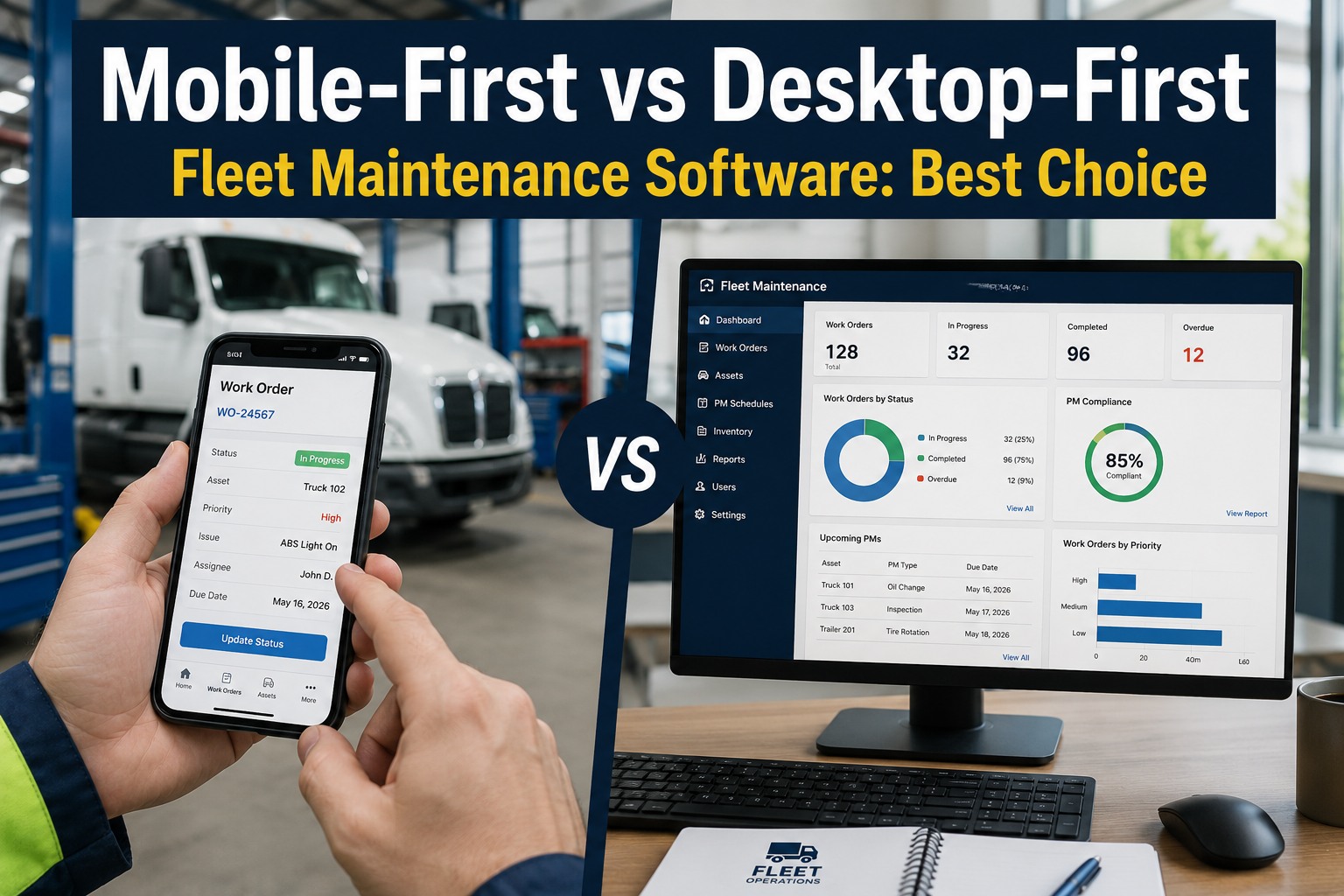
Picking feature count over driver usability. A 200-feature platform that technicians and drivers won't use daily produces zero operational improvement — and 90%+ of fleet software deployment failures trace back to low driver adoption. Drivers reject platforms that fight them: confusing interfaces, slow load times, small tap targets, mandatory typing, no offline support. They engage with platforms that protect them: large tap targets, photo capture, guided workflows, sub-10-minute inspections. The evaluation question isn't "does this platform have feature X?" — it's "will my drivers use it every day without prompting?" Run a real pilot with actual drivers under actual conditions before signing. Driver adoption is the single biggest variable in realized ROI. Talk to our sales team for guidance on driver adoption strategy.