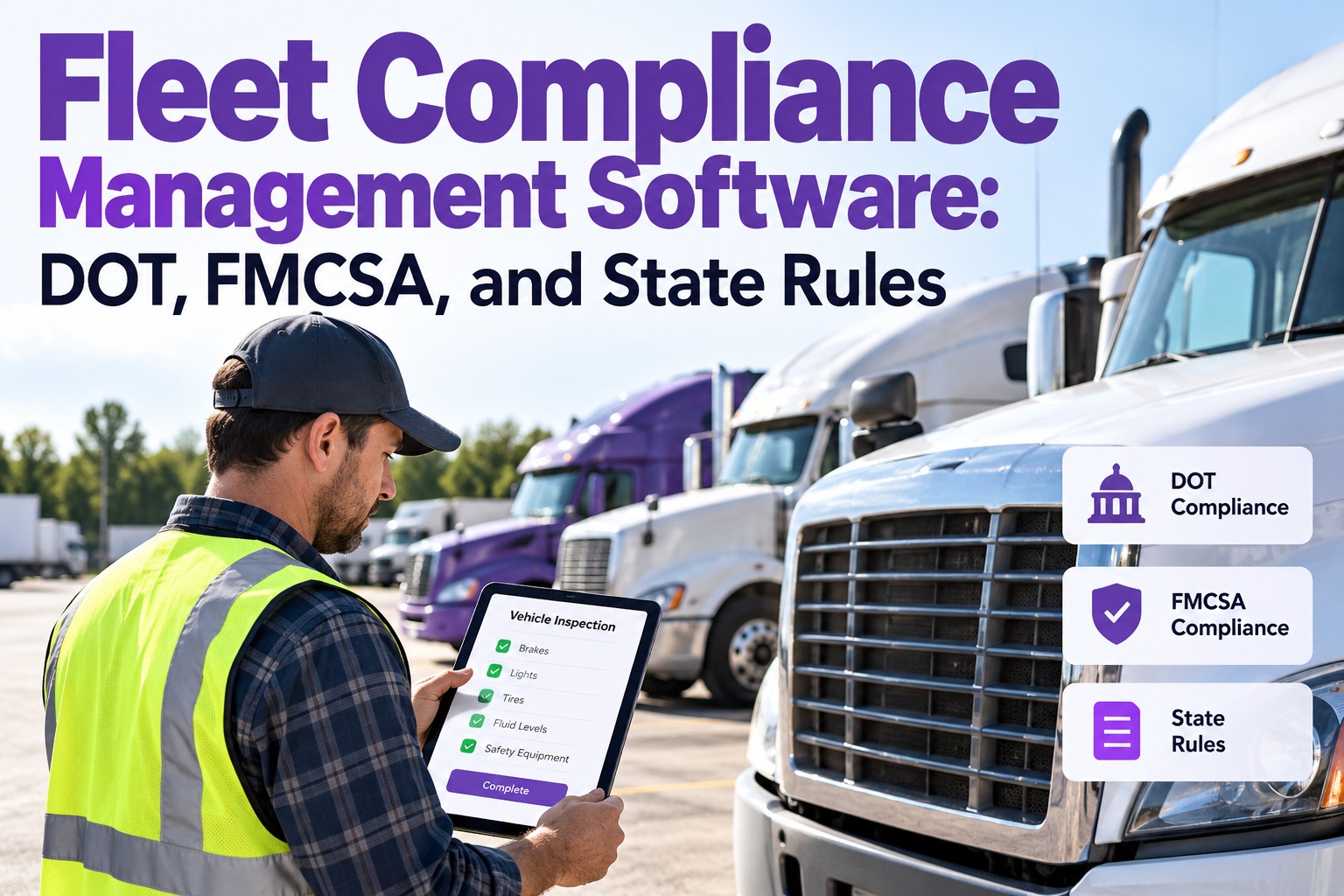
DOT compliance software has shifted from "operational convenience" to "operational requirement" for commercial trucking fleets in 2026. The regulatory environment that emerged through 2025 made paper-based compliance functionally impossible for any meaningful fleet operation: the eDVIR Final Rule (effective March 23, 2026) explicitly authorizes electronic DVIRs under §396.11; paper medical certificates were eliminated January 10, 2026 with all medical examiner records flowing through electronic FMCSA systems; the 2026 CSA scoring overhaul weights out-of-service violations at 2× severity, splits Vehicle Maintenance into two BASIC categories, adds the "Driver Observed" BASIC for pre-trip walkaround quality, and uses a 24-month violation window that compounds documentation gaps over years. The 2025 CVSA International Roadcheck placed 22.6% of inspected vehicles out of service — the highest rate in recent years, with brake violations leading at 41%, tires at 21.4%, and lighting at 12.8%. Industry data shows only 7% of motor carriers pass FMCSA focused compliance reviews without at least one violation. The carriers that maintain clean compliance records have systematic digital workflow; the carriers operating on paper and spreadsheets fail.
The 2026 DOT compliance software market has bifurcated into two clear categories. The first: generic fleet platforms with compliance bolted on as an afterthought — they handle vehicles, drivers, and routes well but produce gaps in DQF retention, DVIR chain of custody, HOS integration, and audit packet generation that show up during FMCSA reviews. The second: compliance-first platforms built around the FMCSA regulatory framework with eDVIR-compliant workflow, automated retention per §396.21 and §391.51, instant audit packet export, and integrated CSA score monitoring. The cost difference between these two categories runs $15-35 per truck per month — trivial compared to the $19,277-$23,048 per-incident penalty for OOS operation, the $7,000+ average DQF violation fine, and the cascade of CSA score damage that compounds across the 24-month violation window. The platform decision matters more than fleet managers typically realize when first evaluating options.
This guide is the complete DOT compliance software buyer's framework for 2026: the regulatory environment driving software requirements, the 8 must-have features for FMCSA compliance, the 4-tier pricing landscape, the 3 most common selection mistakes, and the compliance ROI framework. Start your free trial of our truck inspection and maintenance software to evaluate compliance features against your specific FMCSA requirements — live in 10 minutes, free for up to 3 trucks.
DOT Compliance Software for Trucking Fleets: Features, Benefits & Buyer's Guide
Why DOT Compliance Software Matters in 2026
The regulatory environment has changed in ways that make paper-based compliance functionally impossible. Four 2026 factors drive the shift to digital-first compliance.
eDVIR Final Rule (March 23, 2026)
2026 CSA Scoring Overhaul
Paper Medical Certificates Eliminated
Roadcheck Trends Worsening
The 8 Must-Have DOT Compliance Features
These 8 features distinguish FMCSA-compliant platforms from generic fleet software. Missing any one creates audit exposure with five-figure penalty potential. Contact our sales team to evaluate platform fit against these requirements.
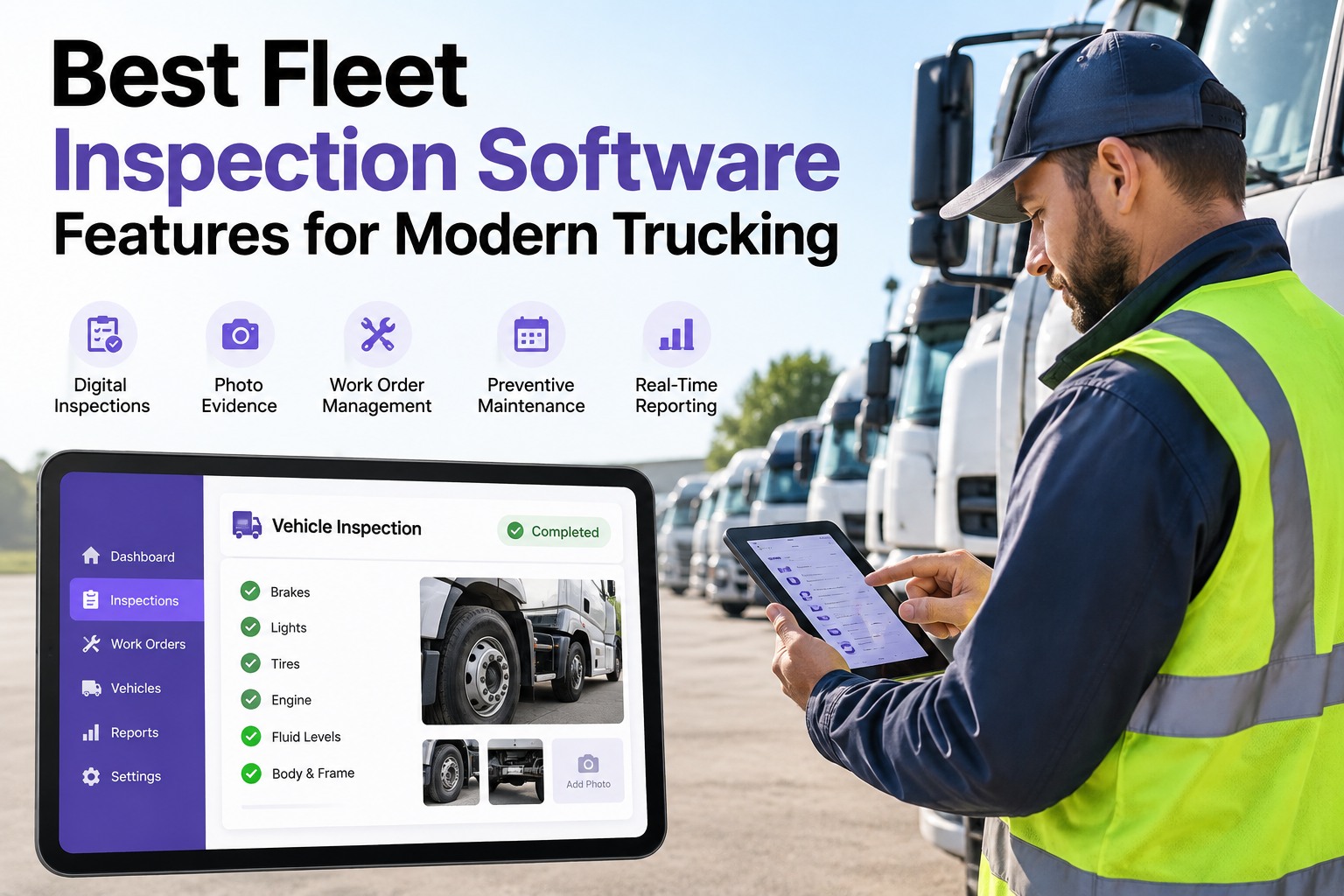
01 eDVIR With §396.13 Chain of Custody
02 ELD & HOS Integration
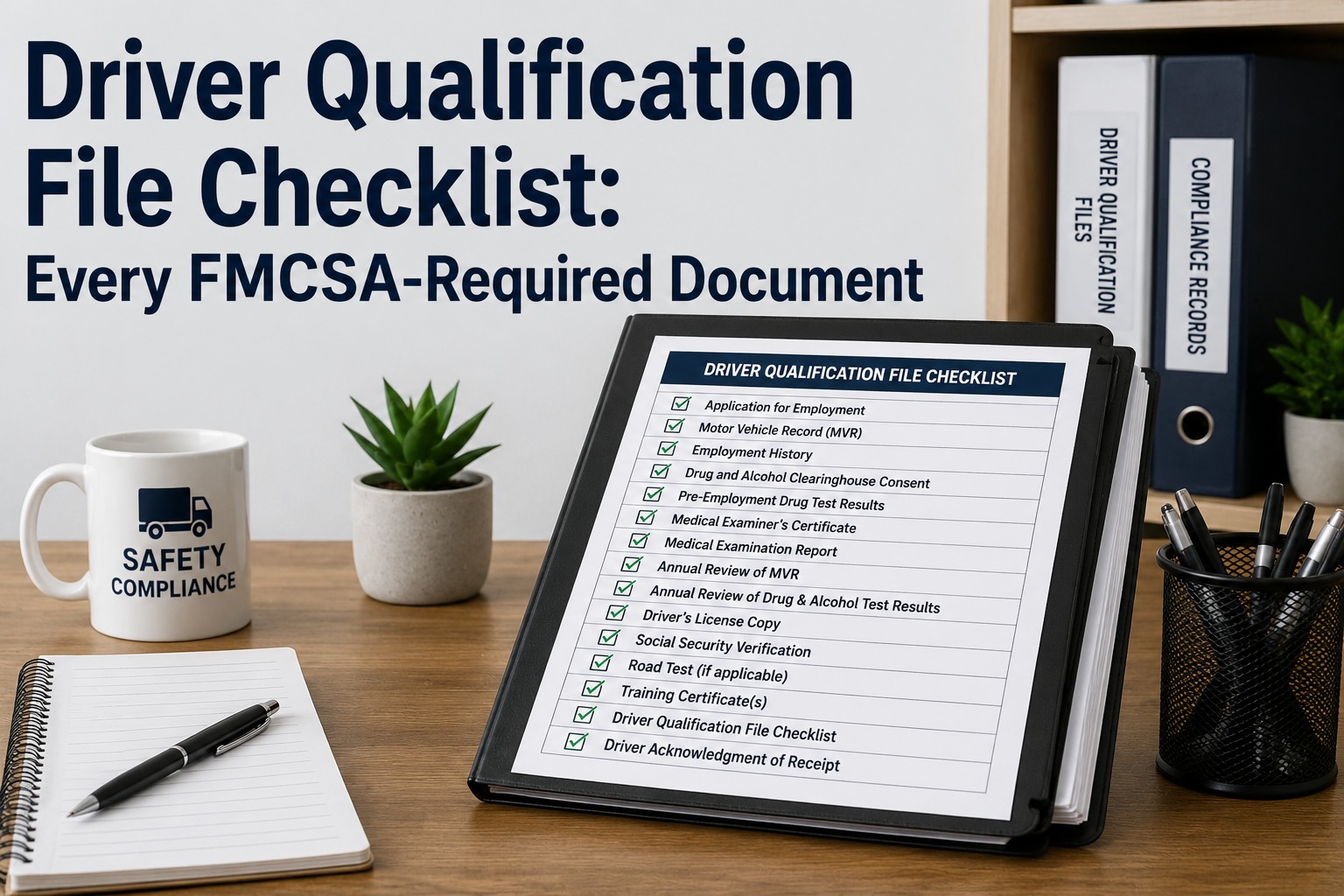
03 Driver Qualification File Management
04 Annual Inspection Records
05 Roadside Inspection Management
06 Drug & Alcohol Testing Records
07 CSA Score Monitoring
08 Audit Packet Export
The 4 Pricing Tiers — From Entry to Enterprise
DOT compliance software pricing aligns with feature depth and integration scope. Match the tier to fleet size and regulatory complexity rather than overpaying or underpaying.
| Tier | Price /Truck /Mo | Best For | Key Capabilities |
|---|---|---|---|
| Entry | $15-25 | 1-10 trucks | Basic eDVIR, DQF management, annual inspection tracking, simple PM |
| Standard | $25-40 | 10-50 trucks | All entry + HOS integration, CSA monitoring, drug/alcohol records, audit export |
| Pro | $40-65 | 50-200 trucks | All standard + Clearinghouse integration, advanced analytics, custom workflows, multi-terminal |
| Enterprise | $65-120+ | 200+ trucks | API access, custom integrations, dedicated support, white-label, advanced compliance |
| Free Tier | $0 (≤3 trucks) | Owner-operators | Basic compliance features for small operations; useful for trial/validation |
The pricing premium for compliance-first platforms over generic fleet software runs $10-25 per truck per month. The math: single avoided OOS operation citation ($19,277-$23,048) pays for the platform premium across a 100-truck fleet for 6-12 months. Single avoided DQF violation ($7,000+) pays for years on a smaller fleet. Insurance premium reduction from improved CSA scores (5-15% typical) commonly pays for the platform several times over. The mistake is choosing generic platforms to save $15-25 per truck monthly, then discovering compliance gaps after a $30,000 audit finding — economically irrational at any fleet size.
The 3 Most Common DOT Software Selection Mistakes
Three patterns produce predictable downstream compliance failures. Watch for these when evaluating platforms.
Choosing Generic Fleet Software
Running Multiple Disconnected Tools
Underestimating 2026 CSA Impact
The Compliance ROI Framework
DOT compliance software ROI comes from five distinct mechanisms, each producing measurable financial impact. The cumulative effect typically returns 4-8× annual platform cost.
Avoided Penalties
Insurance Premium Reduction
Reduced Audit Preparation Time
Customer Contract Retention
Driver Retention Improvement
Frequently Asked Questions
What's the most important DOT compliance feature?
eDVIR with proper §396.13 chain of custody — this is the single feature that produces the most compliance value and the most audit defense. The Driver Vehicle Inspection Report workflow under §396.11 requires a three-signature flow: driver completes pre-trip and signs; mechanic performs any repairs to defects and signs; driver receives the repaired vehicle and signs verification. Most paper-based and many spreadsheet-based systems break this chain — drivers sign pre-trip but defects don't get tracked through repair; mechanics fix items without proper documentation; verification signatures are missed or backdated. Compliance review failures from broken DVIR chain of custody are among the most common FMCSA violations cited. Structured digital eDVIR (now explicitly authorized under the March 23, 2026 Final Rule) maintains the chain automatically with timestamps and signatures captured at each step. Single platform feature defends against the most common Vehicle Maintenance BASIC violations that drive CSA score damage. Start your free trial to test eDVIR chain of custody.
How much should DOT compliance software cost?
Pricing aligns with feature depth and integration scope across four tiers. Entry tier ($15-25/truck/month) covers basic eDVIR, DQF management, and annual inspection tracking — appropriate for small operations (1-10 trucks) with limited compliance complexity. Standard tier ($25-40/truck/month) adds HOS integration, CSA monitoring, drug and alcohol records, and audit packet export — the practical baseline for serious commercial trucking operations (10-50 trucks). Pro tier ($40-65/truck/month) adds Clearinghouse integration, advanced analytics, custom workflows, and multi-terminal coordination — appropriate for mid-size operations (50-200 trucks). Enterprise tier ($65-120+/truck/month) provides API access, custom integrations, dedicated support, white-label capability, and advanced compliance — for large carriers (200+ trucks). Most platforms offer free tiers for 1-3 trucks to validate before scaling. The pricing premium over generic fleet software ($10-25/truck/month) is trivial relative to compliance penalty exposure — single avoided OOS citation pays for years of platform across most fleets.
What changed in 2026 for DOT compliance?
Four major changes reshaped the compliance landscape. (1) eDVIR Final Rule (effective March 23, 2026) explicitly authorizes electronic DVIRs under §396.11 — formalizing what was previously interim guidance and removing the last practical objection to digital pre-trip workflow. (2) CSA scoring overhaul weights out-of-service violations at 2× severity, splits Vehicle Maintenance into two separate BASIC categories making score damage more visible, adds a new "Driver Observed" BASIC tracking pre-trip walkaround quality, and uses a 24-month violation window. (3) Paper medical certificates eliminated effective January 10, 2026 — all CDL driver medical examiner records flow through electronic FMCSA systems, requiring DQF systems with electronic medical certification integration. (4) Roadcheck trends worsening: 2025 OOS rate hit 22.6% (highest in recent years), with only 7% of carriers passing focused FMCSA reviews without violations. The combined effect: digital compliance workflow has shifted from operational convenience to operational requirement. Paper-based systems cannot keep up with the regulatory pace. Contact our sales team for 2026 compliance readiness assessment.
How long does it take to deploy DOT compliance software?
Modern cloud-based DOT compliance software deploys in 10 minutes to 2-4 weeks depending on integration scope. Quick deployment (under 1 day): platform setup, driver mobile app for eDVIR, basic DQF templates, annual inspection tracking. Most fleets start here. Standard deployment (1-2 weeks): ELD/HOS integration with existing provider (Samsara, KeepTruckin, Geotab, etc.), CSA monitoring configuration, drug and alcohol workflow setup, Clearinghouse integration, driver training rollout. Full deployment (2-4 weeks): custom audit packet templates, multi-terminal coordination, API integrations with existing TMS or accounting systems, advanced reporting setup. Most fleets can run a real compliance pilot on 3-10 trucks within 10 minutes of starting a free trial, validating the platform against actual FMCSA workflow before committing to full fleet rollout. Legacy enterprise platforms commonly require 6-18 months to deploy — modern cloud platforms have eliminated this barrier. Sign up free to test deployment speed.
Can DOT compliance software actually defend against audits?
Yes — and audit defense is one of the most important software capabilities. FMCSA compliance reviews follow predictable patterns: investigators request specific documentation (DVIRs for selected dates, DQF for selected drivers, maintenance records for selected vehicles, drug testing for selected events), evaluate completeness against §396, §391, §382, and other applicable regulations, and issue findings for any gaps discovered. The defense pattern: structured digital platforms can produce requested documentation in minutes with complete chain of custody, photo evidence, GPS timestamps, and signature verification. Paper-based systems require manual file searching that often reveals missing or incomplete records. The audit failure rate (only 7% of carriers pass focused reviews without violations) reflects the difficulty of maintaining complete records in paper systems — not actual operational failures. Structured digital workflow eliminates most documentation gaps because compliance is the byproduct of normal operations rather than a separate administrative task. Single defended audit commonly pays for years of platform cost through avoided penalty exposure.
What's the difference between compliance software and a TMS?
Transportation Management Systems (TMS) handle the operational side of trucking: dispatch, routing, customer order management, billing, freight accounting. Compliance software handles the regulatory side: DVIR, HOS, DQF, inspections, drug testing, CSA monitoring, audit prep. Some platforms claim to do both but typically excel at one and treat the other as an afterthought. Best-of-breed approach: dedicated compliance platform integrated with dedicated TMS through API, allowing each to do its specialty well. Integration touchpoints: driver assignment data flows from TMS to compliance for proper DVIR attribution; HOS status flows from compliance to TMS to enable dispatch decisions within regulatory limits; safety scores flow from compliance to TMS for customer-facing safety verification. The mistake to avoid: forcing a generic platform to handle both, producing weakness in both areas. The mistake to avoid: choosing platforms based on bundle pricing rather than fit-for-purpose capability. Talk to our sales team for integration architecture.