Tires are the third-largest expense in a commercial fleet — behind only labor and fuel — and mismanaged tire replacement quietly bleeds an average carrier $2,500 to $4,000 per vehicle every year. The math is brutal: a 100-truck fleet spending $160,000 a year on tires can save $75,000–$100,000 just by getting replacement timing right. Yet most fleets still make that call based on gut, a chalk mark, and a driver's word. This guide breaks down exactly when a commercial truck tire needs replacement — by DOT tread depth, by wear pattern diagnosis, by damage inspection, and by casing condition — and how our Truck Inspection & Maintenance software turns that entire decision from guesswork into a documented data-backed workflow. If you'd rather see it running on your fleet, reach out to our support team for a walkthrough.
Commercial Truck Tire Replacement: The Complete Cost, Safety & Compliance Guide
Knowing when to replace a tire — and when to keep it — is the single biggest lever for controlling fleet tire spend. Get the timing right and you save thousands per vehicle a year. Get it wrong and you either fail DOT or throw money away replacing tires with life still in them.
The Real Cost of Replacing a Truck Tire
Before you decide when to replace, know what you're actually spending. Commercial truck tires are one of the highest-frequency wear items on a Class 8 vehicle, and the true cost is more than the sticker price.
DOT Tread Depth Rules: The Legal Floor
Under 49 CFR § 393.75, every commercial vehicle must maintain a minimum tread depth or the vehicle can be placed out of service on the spot. These numbers aren't guidelines — they're the trigger for CSA points, fines, and dispatch holds.
The 6 Wear Patterns That Actually Tell You When to Replace
Tread depth alone is only half the story. Every wear pattern is a diagnostic clue — the tread isn't just rubber, it's evidence of what's happening under the vehicle. Replacing a tire without fixing the cause guarantees you'll destroy the next one too.
The Replace / Retread / Repair Decision
Not every worn tire needs to hit the scrap pile. Use this decision framework to protect your tire budget without cutting corners on safety.
- Nail or screw puncture in the crown area only
- Puncture ≤ 1/4 inch (6mm)
- No damage visible in casing on internal inspection
- Tread depth still well above DOT minimum
- Casing is sound (no separation, no sidewall damage)
- Tire has completed one wear cycle, tread near DOT limit
- Drive or trailer position (NEVER on steer axle)
- Casing has remaining retread cycles available
- Below DOT tread depth (4/32" steer, 2/32" other)
- Sidewall damage, cuts, bulges, or exposed cords
- Cupping or heavy irregular wear that won't recover
- Tire age exceeds 6–10 years (insurance/fleet policy)
Instant Replacement Triggers
These conditions require immediate tire replacement. No repair, no retread, no continued operation. Any of these found on a DOT inspection puts the vehicle out of service.
Stop guessing which tires to replace
Log tread depth per wheel position, auto-flag DOT limits, capture wear-pattern photos, and cost-track every retread cycle across your entire fleet.
The 5 Habits That Extend Tire Life 25–40%
Replacement timing matters, but so does everything that happens before. Fleets that treat these five disciplines as non-negotiable consistently double the useful life of the same casing. Our software builds each of them into your PM cadence automatically.
The Replacement Inspection: What to Check & When
Under FMCSA rules, tire inspection is a daily driver responsibility — but replacement decisions come out of the periodic inspection, not the pre-trip. Here's the cadence that keeps you audit-ready and cost-controlled.
- Visual inspection all positions
- Pressure check (cold, weekly minimum)
- Damage — cuts, bulges, foreign objects
- DVIR entry — pass or defect
- Gauge reading in major groove
- Log per wheel position
- Trend chart vs prior reading
- Photo of any irregular wear
- Full-tire pattern diagnosis
- Alignment check trigger
- Rotation vs replace decision
- Root cause work order if needed
- Complete tire and wheel teardown
- Casing inspection for retread eligibility
- Tire age vs fleet/insurance policy
- Full alignment and balance verification
How Software Changes the Math
Every fleet knows what should happen. The problem is executing it consistently across dozens or hundreds of vehicles, drivers, and technicians. That's where Truck Inspection & Maintenance software earns its keep.
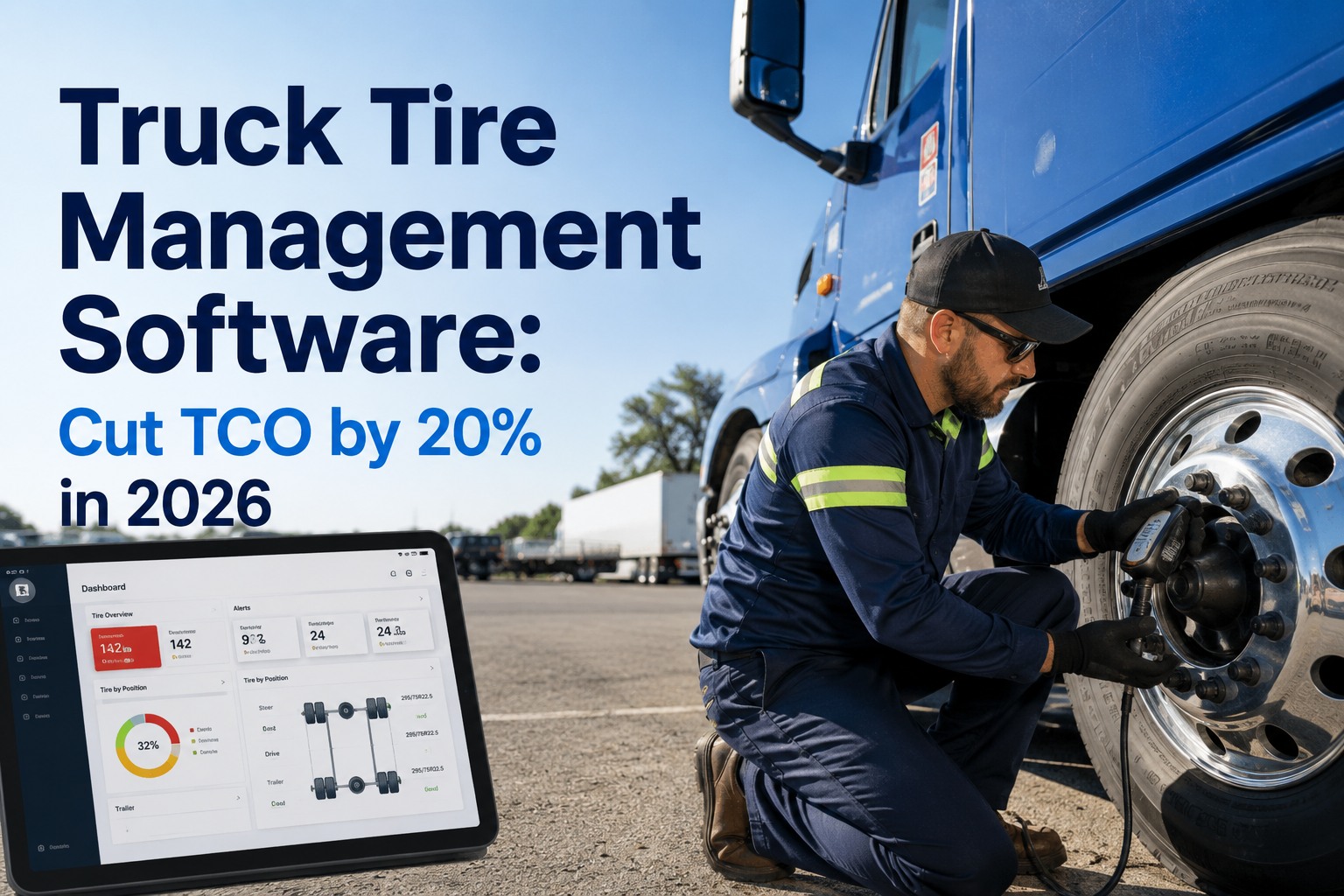
Per-position tracking
Every wheel end gets its own history — tread depths, wear patterns, rotation dates, mileage on tire. When a tire hits its DOT limit, the system flags it automatically.
Photo-verified defects
Drivers capture wear patterns, damage, and sidewall issues right in the DVIR. Photos attach to the vehicle record and forward straight to the maintenance queue.
Cost-per-mile analytics
See tire spend by vehicle, by axle position, by brand, by driver. Identify which trucks eat tires and which drivers destroy them — then act on the data.
Retread cycle tracking
Casings are logged with retread counts. When a casing hits its retread limit, the system moves it out of the retread queue and into replacement — no manual bookkeeping.
Auto-triggered work orders
Below-DOT reading, damage flag, or overdue rotation opens a work order automatically. Nothing gets forgotten between paper and technician.
One-click DOT audit export
Every tread reading, every inspection, every replacement record — exported as a signed PDF for any VIN under audit, in under 30 seconds.
Not sure where to start? Talk to our team and we'll walk through how the software fits your current PM workflow — no reconfiguration required.
Frequently Asked Questions
Under 49 CFR § 393.75, steer tires must have at least 4/32 inch of tread in any major groove. All other tires (drive and trailer) must have at least 2/32 inch. Anything below these limits places the vehicle out of service.
No. FMCSA regulations prohibit retreaded or regrooved tires on the front (steer) axle of buses, trucks, and truck tractors. Retreads are only permitted on drive and trailer positions.
On-road commercial tires typically deliver 100,000 to 200,000 miles depending on position, load, and maintenance. The DOT estimates ~1/32" of tread loss per 10,000 miles. Missing rotation cuts life 25%, poor alignment cuts another 12,000 miles per set.
A new commercial steer or drive tire typically runs $400–$600 depending on brand and specification. Retreads for drive/trailer positions run $200–$300. A simple puncture repair is $40–$80. Total annual tire spend for a 100-truck fleet averages around $160,000.
FMCSA requires that both tires on the same axle be identical in size and load rating. While you don't legally have to replace them simultaneously, mismatched wear creates uneven traction and rolling resistance — most fleets pair-replace as standard practice.
Federal law doesn't cap tire age directly, but many fleet insurance policies and internal SOPs require replacement after 6–10 years regardless of tread condition. Rubber degrades chemically over time even when the tire looks fine — cracking, sidewall dry rot, and reduced casing integrity.
Turn tire replacement from guesswork into a data-backed workflow
Track tread depth per wheel position. Flag DOT limits automatically. Capture wear-pattern photos in the DVIR. Cost-track every retread cycle. Export DOT audit records in one click. Built for fleets that don't want to be part of the $2,500-per-vehicle waste.