A P0088 code is your diesel's ECM saying the fuel rail pressure has climbed higher than it commanded — and it's one of the few codes where the smartest first move is to stop driving. Over-pressurized fuel can leak and ignite, wash the oil off your cylinder walls, and destroy injectors, which is why the engine usually drops into limp mode the moment it sets. But here's the trap that costs fleets thousands: the instinct is to blame the expensive high-pressure pump, when the real culprit is almost always a far cheaper stuck regulator, a kinked return line, or a sensor lying about the pressure. This guide breaks down what P0088 means, its symptoms, the causes ranked by how often they're actually to blame, the correct cheap-to-expensive diagnostic order, and real repair costs — plus how truck maintenance software catches the pressure trend before the code ever fires.
Diesel Fault Code Guide · 2026
P0088: Fuel Rail / System Pressure Too High
Causes, symptoms, diagnosis, and repair costs for the high-fuel-pressure code — and why the pump is usually the last thing to replace, not the first.
What P0088 Actually Means
Your engine's ECM continuously monitors fuel rail pressure with a fuel rail pressure (FRP) sensor and compares it to the pressure it's commanding. When the measured pressure consistently exceeds the programmed limit, it stores P0088 and lights the check-engine lamp. It's the exact mirror image of its more famous sibling:
Pressure too LOW
A delivery shortfall — the system can't build the pressure it needs. Weak pump, restriction, or leak.
Pressure too HIGH
Regulation failed on the high side — the system is over-pressurizing. The rail is climbing past its target and can't bleed off.
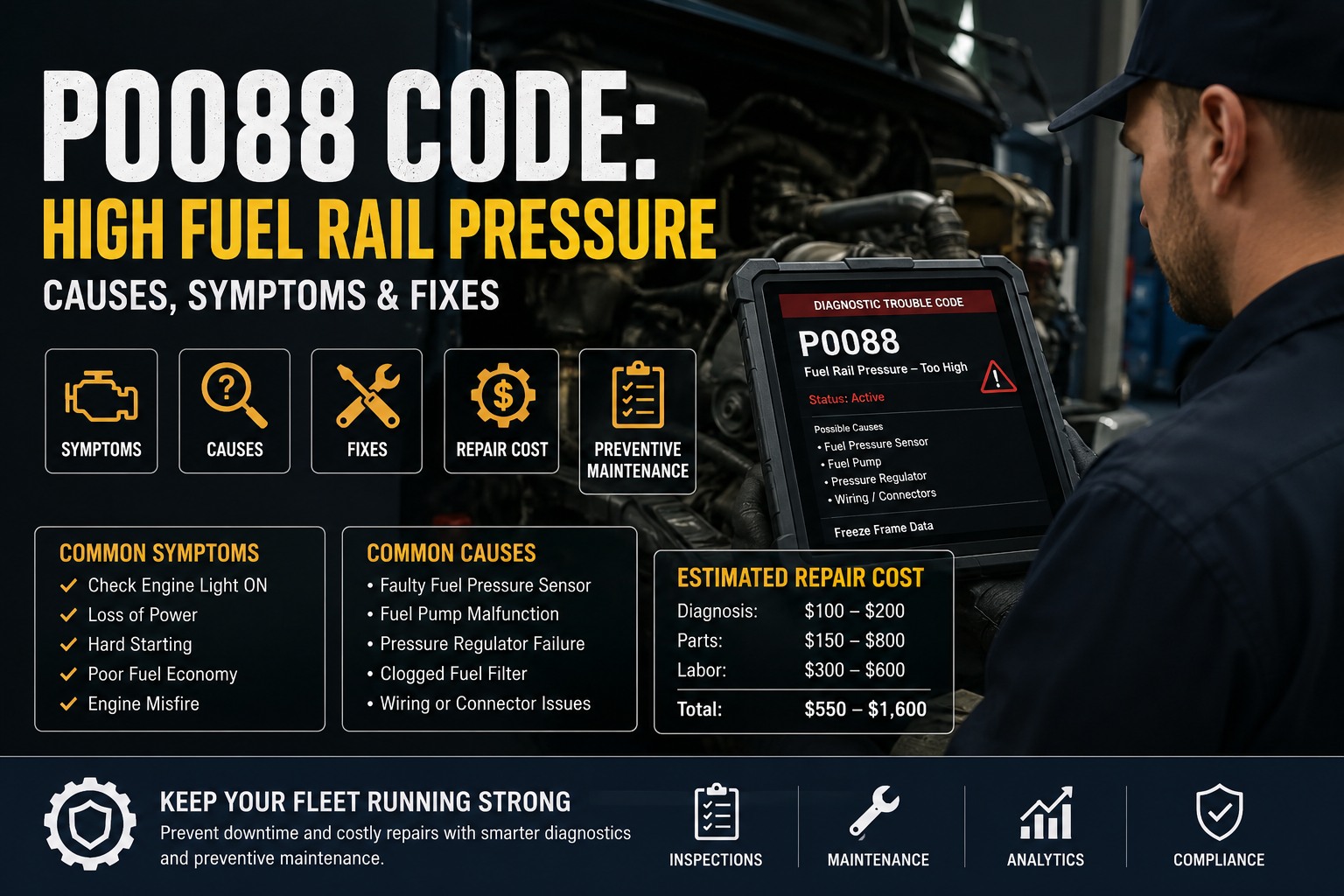
Symptoms of P0088
Excess rail pressure over-fuels the engine and disrupts atomization, creating a rich condition you can often see, smell, and feel. Watch for these signs:
Hard starting
Over-pressure disrupts the start cycle — long cranks or a no-start.
Rough idle & misfires
The rich mixture makes the engine shake, stumble, and run unevenly.
Black smoke
Unburned excess fuel shows as dark exhaust and a rich fuel smell.
Poor fuel economy
The engine is dumping more fuel than it can burn — MPG drops.
Limp mode & power loss
The ECM cuts power to protect the engine — noticeable, sudden sluggishness.
Fuel smell / leaks
Dangerous over-pressure can force leaks at fittings — a genuine fire risk.
Should you keep driving? No.
P0088 is a stop-driving code. Excessively high fuel pressure can cause fuel leaks and a fire hazard, force too much fuel into the cylinders, wash oil from the cylinder walls, and damage injectors and the pump. On 6.6L Duramax engines with the CP4.2 pump especially, this code can signal impending pump failure that scatters metal debris through the entire fuel system. Get it diagnosed before the vehicle moves again.
The Causes, Ranked by Probability
Not all causes are equally likely — and knowing the odds keeps you from throwing money at the wrong part. Across diesel common-rail platforms, this is roughly how P0088 breaks down:
Stuck fuel pressure regulator (DRV)
~50%A regulator stuck closed can't return excess fuel to the tank, so rail pressure builds past target. The single most common cause.
Restricted / kinked fuel return line
~25%If excess fuel can't bleed back to the tank, pressure has nowhere to go. A cheap fix that's often overlooked in favor of expensive parts.
Faulty FRP sensor (over-reporting)
~15%A sensor sending an erroneously high signal sets P0088 even when actual pressure is fine. Connector corrosion is a known trigger on GM trucks.
High-pressure pump or contamination
~10%A sticking or over-delivering pump, a bad control valve (SCV), or debris jamming a check valve. Least likely — but the most expensive, which is why it's confirmed last.
The Right Diagnostic Order
Here's the rule that separates a $200 fix from a needless $3,000 one: work cheapest-to-most-expensive and confirm actual pressure with a mechanical gauge before condemning any part. It's a common, costly mistake to replace the pump chasing a code that a $150 sensor or a kinked hose set.
Read live data & check the sensor at rest
With a scan tool, check the FRP sensor reading with the engine off — it should show near-zero. A non-zero at-rest reading points straight at the sensor before you touch anything else.
Verify against a mechanical gauge
Compare the sensor's live reading to an actual gauge on the rail. If the sensor over-reports while true pressure is normal, you've found it — a sensor, not a pump. This single step saves the most money.
Inspect the return line
Check the fuel return path for kinks, pinches, or clogs. A restricted return is cheap to fix and a frequent real cause of genuine over-pressure.
Test the regulator, wiring & connectors
Check the pressure regulator's operation and inspect for damaged wiring, poor grounds, and connector corrosion that can mimic or cause the fault.
Only then, the pump
If the pressure is genuinely high and the sensor, return line, and regulator all check out, then investigate the high-pressure pump and control valve. Last, not first.
Free · Up to 3 Vehicles
Catch the pressure trend before the code
Truck maintenance software streams live fuel-rail-pressure and fault-code data from your trucks, so a regulator drifting out of range shows up as a trend before P0088 ever trips limp mode. Every code is logged with the vehicle, timestamp, and repair history — turning a scramble into a documented fix. Sign up free for up to 3 vehicles and get ahead of fuel-system faults.
Repair Costs, Cheapest to Most Expensive
The spread here is enormous — which is exactly why diagnostic order matters so much. Confirming the cheap causes first can be the difference between a few hundred dollars and several thousand:
Why the CP4 job is so steep: when a CP4.2 pump fails, it can send metal debris throughout the fuel system, so a proper repair replaces the pump, rails, high-pressure lines, and injectors, plus cleaning the tank and low-pressure lines to prevent re-contamination. Confirming the cheaper causes first is what keeps a sensor fault from ever being mistaken for this.
Preventing P0088
Most fuel-system faults are slow-building, which means they're catchable. A few habits and the right monitoring keep this code off your dash:
Use clean, quality fuel
Contamination and debris jam regulators and pump check valves. Quality fuel and a disciplined filter-change schedule prevent the root cause.
Change fuel filters on time
A restricted filter stresses the whole high-pressure system. On-schedule changes protect the pump and regulator alike.
Trend the pressure data
Rail pressure drifting from its commanded target is an early warning. Monitoring the trend flags a failing regulator before it sets a code.
Log every code
A recurring P0088 across a repair means the real cause wasn't fixed. A documented code history stops the guess-and-replace cycle.
Frequently Asked Questions
What does the P0088 code mean?
P0088 stands for "Fuel Rail/System Pressure – Too High." It means the ECM measured fuel rail pressure higher than the pressure it was commanding — the system is over-pressurizing. It's the opposite of P0087, which indicates pressure that's too low. On diesel common-rail engines, high rail pressure needs prompt diagnosis because it can damage injectors and the pump and over-fuel the engine.
Is it safe to drive with a P0088 code?
No — stop driving. Excessively high fuel pressure can cause fuel leaks and a fire hazard, force too much fuel into the cylinders, wash oil from the cylinder walls, and damage injectors. The vehicle will often enter limp mode and may stall. On 6.6L Duramax engines with a CP4.2 pump, P0088 can also warn of impending pump failure. Contact our team about monitoring fuel-system health across your fleet.
What's the most common cause?
A stuck fuel pressure regulator is the single most common cause — roughly half of cases. When it sticks closed, excess fuel can't return to the tank and rail pressure climbs past target. A restricted or kinked fuel return line is the next most common, followed by a faulty pressure sensor over-reporting. The expensive high-pressure pump is actually the least likely culprit.
Why shouldn't I just replace the fuel pump?
Because it's usually not the pump — and replacing it is a common, costly mistake. A sensor over-reporting pressure sets P0088 even when actual pressure is perfectly normal, and a kinked return line or stuck regulator costs a fraction of a pump. Always verify actual pressure with a mechanical gauge and rule out the cheap causes before condemning the high-pressure pump.
How much does a P0088 repair cost?
It ranges widely with the cause. A fuel rail pressure sensor runs about $120-350, a return line $100-500, a pressure regulator $150-500, and a control valve $300-800. If the high-pressure pump has genuinely failed on a CP4-equipped diesel, a full fuel-system replacement can run $2,000-4,000 or more, because contamination requires replacing multiple components at once.
Will P0088 clear itself?
No. P0088 points to a real fault in the fuel system and won't clear on its own — it'll return whenever the over-pressure persists. You need to repair the underlying cause, confirm that rail pressure tracks the commanded target, then clear the code and verify. A vehicle also won't pass inspection with the check-engine light on. Sign up free to log and track fault codes across your fleet.
Fix the Cause, Not the Guess
Turn fault codes into documented, data-driven repairs.
Truck maintenance software streams fuel-rail-pressure and diagnostic data from your trucks, trends developing faults before they set a code, and logs every P0088 with the vehicle, timestamp, and repair history — so you fix the real cause once instead of guessing twice. Free for up to 3 vehicles. Works with your existing telematics, no contracts.