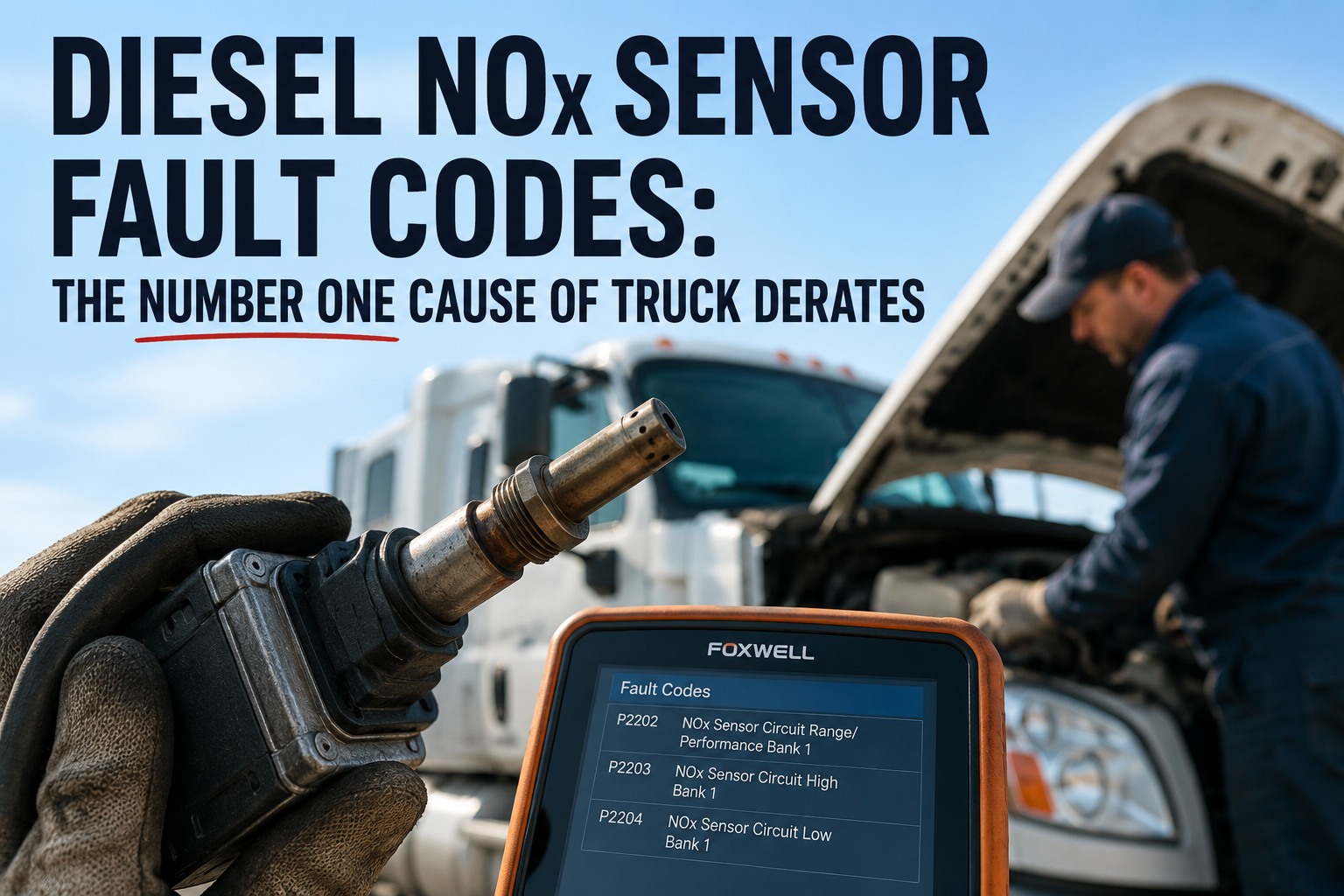
A DEF system fault is different from almost every other code on a diesel truck, because it comes with a countdown. When your emissions system flags a problem, federal law requires the truck to progressively reduce its own power — first a warning, then a speed and power cut, and finally a 5-mph limp mode the engine won't restart from once the timer runs out. That's what turns a $200 sensor into a truck stranded on the shoulder: not the fault itself, but ignoring it while the derate clock ticks. The good news is that most DEF codes are predictable and recoverable if you understand the system you're troubleshooting and catch them early. This guide maps the SCR/DEF architecture, decodes the common fault codes into the three types that actually matter, walks the derate timeline, and covers the cheap-first diagnostic order and real repair costs — plus how truck maintenance software catches DEF faults before the countdown starts.
Diesel Emissions Guide · DEF & SCR Codes · 2026
DEF System Fault Codes Explained for Diesel Trucks
Decode the SCR emissions codes, understand the derate countdown that follows them, and fix the cause cheaply before a warning light becomes a stranded truck.
2010+
Every diesel with SCR/DEF can throw these codes
3 types
Efficiency, quality & system — very different fixes
5 mph
Final limp-mode speed if the derate is ignored
4×
DEF burn can spike when the system fails
How the SCR / DEF System Works
You can't troubleshoot what you can't picture. The SCR (Selective Catalytic Reduction) system injects DEF — a urea solution — into the exhaust, where it converts harmful NOx into harmless nitrogen and water. Every DEF code points to a failure somewhere along this chain:
DEF tank & quality sensor
Stores the fluid and reports level and quality. Bad fluid or a failing sensor starts many codes here.
Pump & pressure line
Builds and holds regulated pressure. Leaks or a weak pump cause performance faults.
Injector / doser
Sprays DEF into the exhaust stream. Crystallizes and clogs if fluid is poor or dosing is off.
SCR catalyst & NOx sensors
Converts NOx and measures the result. Sensors report whether the whole chain is working.
Heavy-duty note: alongside standard OBD-II codes, Cummins, Paccar, Detroit, and Volvo/Mack use their own SPN + FMI designations — for example, Detroit's SPN 3361 covers the DEF dosing unit and SPN 3364 the DEF quality sensor. A platform that decodes both is essential on a mixed fleet, because the same physical fault can appear under different code systems.
The Three Types of DEF Codes
Here's the insight that saves the most time and money: DEF codes fall into three categories, and confusing them leads straight to replacing the wrong part. Read the type before you touch anything:
P20EE — catalyst not reducing NOx enough
The system isn't hitting the conversion rate federal law requires. Despite the name, it's often not the catalyst — incorrect dosing, contaminated fluid, or a bad NOx sensor is the usual culprit. The most common SCR fault of all.
P207F — DEF quality below specification
The fluid is reported as out of spec — contaminated, wrong fluid, or a misbehaving quality sensor. Triggers the derate sequence, so it needs prompt attention even if the fluid turns out fine.
P204F — reductant system performance
A logic-based "ghost code": the ECU commanded dosing but the result was off, usually from a pressure leak or weak pump. Frequently follows other codes — fix those first and it often clears on its own.
The Derate Countdown: why DEF codes can't wait
Emissions law forces the truck to punish a lingering DEF fault in escalating stages. Every stage is recoverable — until the last one isn't:
Warning
Check-engine light plus the amber or blue DEF lamp. Full power — but the clock has started.
Power & speed reduction
The ECM cuts power roughly in half and limits speed to about 30-40 mph to force the repair.
Severe limp mode
Speed drops to 5-15 mph. The truck is barely mobile and effectively out of service.
No restart
Once the shutdown countdown ends, the engine won't restart — leaving the truck stranded wherever it stopped.
Common DEF Codes at a Glance
Beyond the big three, a handful of related codes show up regularly. Reading them together is how you find the real fault instead of chasing a downstream symptom:
SCR NOx catalyst efficiency below threshold — the system isn't reducing NOx enough.
Reductant (DEF) quality below specification — contaminated fluid or a failing quality sensor.
Reductant system performance — a system-level "ghost code," usually pressure or pump related.
Reductant level sensor range/performance — the tank may be falsely reporting empty.
Reductant injector performance — the doser is likely clogged with DEF crystals.
Reductant pump control range/performance — the DEF pump isn't operating within spec.
Symptoms of a DEF System Fault
DEF problems announce themselves through the dash and the way the truck drives. Any of these means the system needs attention before the derate advances:
Warning lights
Check-engine light plus a blue or amber DEF lamp signalling low fluid, bad quality, or SCR failure.
Power loss & limp mode
Reduced power and a speed cap as the derate engages — highway merges and hills become a struggle.
Increased DEF consumption
A failing system can burn DEF far faster than normal — roughly a gallon per 50 miles instead of 200.
Excess smoke / high NOx
Unconverted emissions show as black smoke and can trigger a "high NOx" dashboard message.
Poor fuel economy
The engine works harder to compensate for a malfunctioning emissions system, and MPG suffers.
Failed emissions inspection
Excess NOx guarantees a failed state inspection — a direct problem for registration and compliance.
Free · Up to 3 Vehicles
Catch DEF faults before the countdown
Truck maintenance software streams emissions fault codes and DEF data from your trucks the moment they set — so a quality-sensor warning or rising DEF consumption reaches you while it's still a cheap fix, not a speed-limited truck. Every code is logged against the VIN with its repair history, giving fleet-wide pattern visibility across every engine make. Sign up free for up to 3 vehicles and stay ahead of the derate.
Causes & the Cheap-First Rule
DEF repairs swing from a $5 hose clamp to a full pump module, so diagnostic order is everything. The recurring mistake is replacing an expensive catalyst or pump when a cheap part or a companion code was the real cause:
Crystal buildup
DEF crystallizes on injectors and sensors, blocking dosing and skewing readings. Often cleanable — check before condemning the part it's fouling.
Check the relay before the pump
DEF pump relay failures are common and far cheaper than a pump. Test the relay and fuse before ordering the expensive module.
Fix companion codes first
A system-level code like P204F often clears once the pressure, heater, or injector code that caused it is repaired. Chase the root, not the ghost.
Contaminated or wrong fluid
Bad or incorrect DEF sets quality codes and fouls the system. Verify the fluid before assuming a sensor or catalyst has failed.
NOx sensor faults
Electrical faults or crystal buildup make NOx sensors misreport. New sensors need a scan-tool relearn, or codes return despite the swap.
Check for TSBs first
Some DEF faults are fixed by a control-unit software update, not a part — on certain trucks a flash resolves the fault outright.
The verification rule: before replacing any expensive component, confirm the fault is real — many DEF codes are set by sensors or software, not by a physically failed catalyst or pump. Checking cheap causes and companion codes first is what keeps a $200 job from being mistaken for a $3,500 one.
Repair Costs, Cheapest to Most Expensive
The range is enormous, which is exactly why early, ordered diagnosis pays. Catching a DEF fault while it's still a sensor or a relay keeps you far from the top of this chart:
Preventing DEF System Faults
Most DEF trouble traces back to fluid quality and neglected early warnings — both preventable with a little discipline:
Use fresh, certified DEF
DEF degrades with heat and age and is easily contaminated. Certified fluid stored properly prevents the quality faults that start the whole cascade.
Never let the tank run dry
Running out of DEF forces a derate on its own and can introduce air and debris. Keep it topped and never substitute anything but proper DEF.
Act on the first warning
The derate is staged for a reason — the earliest light is the cheapest moment to fix. Waiting removes the simple options.
Log codes across the fleet
A DEF code recurring across trucks or after a repair reveals a pattern — bad fluid batch, a weak part, or an incomplete fix.
Frequently Asked Questions
What is a DEF system fault code?
It's a diagnostic code indicating a problem in the SCR (Selective Catalytic Reduction) emissions system, which injects DEF — a urea fluid — into the exhaust to reduce NOx. Any 2010-or-newer diesel with SCR can set these codes when the system isn't reducing emissions to the level federal law requires. They fall into three types: efficiency codes like P20EE, quality codes like P207F, and system-level codes like P204F.
Can I keep driving with a DEF warning?
Only briefly, and it's risky. Emissions law forces a staged derate: first a warning, then a power cut and a 30-40 mph speed limit, then a 5-15 mph limp mode, and finally a state where the engine won't restart after a shutdown countdown. You may have a short window of normal driving, but that clock is running — get it diagnosed before it escalates. Contact our team about fleet-wide DEF monitoring.
What's the most common DEF code?
P20EE — "SCR NOx Catalyst Efficiency Below Threshold" — is the most common. Despite its name, it usually isn't a failed catalyst; incorrect DEF dosing, contaminated fluid, or a faulty NOx sensor is the more frequent cause. That's exactly why you should diagnose the system rather than immediately replacing the expensive catalyst the code seems to point at.
Why does my truck use so much DEF now?
Sharply increased DEF consumption is itself a symptom of a failing system. A healthy truck might use about a gallon of DEF per 200 miles; a malfunctioning SCR system can burn through it as fast as a gallon per 50 miles as it struggles to hit conversion targets. If your DEF usage has spiked, treat it as an early warning and scan for codes before a derate begins.
Do I have to replace the SCR catalyst?
Usually not — and it's the most expensive assumption you can make. Most DEF codes trace to sensors, dosing, fluid quality, crystal buildup, or the pump, all far cheaper than the catalyst. Check the relay before the pump, clean crystallized components, verify the fluid, and fix companion codes first. On some trucks a control-unit software update resolves the fault entirely, with no parts at all.
How much do DEF repairs cost?
The range is wide because these codes can mean very different things. A fluid or hose issue might be $5-60, a relay $30-150, a DEF injector $200-700, a NOx or quality sensor $300-900, and a pump module $500-1,400. A genuine SCR catalyst replacement or contamination repair can run $2,000-3,500 or more — which is why catching the fault early, while it's still a cheap component, matters so much. Sign up free to track DEF codes across your fleet.
Beat the Derate Clock
Turn DEF fault codes into fixes, not stranded trucks.
Truck maintenance software streams SCR and DEF diagnostics from your fleet, flags emissions faults the moment they set, decodes them across every engine make, and logs each one against the VIN with its repair history — so you fix the cheap cause early and never meet the 5-mph limp mode. Free for up to 3 vehicles. Works with your existing telematics, no contracts.