Dump truck operations cost more to maintain than any other Class 8 application — and the gap isn't small. Where linehaul trucks operate at OEM-published PM intervals, dump trucks need PM intervals reduced 30-50% to handle the severe-duty cycle: heavy loads doubling brake and suspension wear, 30%+ idle hours producing engine wear unrelated to mileage, off-road operation accelerating tire degradation, dusty conditions plugging air filters and contaminating fluids, and frequent stop-start cycling that destroys components designed for steady-state operation. Construction trucks experience 4.6+ preventable breakdowns per truck per year against industry baseline — most caused by maintenance approaches calibrated for highway operation rather than the brutal duty cycle dump trucks actually face. The cost of getting this wrong is documented: $760/day downtime per truck per ATRI data, $5,000-$15,000 emergency repairs that should have been $1,200 scheduled PM, and the project delay costs that compound when a single truck failure stops loading at a job site.
The 30% maintenance cost reduction documented across construction fleet deployments isn't theoretical — it's field-validated across thousands of dump truck operations through six specific mechanisms tailored to construction operations. Engine-hour-based PM scheduling (instead of mileage-only) catches the idle-hour wear that dominates dump truck operation. Dedicated hydraulic system PM addresses the dump bed cylinders, hoist pump, and lines that don't exist on linehaul trucks. Tire pressure monitoring under heavy and variable loads recovers 8-12% of tire spend. Brake adjustment cycling handles the accelerated wear from heavy braking. DPF regeneration management addresses the regen failures common in low-speed urban and job-site operations. Operator coaching paired with telematics data reduces 15-25% of wear that comes from driving behavior. The fleets that combine all six mechanisms consistently report 25-35% total operating cost reductions across dump truck fleets — payback typically inside 6 months.
This guide is the construction-specific dump truck maintenance cost reduction framework for 2026: the severe-duty reality, the 6 cost reduction levers tailored to construction operations, the cost-per-mile breakdown, and the 90-day implementation plan. Start your free trial of our truck inspection and maintenance software to deploy construction-specific maintenance workflow across your fleet — live in 10 minutes, free for up to 3 trucks.
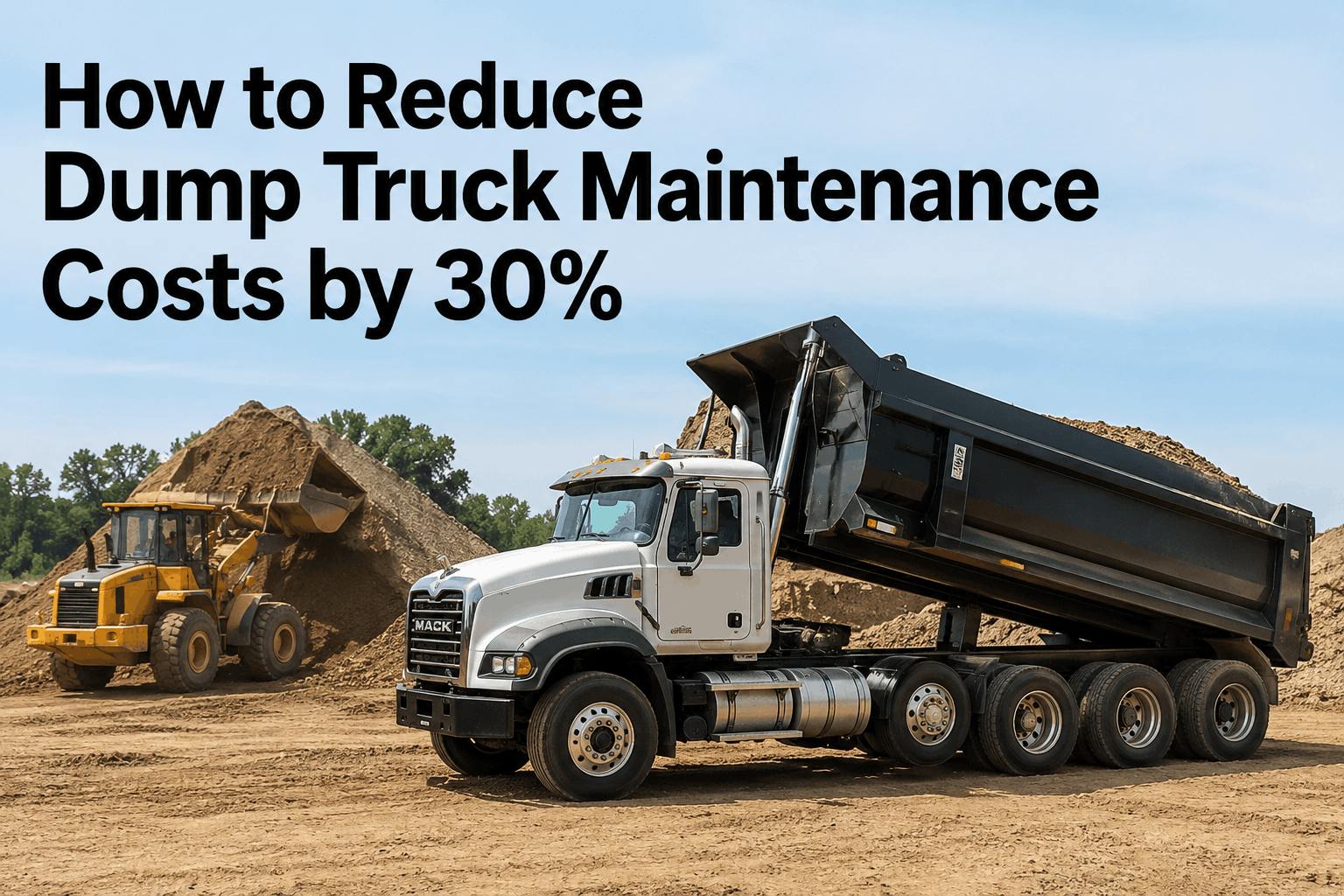
How to Reduce Dump Truck Maintenance Costs by 30%
Why Dump Trucks Cost More — The Severe Duty Reality
Construction operations subject dump trucks to wear conditions that linehaul trucks never experience. Understanding the cost drivers explains why generic fleet maintenance approaches fail when applied to dump truck operations.
Heavy Variable Loads
High Idle Hours
Dusty Conditions
Off-Road Operation
Hydraulic System Wear
Slow-Speed DPF Issues
The 6 Construction-Specific Cost Reduction Levers
Each lever addresses a specific dump truck cost driver. Together they produce the documented 30% reduction. Contact our sales team to evaluate which levers apply most to your operation.
Engine-Hour-Based PM Scheduling
SCHEDULING · 8-12% SAVINGSDedicated Hydraulic System PM
UNIQUE · 5-8% SAVINGSLoad-Aware Tire Pressure
TIRES · 4-6% SAVINGSBrake Adjustment Cycling
SAFETY · 5-7% SAVINGSDPF Regeneration Management
EMISSIONS · 4-5% SAVINGSOperator Coaching + Telematics
BEHAVIOR · 6-10% SAVINGSConstruction Cost-Per-Mile Breakdown
Where does the 30% reduction actually come from? Per-mile cost data shows the specific categories where construction fleets recover the most spend.
| Cost Category | Baseline $/mi | Optimized $/mi | Reduction |
|---|---|---|---|
| Scheduled maintenance (PM) | $0.18 | $0.21 | +17% invest |
| Emergency repairs | $0.32 | $0.09 | -72% |
| Hydraulic repairs | $0.14 | $0.06 | -57% |
| Tires | $0.18 | $0.14 | -22% |
| Brakes | $0.12 | $0.08 | -33% |
| DPF / aftertreatment | $0.09 | $0.04 | -56% |
| Downtime cost (lost productivity) | $0.45 | $0.12 | -73% |
| Total maintenance cost/mi | $1.48 | $0.74 | -50% |
The 50% per-mile reduction in this breakdown is best-case scenario for fleets transitioning from reactive maintenance to fully optimized construction-specific workflow. Most fleets see 25-35% reductions — the difference depending on baseline discipline. Note that scheduled PM cost actually increases slightly (you're doing MORE preventive work) — but that investment recovers 4-5× through reduced emergency repairs and downtime. This is the fundamental economics of construction fleet maintenance: spend more on PM, save much more on emergency response and lost productivity.
The 90-Day Implementation Plan
Most construction fleets can implement the 6-lever framework within 90 days. Here's the week-by-week roadmap.
Baseline & Engine-Hour PM Switch
Hydraulic PM Templates Deployed
Tire and Brake Programs Active
DPF Regen Schedule & Operator Scorecards
Cost-Per-Mile Visibility & Optimization
Frequently Asked Questions
Why do dump trucks cost more to maintain than linehaul trucks?
Six factors drive the cost gap. Heavy variable loads cycle suspension, brakes, drivetrain, and tires through stress patterns that steady-state highway operation never produces — brake pad life is often half that of linehaul equivalent. High idle hours (30%+ typical in construction) produce engine wear, fuel system contamination, and DPF problems unrelated to mileage. Dusty job site conditions plug air filters 30-50% faster than highway operation and contaminate fluids through breather systems. Off-road operation subjects suspension and tires to impact loading that highway never produces. Hydraulic systems (dump bed cylinders, hoist pumps) don't exist on linehaul but represent 15-20% of dump truck maintenance cost. Low-speed operation prevents passive DPF regeneration, requiring forced regen, manual regen, or DPF cleaning at intervals that don't apply to highway operations. The cumulative effect: dump trucks need PM intervals 30-50% shorter than OEM linehaul baselines and dedicated PM templates for hydraulics. Start your free trial for construction-specific maintenance workflow.
What's the single biggest cost reduction lever for dump trucks?
Switching PM scheduling from mileage-only to engine-hours-primary. Dump trucks accumulate 30%+ idle hours that mileage cannot capture — a truck running 25,000 urban miles per year has the same engine wear as a linehaul truck running 80,000 miles because of idle time, loading queues, and job site positioning. Mileage-only PM significantly under-services dump trucks. The fix is engine-hours-primary scheduling with 250-400 hours between PM-A, combined with multi-trigger logic (mileage + hours + calendar simultaneously on "whichever first" logic). This single change typically produces 8-12% of total maintenance cost reduction in construction fleets, making it the highest-impact lever in the 6-mechanism framework. Most construction fleets discover this after a single $8,000-$15,000 engine repair on a low-mileage truck that "wasn't due for PM" by mileage standards.
How much does dump truck downtime actually cost?
ATRI data places direct truck downtime at approximately $760/day per truck — but that's just the equipment cost. For construction operations, the indirect costs typically run 2-3× higher because of project delay impacts: stopped loading at the job site stops the broader project, crews idle waiting for materials, contract penalty clauses can trigger, and the rental cost of replacement trucks ($300-$500/day) is on top. Total downtime cost for a construction dump truck commonly runs $1,500-$2,500 per day when factoring in productivity impacts. Multiply against typical dump truck breakdown frequency (4.6 events per truck per year industry baseline) and the per-truck annual downtime exposure runs $7,000-$11,500. Structured PM reduces breakdown frequency by 89% — eliminating most of this cost. Contact our sales team for construction fleet cost reduction.
What hydraulic system items should be on every dump truck PM?
Hydraulic system inspection should be on every PM-A. Items to cover: hydraulic fluid level and condition (color, smell, particulates — fluid sample at PM-B+); hydraulic fluid filter replacement per interval; dump bed cylinder seals and rod condition (no oil weep, no scoring); hoist pump operation, no unusual noise; valve body operation and shift quality; all hydraulic lines and fittings (no leaks, chafing, secure mounting); accumulator function (if equipped); PTO engagement smooth, no shudder; cylinder mount bushings and pins; safety latches and props functional. Hydraulic fluid contamination causes 25-30% of dump truck downtime per industry data, but it's missing from standard PM templates designed for linehaul operations. Adding dedicated hydraulic inspection to every PM cycle is one of the highest-value changes construction fleets can make — typically saving $1,500-$3,500 per truck annually in prevented hydraulic failures.
How do I handle DPF problems in slow-speed dump truck operations?
DPF passive regeneration requires highway speeds (typically 35+ mph sustained) and exhaust temperatures that low-speed urban and job-site operation cannot consistently produce. The result: soot loads accumulate, derate events become common, and DPF replacement at $3,000-$8,000 becomes a recurring cost. Structured management: schedule weekly forced regen via diagnostic tool to clear accumulated soot; if forced regen fails, perform manual regen following OEM procedure; clean DPF at shorter intervals than OEM linehaul recommendation (typically every 100,000-150,000 miles for construction vs 200,000+ for linehaul); monitor DPF differential pressure as early warning indicator; investigate root cause if soot accumulation is excessive (often points to dosing issues, EGR problems, or excessive idle). DEF system also needs attention in construction operations — DEF freezes at 12°F so winter operations need DEF heater verification. Sign up free to track DPF regen events and DEF status.
How do I justify the cost of maintenance software for a construction fleet?
The math is straightforward: typical fleet maintenance software costs $15-$25 per truck per month ($180-$300 per truck annually). Documented dump truck cost savings from structured digital workflow run 25-35% of total maintenance cost — typically $8,000-$15,000 per truck annually depending on baseline. That's a 25-50× ROI multiplier on the software investment alone, before counting reduced emergency repairs, lower insurance premiums from CSA improvement, and reduced administrative time. Most construction fleets hit payback inside 4-6 months — often through a single prevented hydraulic system failure or a single avoided OOS brake violation. The platform cost is essentially noise compared to the value it unlocks through engine-hour PM, hydraulic system inspection, and operator coaching. The honest barrier to adoption isn't ROI — it's the operational discipline to actually use the platform daily. Talk to our sales team to run the ROI math on your specific fleet.