On a dairy or feedlot, the feed truck is the one machine that can't take a day off. Cows get fed on a schedule whether or not the mixer is running, and when a feed truck goes down, the ration doesn't just get delayed — it gets improvised, and inconsistent feed hits milk production and weight gain within days. The hard part is that feed mixers wear in ways an ordinary truck doesn't: augers grinding through hay and silage, knives dulling, planetary gearboxes under constant torque, a scale system that has to stay accurate to the pound. Most of that wear is gradual and visible long before it strands the truck — if someone is looking. Start scheduling feed-truck PM free. This guide lays out how livestock operations cut feed-truck downtime by roughly 30% — the mixer-specific wear points, the preventive schedule that catches them, and the parts and records that keep the ration on time every single day.
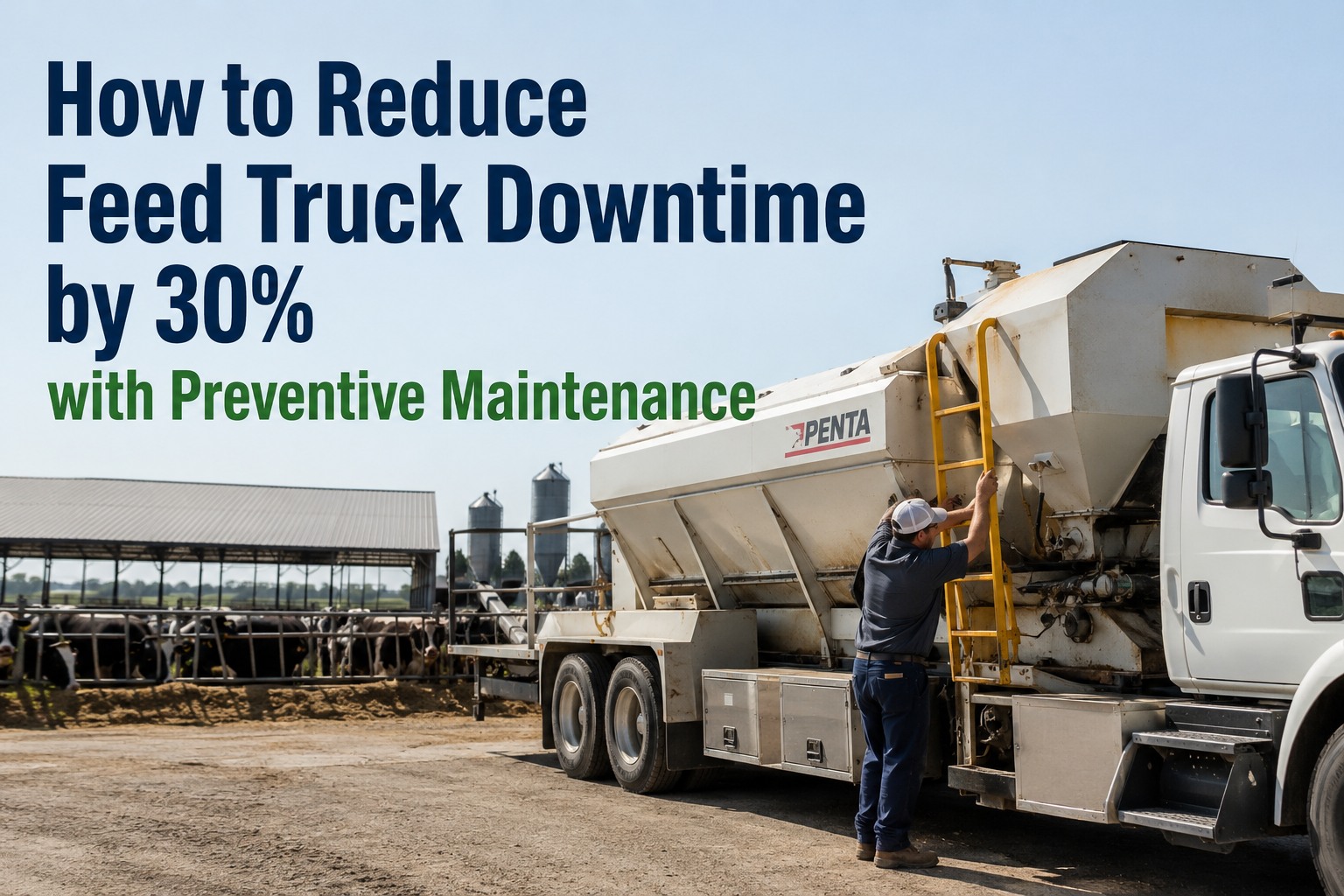
How to Reduce Feed Truck Downtime by 30% with Preventive Maintenance
The preventive-maintenance playbook for dairy and livestock feed trucks — mixer wear points, greasing and inspection intervals, early warning signs, parts inventory, and digital records that keep the ration on time and the truck out of the shop.
Why a Feed Truck Isn't Just a Truck
A road tractor's job is to move. A feed truck's job is to process — cut, mix, weigh, and dispense a precise ration — all day, every day. That dual duty is exactly why it needs a maintenance program that a standard truck PM plan would miss entirely.
Livestock eat on a fixed schedule. A downed feed truck doesn't delay a load — it disrupts every animal's ration that day, with production losses that follow.
Augers and gearboxes run under high torque through abrasive hay, silage, and grain — wear accumulates far faster than on an over-the-road drivetrain.
Dull knives and a drifting scale don't stop the truck — they quietly wreck mix consistency, wasting feed and hurting the herd before anyone notices.
The Wear Points Unique to Feed Mixers
Downtime on a feed truck almost always traces back to the mixing system, not the chassis. These are the components that wear on their own clock — and the ones a generic truck inspection walks right past.
The workhorses of a vertical mixer. Worn flighting and thinning edges slow mixing, waste fuel, and eventually deflect into the tub floor. Augers are removable for repair — catch wear before it spreads.
Dull knives slow the mix and waste fuel; worn lead-edge scrapers and kicker arms cut feed-out rates. These wear items are the most-missed — and the cheapest to replace on time.
Under constant torque. Maintain correct oil-bath levels on reel and four-auger units, keep drivelines greased, and verify auger timing so feed transfers cleanly between augers.
The PM Schedule That Hits 30%
Downtime drops when service moves from "fix it when it quits" to fixed intervals matched to how feed mixers actually wear. Here's the schedule that catches every wear point above before it becomes a breakdown.
Grease drivelines and fittings, check chain tension, test all lights and safety shields, scan for leaks and loose knives before the first load.
Inspect knife sharpness, scraper and kicker-arm condition, hydraulic hoses, and belts. Note anything trending toward replacement.
Check gearbox oil-bath levels, verify auger timing, confirm scale calibration against a known weight, inspect tub liners for thinning.
Replace worn knives and flighting in a planned window, service the gearbox, and stage parts ahead of peak feeding demand.
Put Every Feed-Truck Interval on Autopilot
Truck Inspection & Maintenance schedules mixer PM by hours or calendar, sends alerts before greasing, scale checks, and knife changes come due, captures wear findings with photos on the daily walk-around, and turns any defect into a work order the moment it's logged — so the ration never waits on a repair.
Catch It Early: The Warning-Sign Ladder
Feed-mixer wear escalates in stages, and the earlier you act, the cheaper the fix. The gap between a planned knife swap and a stranded truck at feeding time is usually just a week of paying attention.
Parts on the Shelf Beat Parts on Order
The fastest PM program still stalls if the part isn't there. For a machine that can't wait, a small on-hand inventory of high-wear items is the difference between an hour of downtime and a day.
The Math: Why 30% Pays Off
Feed-truck uptime isn't just a repair-bill question — it's a herd-performance question. Every prevented breakdown saves on several fronts at once, and the biggest one is the ration itself.
Frequently Asked Questions
The mixing system, not the chassis. Worn augers and flighting, dull knives, worn scrapers and kicker arms, planetary gearbox and driveline issues, and failed chains, belts, or hydraulic hoses are the leading causes. Many of these wear gradually and are visible well before they cause a breakdown — but a standard truck inspection misses them because it isn't looking at the mixer. A mixer-specific PM program is what catches them in time. Start a free trial to schedule mixer PM.
Daily at minimum: grease drivelines and fittings, check chain tension, test lights and safety shields, and scan for leaks. Weekly, inspect wear items like knives, scrapers, kicker arms, belts, and hydraulic hoses. Monthly, check gearbox oil-bath levels, verify auger timing, and confirm scale calibration. Seasonally, plan a fuller overhaul of knives and flighting. Always follow your operator's manual for the exact intervals specific to your mixer type and hours of use.
They cost you even while the truck still runs. Processing hay and forage with dull knives slows mixing, wastes fuel, and produces an inconsistent ration — and inconsistent feed directly affects milk production and weight gain. Because the truck keeps operating, worn knives are one of the most overlooked problems on a feed mixer. Replacing them on a regular schedule protects both your uptime and your herd's performance. See how digital checklists flag wear early.
Because ration accuracy depends on it. The scale meters each ingredient by weight to build a balanced mix, so if it drifts out of calibration, every batch is off — over- or under-feeding ingredients without any obvious sign. A drifting scale is a silent cost: the truck runs fine, but feed is wasted and nutrition suffers. Checking calibration against a known weight monthly, and after any hard impact, keeps rations accurate and dollars from leaking out of the bunk.
Moving from reactive repair to interval-based PM — daily greasing and walk-arounds, weekly wear checks, monthly drivetrain and scale service, and planned seasonal overhauls — commonly cuts unplanned feed-truck downtime by around 30%. The savings compound: an emergency repair typically costs several times a scheduled one, and keeping a small inventory of high-wear parts on the shelf turns what could be a full day down into an hour. Most importantly, it keeps the ration on time every day. Start free and build your PM schedule.
Keep the Mixer Turning and the Ration on Time
Truck Inspection & Maintenance gives dairy and livestock operations one platform to schedule feed-truck PM, track every mixer wear part, capture issues on digital walk-arounds with photos, manage spare-parts inventory, and turn each defect into an instant work order — so downtime drops and your herd gets a consistent ration every single day.