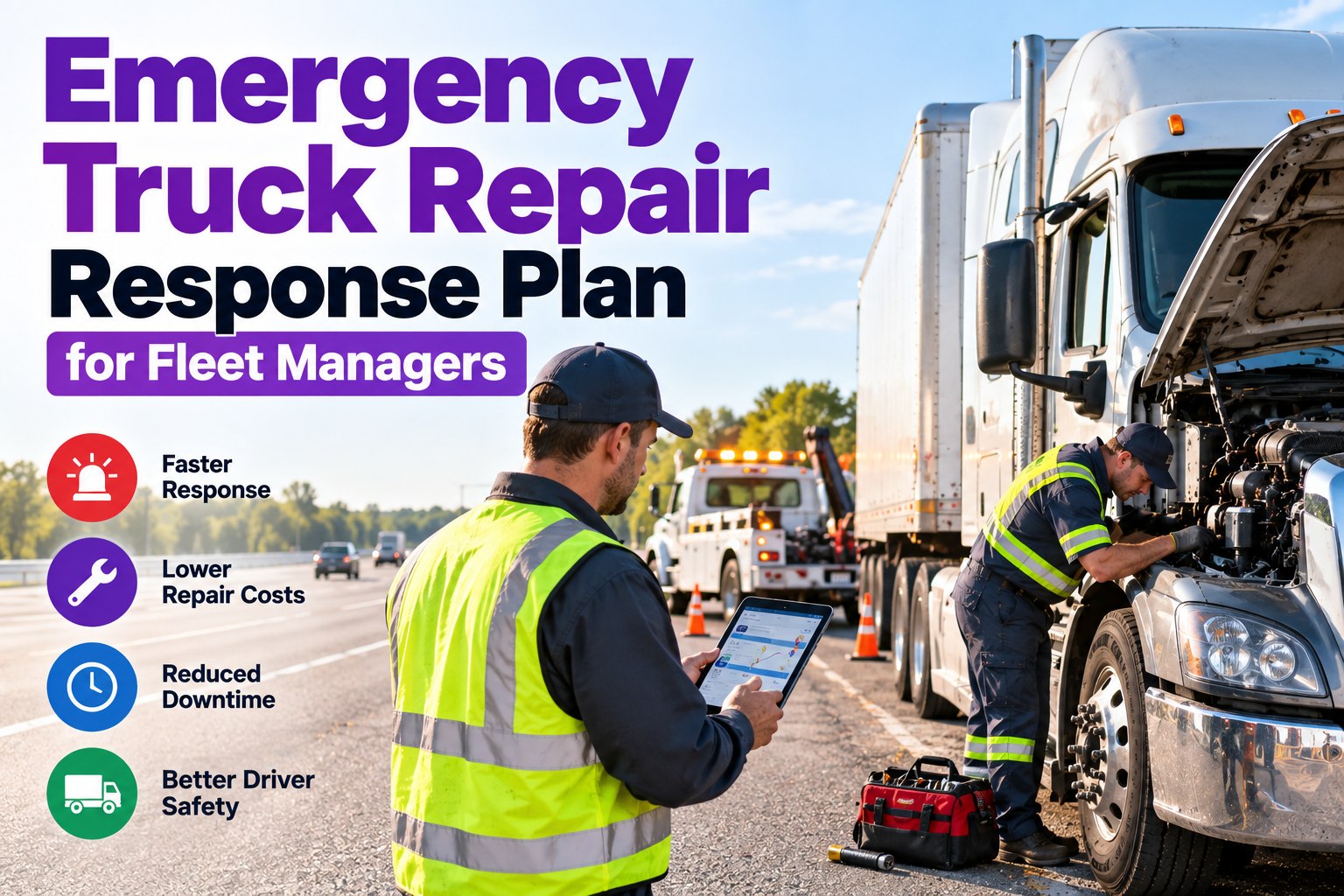
A commercial truck breakdown on the interstate looks like a repair bill. It's actually seven separate bills stacked on top of each other — the tow, the roadside diagnosis, the rush parts freight, the after-hours labor, the hotel for the driver, the missed delivery penalty, and the two or three days of lost revenue while the truck sits. Element Fleet Management data pegs the average unplanned downtime cost at $448–$760 per vehicle per day. On a single major breakdown, total damage runs $3,500–$8,000 or more — for a repair that might have cost $500 as scheduled maintenance. This guide gives you a live calculator to price your own breakdown scenarios, the breakdown of every hidden cost bucket, the top 6 causes worth preventing first, and the roadmap for cutting breakdown frequency 70%. Ready to see the numbers on your own fleet? Start your free trial or reach out to our support team for a walkthrough.
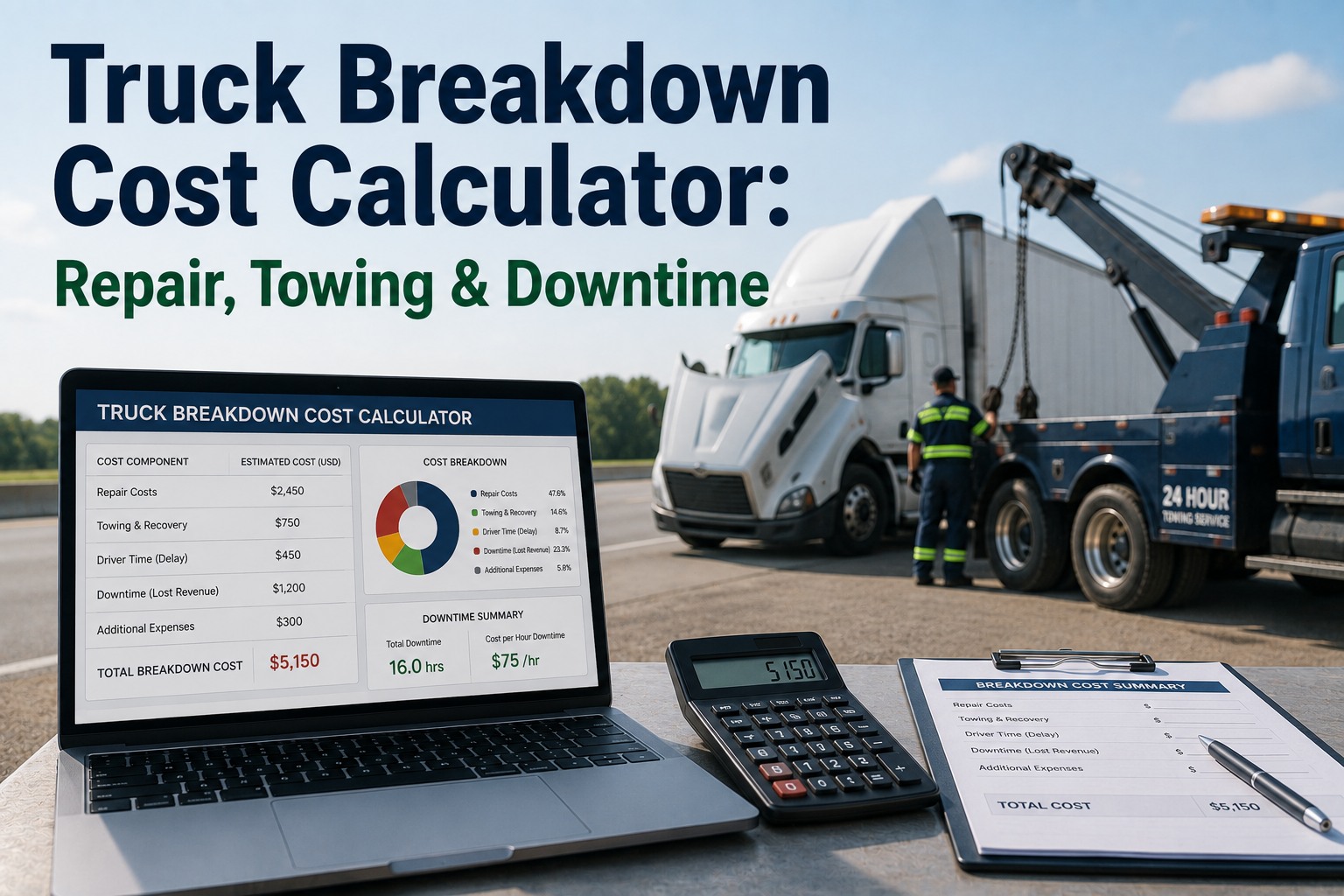
Truck Breakdown Cost Calculator: Repair, Towing & Downtime
One breakdown, seven cost buckets, one giant bill. See exactly what a single major failure costs your fleet — and what preventing it is worth.
The 7 Cost Buckets of a Truck Breakdown
The repair invoice is only the first layer. Here's what actually stacks up when a truck breaks down on the road.
Emergency Towing
Heavy-duty tow rates run $8–$15 per loaded mile, with $250–$450 hookup fees. Interstate tows or specialty equipment (lowboy, wheel-lift) push higher.
Roadside Diagnosis
Mobile diagnostic service call to determine root cause. Sometimes credited against repair, often not. Overtime rates apply after hours.
The Actual Repair
Parts and labor at whichever shop can accommodate you. Same repair costs 30–60% more at a "next available" shop vs your usual PM shop.
Rush Parts Freight
Overnight or same-day parts freight. Common for OEM parts on European or specialty engines (MBE, Detroit, Cummins ISX).
Driver Cost While Idle
Driver still on the clock. Hotel, meals, transport home if breakdown lasts multiple days. Layover pay per union or fleet policy.
Lost Revenue (2–3 days downtime)
Every day off the road = missed revenue at $448–$760/day. Two-to-three day repairs are typical for major failures.
Customer & Reschedule Impact
Missed delivery penalties, expedited freight to make up service failure, customer retention damage. Hardest to quantify — often the largest hit.
Calculate Your Breakdown Cost
Enter a real scenario. See exactly what one breakdown costs — and what preventing 10 of them across your fleet would return.
Breakdown Scenario
The 6 Top Causes of Commercial Truck Breakdowns
Breakdowns aren't random. Six root causes drive the majority of unplanned events. Focus prevention here.
Tire Failures
Blowouts, tread separation, sidewall damage. Nearly always preventable through pressure discipline and tread inspection.
Brake System Failures
Air leaks, out-of-adjustment strokes, worn linings. Almost always show warning signs on DVIR before catastrophic failure.
Cooling System / Overheating
Radiator leaks, water pump failure, thermostat sticking. Predictable through coolant testing and hose inspection.
Electrical / Starter / Alternator
Dead batteries, corroded connections, failed alternators or starters. Detectable via voltage checks and cranking symptom tracking.
Fuel System & DPF Issues
Clogged filters, contaminated fuel, failed DPF regeneration. Predictable through fuel-quality checks and regen cycle monitoring.
Drivetrain / Suspension
Axle, differential, U-joint, spring failure. Often show subtle vibration or noise on DVIR days or weeks before catastrophic failure.
Cost Comparison: Planned vs Breakdown Repair
Same repair. Two paths. Wildly different total costs. This is the math that funds every serious PM program.
Stop paying breakdown prices
Structured PM cadence, DVIR defect capture, and predictive flagging move breakdowns from surprise to schedule.
How to Cut Breakdown Frequency 70%
Industry-leading fleets don't magically avoid failures — they follow a specific playbook. These are the five levers, in the order that delivers the fastest impact.
Digital DVIR with photo verification
Drivers report defects at pre-trip with photo evidence. Nothing gets missed between shifts. The daily inspection is your cheapest early-warning system.
Auto-triggered PM cadence
Every service interval fires automatically on engine hours or mileage — not on someone remembering. Missed PM is the largest source of preventable failures.
Defect-to-work-order routing
Every driver-reported defect auto-generates a work order in the maintenance queue. No email, no phone tag, no defects dying in a binder.
Trend-based predictive flagging
Repeat symptoms on the same vehicle trigger predictive alerts. A truck reporting "slow crank" on three DVIRs is a starter waiting to strand you.
Component life tracking
Batteries, tires, brake linings, hoses — each has a predictable service life. Schedule replacement before failure, not after.
Frequently Asked Questions
Industry benchmarks put the average major breakdown at $3,500–$8,000 all-in — with a median around $5,600 per event. That includes towing, roadside diagnosis, repair, driver cost, downtime, and customer impact. The repair itself is often only 20–35% of the total.
Per Element Fleet Management data, unplanned downtime costs $448–$760 per vehicle per day. This includes lost revenue, driver still-on-clock costs, rental or replacement equipment, and customer service impact. Every day the truck sits, this cost accrues.
Heavy-duty semi towing runs $8–$15 per loaded mile with $250–$450 hookup fees. A typical 50-mile interstate tow lands at $650–$1,200. Specialty equipment (lowboy, wheel-lift, or wrecker-tractor combos) can push $1,500+ for complex recoveries.
Yes. Industry data indicates ~95% of commercial truck breakdowns show detectable warning signs on inspection within 2–4 weeks of failure. Fleets that combine digital DVIR, structured PM, and predictive trend flagging typically cut breakdown frequency 70% inside 12 months.
Tires account for roughly 30% of roadside events, followed by brake systems (~20%), cooling systems (~15%), electrical (~12%), fuel/DPF (~10%), and drivetrain/suspension (~8%). All six categories have predictable warning signs on proper inspection.
The same repair costs 3–9x more as a breakdown than as scheduled PM. Preventive maintenance moves the repair from an emergency with tow, downtime, and rush freight into a planned window with normal parts pricing and standard shop labor. On a fleet of 50 trucks preventing 10 breakdowns per year, that's typically $40,000–$60,000 in annual savings.
Turn breakdowns into planned repairs
Digital DVIR with photo capture. Auto-triggered PM cadence. Defect-to-work-order routing. Predictive symptom flagging. Component life tracking. Everything you need to make a $5,600 breakdown into a $500 scheduled service — one fleet, one platform.