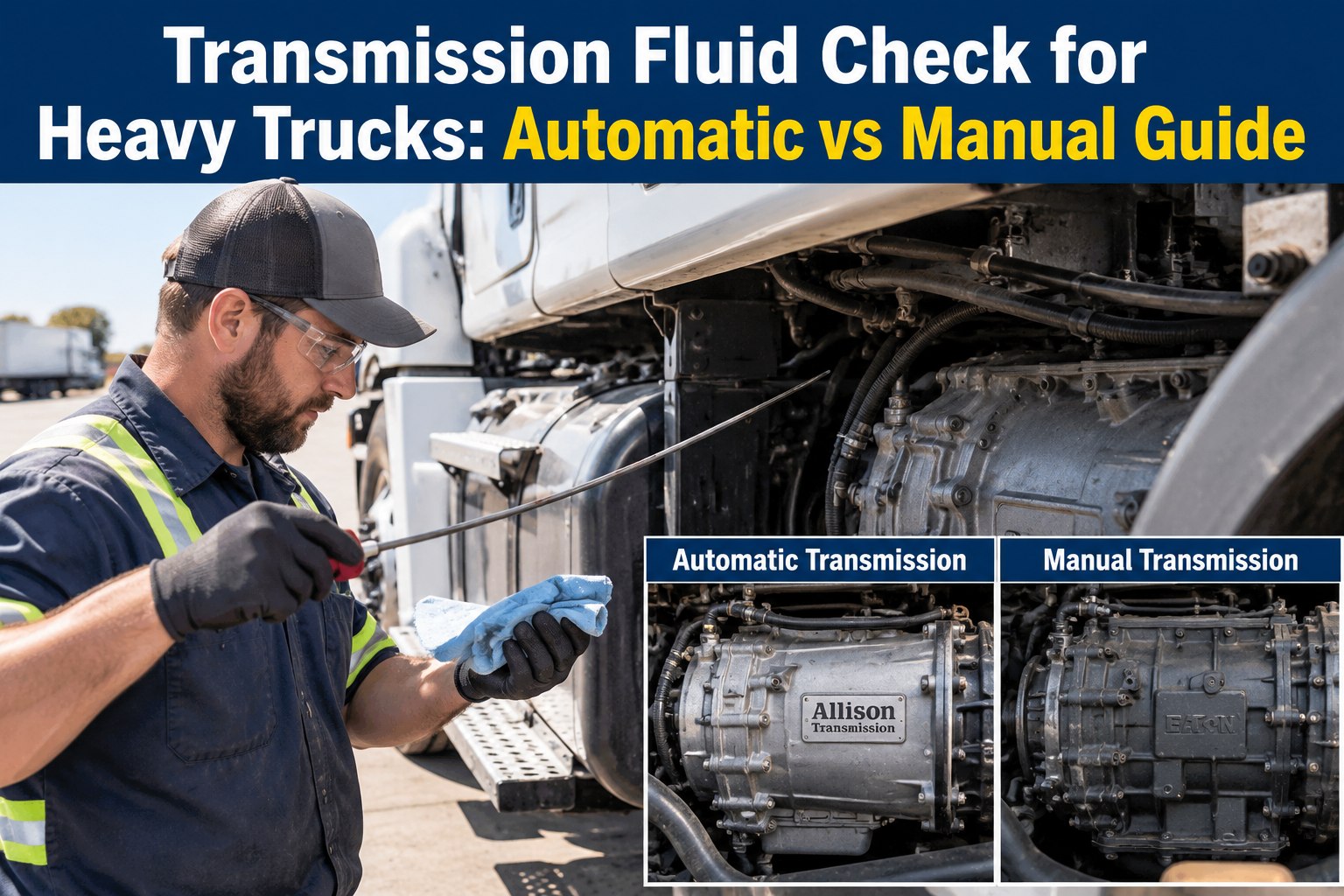
Ask a driver to "check the transmission fluid" and the right answer depends entirely on what's bolted behind the engine. On an Allison automatic, checking it with the engine off gives you a dangerously wrong reading. On an Eaton Fuller manual, checking it with the engine running is how you get burned. Same task, opposite procedures — and getting them mixed up is exactly how a truck ends up overfilled, underfilled, or towed. This guide splits the two cleanly: the automatic procedure (Allison, and automated boxes like Eaton and Volvo I-Shift), the manual procedure (Eaton Fuller, PACCAR), the fluids each demands, and the checks a DVIR should actually capture. Start a free trial and build transmission-type checks into your fleet's mobile inspection.
Transmission Fluid Check: Automatic vs Manual
Two transmission types, two opposite procedures. Engine running or engine off. Dipstick bands or a side fill plug. Hot check or level ground. Get the wrong one and the reading lies to you — here's each done right.
Why the Procedures Are Opposite
This isn't arbitrary — it comes down to how each transmission holds and moves its fluid. Understanding the "why" is what stops a tech from defaulting to the car-engine habit of "running, dipstick, done."
An automatic circulates fluid through a torque converter and hydraulic circuits. You have to run the engine to fill those circuits, and read the level warm — fluid expands with heat, so a cold reading on a hot-spec transmission shows falsely low.
A manual is a sealed gear bath — parts run submerged in oil moved by the gears themselves. There's nothing to pressurize, so you check it static: engine off, truck level, fluid measured right at the fill hole. Running it would only sling oil and burn your hand.
The Two Procedures, Side by Side
Here's each procedure step by step. Print both, and make sure the driver knows which transmission is under their truck before they start — the steps do not transfer between them.
Know Your Fluid — They Are Not Interchangeable
The wrong fluid voids warranties and wrecks transmissions. Each maker specifies its own, and mixing types or adding friction modifiers to a manual is explicitly prohibited.
Synthetic ATF meeting Allison's spec. Approved synthetics unlock extended drain intervals — but always verify the current spec for the unit.
Eaton-approved lubricants. Synthetic fill extends drains to ~500,000 miles. No additives, no friction modifiers, no multi-viscosity gear oils.
Automated manuals from Volvo and others run their own factory-specified synthetic. Check the OEM manual — do not assume it matches the manual-box fluid.
Make Every Driver Run the Right Procedure
Truck Inspection & Maintenance lets you build the correct fluid-check steps into each truck's mobile DVIR by transmission type — so an Allison truck prompts the hot-check sequence and an Eaton truck prompts the level-ground fill-plug check. Drivers log level, color, and leaks with a photo; low or burnt fluid routes straight to the shop as a work order; and fluid-change intervals fire as automatic PM reminders. No more guessing which procedure applies.
What the Fluid Is Telling You
Level is only half the check. The condition of the fluid on the stick or plug is an early warning system — reading it right catches a failing transmission weeks before it strands a load.
Clean, translucent fluid at the correct level. Note it and move on.
Oxidized from heat and miles. Not an emergency, but flag it for the next service window and check the interval.
Water or coolant intrusion. Diagnose the source before it destroys internals — don't just top off.
Overheated, breaking down, likely clutch/gear wear. Pull it for diagnosis before the next dispatch.
Frequently Asked Questions
Look at the shifter and the make. A traditional manual has a clutch pedal and an H-pattern or range/splitter shifter — Eaton Fuller is the classic example. A true automatic like an Allison has no clutch pedal and a PRNDL-style selector, and checks with the engine running. The tricky middle category is the automated manual transmission (AMT) — Volvo I-Shift, Eaton's automated boxes, Mercedes mDrive — which drives like an automatic but is mechanically a manual. Those follow the OEM's own procedure and fluid spec, so always confirm against the specific manual rather than assuming. Start free and tag each truck's transmission type so the right check loads automatically.
Because fluid expands as it warms, the dipstick has two separate bands — a COLD CHECK band and a HOT CHECK band. The cold check only confirms there's enough fluid to safely drive until it warms up; the hot check at operating temperature (roughly 160–200°F) is the one that matters for setting the actual level. If you fill to "full" while cold, the level will climb past full once hot and can overflow. Always set the final level against the hot band, and never add above the cold band when the fluid is cold.
No — heavy manual transmissions like Eaton Fuller are filled through a plug on the side of the case, and the correct level is exactly at the bottom of that fill opening. There's no dipstick and no top fill. Being able to touch fluid with a fingertip through the hole does not mean it's full; it has to be right at the opening's lip. A common field tip: roughly one inch of level equals about a gallon, so small differences matter. Add approved fluid until it just begins to weep out, then reinstall the plug — and never overfill.
It depends heavily on transmission and fluid. Eaton Fuller boxes factory-filled with approved synthetic can go up to around 500,000 miles between changes in linehaul use, but vocational and severe-duty service shortens that substantially. Allison intervals vary by application and are extended with TES-295/668 synthetics, and newer Gen 4/5 units calculate service need and light a maintenance indicator. The reliable answer is to follow the OEM interval for your exact model and duty cycle, and let the level-and-condition check catch problems between changes. Talk to our team about automating transmission PM intervals on Truck Inspection & Maintenance.
Give Every Transmission the Right Check
Truck Inspection & Maintenance connects drivers, mechanics, and managers on one mobile-first platform — transmission-specific fluid checks in the DVIR, photo-logged level and condition, instant defect routing when fluid reads burnt or contaminated, and automatic PM reminders for every fluid-change interval. Replace guesswork and paper checklists with a maintenance system your drivers will actually run.