Diesel Exhaust Fluid is 67% deionized water and 33% chemically pure urea — nothing exotic on paper, but that mixture is the single most contamination-sensitive fluid on a modern diesel truck. Pour in something that shouldn't be there, store it warmer than it should be stored, or run past its shelf life, and the SCR system that depends on it starts throwing derate codes, crystallizing injectors, and cascading into repairs that run $4,000 to $8,000 per truck. The frustrating part is that DEF failure almost never happens because the truck did anything wrong. It happens because the fluid was mishandled before it ever reached the tank — stored in a hot yard, dispensed with a dirty nozzle, left uncapped in humid air, or bought a year past its expiration. According to ISO 22241, DEF stored between 10°F and 90°F carries roughly a one-year shelf life; drop that range to a constant 75°F and shelf life doubles; push storage above 86°F and shelf life collapses to about six months. That's the entire game — temperature, cleanliness, and time. This guide covers how to store DEF correctly, how to spot contaminated or degraded fluid before it goes in the truck, how to prevent the freezing and heat-degradation problems that cost fleets thousands per year, and how Truck Inspection & Maintenance software keeps DEF quality tracked from delivery to injection. Ready to run DEF, diesel, and DVIR data in one place? Start a free trial of Truck Inspection & Maintenance, or contact our support team for a walkthrough.
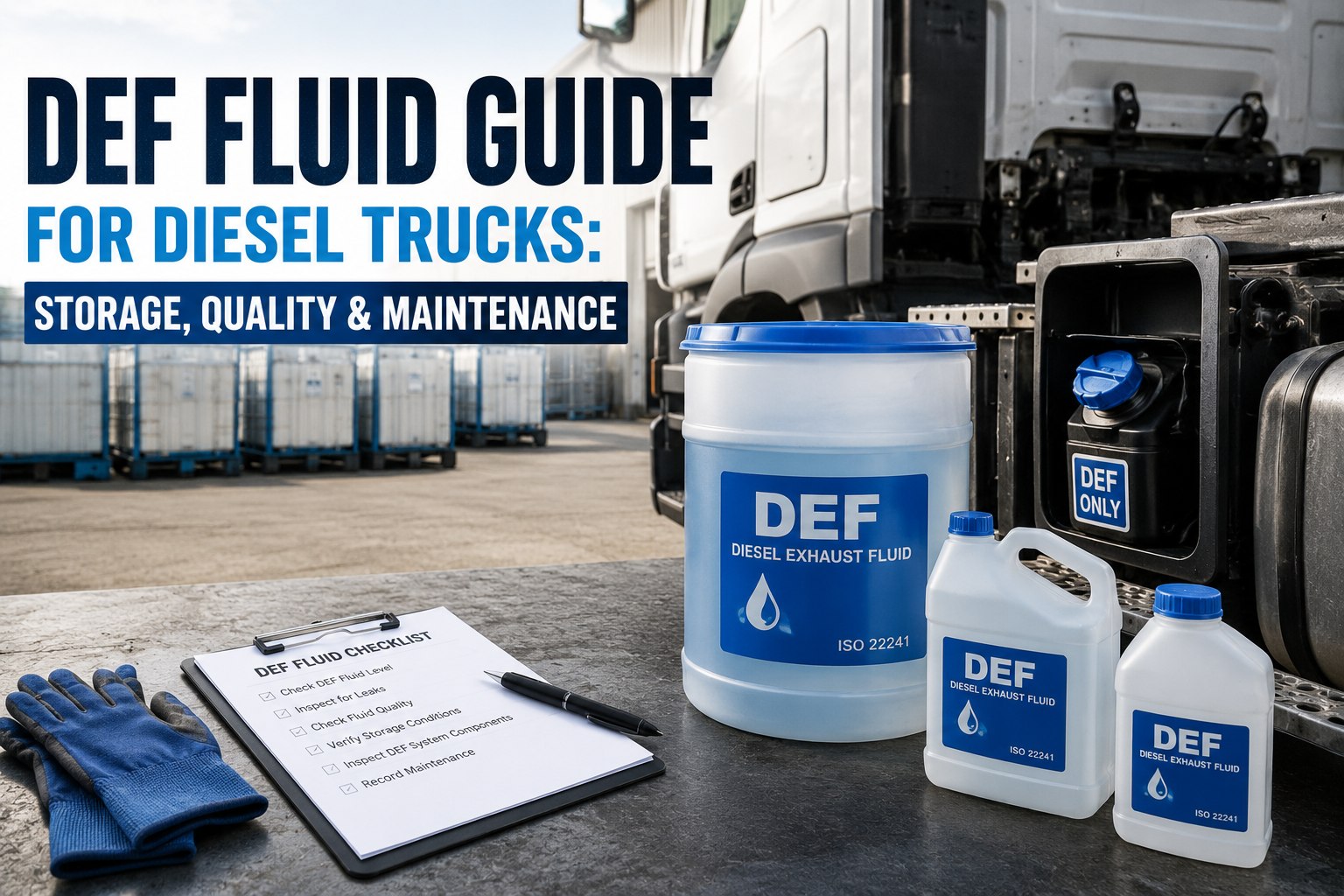
DEF Fluid Guide for Diesel Trucks: Storage, Quality & Maintenance
67% deionized water. 33% chemically pure urea. The most contamination-sensitive fluid on a modern diesel truck — and the one most fleets store wrong.
What DEF Does — And Why Quality Matters
DEF is the working fluid that lets your SCR system convert nitrogen oxides into harmless nitrogen and water vapor. That reaction only works with fluid that meets ISO 22241 spec. Off-spec DEF doesn't just underperform — it damages the very components it's meant to protect.
The Temperature-Shelf Life Curve
This is the most important chart in DEF management. Storage temperature is the single biggest lever on shelf life — everything else is secondary. Match your storage environment to the row that fits.
The Contamination Threats (Ranked)
Every drop of contamination has a cost. Here are the six threats to DEF quality, ranked by how often we see them destroy SCR systems in the field.
Storage Container Guide — What to Use, What to Avoid
Container selection is where most DEF quality problems start. Not every jug is safe. Not every tank is engineered for the job. Match your storage volume to the right container class.
How to Spot Contaminated or Degraded DEF
Fresh DEF is water-clear, colorless, and odorless (or slightly ammoniac). Any deviation means the fluid is compromised. Train your team to inspect before every dispense.
Track DEF lot numbers, expiration, and quality across your fleet
Log every DEF delivery. Track expiration by tote. Attach quality inspections to unit fill records. Set alerts when stored fluid nears shelf-life limits — before it costs you an SCR system.
Winter DEF Management: The Freeze-Thaw Playbook
Winter is where fleets make their biggest DEF mistakes. The truck itself is engineered for cold — the storage yard usually isn't. Follow this playbook to keep DEF in spec through every winter.
Summer DEF Management: The Heat Playbook
Heat is more destructive to DEF than cold. Every 18°F above 77°F roughly halves shelf life. Southern fleets, warehouse yards, and truck cab storage all need active management.
The Warning Codes: What the Truck Tells You
Modern SCR systems monitor DEF quality and level in real time. When something's wrong, the truck escalates in stages — from a light on the dash to a full engine derate. Recognize the progression.
Frequently Asked Questions
Shelf life depends almost entirely on storage temperature. Stored constantly between 12°F and 86°F, sealed DEF lasts 12 months per ISO 22241. Kept at 75°F or below, shelf life extends to 24 months. Above 86°F, shelf life drops to about 6 months. Above 95°F, degradation happens in weeks. UV exposure, dirty caps, and freeze-thaw cycling all shorten it further. Truck Inspection & Maintenance software tracks DEF lot dates and alerts you before stock ages out.
Store DEF in a cool, dry, shaded area — ideally between 23°F and 77°F. Use only HDPE plastic or stainless steel containers with sealed caps. Never store in copper, brass, aluminum, zinc, or ferrous steel containers, and never reuse jugs that held fuel, oil, coolant, or chemicals. Keep containers off concrete floors when possible to reduce temperature swings, and rotate stock first-in first-out to prevent aged inventory.
Nothing bad — DEF freezes at 12°F (-11°C) and expands about 7% during freezing, but approved containers are designed to allow the expansion. Once thawed, the fluid is safe to use with no loss of quality. What causes problems is repeated freeze-thaw cycling and, worse, thawing frozen DEF with direct heat above 86°F. Trucks have heated DEF lines to handle winter operation. Storage yards should minimize freeze-thaw cycles by keeping bulk stock above 23°F when practical.
Fresh DEF is water-clear, transparent, with a faint ammonia odor and no particles. Any yellow tint, cloudiness, brown color, chemical smell, or visible sediment means the fluid is degraded or contaminated. Also inspect around fill caps and dispensing nozzles for white urea crystallization — a sign of prolonged air exposure. When in doubt, dispose of the suspect fluid; a $20 jug of DEF is cheaper than a $5,000 SCR repair. Contact our team to see how the software logs DEF quality inspections at every fill.
No. DEF is a precise 32.5% urea / 67.5% deionized water mixture. Adding tap water introduces calcium, magnesium, chlorides, and other minerals that poison the SCR catalyst. Adding distilled water dilutes the urea concentration below the 31.8–33.2% specification, triggering the truck's quality sensor and eventually a derate. If DEF level is low, refill with fresh DEF only. If the concentration is already off-spec, drain the tank and refill completely.
Even 1% diesel contamination in DEF destroys the SCR catalyst. The truck will throw a quality-fault code, derate, and require draining, flushing, and often catalyst replacement — a $4,000 to $8,000 repair. This is why DEF caps are blue, DEF nozzles are 19mm (smaller than the 22mm diesel nozzle), and DEF fill necks are keyed. Never use the same funnel for diesel and DEF, never share dispensing equipment, and never assume "just a splash" is harmless. Try free: sign up here.
Truck Inspection & Maintenance software turns DEF management from guesswork to data
Track DEF deliveries by lot number and receiving date. Set shelf-life alerts before stock ages out. Log quality inspections at every fill. Route DEF warning codes from DVIRs to maintenance instantly. Attach SCR repair history per unit. All the data a fleet needs to keep every truck compliant, running clean, and out of derate — one platform, one workflow, one source of truth.