Fuel is the single largest operating expense in most trucking fleets — and the air filter is one of the smallest components that materially moves it. A restricted air filter forces the turbo to work harder, reduces combustion efficiency, and quietly costs a diesel truck 3–5% MPG before the driver ever notices a power loss. At today's diesel prices, that's real money per truck per month, multiplied across every unit in the fleet. Worse, the industry's default advice — "change every 12,000–15,000 miles" or "wait for the restriction indicator" — is wrong for most fleets, because it treats a component whose service life varies by factor of five across duty cycles as a fixed-interval item. A local delivery truck running paved routes and a construction hauler running gravel yards do not have the same air filter interval, and pretending they do is why fleets either overpay on filters or leave MPG on the table. This guide gives you the 2026 PM schedule logic — how to set intervals by duty cycle, dust exposure, and turbo boost data — and how Truck Inspection & Maintenance turns those variables into per-unit PM reminders so no truck ever runs past its real interval. Start a free trial to set duty-cycle-aware PM schedules across your fleet.
Best Air Filter PM Schedule for Diesel Truck MPG in 2026
A restricted air filter quietly costs 3–5% MPG before drivers notice. This is the 2026 PM schedule logic — intervals set by duty cycle, dust exposure, and turbo boost data — that keeps every truck running efficiently without over-servicing filters that still have life left.
How a Restricted Air Filter Actually Costs You Money
The physics are simple. A diesel engine needs a specific mass of air to burn each pound of fuel efficiently. When the filter restricts intake airflow, the turbocharger has to work harder to move the same air mass — spinning faster, running hotter, and consuming more fuel to produce the same power. Every step of that cascade costs money, and the driver rarely feels any of it until the losses have already accumulated.
Filter restriction rises as dust and debris accumulate. Intake vacuum increases — measured in inches of water (H₂O).
The turbocharger spins faster to overcome the restriction. Higher shaft speed, higher bearing temperatures, accelerated wear.
Air-to-fuel ratio drifts rich. Incomplete combustion means more soot, more DPF loading, more regens.
3–5% fuel economy loss, plus long-term damage to turbo vanes, cylinder liners, and DPF service life.
The Real Numbers: MPG Loss by Restriction Level
Not all restriction is equal. A filter at 10" H₂O of pressure drop is still doing its job well. At 20" it's costing you real money. Past 25" the filter is fully loaded and the losses accelerate sharply — plus contamination begins bypassing the media entirely.
Filter operating within design range. Airflow unrestricted, turbo working at baseline load. Continue monitoring.
Normal service life midpoint. Small but measurable fuel penalty. Schedule change at next PM window if trending up.
Restriction indicator typically triggers here. Fuel cost impact is now material — priority change before next dispatch.
Filter fully loaded. Dust bypass risk — contamination can now reach the engine. Also risks pulling filter media into intake.
The Four Variables That Set the Right Interval
The single-number "change every X miles" advice fails because service life depends on four independent variables. A good PM program treats each of these as an input and produces a per-unit interval — not a fleet-wide default.
Long-haul highway vs. regional stop-and-go vs. vocational/off-road. Each cycle loads the filter at a different rate independent of miles logged.
Paved routes vs. gravel yards vs. construction sites vs. agricultural fields. Dust exposure can vary the interval by a factor of 3–5x.
Idle time and PTO operation load the filter without adding miles. Vocational trucks with heavy PTO run much shorter than their odometer suggests.
The actual gauge or telematics reading. The only real-time measurement. When available, this beats any mileage schedule.
The 2026 Interval Recommendations by Duty Cycle
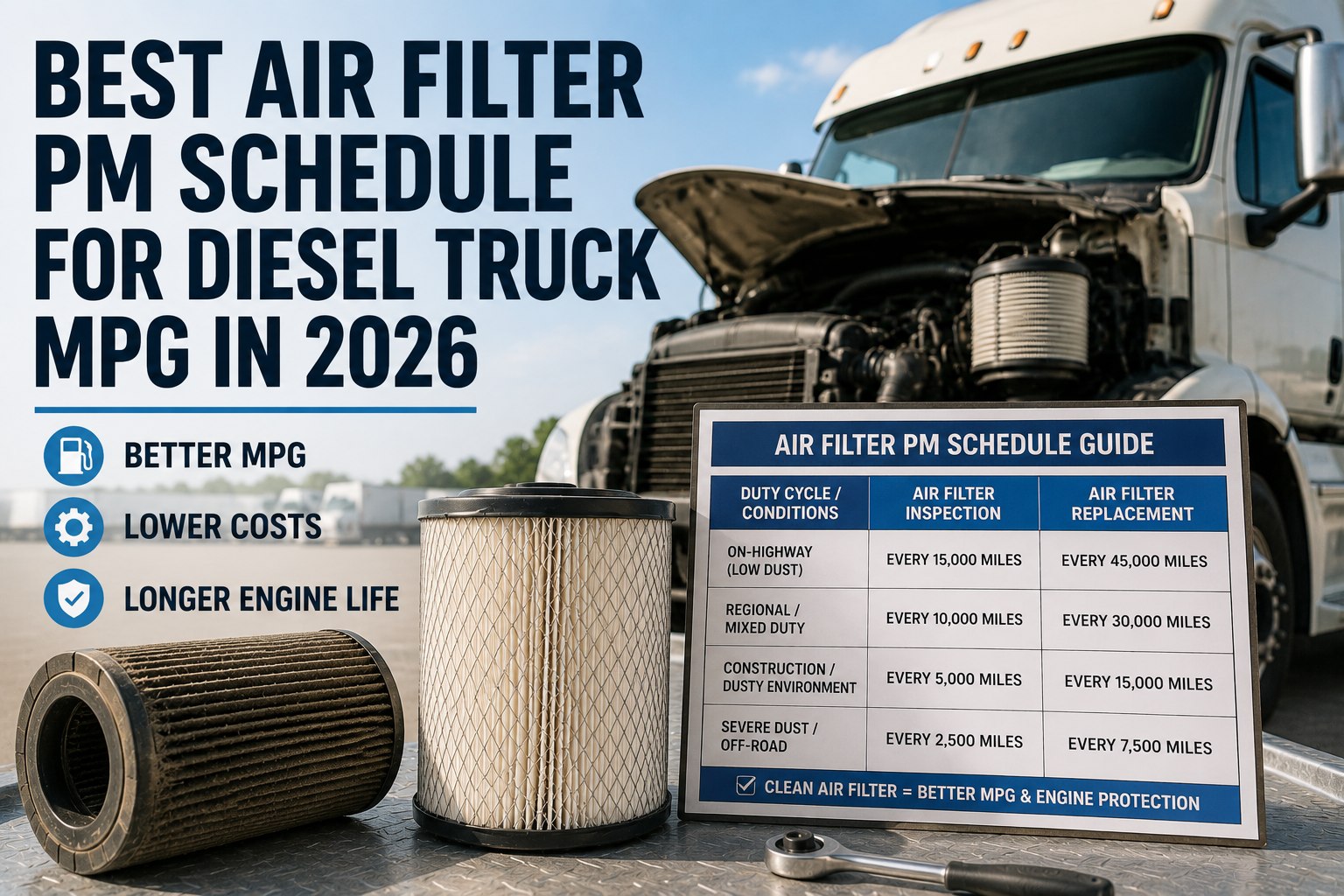
These are the starting points — use them as the initial interval, then adjust each unit based on its restriction gauge readings over the first two service cycles. Every fleet drifts these numbers up or down based on actual data.
OTR runs on paved interstate. Consistent speeds, minimal idle, low dust exposure.
Regional freight, LTL, pickup and delivery. Mixed urban and highway, moderate idle.
Refuse, utility, service trucks. High PTO use, high idle, some off-pavement work.
Construction, agriculture, mining haul. High dust exposure, low speeds, high loads.
Set the Interval Once. Never Miss It Again.
Truck Inspection & Maintenance lets you assign duty-cycle-aware PM intervals per unit or per class — filter changes trigger by miles, engine hours, or restriction telemetry, whichever hits first. Reminders route to the shop, work orders open automatically, and the change history stays linked to the unit forever.
The "Wait for the Indicator" Mistake
Every diesel truck has some form of air filter restriction indicator — a mechanical gauge, a dashboard lamp, or a telematics reading pulled from the ECM. It is tempting to treat it as the whole PM strategy: "we'll change it when the light comes on." That approach is wrong for three specific reasons.
By the time most restriction indicators trigger, the filter has been in the 20–25" H₂O range for weeks — meaning the 3–5% MPG loss has already accumulated. The indicator confirms; it doesn't prevent.
Mechanical gauges seize, dashboard lamps can burn out, ECM sensors can drift. A missed indicator on a severe-duty truck can let restriction climb past 25" — where dust bypass begins damaging the engine.
Restriction triggers happen on the road, at random. That means unplanned downtime and dispatch disruption. A scheduled PM interval — with the indicator as a backstop — keeps the change on your terms.
Turbo Boost Data: The Modern Signal Worth Watching
Modern trucks equipped with telematics report turbo boost pressure and intake manifold pressure directly from the ECM. Rising baseline boost pressure at steady-state cruise is one of the earliest signals of intake restriction — often preceding a mechanical indicator trigger by weeks. Fleets running telematics-integrated maintenance software can catch it before it costs fuel.
Compare same-route, same-load, same-driver runs month over month. A 2–3 PSI rise at steady cruise with no other changes = intake restriction building.
ECM-reported turbo shaft speed rising for the same load points. Same output, harder work — restriction is the usual culprit.
Exhaust gas temperature rising for equivalent load. Not always intake-side, but combined with the above signals, points at airflow restriction.
The endpoint. A steady mile-per-gallon drop on established routes, with no driver or route change, is the wallet-level proof intake is restricted.
Building the PM Schedule: A 4-Step Setup
You don't need a full telematics stack to start doing this right. These four steps can be implemented on any fleet in one week and produce measurable results within a quarter. Sign up free and use the platform to run the whole workflow.
Group your fleet into the four duty categories above. Assign the starting interval. Even a rough classification beats a fleet-wide default.
Log the restriction gauge reading at every service. After two cycles, you'll see whether your interval is too short (still low readings) or too long (near the redline).
Tighten or extend the interval for each unit based on actual data. Two units in the same "duty B" class may end up on different schedules — that's the point.
Overlay MPG trends on the PM history. Fleets that get this right typically recover 2–4% MPG over the first year — real, measurable, ongoing.
Frequently Asked Questions
Rarely for commercial diesel fleets. High-flow oiled filters can allow silica and fine dust to pass into the intake — which on a turbocharged diesel accelerates turbo vane wear and cylinder liner scoring. The small potential MPG gain from freer flow is regularly offset by shortened turbo and engine life. OEM-spec filters, changed on the right interval, consistently deliver better total cost of ownership. Start free and track filter type against long-term unit costs.
Not on modern common-rail diesels with tight-tolerance turbos. Tapping a filter dislodges some surface debris but damages the pleat structure and can create tiny tears that let unfiltered air through — and even a small amount of unfiltered air on a heavy-duty diesel causes measurable engine wear over time. The savings on a $50–$120 filter aren't worth the risk to a $12,000 turbo. Fleet-wide policy: replace, don't reuse.
The right software makes this simple. Assign each unit its class and interval; the platform tracks miles, engine hours, and (where available) restriction telemetry independently, and triggers PMs when the correct threshold hits — whichever comes first. A 100-unit fleet with four duty classes should look like four different PM cadences, not one universal schedule that either over-services the highway trucks or under-services the vocational ones.
You still get most of the benefit. Duty-cycle classification and disciplined interval-with-restriction-reading logging cover the majority of the MPG opportunity — telematics is optimization on top, not a prerequisite. Fleets running mobile DVIRs with a restriction gauge reading field capture 80% of the value of a full telematics setup at a fraction of the cost. See how the mobile DVIR captures this.
Within one to two service cycles. The MPG improvement from correctly-timed filter changes is immediate — the moment a restricted filter is replaced, the truck returns to baseline consumption. The compounding benefit shows up over 6–12 months as the whole fleet moves onto the right schedule and turbo/DPF wear rates drop. The initial payback is fuel; the longer-term payback is equipment longevity.
Turn Air Filter PM Into a Fuel-Economy Program
Truck Inspection & Maintenance is the fleet maintenance management platform that treats every unit as its own PM case — mobile DVIRs to capture restriction readings, PM reminders that respond to miles, hours, or telemetry, digital work orders that route to the shop, and audit-ready reports. Small components managed correctly are how uptime and fuel economy compound.