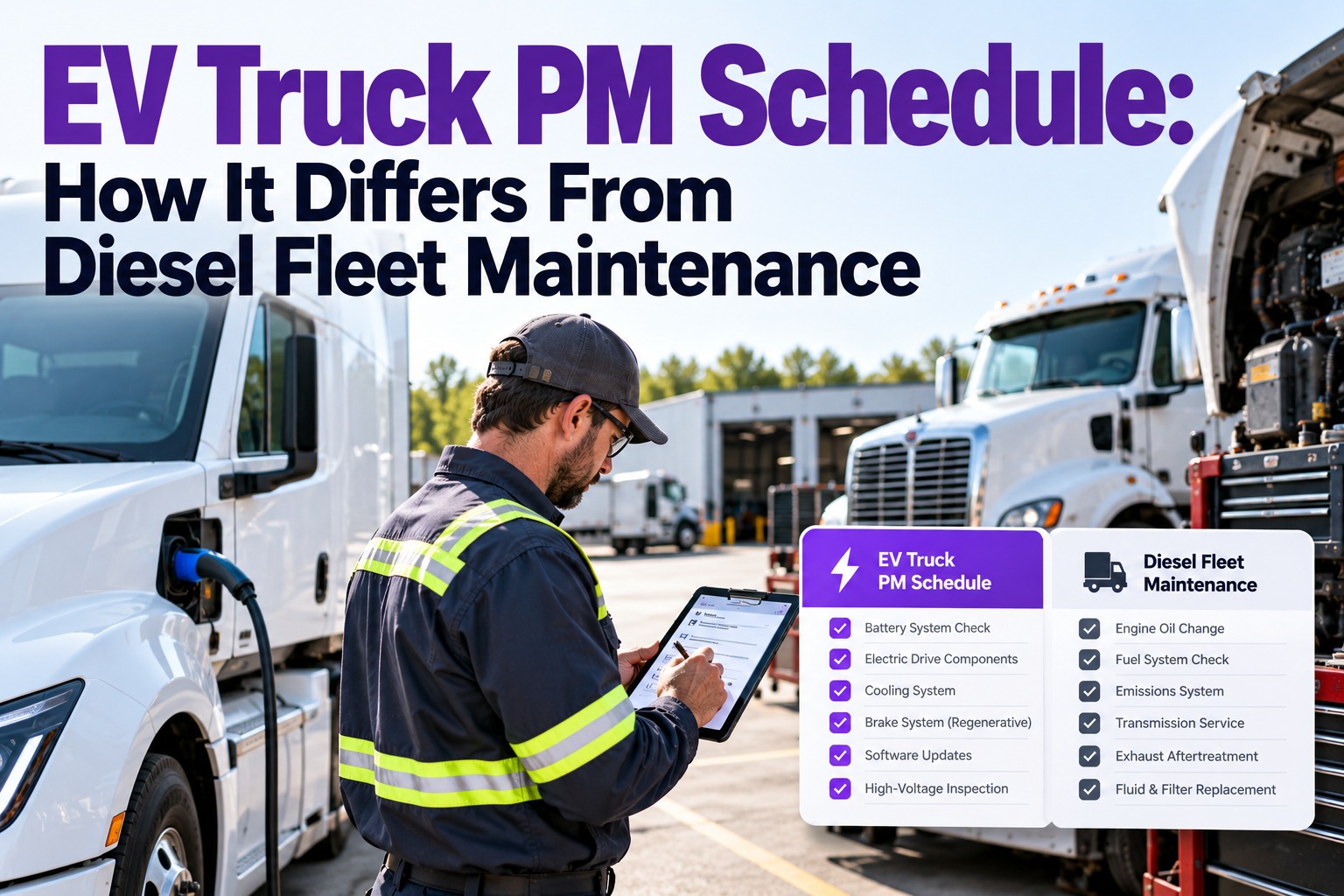
An EV truck isn't a diesel with a battery bolted in — and its PM program can't be either. Take a diesel schedule, delete the oil, DEF, and aftertreatment lines, and you'd be left with a program that ignores the three systems that now matter most: the 600–900V battery, the thermal loops, and the power electronics. The trade is real — NACFE projects BEV maintenance costs 30–50% lower than a comparable diesel — but only if the program is rebuilt, not just trimmed. This guide maps what goes away, what stays, and what's new when you convert a diesel PM schedule for electric, plus the technician skills and tools that change with it — and how Truck Inspection & Maintenance Management Software (TIM) runs EV and diesel intervals side by side on one platform. Start free and build your EV PM program in minutes.
You Don't Trim a Diesel PM Schedule for EV. You Rebuild It.
You want an EV PM program that drops what's gone, keeps what still wears, and adds the high-voltage and thermal checks a diesel schedule never had — not a diesel template with the oil line crossed out. This guide shows exactly what changes and how to convert the schedule. TIM runs it: EV and diesel units on one platform, each interval firing on miles or hours. Every defect logged gets a first response within 4 hours — acknowledged, graded, and assigned.
The Three-Way Split — What Goes, Stays, and Arrives
Converting a diesel program starts with sorting every PM line into three buckets. Delete the first, keep the second, and — the part fleets miss — build the third from scratch. This is the whole conversion in one view.
- Oil & oil filter changes
- Diesel exhaust fluid (DEF)
- Exhaust aftertreatment / DPF
- Fuel filters & injectors
- Turbocharger service
- Tires (wear faster — torque + regen)
- Suspension & wheel ends
- Steering systems
- Air compressors
- Hydraulic/foundation brakes*
- HV battery, cables & connectors
- Thermal loops & coolant
- Inverter & DC-DC converter
- Low-voltage support battery
- Battery state-of-health trending
*Brakes stay on the list but wear far more slowly — regenerative braking significantly reduces pad, drum, and rotor wear, so the inspection stays while the replacement interval stretches.
Same Truck, Different Interval — the PM Comparison
Some tasks don't disappear; they change frequency. A few EV items get more attention than diesel, a few get less. Here's how common PM lines shift when the powertrain goes electric.
| PM Item | Diesel | Electric |
|---|---|---|
| Engine oil & filter | Every 25–50k mi | Eliminated |
| DEF / aftertreatment | Ongoing | Eliminated |
| Foundation brakes | Standard wear | Slower — regen offloads them |
| Tires | Standard wear | Faster — torque & weight |
| Coolant / thermal loop | Engine cooling | Critical — battery + electronics |
| HV cables & connectors | — | New — inspect for chafing/damage |
| Battery state-of-health | — | New — trend to predict degradation |
The New Checkpoints — What a Diesel Schedule Never Had
These four are the heart of an EV PM program — the systems that replace the engine as the thing most likely to strand a truck or cost a pack. A diesel schedule has no line for any of them.
Inspect high-voltage cables and connectors for chafing or damage; check the low-voltage support battery separately.
Monitor the cooling that keeps the pack, motor, and power electronics in their window — uneven cooling shortens pack life.
Verify inverter and DC-to-DC converter performance — the power electronics that run the whole drivetrain.
Trend SOH over time to forecast degradation before it fails — the shift from preventive to predictive.
Converting Your Program — the Five Moves
You don't need to throw out your diesel PM system — you need to remap it. These are the five moves that turn a diesel schedule into an EV one without losing the units still running diesel.
Retire oil, DEF, aftertreatment, fuel-filter, and turbo tasks for EV units — they no longer exist.
Keep tires, brakes, suspension — but stretch brake intervals and tighten tire checks for regen and torque.
Build new lines for HV cables, thermal loops, inverter/DC-DC, and SOH trending, scheduled by OEM spec.
Flag every EV thermal/electrical task as requiring lockout/tagout, insulated tools, and trained techs.
Keep diesel and EV units on the same platform so each fires its own intervals without two separate programs.
One Platform for a Fleet That's Half Diesel, Half Electric
Most fleets aren't all-EV — they're mixed, and running two PM systems is how intervals slip. TIM assigns each unit its own program: diesel trucks keep their oil and DEF triggers, EV trucks fire HV-cable, thermal, and SOH checks, and every task carries its safety and skill requirements. A defect gets photographed, opens a work order, and holds the unit out of service until certified — same workflow whether the powertrain burns diesel or electrons.
Frequently Asked Questions
Rebuild the Schedule — and Earn the 30–50% Savings
Delete the engine lines, re-time what stays, add the HV and thermal checkpoints, and gate the high-voltage work behind trained techs. TIM runs EV and diesel units side by side, each firing its own intervals — so a mixed fleet stays on one system instead of two.