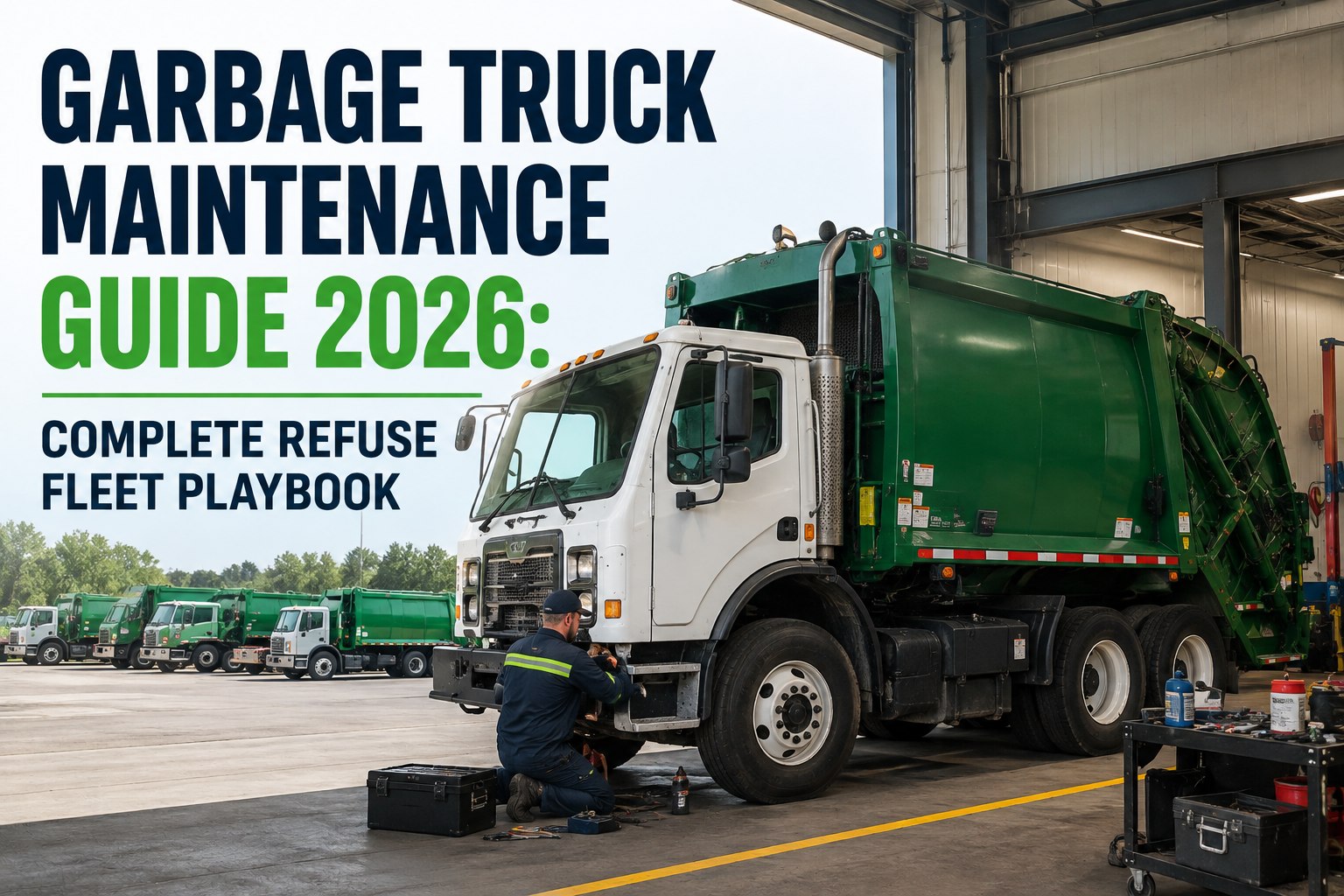
A refuse truck does more mechanical work in one day than a long-haul truck does in a week. 800+ stops, 15,000+ hydraulic cycles a week, and constant PTO operation age brakes, hydraulics, and packers on a timeline no generic fleet software understands. This 2026 buyer guide breaks down the six refuse-specific capabilities that separate purpose-built software from adapted line-haul tools — and how Truck Inspection & Maintenance handles the realities of running garbage, recycling, and roll-off operations. Start a free trial to configure a refuse-ready PM schedule this week.
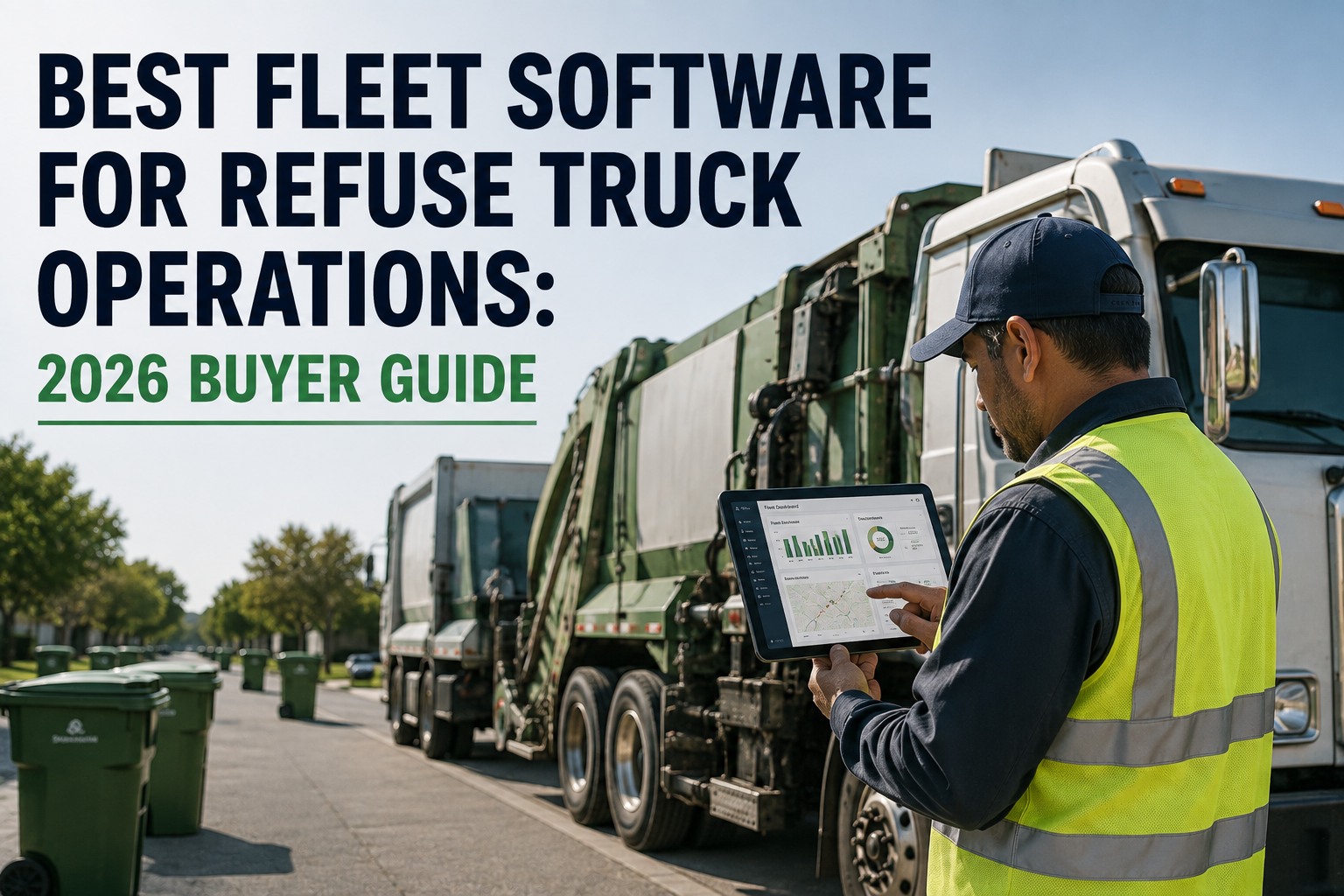
Best Fleet Software for Refuse Truck Operations: 2026 Buyer Guide
Refuse trucks need software tuned for hydraulic cycle tracking, engine-hour PM, body-specific inspections, and route-aware scheduling — not generic mileage-based tools built for delivery vans. Here's the 2026 buyer's checklist and what refuse-native capability actually looks like.
Why Generic Fleet Software Fails on Refuse Trucks
Almost every fleet management tool on the market was designed for a truck that spends most of its life at highway speed with a driver in the seat and a load in the trailer. Refuse trucks break every assumption in that model. Here's what generic software gets wrong.
Generic assumption: service triggered by odometer.
Refuse reality: a truck that idles 4 hours/day with 800 lift cycles accrues far more wear per mile than a highway truck. Mileage PM misses hydraulics entirely.
Generic assumption: engine and drivetrain are the failure points.
Refuse reality: compactors, packers, hydraulic pumps, and lift arms fail 3× more often than powertrain components. Software that doesn't track them misses the biggest cost driver.
Generic assumption: pre-trip covers brakes, lights, tires, coupling.
Refuse reality: hydraulic hoses, lift arm safety pins, tailgate seals, packer wear plates. A 30-item DVIR that skips 20 of them.
Generic assumption: point A to point B optimization.
Refuse reality: alley access, weight limits, cul-de-sac logic, one-way street constraints, and time windows that generic routing engines don't respect.
The Six Refuse-Specific Capabilities to Look For
Every serious buyer conversation should test the software against these six criteria. If the answer to any of them is "we can add that as a custom field" — that's a hard no. Refuse-native means built in, not bolted on.
What it does: Triggers PM based on hydraulic cycles, lift arm operations, or PTO hours — not just miles or calendar days.
Why refuse needs it: A $280 fluid change at 15,000 cycles prevents a $4,200 hydraulic pump failure. Mileage schedules will always be behind.
What it does: Pre-configured DVIRs covering compactor, packer, tailgate, hydraulic hoses, lift arms, plus standard vehicle items.
Why refuse needs it: Body defects that never make it onto a generic pre-trip end up as mid-route breakdowns. Custom DVIRs by unit type solve this.
What it does: Runs multiple PM triggers per unit — mileage, engine hours, hydraulic cycles — with the earliest hit firing the service.
Why refuse needs it: Different systems wear at different rates. Cycles for hydraulics, hours for engine, miles for chassis — all in one PM record.
What it does: Tracks the body separately from the chassis — service history follows the packer or lift arm even when swapped between units.
Why refuse needs it: Bodies have their own OEM warranties, service intervals, and failure histories. Tracking them as attached to a specific chassis loses that data.
What it does: Schedules PM in windows that respect route commitments — avoiding pulling a truck the day of its heaviest residential route.
Why refuse needs it: A missed pickup has direct contract and service consequences that a late delivery doesn't. PM discipline that ignores route obligations creates operational chaos.
What it does: Manages dumpsters, roll-off containers, transfer station equipment as tracked assets with inspection and service records.
Why refuse needs it: These represent serious capital and drive revenue. Software that only tracks trucks leaves 30–40% of the asset base invisible.
Refuse-Native vs Generic: The Feature Matrix
The clearest way to test any candidate software is a side-by-side. Here's what refuse-native capability looks like versus what most generic fleet tools deliver.
Refuse-Ready Out of the Box
Truck Inspection & Maintenance ships with pre-configured refuse templates — cycle-based PM, waste-specific DVIRs covering hydraulics and body systems, engine-hour scheduling, container tracking, and audit-ready DOT records. Mobile-first for drivers, work-order-driven for the shop, dashboard-ready for management. Live in days, not weeks.
The Buyer's Question Set for Every Demo
Bring this list to every software demo. If the vendor can't answer yes to at least the first six, they're selling a generic tool with a refuse label on the box. Sign up free and check the answers against a working refuse configuration.
Implementation: What to Expect the First 30 Days
Good refuse fleet software should be operationally useful in days, not months. Here's the realistic timeline for a fleet of 10–50 trucks.
Import truck list. Configure PM triggers (mileage, hours, cycles). Load refuse-specific DVIR templates. Import driver and mechanic accounts.
Mobile DVIRs go live. Drivers walk through refuse-specific checklist on tablets. First defects route to work orders as designed.
Mechanics work from digital work orders. PM reminders fire per unit class. First cycle-based hydraulic PM triggers automatically.
PM compliance dashboard live. DOT audit-ready reports available. First month's cost-per-truck data ready for management review.
The KPIs That Prove Refuse Software Is Working
Any software worth its subscription cost should move these five metrics within one quarter. Baseline them at signup; re-measure at day 90.
% of scheduled PMs completed on time — hydraulic, chassis, and body combined. Target: 95%+. Cycle-based scheduling typically lifts this from 60–70% to 95%+ within a quarter.
Trucks that fail during collection routes per month. Every one is a missed contract commitment. Cycle-triggered hydraulic PM directly reduces this.
The bottom line. Refuse-native PM discipline typically reduces this by 10–20% within 6 months by shifting spend from unplanned repair to scheduled service.
Hours from DVIR entry to closed work order. Mobile DVIRs with photo capture typically cut this in half versus paper-and-radio workflows.
Hours needed to produce records for a random-audit request. Purpose-built compliance reporting takes this from days-to-weeks down to minutes.
Frequently Asked Questions
You can — most fleets do — but you pay for it in unplanned hydraulic failures, missed PMs, and shop staff working around software instead of with it. Generic tools can be customized, but every custom field you add is technical debt that has to be maintained, backed up, and re-explained when someone new joins the team. Refuse-native software ships with the customization already done for the refuse use case. Cheaper in the long run, faster to value in the short run. Start a free trial and see the pre-configured refuse setup.
Increasingly, no. The best refuse platforms unify DVIRs, PM, work orders, and route awareness in one system — because the disciplines are interdependent. A PM that fires the day of a heavy route is a scheduling failure; a defect that grounds a truck mid-route is a maintenance failure that shows up in operations. Two separate systems make each side blind to what the other is doing. One system with awareness of both keeps the whole operation running.
Two paths. If the truck has a telematics or body controller reporting hydraulic cycle count, the software pulls it directly via API integration. If not, drivers or mechanics log the count during pre-trip or weekly PM — a mobile DVIR field takes 15 seconds. Purpose-built refuse software supports both. Manual capture is not ideal but works well enough to catch the biggest PM windows; it's about 80% as effective as automated capture at a fraction of the cost.
Look for software that supports multiple unit classes with different PM rules, DVIR templates, and dashboards per class. Refuse trucks run on cycles and hours; support pickups run on mileage; roll-off tractors are somewhere in between. A good platform lets each unit class run under its own rules while producing unified fleet-wide reporting. Truck Inspection & Maintenance handles mixed fleets natively. Ask about mixed-fleet configurations.
Per-truck subscription is the visible cost, but total cost includes implementation time, training, and ongoing support. Purpose-built refuse platforms typically deliver lower TCO than generic tools because implementation is measured in days instead of weeks, and configuration doesn't drift as you add custom fields. Free-tier options for small fleets let you validate fit before committing to a paid plan — the correct way to buy this software in 2026.
Fleet Software That Understands How Refuse Trucks Actually Break
Truck Inspection & Maintenance is the mobile-first fleet maintenance platform built for the wear patterns refuse trucks actually have — cycle-based PM for hydraulics, engine-hour scheduling for powertrain, refuse-specific DVIR templates, and audit-ready DOT records. One platform for drivers, mechanics, and managers. Live in days, not months.