A CNG fuel system is unlike anything else on a truck, because it stores natural gas at roughly 3,600 PSI — pressure high enough that maintenance isn't just about reliability, it's about safety, and it's governed by federal regulation rather than left to a shop's discretion. Two facts make CNG maintenance genuinely different from diesel. First, the fuel cylinders must be inspected on a mandated schedule — every three years or 36,000 miles under FMVSS 304, and after any fire or accident — by a certified inspector, not just any mechanic. Second, and the one fleets forget: the cylinder itself has an expiration date. It's a critical safety device with a finite design life, often shorter than the truck it's bolted to, and running past it isn't an option. Miss either and you're carrying uninsurable liability at 3,600 PSI. Track every CNG cylinder and deadline free. This guide walks the inspection cadence, the high-pressure components that get checked, how leaks are found, when cylinders retire, and how to keep the whole compliance trail audit-ready.
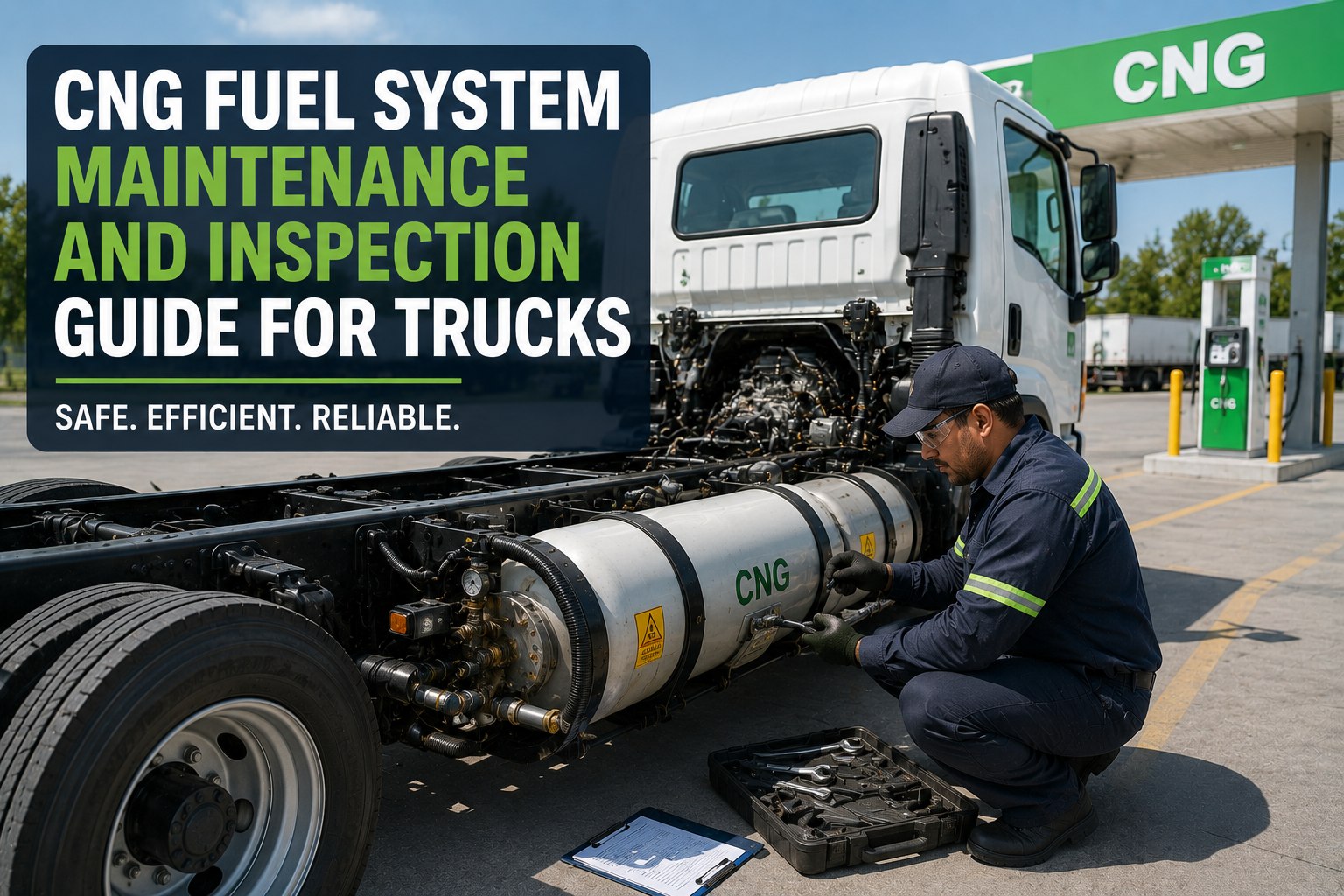
CNG Fuel System Maintenance and Inspection Guide for Trucks
CNG stores fuel at 3,600 PSI — so maintenance is a safety-and-compliance discipline, not a routine. The mandated inspection cadence, the high-pressure components that get checked, and the cylinder expiration dates you cannot miss.
Why 3,600 PSI Changes Everything
The pressure is the whole story. Diesel sits in a tank at atmospheric pressure; CNG is compressed to thousands of times that, which turns every fitting, valve, and cylinder into a safety-critical component and every leak into a hazard.
The Inspection Cadence
CNG inspection works in tiers, and understanding which one applies when is the core of staying compliant. A routine look happens all the time; a detailed inspection is triggered by the calendar, by mileage, or by any incident.
A regular check of the system's visible elements — cylinder shields, mounting brackets, and high-pressure components — for obvious or gross external damage. If damage is found, it escalates.
The mandated deep inspection of the entire high-pressure system by a certified inspector — required on the FMVSS 304 interval, whenever the general check finds damage, and after any fire or accident.
Any fire or collision triggers a full detailed inspection before the vehicle returns to service — regardless of where it sits in the normal interval.
What Gets Inspected
Since 2008 the industry best practice has been to inspect not just the cylinders but the entire high-pressure fuel system. A detailed inspection examines every component that holds or handles pressurized gas.
The tanks themselves and their protective shields, checked for cracks, gouges, abrasion, and impact damage.
Mounting hardware inspected for looseness, corrosion, or damage that could stress the cylinders.
Pressure relief devices — the safety valves that vent gas in a fire — checked for damage and correct seating.
Manual and solenoid valves, quarter-turn valves, and all fittings examined and leak-checked.
High-pressure fuel lines and hoses inspected for wear, chafing, kinks, and secure routing.
The high-pressure regulator and coalescing filter checked for damage, seating, and leaks.
Finding the Leaks
Leak detection is the heart of CNG safety, because escaping methane is invisible and, in the wrong place, dangerous. Every connection in the high-pressure system gets checked two ways.
A solution applied to fittings, valve packing, seals, and pressure chambers — bubbles reveal an escaping-gas leak at the exact point.
An electronic detector sweeps the system to pinpoint the general location of a gas leak that a visual check might miss.
The Cylinder Has an Expiration Date
This is the fact that catches fleets off guard: a CNG cylinder is a critical safety device with a finite, designated life — commonly 15, 20, or 25 years depending on type — and that life can be shorter than the truck it's mounted on. It must be retired at that date, or earlier if it's ever damaged or fails an inspection. There's no extending it. Truck Inspection & Maintenance tracks every cylinder's serial number, manufacture date, and retirement date, and alerts you well before the deadline — so a tank never quietly ages past its limit on an in-service truck.
The Cylinder Lifecycle
Every cylinder moves through a fixed lifecycle from manufacture to mandatory retirement, punctuated by recurring inspections. Managing that timeline per tank is the essence of CNG fleet compliance.
Who Can Actually Do the Work
CNG fuel-system work isn't general mechanic work. The pressure and the fuel demand specific qualifications, and using an untrained tech is both a safety risk and a compliance problem.
Standard technicians can handle the truck's non-fuel systems — brakes, suspension, tires, and the usual chassis PM — just as on any vehicle.
Cylinders, regulators, fuel lines, and PRDs require compressed-gas safety certification and CNG-specific training. Most states require documented training records — and courts look hard at whether the mandated interval and qualified-inspector standard were followed after any incident.
The CNG-Specific PM Items
Beyond the mandated inspections, CNG engines carry their own routine maintenance schedule alongside standard vehicle PMs — components that don't exist on a diesel or wear differently.
Documentation Is Not Optional
With a federally-mandated inspection regime, the paper trail is as important as the wrench work. Every detailed inspection has to be recorded and kept — and when it's needed, you need it fast.
Each detailed visual inspection requires a completed CNG Fuel System Inspection form with accompanying photos documenting the system and any damage found.
Inspection records must be retained for DOT annual compliance reviews. They aren't submitted to a regulator up front — but you must produce them on demand.
Contract renewals and audits require showing an unbroken inspection history per cylinder. A missing record is a compliance gap even if the work was done.
Every Cylinder, Every Deadline, One System
CNG compliance lives or dies on tracking dozens of cylinders, each with its own serial number, manufacture date, inspection history, and retirement date — by mileage and by calendar. Truck Inspection & Maintenance auto-alerts before every requalification and retirement deadline, stores each inspection form and photo against the cylinder, runs CNG-specific PM schedules alongside standard ones, and generates the compliance reports audits and contract renewals demand in one click.
Frequently Asked Questions
The mandated detailed visual inspection is required every three years or 36,000 miles, whichever comes first, under FMVSS 304 — and additionally after any fire or accident, regardless of where the vehicle sits in the normal interval. That detailed inspection covers the entire high-pressure system and must be done by a certified inspector. Separately, a general visual inspection of the visible components should happen as part of routine PM, and for heavy-duty trucks with a GVWR of 10,000 pounds or more, a general visual inspection is required at least every 12 months. One important wrinkle: high-mileage heavy-duty trucks can hit the 36,000-mile trigger so quickly that they'd need inspection every 11 to 13 weeks, which is why at least two fuel-system manufacturers offer documentation supporting a one-year / 100,000-mile interval for their systems. Track both the mileage and the date per vehicle so neither trigger is missed. Start a free trial to automate scheduling.
Yes — this is one of the most important and most overlooked facts in CNG operations. A CNG cylinder is a critical safety device manufactured to a finite, designated design life, commonly 15, 20, or 25 years depending on the cylinder type. At the end of that life it must be retired from service; there is no requalification that extends it. What makes this genuinely unusual is that the cylinder's lifespan can be shorter than the truck it's installed on, so a vehicle can outlive its own fuel tanks. A cylinder must also be retired early if it's ever damaged or fails an inspection — the design-life date is a maximum, not a promise. Because these dates arrive years apart across a fleet of cylinders, tracking each one's manufacture date and retirement deadline individually is essential; letting a tank age past its limit on an in-service truck is a serious safety and liability problem. Ask about cylinder lifecycle tracking.
Not on the fuel system. For general chassis work — brakes, suspension, tires, and standard vehicle PM — a regular technician is fine. But for the fuel-system components, meaning the cylinders, regulators, fuel lines, and pressure relief devices, technicians need compressed-gas safety certification and CNG-specific training, and most states require documented training records. This isn't bureaucratic box-checking: these components handle gas at around 3,600 PSI, where a mistake is dangerous, and the mandated detailed inspection specifically must be performed by a certified inspector. There's also a liability dimension — if an incident occurs and the inspection interval or the inspector's qualifications are ever in question, following the widely adhered-to standard matters a great deal. Using untrained personnel on the high-pressure system is both a safety risk and a compliance exposure. Start free and track technician certifications.
Leak detection uses two complementary methods because escaping methane is invisible. First, a leak-check solution is applied to fittings, valve packing, seals, and pressure chambers — where gas is escaping, the solution bubbles, pinpointing the exact leak location. Second, a portable methane detector is used to sweep the system and identify the general location of any gas leak that might not be obvious. During a detailed inspection, technicians leak-check every connection in the high-pressure system, including all solenoid valves, the high-pressure coalescing filter, the quarter-turn valves, the high-pressure regulators, and the pressure relief devices, along with all fittings. Inspectors also carry supporting tools — a depth gauge and measuring tape to assess any cylinder damage precisely, and a camera to document findings. Thorough leak checking of every connection is what keeps a high-pressure gas system safe. Start free and log leak-check results.
For each detailed visual inspection, you should retain a completed CNG Fuel System Inspection form along with accompanying photos documenting the system's condition and any damage discovered. These records aren't required to be submitted to a regulatory agency or manufacturer up front, but they must be retained and available for DOT annual compliance reviews, and you'll need to produce an unbroken inspection history for audits and contract renewals. Practically, that means maintaining per-cylinder documentation — serial number, manufacture date, every inspection date and result, and the retirement date — so the full lifecycle of each tank is provable on demand. A missing record is effectively a compliance gap even when the physical work was performed correctly, which is why keeping this trail organized and instantly retrievable matters as much as the inspections themselves. This is exactly the kind of documentation a maintenance platform is built to hold and produce on one click. Start free and keep audit-ready records.
Run a CNG Fleet That's Always Audit-Ready
CNG maintenance is a safety-and-compliance discipline at 3,600 PSI — mandated inspection intervals, certified inspectors, and cylinders that expire on a fixed date. Truck Inspection & Maintenance tracks every cylinder's serial, mileage, and calendar triggers, alerts before each inspection and retirement deadline, stores every form and photo, and produces one-click compliance reports — so nothing ages past its limit and every audit is a formality.