A fire truck spends almost its entire life parked — and has to perform at 100% the second the call comes in. That's what makes its maintenance unlike any other vehicle's: a dead battery, a pump that won't catch prime, or an aerial past its annual test stays hidden in the bay and shows up at the worst possible moment, on scene. A real preventive maintenance program keeps the apparatus ready, not just running. This guide lays out that program, and shows how Truck Inspection & Maintenance Management Software (TIM) runs it. Start free and keep every apparatus ready with TIM.
TIM · Fire Apparatus Inspection & PM Program
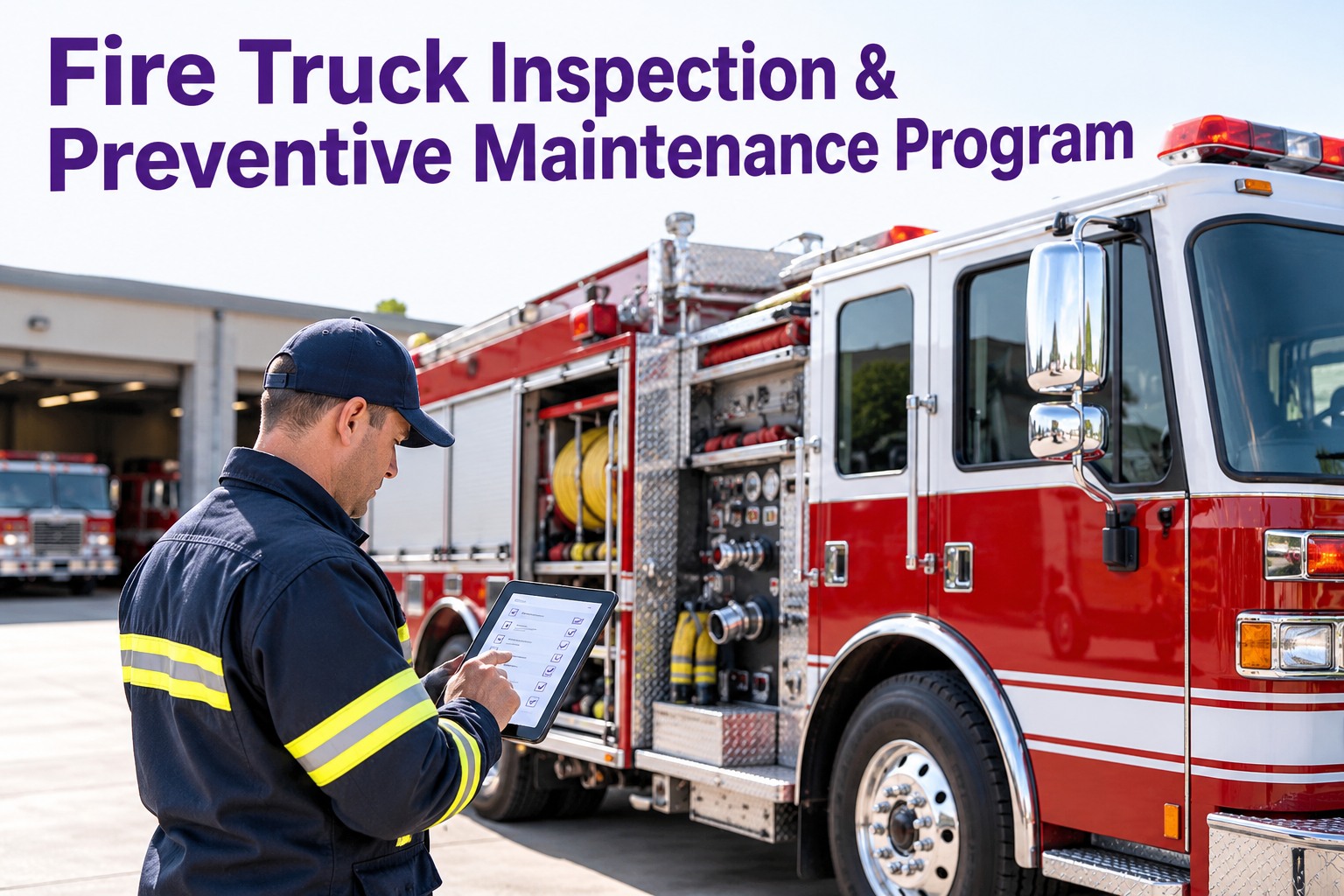
Fire Truck Inspection & Preventive Maintenance Program.
Most trucks warn you as they wear. A fire apparatus sits idle, hides its defects, and then has to deliver everything at once when the alarm sounds — pump, aerial, water, warning lights, all at full capability. A PM program built on readiness catches the problem in the bay instead of on the fireground, and TIM runs the inspections, the NFPA test schedule, and the repairs on one record.
Our promise: every flagged defect gets a 4-hour first response — acknowledged, graded, and assigned.
100%
ready when the call comes
1911
the NFPA standard you run to
1
record, inspection to repair
Why Fire Apparatus PM Is Different
A fire truck breaks the usual rules of fleet maintenance in three ways — and each one is why it needs a program, not just a service interval.
◉
Readiness, not uptimeIt isn't measured by miles driven but by whether it delivers everything, instantly, the one time it's needed.
⬒
Systems no other truck hasA pump, an aerial, a water tank, a foam system, and warning gear all have to be maintained beyond the chassis.
⚑
Failure shows up on sceneA parked apparatus hides a defect for weeks, then reveals it at the fireground — the costliest possible place.
That combination is why "it ran last week" isn't good enough. Contact our team to build a readiness-based program.
Beyond the Chassis — What a Fire Truck Adds
Every fire apparatus is a heavy truck plus a set of mission systems that no delivery rig carries. A PM program has to cover all of them, because any one can be the thing that fails on scene.
◆
Fire pump & plumbingPump, primer, valves, intakes, and discharges — the heart of the apparatus, tested annually for capacity.
↥
Aerial or ladderBoom, ladder, rungs, cables, and hydraulics — structural and operational integrity on a hard schedule.
◱
Water tank & foamTank, baffles, foam proportioner, and tank-to-pump line — the agent has to flow when it's called for.
✸
Emergency warningLights, siren, and controllers — the apparatus has to be seen and heard responding.
◈
SCBA & onboard gearAir brackets, mounts, and equipment that have to be secure and present on every call.
⬓
Chassis & drivelineBrakes, steering, tires, and engine — the same heavy-truck basics, held to a readiness bar.
Six systems, one program — miss any and readiness is a gamble. Start free and cover every system on one record with TIM.
The Inspection & Testing Cadence
Fire apparatus maintenance runs on a layered schedule, framed by NFPA 1911 for in-service apparatus. Match the check to how fast each risk builds — from the daily walk-around to the annual certified tests.
DAILY / SHIFT
Readiness checkSteering, brakes, interlocks, warning lights, siren, SCBA brackets, and fluid levels at the start of every shift.
WEEKLY
Operational checkPump engaged and primed, aerial cycled, tank and foam confirmed, equipment inventoried.
PERIODIC
Scheduled serviceFluids, filters, brakes, and the deeper mechanical inspection on the maker's and the department's interval.
ANNUAL
Certified NFPA testsThe pump service test and the aerial structural and operational test, each certified and documented once a year.
The daily check catches the fast stuff; the annual tests prove the mission systems still perform. Contact our team to set the full cadence for your apparatus.
THE ANNUAL TESTS THAT MATTER MOST
The pump and the aerial are tested, not just inspected. Under NFPA 1911, in-service apparatus get a certified annual pump service test — capacity verified at 100% at 150 PSI, 70% at 200 PSI, and 50% at 250 PSI, plus the dry vacuum primer and relief-valve checks. Aerial devices get an annual structural and operational test, including non-destructive examination of welds and pins and hydraulic drift tolerances. These aren't walk-arounds — they're pass-or-fail certifications, and the results become part of the apparatus record. Confirm exact requirements against NFPA 1911; this is general guidance, not a substitute for the standard.
The PM Program Loop
A program is more than a schedule — it's a loop that turns every check into a closed, documented repair. These five steps run continuously for each apparatus.
1
InspectDaily, weekly, and annual checks run on schedule, every apparatus.
→
2
Flag the defectA finding is logged and graded by how much it threatens readiness.
→
3
RepairThe defect becomes a work order routed to the shop — no re-keying.
→
4
Re-testThe fix is verified, and mission systems re-tested where needed.
→
5
DocumentThe whole history kept on the apparatus record for NFPA proof.
Close the loop every time and readiness stops being a hope. Start free and run the whole loop on one record with TIM.
The Failures That Catch a Crew on Scene
When an apparatus lets a crew down, it's usually one of these — and each is a program step that got skipped.
✕
Pump won't catch primeA primer or intake problem hidden in the bay means no water pressure at the one moment it's needed.
✕
Aerial past its test dateAn overdue structural test leaves the ladder's integrity unverified when a crew's weight is on it.
✕
Dead battery or no-startA truck that sits can't crank when the alarm sounds — the simplest and most preventable failure.
✕
Warning lights or siren outAn apparatus that can't be seen or heard responding is a hazard to its own crew and the public.
Every one traces back to a check that didn't happen or a defect nobody tracked. Start free and make sure nothing gets skipped with TIM.
How TIM Helps
Checks Scheduled, Tests Tracked, Readiness Documented
A readiness program has two things that can't slip: the daily checks and the annual NFPA tests. TIM runs both — it puts the shift and weekly checks on every crew's phone, tracks the pump and aerial test due dates so neither lapses, turns any finding into a graded work order, and keeps the whole history on the apparatus record for proof.
1Check runs on schedule
→
2Defect graded
→
3Work order routed
→
4Record retained
Shift & weekly checklistsReadiness and operational checks on every crew's phone, every apparatus.
NFPA test intervals trackedAnnual pump and aerial test due dates held and counted down so neither lapses.
Finding becomes a work orderA flagged defect routes to the shop the moment it's filed — no re-keying.
Readiness-based severityA mission-critical fault goes now; a minor item joins the planned queue.
Records on the apparatusTest certificates and repairs kept on the unit and produced on demand.
Per-unit historyEvery check, test, and repair logged against that apparatus for its service life.
Frequently Asked Questions
What is NFPA 1911 and what does it cover?
NFPA 1911 is the standard for the inspection, maintenance, testing, and retirement of in-service automotive fire apparatus — the rules for keeping an apparatus ready once it's in the fleet. It covers the daily and weekly checks crews perform, the periodic service, and the certified annual tests of the pump and aerial, along with the out-of-service criteria that pull a truck from the fleet when a critical defect is found. It's the in-service companion to NFPA 1901, which governs how the apparatus is built in the first place.
Start free and track your NFPA program with TIM.
How often does a fire pump need to be tested?
A certified pump service test is performed annually on in-service apparatus under NFPA 1911. It verifies the pump's capacity at the standard points — 100% at 150 PSI, 70% at 200 PSI, and 50% at 250 PSI — along with the dry vacuum primer pull and the relief-valve response. It's a pass-or-fail certification, not a visual check, and the results are retained as part of the apparatus record. Crews still confirm the pump engages and primes during their weekly checks between annual tests.
How are aerial devices tested and inspected?
Aerial devices get an annual structural and operational test that goes well beyond a visual inspection — including non-destructive examination such as magnetic particle testing of welds and ultrasonic examination of pins, hydraulic cylinder drift checks, and verification of the operational interlocks. Because a crew trusts the aerial with their weight at height, an overdue or failed test takes the device out of service until it's corrected and re-certified. Daily and weekly checks cover the operational basics in between.
What takes a fire apparatus out of service?
A critical deficiency — one that affects safe operation or the apparatus's ability to perform its mission. NFPA 1911 sets out-of-service criteria for exactly this, with examples like a defective steering drag link, an inoperative windshield wiper in the rain, or an unseated pump transmission. The principle is that a readiness-critical fault isn't a "fix it next week" item: the apparatus comes out of front-line service until it's corrected, rather than risk it failing on a call.
Why does fire apparatus need a program instead of just scheduled service?
Because readiness can't be achieved by mileage intervals alone. A fire truck sits idle most of the time, so a defect doesn't reveal itself through use — it has to be found by deliberate daily, weekly, and annual checks, then tracked through repair and re-test until it's closed. A program ties those checks, the NFPA test schedule, the defect tracking, and the documentation together, so the apparatus is provably ready rather than assumed ready. That's the gap software like TIM is built to close.
Inspect · Test · Repair · Document · Ready
Readiness Is Built in the Bay, Not on the Fireground
A fire apparatus gives no warning and gets no second chance — it's either ready when the alarm sounds or it isn't. Between calls, that readiness is built by daily checks, weekly operational tests, certified annual pump and aerial tests, and a defect-to-repair loop that never leaves a finding open. A program ties it all together, and TIM runs it on one record — so the truck that rolls out of the bay is one the crew can count on.
No credit card required · Free for up to 3 trucks · Shift checklists, NFPA test tracking, and apparatus records built in