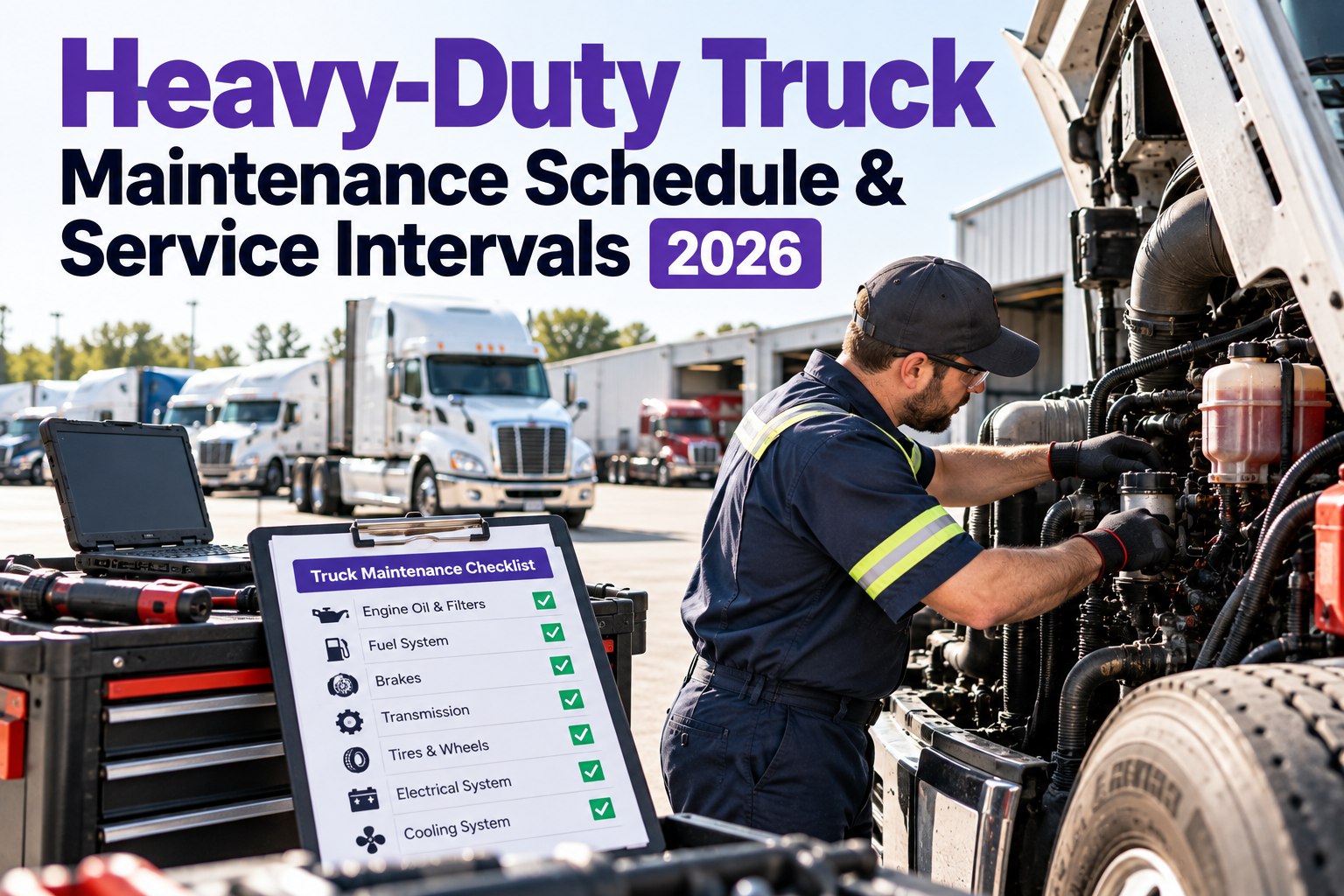
Most fleets don't fail PM because they lack checklists — they fail because the checklists live in spreadsheets nobody updates, get applied with the wrong trigger logic, or never connect to the work orders that turn an inspection finding into an actual repair. The 2026 industry baseline is sobering: 70% of fleet managers still rely on reactive maintenance even though structured PM programs deliver 25–40% cost reduction, 300–500% ROI, and reduce unplanned downtime by 70%. The gap between knowing what to inspect and running an actual operational PM program is where most fleets bleed money — typically $15,000–$25,000 per truck per year that should never have left the bank account.
A complete PM program isn't a single checklist. It's an integrated system: an asset registry that tracks every vehicle, multi-trigger scheduling logic (mileage OR engine hours OR calendar — whichever comes first), tiered service Class A through D for trucks AND trailers, daily/weekly/monthly/quarterly inspection cadences layered on top, automated work order generation when defects are found, and KPI tracking that reveals whether the program actually works. Modern fleet platforms tie all these elements together so technicians work from mobile checklists instead of clipboards, scheduling fires automatically, and audit packets generate in seconds rather than days.
This guide is the complete operational blueprint: how to build the PM program (not just inspect a truck), the three scheduling triggers, the cadence overlay, Class A through D plus T-class checklists for trucks and trailers, the 5-step implementation framework, and the KPIs that prove the program works. Start your free trial to deploy a complete PM program across your fleet — live in 10 minutes, no credit card required.
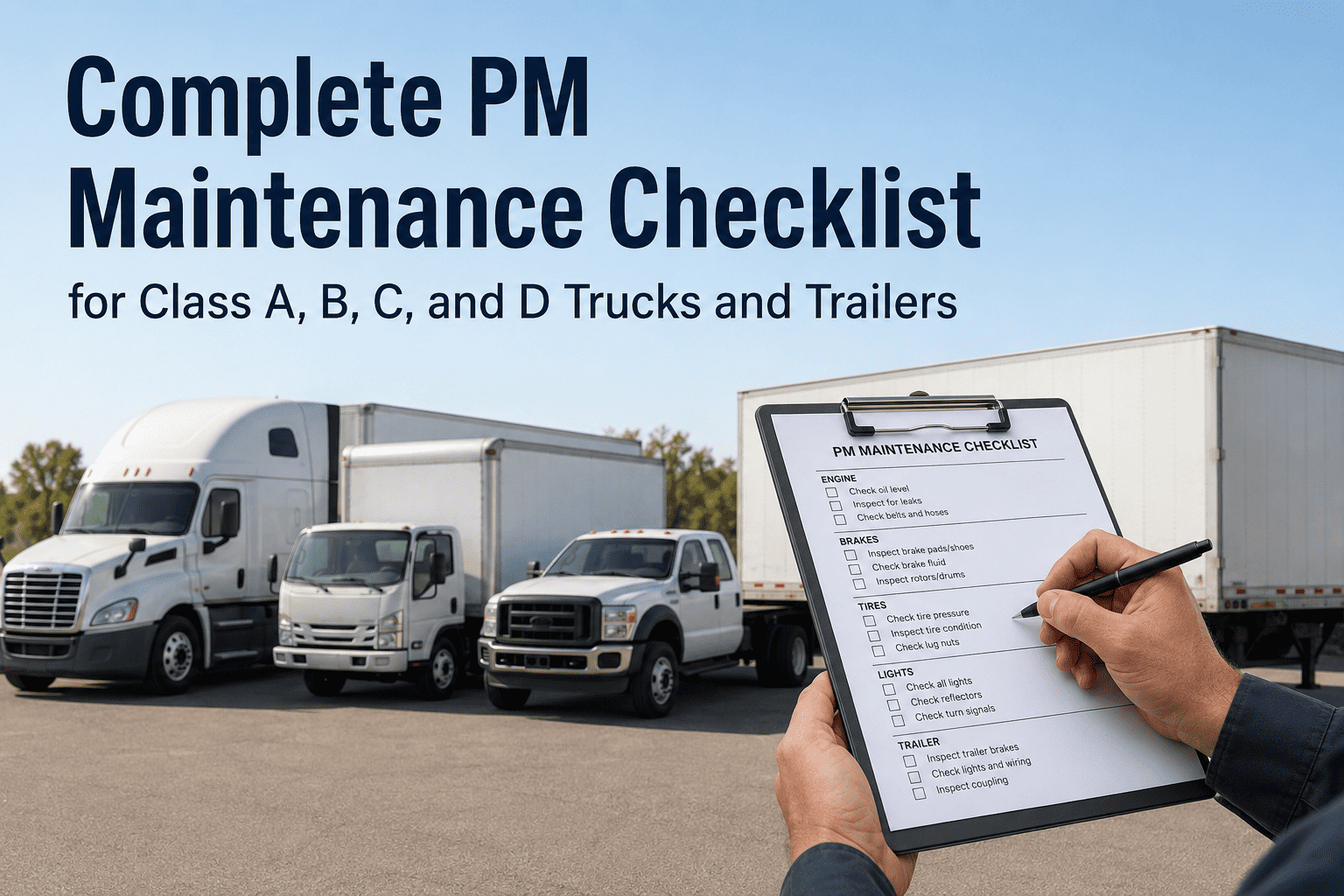
Complete PM Maintenance Checklist for Class A, B, C, and D Trucks and Trailers
Beyond static checklists — the complete operational PM program: trigger systems, daily/weekly/monthly/quarterly cadences, Class A–D + trailer T-class, work order integration, and the KPIs that prove it works.
Quick Answer: What Makes a Complete PM Program?
A complete PM maintenance program is an integrated operational system — not a static checklist. It includes five components: (1) an asset registry tracking every truck and trailer with current mileage/hours/year/make/model, (2) multi-trigger scheduling (mileage OR engine hours OR calendar — whichever comes first), (3) tiered Class A through D service templates for trucks plus T-class for trailers on a parallel quarterly cadence, (4) a daily/weekly/monthly/quarterly inspection cadence overlay covering DVIRs to deep service, and (5) integrated work orders auto-generated from inspection findings. Fleets running complete PM programs reduce unplanned downtime by 70%, deliver 300–500% first-year ROI, and save $4–$8 for every $1 invested in preventive maintenance versus reactive repair.
The 5 Building Blocks of a Complete PM Program
Skip any one of these and the entire program weakens. Most "PM failures" trace back to a missing building block — usually #2 (trigger logic) or #5 (work order integration). Contact our sales team for a PM program audit against these five building blocks.
The 3 PM Trigger Types
Not every truck needs the same scheduling logic. Highway tractors accumulate miles fast and need mileage triggers. Construction equipment idles for hours without moving and needs engine-hour triggers. Trailers sit in yards needing only calendar triggers. The 2026 standard: use all three simultaneously, with "whichever comes first" logic.
Class A through D: Cumulative Service Hierarchy
Each PM class builds on the previous. PM-B includes all PM-A items plus deeper service. PM-C includes all of B plus annual DOT and major fluids. PM-D includes everything plus rebuild-level work. This cumulative structure prevents duplicate inspection while ensuring increasingly deep coverage at longer intervals.
Trailer T-Class: The Parallel Quarterly Schedule
Trailers don't accumulate mileage the same way tractors do — they sit in yards for days, hook to multiple tractors, and rack up calendar time without rolling. The 2026 standard: every trailer runs a parallel quarterly schedule (T1/TA every 3 months) regardless of usage, because brakes corrode, ABS components degrade, lights fail, and tires age whether the trailer moves or not.
The Cadence Overlay: Daily / Weekly / Monthly / Quarterly
Class A–D services run on long-cycle intervals (10K mi to 100K+). But shorter inspection cadences catch different defect types — a daily DVIR catches a flat tire that a 10,000-mile PM-A would miss. The 2026 best practice layers four inspection cadences ON TOP of the Class A–D service tiers. Sign up free to deploy all four cadences automatically.
5-Step Implementation Framework
Going from reactive to proactive PM isn't a one-day switch. Here's the 5-step framework fleets typically use to roll out a complete PM program over 60–90 days.
Pre-Trip Inspection vs PM Checklist: They're Different
One of the most common confusions: drivers complete pre-trip inspections and DVIRs daily; technicians complete PM checklists at scheduled intervals. They overlap on safety items but serve fundamentally different roles in the program.
The KPIs That Prove Your PM Program Works
You can't improve what you don't measure. These five KPIs are the dashboard fleet managers should review monthly to verify the PM program actually delivers results — not just generates paperwork. Talk to our sales team for a KPI dashboard tailored to your fleet baseline.
Frequently Asked Questions
A PM checklist is a single document — the items technicians inspect during a service. A PM program is the operational system that surrounds the checklist: asset registry, multi-trigger scheduling, work order integration, retention, and KPI tracking. Most fleets have checklists; far fewer have complete programs. The 2026 best-practice fleet runs the entire program on one platform that connects all five components automatically. Start your free trial to deploy the full program — not just a checklist.
Use both — plus calendar — with "whichever comes first" logic. Highway tractors fire on mileage first. Construction equipment, yard trucks, and heavy-idle units fire on engine hours first (high idle accumulates wear without adding miles). Trailers and seasonal vehicles fire on calendar. The 2026 best practice runs all three triggers simultaneously per vehicle. Modern fleet platforms handle the logic automatically — no truck slips through.
It varies by carrier. Some fleets formally label major rebuilds and seasonal services as "PM-D" or "Class D." Others stop the lettering at C and schedule major work as it comes due — engine rebuild at 500K, transmission overhaul at 600K, etc. Some companies extend further (PM-E, PM-F) for specialized service categories. The label matters less than ensuring major maintenance gets scheduled, documented, and tracked against the asset's permanent record. Contact our sales team for help configuring custom service tiers.
Every 3 months on a calendar basis (T1/TA schedule), regardless of mileage. Trailers don't accumulate use the way tractors do — they sit in yards while brakes corrode, ABS components degrade, and tires age. The quarterly cadence catches all the time-sensitive defects (brake corrosion, light failures, tire age) that mileage-based triggers would miss. Severe-duty trailers (heavy-haul, off-road, salt exposure) typically shorten to 60-day cadence. Sign up free to track trailer T-class on a separate cadence from your tractor PMs.
Industry data shows 300–500% first-year ROI on PM investment, with $4–$8 saved for every $1 spent on preventive vs reactive maintenance. Specific metrics: 25–40% reduction in total maintenance cost, 70% reduction in unplanned downtime, $15,000–$25,000 annual savings per truck versus reactive operations, and 20% extended vehicle lifespan. Average truck downtime costs $500–$760 per day — preventing even one breakdown per truck per month saves $6,000–$9,000 annually per vehicle.
Software-first deployment: under 10 minutes for technical setup, then 60–90 days for full operational rollout. Week 1: baseline assessment + asset registry. Weeks 2–3: template configuration and trigger setup. Weeks 4–6: pilot on 5–10 trucks with 2–3 technicians. Weeks 7–12: full fleet rollout. KPI dashboards activate from day one but only become meaningful after 90 days of data. Plan for parallel paper/digital operation during pilot phase. Talk to our sales team for a tailored rollout plan.
Deploy the Complete PM Program — Not Just Another Checklist
Multi-trigger scheduling, Class A–D + T-class templates, daily-weekly-monthly-quarterly cadences, auto-generated work orders, KPI dashboards, and FMCSA-compliant audit retention. The 2026 standard for proactive fleet maintenance — the operational system, not the spreadsheet.