A Class 8 linehaul tractor and an oilfield vacuum truck can roll off the same assembly line — but they age nothing alike. The linehaul truck cruises 600 highway miles a day at a steady RPM. The oilfield truck might cover 40 miles to a remote wellpad, then sit on location for 11 hours with its PTO engaged, pump running, engine idling in the West Texas heat. By mileage, that vacuum truck looks barely used. By actual engine wear, it's burning through component life two to three times faster than the odometer suggests. This is exactly why calendar-and-mileage scheduling quietly destroys oilfield fleets — and why the operators who survive 2026 schedule on engine hours and duty cycles instead. Truck Inspection & Maintenance software is built to run that exact schedule for you — tracking every trigger, firing alerts before service goes overdue, and keeping audit-ready records on every unit. Here's how to build the schedule, and how the software does the heavy lifting.
Maintenance Guide · 2026 Oilfield Edition
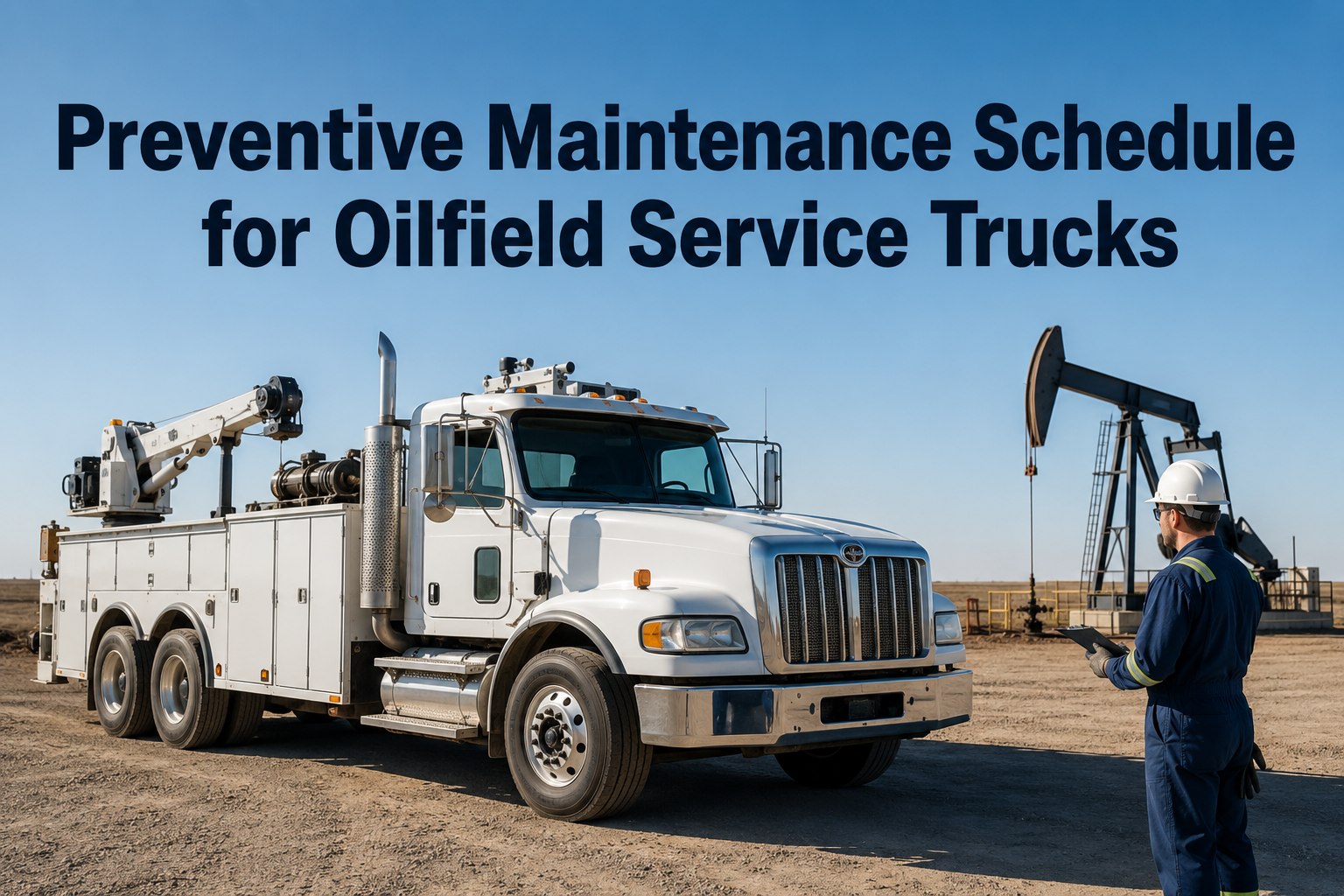
Preventive Maintenance Schedule for Oilfield Service Trucks
Build a PM schedule on engine hours and duty cycles — not mileage that lies — and let Truck Inspection & Maintenance software track every trigger, alert you before service is due, and keep DOT records audit-ready.
2-3×
Faster wear from idle & PTO time vs mileage
35-40%
Of service points missed by mileage-only schedules
$150K+
Cost of one remote-wellsite breakdown
32.8%
2026 CVSA roadside out-of-service rate
Why Mileage Lies About Oilfield Trucks
Standard fleet schedules assume one thing: the engine works hardest when the wheels turn. On the highway, that's true. On a lease road, it's the opposite. An oilfield service truck does most of its damage while parked — idling for hours, driving a hydraulic pump or vacuum system through the PTO, running compressors in extreme heat or cold. The odometer doesn't count any of it. Engine hours do.
Highway Truck
Daily distance500-600 mi
Idle / PTO timeLow
Engine hours / 100 mi~1.5 hrs
Mileage tracks wear accurately
Oilfield Service Truck
Daily distance40-120 mi
Idle / PTO time8-11 hrs/day
Engine hours / 100 mi6-10 hrs
Mileage hides 2-3× the real wear
Industry rule of thumb: one engine hour of idle/PTO work equals roughly 30-40 miles of wear. A truck idling 9 hours on a pad accumulates the equivalent of 270-360 "wear miles" — while the odometer reads near zero. That's why Truck Inspection & Maintenance software ingests engine-hour data and schedules on the clock that's actually running, not the one that looks clean.
The Three Triggers — Whichever Comes First
A reliable oilfield PM schedule doesn't pick one metric. It fires on the first of three triggers to hit threshold, so no truck ever slips through because its odometer or calendar looked clean. Truck Inspection & Maintenance software watches all three at once on every unit and triggers the work order the moment any one crosses the line:
Engine Hours
The primary trigger for any high-idle asset. Captures PTO load, pump runtime, and idle wear that mileage ignores. PM intervals of 400-600 engine hours are standard for oilfield duty cycles.
Mileage
Still matters for tires, brakes, drivetrain, and road-load components. Useful as a backstop for the rare high-transit unit — but never the sole trigger for an oilfield truck.
Calendar Time
Fluids degrade and seals dry out even on a parked truck. A maximum calendar interval (e.g. 90 or 180 days) catches the low-utilization unit before time-based decay turns into failure.
PM fires when ANY of these hits threshold first
600 engine hrs or 25,000 mi or 180 days Service Due
Tiered PM Schedule by Engine Hours
The proven structure is a tiered A/B/C system where each level builds on the one before. When a higher tier comes due, it absorbs the lower ones — the truck gets everything in a single shop visit, and the interval clocks reset together. Truck Inspection & Maintenance software manages this nesting automatically: configure the tiers once, and the right service items roll into each work order on their own:
Service A
Every 250 engine hrs
Safety & fluids check · ~30-45 min
- Engine oil & filter (severe-duty interval)
- Lights, reflectors, horn, wipers
- Tire pressure, tread, visible damage
- Air system pressure & brake adjustment
- Fluid levels — coolant, hydraulic, DEF
- Driver DVIR defect review
Service B
Every 500 engine hrs
All of A, plus driveline · ~2-3 hrs
- Everything in Service A
- Fuel filters — primary & secondary
- Air filter inspection / replacement
- Chassis lube, U-joints, king pins
- Brake lining thickness & drums
- ECM data pull & trouble-code scan
- PTO & pump/vacuum system service
Service C
Every 2,000 hrs / annual
All of B, plus major service · DOT prep
- Everything in Service B
- Coolant test / flush, cooling system
- Transmission & differential service
- DPF regen-frequency check / cleaning
- Fifth wheel, air dryer, suspension
- FMCSA 49 CFR 396.17 annual inspection
- Specialty equipment full certification
Adjust intervals down 20-30% for the harshest duty — H2S environments, sub-zero winter idling, deep-basin lease roads, or continuous heavy-load pumping. The "right" interval is the one matched to that truck's actual duty cycle, not a fleet-wide average — and the software lets you set per-unit intervals so each truck runs its own schedule.
Match the Schedule to the Truck
"Oilfield service truck" covers a dozen very different machines. A vacuum truck stresses its pump and tank; a winch truck stresses its drivetrain and hydraulics; a pump truck runs high-pressure systems to 10,000 psi. Each needs its own PM emphasis — and many run two maintenance clocks at once: one for the chassis, one for the process equipment. Truck Inspection & Maintenance software handles a mixed fleet by giving every unit its own template, intervals, and checklists instead of forcing one schedule across all of them.
Vacuum / Vac Trucks
Suction pumps, large tanks, heated components for winter. Heavy PTO and pump runtime — engine hours far outpace mileage.
PM focus: gear pump, tank integrity, vacuum seals, automatic shutdown devices
Winch / Bed Trucks
Haul and relocate rig equipment over rough lease roads. Drivetrain, brakes, and hydraulics take the brunt.
PM focus: winch hydraulics, cable, brakes, suspension, drivetrain
Pump / Bobtail Trucks
High-pressure pumping up to 10,000 psi with divided fluid compartments. Process equipment runs hard while parked.
PM focus: pressure pump, valves, fluid-end wear, pressure-relief systems
Water / Steam Trucks
Fluid delivery and hot-oil service. Boilers, heated tanks, and transfer pumps add a whole second service domain.
PM focus: heating system, transfer pumps, tank baffles, plumbing
Dual maintenance clocks: A frac or pump truck's drivetrain and its process equipment wear at completely different rates. Truck Inspection & Maintenance software tracks them on separate hour meters and schedules each independently — so you service the pump when the pump needs it and the engine when the engine needs it, with no manual tracking.
Free · Up to 3 Trucks
Stop guessing which truck is due
Truck Inspection & Maintenance tracks engine hours, mileage, and calendar intervals for every unit — and fires alerts before service is overdue, not after a breakdown on the pad. Set up your first three trucks in 10 minutes, no hardware, no credit card. Sign up free and put your PM schedule on autopilot.
The Real Cost of Getting It Wrong
Skipped or mistimed PM doesn't just risk a repair bill. On a remote wellpad, every failure cascades into mobilization fees, deferred production, contractor penalties, and a hit to your safety record with operator clients. The math is brutal — and it's why planned maintenance is the single highest-ROI activity in fleet management. Truck Inspection & Maintenance software keeps you on the cheap side of this equation by surfacing the service window weeks before a component reaches failure:
$448-$760Unplanned downtime cost per truck, per day
25-40%Lower total maintenance cost with a real PM program
95%+Uptime for PM fleets vs 85-90% reactive
Compliance Isn't Optional in 2026
Oilfield trucks live under a stack of overlapping regulators — and 2026 made enforcement sharper. Your PM schedule is also your compliance evidence, which is why it needs to be documented, timestamped, and exportable on demand. Truck Inspection & Maintenance software captures every service and inspection as a tamper-evident digital record, so the schedule you run is the audit trail you produce:
FMCSA
49 CFR Part 396 requires a systematic inspection, repair & maintenance program. The 2026 CVSA Roadcheck logged a record 32.8% out-of-service rate — nearly one in three trucks grounded. Violations up to $16,000+ each.
eDVIR Rule
The February 2026 Final Rule confirmed DVIRs can be created, signed, and stored electronically under §396.11 — paper forms can't be submitted from beyond cellular coverage, where oilfield trucks live.
PHMSA
Trucks hauling produced water, crude, or chemicals need verified HAZMAT endorsements, shipping papers at dispatch, and offline SDS access on the driver's device.
OSHA / EPA
H2S monitoring, SPCC inspections, and emissions controls carry citations up to $70,000 (OSHA) and daily EPA fines up to $50,000. Missed-inspection risk compounds fast.
Paper DVIR systems at oilfield fleets average just 55-65% completion — not because inspections don't happen, but because forms can't be filed from dead zones. Truck Inspection & Maintenance software captures DVIRs and service records offline on the driver's device and syncs them on reconnection, closing that gap and turning a 40-60 hour audit scramble into a sub-2-hour export.
Build Your Schedule in 6 Steps
You don't need a consultant or a six-figure platform to do this right — Truck Inspection & Maintenance software gives you the framework out of the box. Here's the practical sequence to stand up an engine-hour PM schedule across a mixed oilfield fleet:
Inventory every asset
List each truck by make, model, engine, type, and the specialty equipment it carries. Note which units need a second clock for process gear.
Pull OEM intervals as your baseline
Start from manufacturer recommendations for each engine platform and component, then treat them as a starting point — not gospel.
Classify the duty cycle
Tag each truck: high-idle, heavy-load, extreme-climate, H2S, deep-basin. Shorten intervals 20-30% wherever severe duty applies.
Set the three triggers per unit
Define engine-hour, mileage, and calendar thresholds for each truck in the software — the schedule fires on whichever hits first, automatically.
Let the software do the tracking
Manual hour logs drift and get missed. Truck Inspection & Maintenance software logs engine hours, fires 60/30/7-day alerts, and auto-generates work orders — removing the human error that causes breakdowns.
Review with real data
Use the software's service history, defect trends, and ECM/oil-analysis records to tighten or extend intervals based on evidence — not arbitrary numbers.
Frequently Asked Questions
Should oilfield trucks use engine hours or mileage for PM?
Engine hours as the primary trigger, with mileage and calendar time as backstops. Oilfield trucks accumulate massive idle and PTO time that mileage doesn't capture — a truck idling 9 hours a day racks up wear equivalent to 270-360 miles while the odometer barely moves. One engine hour roughly equals 30-40 miles of wear. Truck Inspection & Maintenance software tracks all three triggers and fires the schedule on whichever hits threshold first.
What's a typical engine-hour interval for oilfield service trucks?
PM intervals of 400-600 engine hours are standard for high-idle, variable-duty oilfield assets. A tiered approach works best: a light safety-and-fluids service around 250 hours, a driveline service around 500 hours, and a major service with DOT prep around 2,000 hours or annually — whichever comes first. Shorten by 20-30% for severe duty.
Why do mileage-only schedules miss so many service points?
Because they only measure road distance, mileage-based intervals miss roughly 35-40% of the service points an oilfield truck actually needs. The engine logs hours of pump, PTO, and idle work that never registers on the odometer. By the time a mileage schedule says "service due," the engine may already be hundreds of wear-hours past its real interval.
What is a dual maintenance clock?
Specialty trucks like frac and pump units have two systems that wear independently — the vehicle drivetrain and the process equipment (pump, vacuum, compressor). A dual-clock approach tracks each on its own hour meter and schedules them separately, so you service the pump when the pump needs it and the engine when the engine needs it. Contact our team to set up dual-clock tracking for your specialty units.
How does a PM schedule help with DOT and FMCSA compliance?
49 CFR Part 396 requires a documented, systematic maintenance program — your PM schedule is that evidence. Truck Inspection & Maintenance software keeps timestamped service records, electronic DVIRs, and on-demand audit exports ready for roadside checks (a record 32.8% out-of-service rate in 2026) and compliance reviews — turning a 40-60 hour audit scramble into a sub-2-hour export.
Can I run this without expensive hardware or a big upfront cost?
Yes. You don't need proprietary telematics hardware to start. Truck Inspection & Maintenance software is software-first — technicians log engine hours via the mobile app, it ingests data where sensors exist, and it fires automated reminders for as little as a few dollars per vehicle per month. Sign up free for up to 3 trucks and build your schedule before you spend a dollar.
Built for the Oilfield
Put every truck on the clock that actually matters.
Truck Inspection & Maintenance schedules PM on engine hours, mileage, and calendar time — fires alerts before service goes overdue, captures DVIRs offline from any dead zone, and exports audit-ready records in minutes. Free for up to 3 trucks. No hardware. No contracts. Live in 10 minutes.