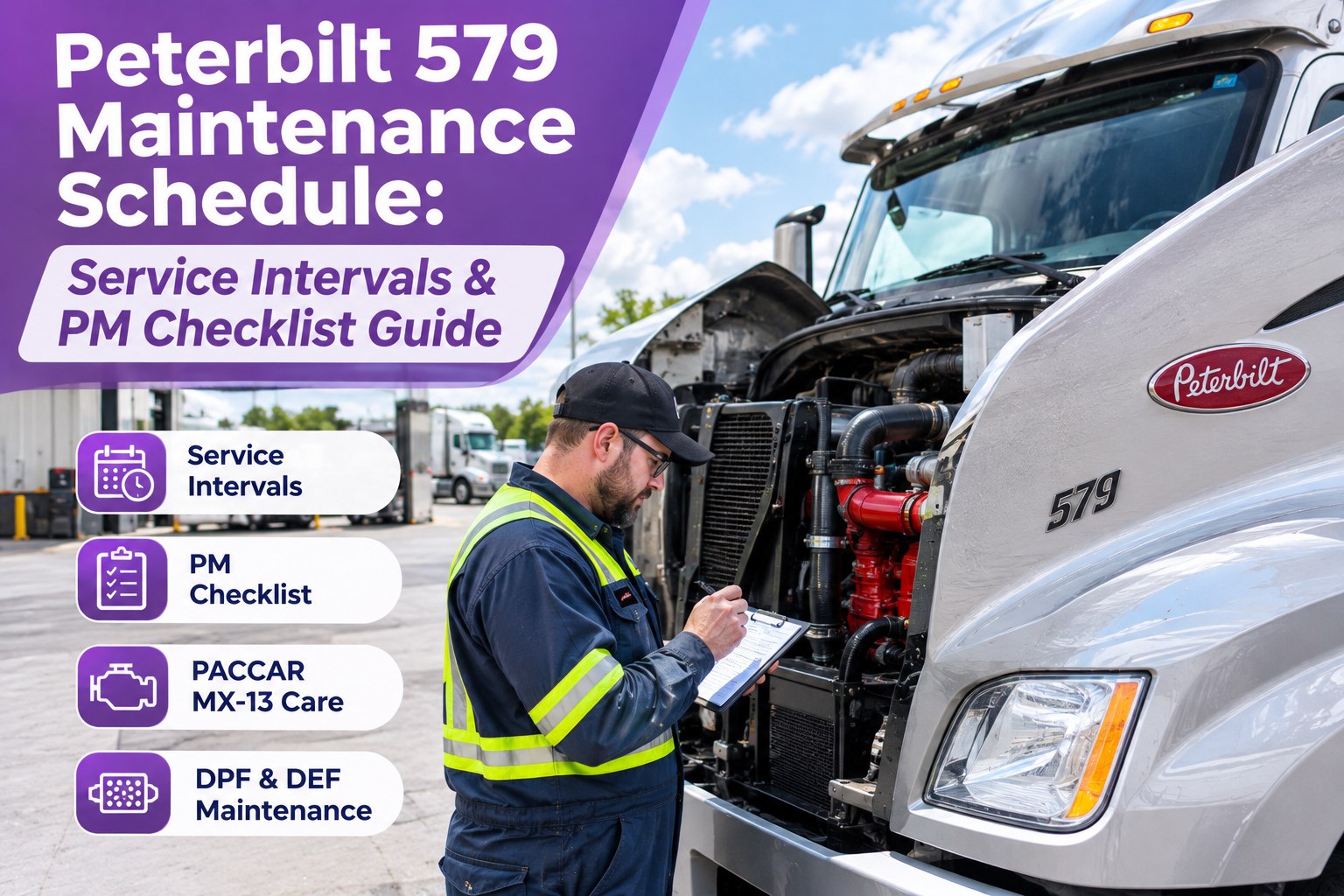
The Peterbilt 579 runs the same PACCAR MX-13 as its Kenworth cousin, so the engine intervals are no mystery — but a schedule you can actually run isn't a list of numbers. It's knowing which engine is under the hood, which services bundle into one visit, and what each PM should touch. Spec a 579 with a Cummins X15 instead of a PACCAR engine and the clock changes entirely. This guide builds the 579 schedule the way a shop runs it — by engine, by service tier, and by system. Start free and put every 579 on the right PM rhythm.
Peterbilt 579 Maintenance Schedule: Service Intervals & PM Checklist Guide
First, Which Engine Did You Spec?
The 579's defining choice sits under the hood, and it decides the whole schedule. A PACCAR engine and a Cummins don't service on the same clock, and a single generic template is exactly how an interval gets missed on a mixed-spec fleet.
Oil interval set by idle share, DPF dry and wet cleaning on the PACCAR schedule, and SmartLINQ remote diagnostics native to the truck. The 12.9L MX-13 runs 405–510 hp with a million-mile design life.
A different service clock, different filters and its own aftertreatment and oil intervals. Spec'd this way, the 579 follows Cummins intervals — never the MX schedule — so it needs its own PM template.
The Engine Interval: Idle Sets the Oil
On the MX-13, PACCAR sets the oil interval by how much the truck idles, not its fuel economy — and the fuel filter changes with it. Confirm the duty profile, then read the number.
The Three Service Tiers, Item by Item
Most shops don't service every interval separately — they bundle the work into A, B and C visits that build on each other. These baseline mileages are the common fleet-software rhythm for PACCAR trucks, not a published PACCAR schedule; tune them to your duty cycle.
Aftertreatment: Dry Clean, Then Deep Clean
The MX-13's DPF, DEF system and SCR catalyst are one package, and the headline services are two cleanings at different depths. Catch them on schedule and the aftertreatment stays off the critical path.
Driveline & Chassis Milestones
Beyond the engine, a handful of services fall due on their own clocks across the truck's life. These are the ones a fleet schedules by date and mileage so they don't surface as a breakdown.
One Record Per VIN, Whatever's Under the Hood
A 579 fleet is rarely one spec — some MX-13, some X15, each on its own clock. Put every interval, inspection and repair under the truck's VIN and the schedule follows the engine you actually spec'd, not a template that averages them.
SmartLINQ Flags It — Your PM Loop Schedules It
Every MX-13-powered 579 ships with SmartLINQ, Peterbilt's factory remote diagnostics, continuously watching more than 800 engine and emissions codes and posting alerts to the PACCAR Solutions portal — even pushing over-the-air software upgrades. It's a strong early-warning layer and it belongs in the mix. But an alert fires when something is already wrong; it doesn't bundle the next oil, DPF and brake service into a planned visit, hold the duty profile per truck, or keep the warranty record. That's the PM loop's job — and on a mixed Peterbilt-and-Kenworth fleet, where SmartLINQ and TruckTech+ don't talk to each other, it's the only way to run one standard instead of two. Book a demo to unite SmartLINQ alerts with scheduled PM.
Why Peterbilt Fleets Run 579 PM in Software
Frequently Asked Questions
It's set by idle time, not fuel economy: linehaul under 20% idle runs 75,000 miles, linehaul at 20% idle or more falls to 50,000, and severe or vocational duty is 30,000 — all on API CK-4 or CJ-4 oil, with hour caps that idle-heavy trucks can hit first. Book a demo to set oil intervals by duty cycle.
They build on each other. PM-A near 12,500 miles is the short safety-and-fluids visit; PM-B near 25,000 includes A and adds filters and measured wear checks; PM-C near 50,000 includes B and adds a full inspection and aftertreatment review. The mileages are a fleet baseline, tuned to your duty. Book a demo to set your A/B/C intervals.
Routine dry ash cleaning falls around 300,000 miles, sooner under severe duty, and a deeper wet cleaning near 600,000 recovers the filter further. Tracking regen frequency is the best early warning, and the DEF pump filter sits in the same window. Book a demo to track aftertreatment by truck.
Yes, significantly. A PACCAR MX-13 or MX-11 runs the idle-based oil interval and the PACCAR aftertreatment schedule; a Cummins X15 follows its own clock, filters and intervals. A mixed-spec 579 fleet needs a separate PM template per engine, not one shared list. Book a demo to template each engine separately.
Run Your 579 on a Schedule That Fits the Truck
Truck Inspection & Maintenance Management Software templates each 579 by its engine, runs the A/B/C service rhythm, and keeps a warranty-ready history under every VIN — so nothing slips between SmartLINQ alerts and the shop.