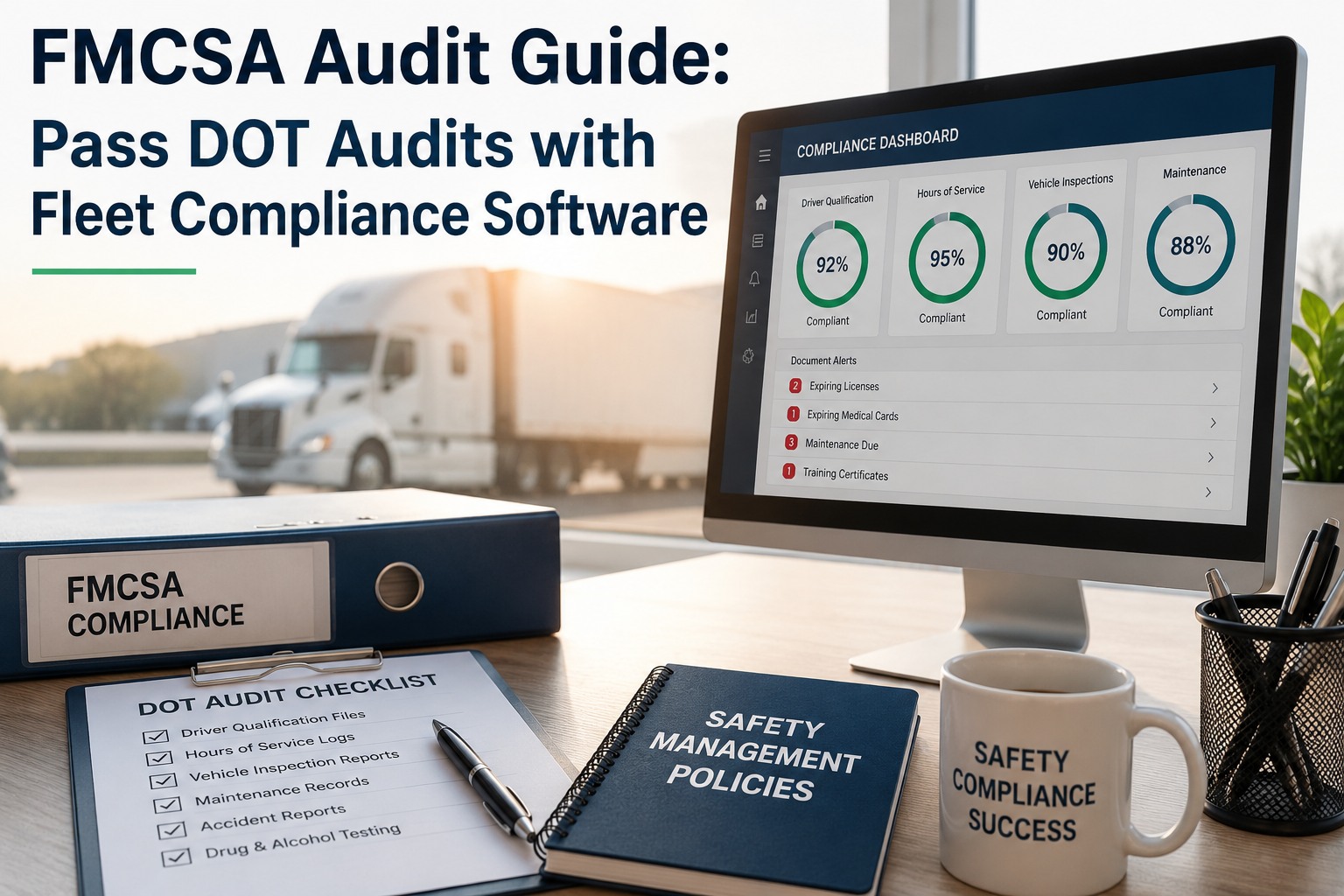
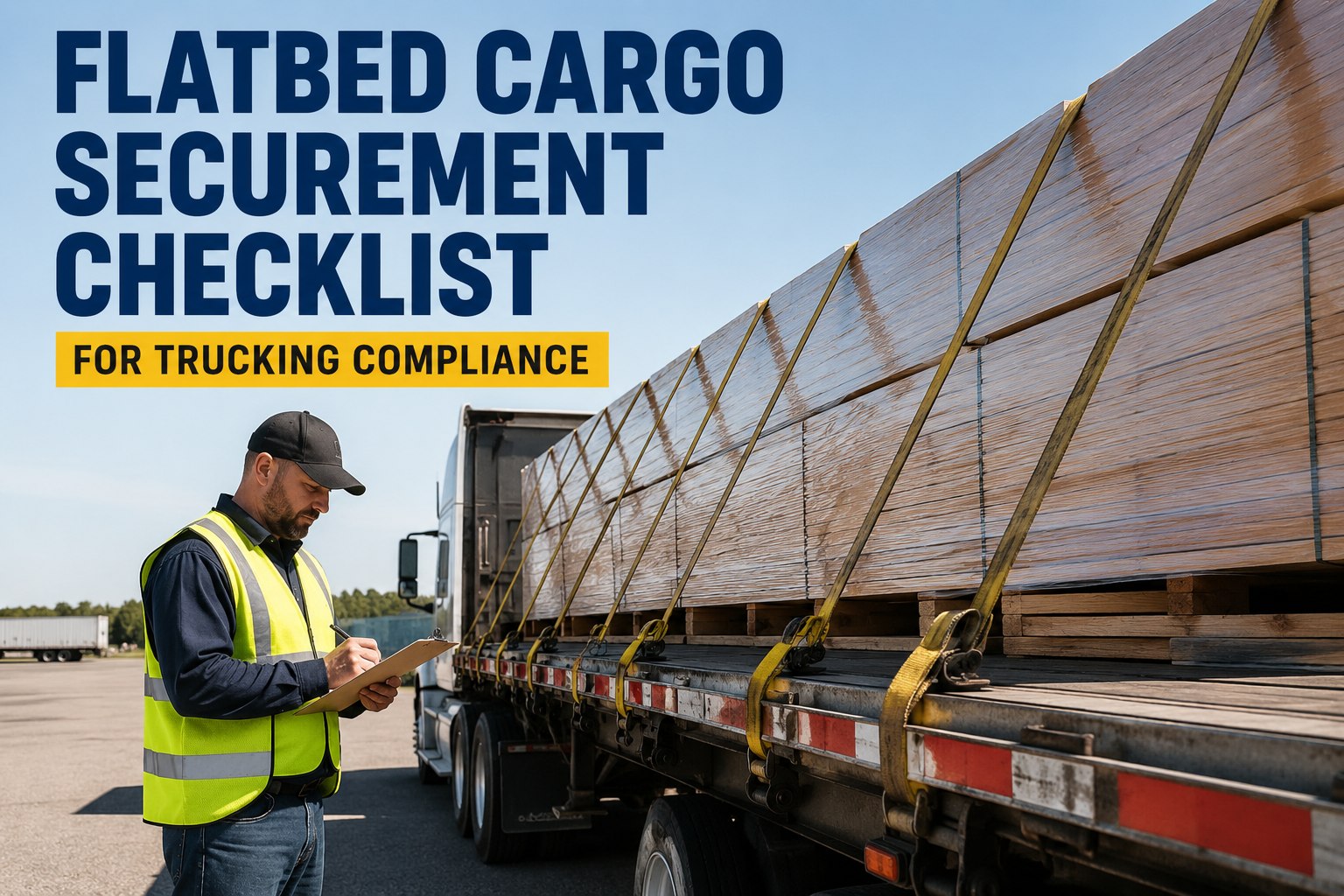
Construction trucking lives in a regulatory blind spot that catches owners off guard. Your dump trucks, aggregate haulers, and crew rigs may run mostly local, short-haul routes — but the moment you operate under your own DOT authority, the full weight of FMCSA compliance applies, audits included. And the numbers are sobering: driver qualification file violations alone account for 12–17% of all FMCSA citations, a single missing document averages $7,000 in fines, and only about 7% of carriers pass a DOT audit with zero violations. Worse, paper-only files fail an estimated 92% of modern audits. For a construction fleet juggling seasonal drivers, mixed equipment, and tight project deadlines, compliance can't be a once-a-year scramble — it has to be a system. This checklist walks the "Big 5" compliance areas auditors hit first, the 2026 rule changes you can't miss, and how to stay audit-ready year-round. Truck Inspection & Maintenance handles the inspection and maintenance pillar. Talk to our team to build it into your operation.
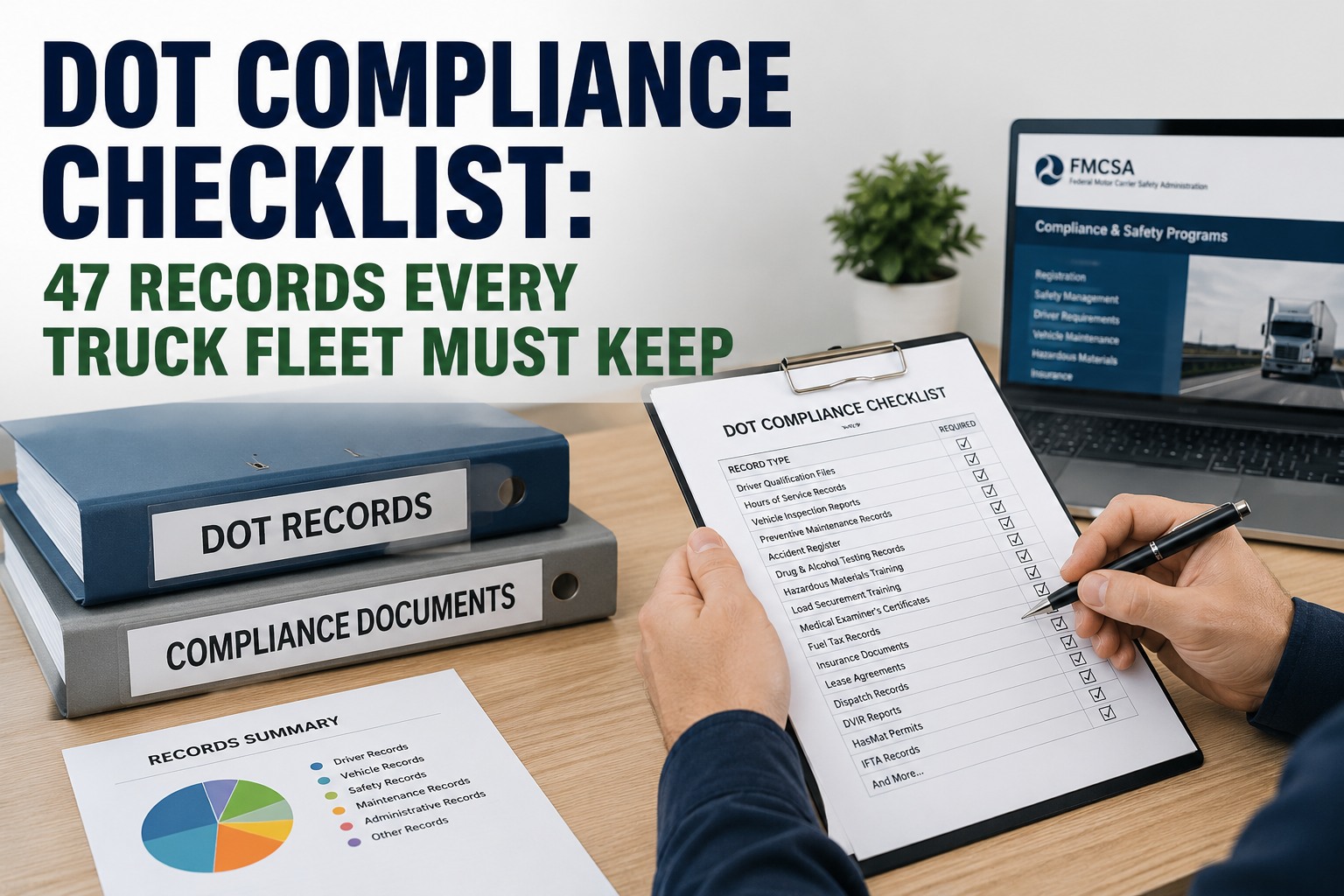
DOT Compliance Checklist for Construction Trucking
The Big 5 files, the 2026 changes, and how to stay audit-ready.
The "Big 5" Compliance Files
Every DOT audit comes down to five document categories. Master these and you've covered the foundation of compliance — neglect any one and it's the first thing an auditor finds. For construction fleets, the order matters: this is what auditors request first, every time. Start a free account to keep the maintenance pillar audit-ready automatically.
Driver Qualification (DQ)
Application, MVR (annual), medical cert, road test, PSP report, employment & safety history. The #1 audit finding — and it can't be fixed during an audit.
Hours of Service / ELD
Defensible logs or short-haul time records. The most common roadside finding — each violation a separate infraction.
Drug & Alcohol
Clearinghouse enrollment & queries, pre-employment negative, random consortium, post-accident records. Retain 5 years.
Maintenance & Inspection
DVIRs, annual periodic inspections (49 CFR 396 App. A), per-vehicle maintenance files. The largest violation category by volume.
Insurance & Authority
Active operating authority, required insurance filings, vehicle list tied to your USDOT number. Keep status clean & current.
What Changed for 2026
Three regulatory shifts make compliance more urgent this year — and construction fleets running older paper systems are most exposed. Know these before your next audit or roadside stop. Reach our team to get ahead of the 2026 changes.
Paper medical certs eliminated
As of January 10, 2026, carriers must verify medical certification status directly through FMCSA's CDLIS system — the paper card no longer suffices.
New CSA / SMS thresholds
SMS now updates monthly. Intervention thresholds: 65% most categories, 80% HOS & Vehicle Maintenance, 90% Driver Fitness & Hazmat.
Maintenance category split
Vehicle Maintenance — the largest violation category — is being split into two under the new CSA scoring methodology, sharpening scrutiny.
The Construction Short-Haul Question
This is where construction fleets get tripped up. Many dump-truck and aggregate operations qualify for the 100 air-mile short-haul exemption, which lets eligible drivers skip ELDs and use simpler time records instead. But the exemption isn't automatic — you must identify which drivers qualify and document their exempt status under 49 CFR 395.1. Use it wrong and you've got HOS violations on every load.
- Driver operates within 100 air-miles of the work-reporting location
- Returns to the same location within the allowed window each day
- Released from duty within the required hours
- Time records maintained in lieu of ELD logs
- Identify & document each exempt driver's status (395.1)
- Keep full DQ, drug/alcohol & maintenance files
- Switch to ELD/full logs the moment criteria aren't met
- Maintain time records proving the exemption held
Make the maintenance pillar audit-proof
Vehicle Maintenance is the largest violation category — and Truck Inspection & Maintenance keeps it airtight with digital DVIRs, annual-inspection tracking, per-vehicle maintenance files, and instant audit trails. No more paper files that fail 92% of audits. Sign up free and close the gap auditors hit hardest.
Record Retention at a Glance
Auditors don't just want current files — they want history, and "we can't find it" is treated the same as "we never had it." Keep these retention windows straight. Talk to our team about digital retention that never loses a document.
| Record Type | Retention Period | Typical Audit Request |
|---|---|---|
| DQ files (active driver) | Employment + 3 years after separation | All active drivers |
| HOS / ELD logs | 6 months | 1 month, 1 driver |
| Drug & alcohol records | 5 years (most records) | MIS reports, queries |
| DVIRs | 3 months minimum | Recent reports |
| Annual inspections | 14 months (current + 1 prior) | Per vehicle |
| Accident register | 3 years | Full register |
The Audit-Ready Routine
Compliance is a weekly habit, not an annual panic. These five practices keep a construction fleet ready for a compliance review or focused investigation at any time.
Frequently Asked Questions
Does DOT compliance apply if my trucks only run local?
Yes. Any carrier operating under its own DOT authority — including single-truck owner-operators and local construction fleets — is subject to FMCSA rules and audits. Running short-haul or local routes may qualify your drivers for the 100 air-mile ELD exemption, but it does not exempt you from driver qualification files, drug and alcohol testing, maintenance records, or the audit itself. The same document categories apply. Start a free account to keep maintenance records audit-ready.
What do auditors check first?
In order: driver qualification files for all active drivers, then drug and alcohol testing records (including Clearinghouse queries and pre-employment results), HOS/ELD logs, DVIRs and maintenance files, and insurance/authority status — the "Big 5." DQ files are the single most common audit finding, accounting for 12–17% of all violations, and crucially they cannot be corrected during an active audit because documentation must predate the review. Talk to our team about getting audit-ready.
How does the construction short-haul exemption work?
Under 49 CFR 395.1, drivers operating within a 100 air-mile radius of their work-reporting location, returning within the allowed daily window and released within required hours, may use time records instead of ELDs. It's common in dump-truck and aggregate hauling. But you must identify and document each exempt driver's status — the exemption isn't automatic, and the moment a driver exceeds the criteria, full HOS/ELD rules apply for that day. Sign up free to track exempt status.
What changed with medical certificates in 2026?
As of January 10, 2026, the paper medical certificate was eliminated for verification purposes — carriers must now confirm a driver's medical certification status directly through FMCSA's CDLIS system rather than relying on the physical card. For construction fleets, that means updating your DQ-file process to verify electronically. A medical cert that isn't reflected in CDLIS can create a Driver Fitness violation. Contact us about updating your process.
Why is vehicle maintenance such a big audit risk?
Because it's the largest violation category by volume — and under the 2026 CSA changes it's being split into two categories, increasing scrutiny. Compliance requires both daily driver inspections (DVIRs) and annual periodic inspections meeting all items in 49 CFR 396 Appendix A, plus a dedicated maintenance file per vehicle. Construction equipment takes a beating, so defects pile up fast. Digital DVIRs create the instant audit trail auditors want. Start free to digitize maintenance records.
What triggers a DOT audit?
Common triggers include poor CSA Safety Measurement System scores, roadside inspection violations, high crash rates, a high-profile accident, citizen complaints, or random selection — and new-entrant carriers get a safety audit within their first 9–12 months. A Compliance Review covers all six BASICs; a Focused Investigation targets one or two elevated areas but can escalate. Keeping CSA scores low through clean inspections is your best defense. Contact us to protect your scores.
Close the maintenance gap auditors hit hardest.
Truck Inspection & Maintenance keeps your largest violation category airtight — digital DVIRs, annual-inspection tracking, per-vehicle maintenance files, defect-to-repair routing, and instant audit trails for every construction truck. Free for up to 3 vehicles, no hardware, no contracts.