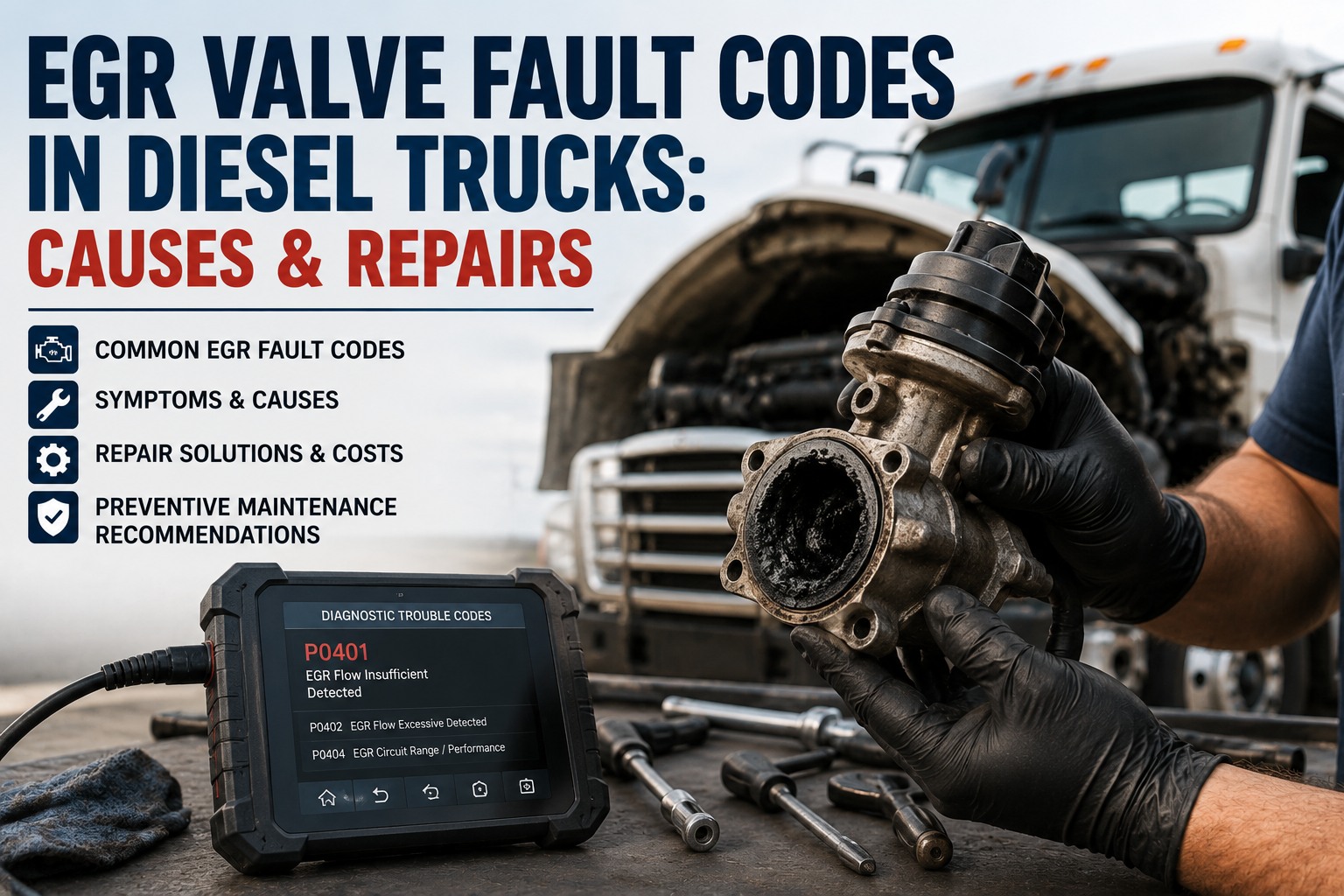
Almost every EGR valve code traces back to one substance: carbon. The exhaust gas recirculation valve spends its life routing hot, soot-laden exhaust back into the intake, and over thousands of miles that soot cakes onto the valve's seat and pintle until the valve can't move the way the ECM commands. Here's the fork that decides everything about the repair — a carbon-jammed valve sticks in one of two positions, and they produce nearly opposite problems. Stuck open floods the engine with exhaust it doesn't want; stuck closed starves it of the exhaust it needs. Same root cause, two completely different code sets, two different symptom lists. A tech who knows which way the valve failed is halfway to the fix. Track your EGR system health free. This guide follows that logic: how the EGR loop works, the stuck-open versus stuck-closed split and the codes each throws, when cleaning beats replacement, and honest cost ranges — plus how to keep carbon from winning in the first place.
EGR Valve Fault Codes in Diesel Trucks: Causes & Repairs
Nearly every EGR code comes down to carbon jamming the valve — stuck open or stuck closed. A tech's guide to reading which way it failed, what codes each throws, when cleaning beats a $700 replacement, and how to keep the carbon out.
Carbon Is the Enemy
Before the codes make sense, the mechanism does. The EGR valve meters a portion of exhaust back into the intake to lower combustion temperature and cut NOx — and diesel exhaust is full of soot that never stops accumulating on the valve.
The Fork: Stuck Open vs Stuck Closed
This is the diagnostic heart of every EGR code. One carbon problem, two failure directions — and they behave like opposites. Read the symptoms and you often know which branch you're on before the scan tool confirms it.
The EGR Code Family
The codes split cleanly into flow problems (the valve is physically misbehaving) and circuit problems (the electrical side or position sensor). Which group you're in changes the whole diagnosis.
Symptoms You'll Notice
EGR trouble shows up in how the truck idles, pulls, and smokes — and the exact mix depends on which way the valve stuck.
The first sign most drivers notice — the engine shakes or vibrates at idle, especially once warmed up.
A stuck-open valve dumps excess exhaust into the intake, creating a rich, incomplete burn.
A stuck-closed valve removes the cooling dilution, so combustion runs hot and knocks.
Hesitation and sluggish acceleration as combustion falls out of its designed range.
Either failure mode pushes NOx or particulates out of spec, failing an emissions test.
Severe cases stall at idle or drop the truck into a low-power, RPM-limited limp mode.
Clean or Replace? The Real Decision
This is where fleets save — or waste — the most money. Cleaning fixes a large share of EGR codes for a fraction of replacement, but it's not always the answer. Here's the honest split.
Catch the Carbon Before It Sets a Code
EGR problems build slowly as carbon accumulates — which means they're visible before they trip a code. Truck Inspection & Maintenance trends EGR position feedback and flow data over time, so a valve responding more sluggishly than its baseline shows up as a drifting line, letting you schedule a cleaning during planned downtime instead of chasing a rough-idle complaint or a limp-mode call from the road.
The Diagnostic Sequence
Confirm the fault the right way and you avoid replacing a valve that only needed a scrub — or scrubbing one that needed replacing.
Repairs & What They Cost
The gap between cleaning and replacement is exactly why diagnosis pays. Match the fix to the finding and most EGR codes land toward the cheaper end.
Remove the valve, soak the carbon in EGR-specific or MAF cleaner, scrub, reinstall. Fixes about half of codes.
Shop cleaning of the valve and passages — mostly labor, and a smart first step on a moving valve.
Fix a leaking vacuum hose, bad solenoid, or circuit fault behind a P0403-type code.
Part typically $150–500 plus labor; deep-in-the-valley diesel valves under the turbo run to the top of the range.
Keeping EGR Codes Away
Carbon is inevitable, but its pace isn't. A few habits slow the buildup and catch a sticking valve before it strands a truck.
Regular highway driving keeps exhaust temperatures high enough to limit the soot that cakes on the valve.
Extended idling produces low-temperature soot that accelerates EGR fouling faster than anything else.
Scheduling a cleaning as preventive maintenance is far cheaper than waiting for the stuck-valve repair.
Clean-burning fuel and the right oil reduce the soot load feeding the whole recirculation system.
Frequently Asked Questions
Usually for a short while, but fix it within days, not weeks. EGR flow codes like P0401 and P0402 are moderately severe — driving a few days generally won't worsen things — but you should stop driving immediately if the truck stalls frequently, loses power severely, or makes loud knocking noises, since a performance drop on the highway is a genuine safety hazard. Beyond safety, ignoring it accelerates carbon buildup in the intake and can interfere with DPF regeneration, potentially clogging the particulate filter and turning a modest EGR bill into a far larger aftertreatment repair. Keep essential trips short and gentle until it's addressed. Start a free trial to catch it early.
The codes and symptoms point opposite directions. A valve stuck open throws P0402 (excessive flow) and behaves like too much exhaust in the engine — rough idle, stalling, black smoke, hard starting, and contaminated oil, because the diluted intake charge burns poorly at every RPM. A valve stuck closed throws P0401 (insufficient flow) and behaves like too little exhaust — pinging and knock under load, higher NOx, and failed emissions, because without the cooling dilution combustion runs too hot. To confirm, use a bi-directional scan tool to command the valve open and closed while watching its position feedback; a valve that won't move or sticks at a fixed percentage tells you which way it's jammed. Stuck-open valves tend to cause the most drivability problems. See live EGR position data.
Start with cleaning if the conditions favor it, because it resolves roughly half of EGR codes at a fraction of the cost. Cleaning is the right first response on a road-legal truck with moderate carbon buildup — generally under about 120,000 miles on the valve — where the valve plate still moves and the cooler isn't completely blocked. Move to replacement when the carbon is hardened and the plate won't move freely, when the code returns quickly after a cleaning, when the integrated position sensor has genuinely failed, or when the valve or cooler is internally damaged. One critical warning: never clean an EGR valve with brake cleaner — its solvents destroy the actuator's rubber diaphragms and can ruin the sensor electronics. Use an EGR-specific solvent or MAF cleaner. Start free and track clean-vs-replace history.
Because the job itself is dirty and the process is one-directional. The valve continuously routes hot, soot-heavy exhaust back into the intake, and diesel engines produce a lot of soot, so carbon steadily cakes onto the valve seat, pintle, and surrounding passages over thousands of miles. Critically, carbon only accumulates — components get dirtier over time, never cleaner — so left alone, fouling is inevitable. That's also why insufficient-flow codes (P0401) outnumber excessive-flow codes (P0402) by roughly ten to one: most valves clog toward closed. Contributing factors like extended idling and low-temperature operation make it worse by producing soot without the heat to burn it off, while highway running slows the buildup. Start free and monitor EGR health.
That specific pairing is a classic signature: a severely carbon-coated EGR valve that physically cannot force itself open. P0401 says the ECM isn't seeing enough EGR flow, and P0404 says the valve's position feedback doesn't match what was commanded — together they describe a valve so packed with carbon that it can't move, with the position sensor accurately reporting that stuck condition. The important takeaway is that this is almost always the mechanical valve jamming, not the sensor failing; an electrical failure of the sensor itself is far less common than a physical carbon jam. So the right move is to rule out the stuck valve first — inspect and clean or replace it — rather than immediately condemning the position sensor, which would leave the actual problem unfixed. Start free and log the diagnosis.
Beat the Carbon Before It Beats the Valve
EGR codes are a diagnosis, not an automatic new valve. Truck Inspection & Maintenance trends EGR position and flow across your fleet, so a sticking valve is caught before it sets a code, cleaning gets scheduled during planned downtime, and every service and cost is logged so you know whether a clean or a replacement actually fixed it. Read which way it stuck, fix the real cause, and keep the carbon from winning.