A hydraulic leak on a heavy truck is not a single event — it's a progression. A hose that started as a weep at Tuesday's pre-trip becomes a seep by Thursday, a drip by Saturday, and a spray when the driver hits 2,500 PSI on Monday's first dump cycle. The classification isn't cosmetic. The industry-standard SAE J1176 / ISO/TR 11340 hydraulic leak severity scale runs from 0 (dry) to 5 (measurable stream) — and where a leak sits on that scale determines everything: whether the truck rolls today, whether the driver is at risk of a fluid injection injury (a serious medical emergency when high-pressure fluid pierces skin), whether the fleet is looking at a $200 seal replacement or a $3,000 pump rebuild after cavitation damage. Vocational trucks — dump, mixer, refuse, boom, oilfield — live and die on their hydraulic systems, and hydraulic failures are the single biggest cost category in vocational fleet maintenance. Structured PM tracking cuts hydraulic failures 42% because most leaks are caught while they're still in the "weep to seep" window where repairs are cheap and scheduled. Miss that window and you're in the "drip to spray" zone where repairs are expensive, dangerous, and unscheduled. This guide walks the diagnostic ladder, the 6-level classification, the common leak sources, and the fix-vs-defer decision that keeps trucks moving without gambling. Sign up free for Truck Inspection & Maintenance today — no credit card required to catch hydraulic leaks at the weep stage on every pre-trip, or contact our team for a hydraulic PM program design configured to your fleet type and duty cycle.
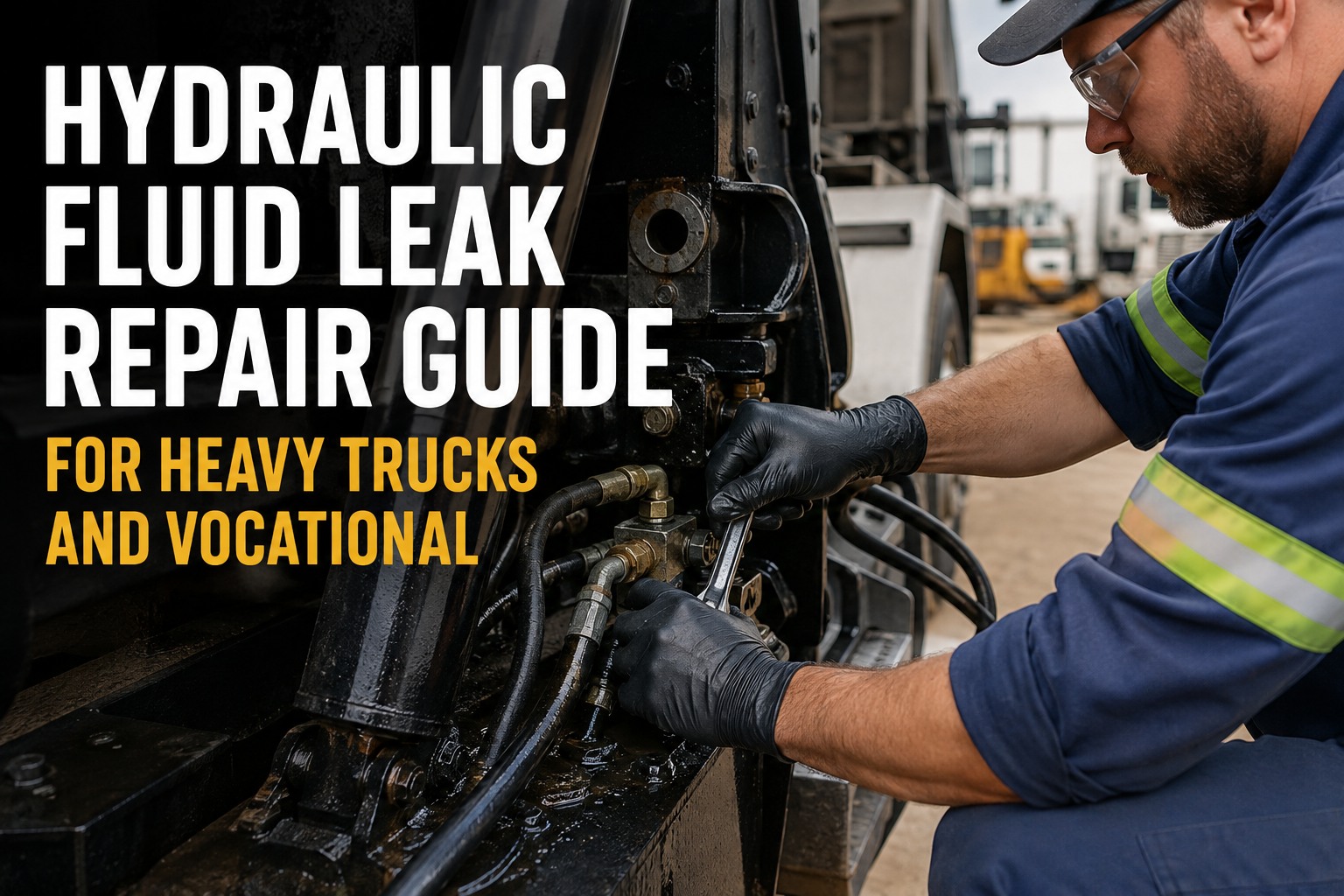
Hydraulic Fluid Leak Repair Guide for Heavy Trucks and Vocational
Leaks are a progression, not an event. Where a hose sits on the 6-level severity scale determines whether it's a $200 seal fix or a $3,000 pump rebuild.
The 6-Level Hydraulic Leak Severity Scale
SAE J1176 and its ISO equivalent (ISO/TR 11340) define six discrete severity levels for hydraulic external leakage. Every fleet's hydraulic PM program should classify leaks against this scale — it's the difference between subjective ("the hose is leaking a little") and actionable ("Level 2 seep on the return line, monitor 500 hours").
Where Heavy-Truck Hydraulic Leaks Actually Start
90% of hydraulic leaks originate at one of five predictable failure points. Knowing where to look cuts diagnostic time from 45 minutes to 5.
The 5-Step Diagnostic Workflow
A structured diagnostic process finds the leak source in 10 minutes instead of an hour of guessing. Same workflow works on every hydraulic system from bucket truck to refuse packer.
Repair Type by Leak Source
Not every leak needs the same repair. Matching the fix to the source saves time and keeps parts costs predictable.
| Leak Source | Typical Repair | Shop Time | Est. Cost |
|---|---|---|---|
| Threaded fitting loose | Torque to spec, replace O-ring | 15-30 min | $25-50 |
| Crimped fitting cracked | Replace hose assembly with new crimp | 1-2 hrs | $150-350 |
| Hose rub-through | Replace hose, add abrasion sleeve or reroute | 1-2 hrs | $120-280 |
| Cylinder rod seal weep | Rebuild cylinder head, replace rod seal kit | 3-5 hrs | $250-600 |
| Cylinder rod seal drip | Full cylinder rebuild or replacement | 4-8 hrs | $600-1,800 |
| Pump shaft seal leak | Seal replacement + shaft inspection | 3-6 hrs | $400-900 |
| Pump internal wear (cavitation) | Pump rebuild or replacement | 6-10 hrs | $1,500-3,500 |
| Reservoir gasket | Drain, replace gasket, refill & bleed | 2-3 hrs | $100-250 |
The Advanced Detection Toolkit
For leaks that resist visual diagnosis — internal leaks, tight spaces, cold-side seepage — four detection methods find what the eye can't.
Catch every leak at the weep stage — not the drip stage
Structured hydraulic PM tracking with SAE J1176 severity classification per defect. Photo evidence auto-attached to DVIR. Work orders sized to leak severity. PTO cycle tracking. 42% reduction in hydraulic failures reported by fleets using structured tracking.
Hydraulic PM by Vocational Truck Type
Different vocational applications wear different hydraulic components first. Match the PM focus to the truck type.
Frequently Asked Questions
SAE J1176 (and its ISO equivalent, ISO/TR 11340) is the industry-standard hydraulic external leakage classification scale. It defines six severity levels from 0 to 5: Level 0 (dry, no moisture), Level 1 (weep, non-recurring fluid with no droplet), Level 2 (seep, recurring fluid but still no droplet), Level 3 (droplet forms but doesn't fall), Level 4 (drip, droplet forms and falls to ground), Level 5 (flow, measurable stream with pressure loss). Every hydraulic leak on a heavy truck should be classified against this scale rather than described subjectively. The classification determines urgency: Levels 0-2 are monitored, Level 3 gets scheduled repair within 250 hours, Level 4 requires fix-before-next-dispatch, Level 5 puts the truck immediately out of service. Using the standard scale creates consistent decision-making across drivers, mechanics, and shop foremen — instead of one person calling it "a little leak" and another calling it "serious."
90% of hydraulic leaks originate at one of five failure points. Fittings and crimps are the single largest source — vibration loosens threaded fittings and work-hardens crimped connections until they crack. Hose rub and abrasion is second, caused by off-road vibration causing hoses to wear against frame rails, brackets, or other hoses. Cylinder rod seals are third, wearing from every cycle plus dirt contamination — common on dump beds, boom arms, and refuse packers. Pump shaft seals are fourth, failing from misalignment or age. Reservoir and return-line fittings are fifth, typically low-pressure but capable of draining the reservoir overnight if severe. Knowing these five sources cuts diagnostic time from 45 minutes of guessing to 5 minutes of focused inspection. Every hydraulic PM should include a torque check on fittings and a visual scan for rub-wear on hoses.
Fluid injection injury occurs when high-pressure hydraulic fluid (typically 2,500+ PSI on vocational systems) pierces skin through a pinhole leak the eye can barely see. The entry wound looks minor — sometimes just a pinprick — but the fluid enters tissue and causes rapid necrosis, requiring hospital surgical treatment within 6 hours to avoid amputation. Prevention rules: never test for a pressure leak with your hand or finger, always use a piece of cardboard held at arm's length; depressurize the system before any hands-on work; wear cut-resistant gloves rated for hydraulic work; assume every hydraulic line is pressurized until proven otherwise. If skin contact happens during operation, seek emergency medical care immediately even if the entry point looks minor — describe the exposure as "high-pressure hydraulic fluid injection" so the ER team recognizes the diagnosis. This is one of the most misdiagnosed industrial injuries in emergency medicine. Try the platform free to build hydraulic safety protocols into pre-trip.
10-30x cost multiplier depending on the leak type. A Level 2 seep at a fitting caught during PM-A costs $25-50 to fix (torque, new O-ring, 15-30 minutes). Left to progress to Level 4-5, the same underlying failure cascades to contaminated fluid (draws air, oxidizes), cavitation damage in the pump, and cylinder scoring from contaminated fluid abrading the rod. Repair cost jumps to $1,500-3,500 for pump rebuild plus cylinder work. Same original problem, dramatically different economics based purely on when it was caught. Structured hydraulic PM tracking is what makes early catch possible — fleets using formal hydraulic tracking systems report 42% reductions in hydraulic failures compared to reactive-only maintenance. The math almost always favors preventive investment: even conservative estimates show 4-8x ROI on structured hydraulic PM programs within the first year for vocational fleets.
Four tools cover the leak scenarios that resist visual diagnosis. UV dye and blacklight — fluorescent dye added to the reservoir circulates through the system, then blacklight scan reveals glowing tracks at leak points; best for Level 1-2 leaks and hard-to-see areas. Thermal imaging camera — infrared shows temperature differences between hot hydraulic fluid (140-180°F operating temp) and cooler surroundings, useful for internal leaks and insulated line paths. Ultrasonic detector — electronic device senses high-frequency sound from pressurized fluid escaping through pinhole orifices, finds leaks that dye and thermal miss. Pressure drop test — isolate the circuit, pressurize to working pressure, monitor decay over 5 minutes; quantifies leak volume and identifies which circuit contains the failure without visual inspection. Most shops start with UV dye (under $100 kit) and add thermal or ultrasonic when the failure patterns justify the investment. Pressure drop testing requires only basic gauges and is often the first-response test when a leak is suspected but not visible.
Yes — the base PM structure is the same but the focus areas differ by application. Dump trucks (15-40 lift cycles/day) wear bed cylinder rod seals fastest; inspect every PM-A. Refuse packers (300-1,000 pack cycles/day) have the highest cycle count of any vocational type — packing cylinders and tailgate cylinders wear rod seals faster than dump trucks by 3-4x. Concrete mixers run continuous drum rotation, stressing pump shaft seals; oil analysis every PM-B catches metal wear before pump failure. Boom and bucket trucks require dielectric integrity testing because hydraulic leaks in insulated boom sections compromise operator electrical safety. Oilfield service trucks face high-cycle PTO operation and ambient contamination — pump oil analysis every 500 hours. Utility bucket trucks share the boom truck dielectric concern but with lower cycle counts. Match the PM focus to the application, but use the same SAE J1176 classification and 5-step diagnostic workflow across all types. Contact our team for a PM template scoped to your truck mix.
Any Level 5 leak (measurable stream with pressure loss) is immediately out of service — this is a safety and functional failure both. Any leak in an insulated boom section of a bucket or utility truck is out of service regardless of severity because dielectric integrity is compromised. Any Level 4 drip on a truck heading into severe duty (heavy load, extended distance, remote area) should be fixed before dispatch even if it would technically be defer-able on a shorter run. Any leak accompanied by visible cavitation symptoms (foamy fluid, whining pump, erratic function) is out of service because internal pump damage is likely already accumulating. Any leak the driver reports as spraying or misting under pressure is out of service pending inspection — fluid injection injury risk is real. Below those thresholds, structured monitoring with the SAE J1176 classification and defined repair timelines (250 hrs / 500 hrs / next-dispatch) keeps the truck moving without gambling. The key rule: never let a driver make the out-of-service call alone — always involve the shop foreman with the leak classification and photo evidence to decide.
Catch every hydraulic leak at the weep stage — not the roadside stage
SAE J1176 severity classification on every DVIR. Photo evidence auto-attached. Work orders sized to leak severity. PTO cycle tracking. Vocational-specific PM templates for dump, refuse, mixer, boom, oilfield, and utility applications. Cut hydraulic failures 42% in the first year.