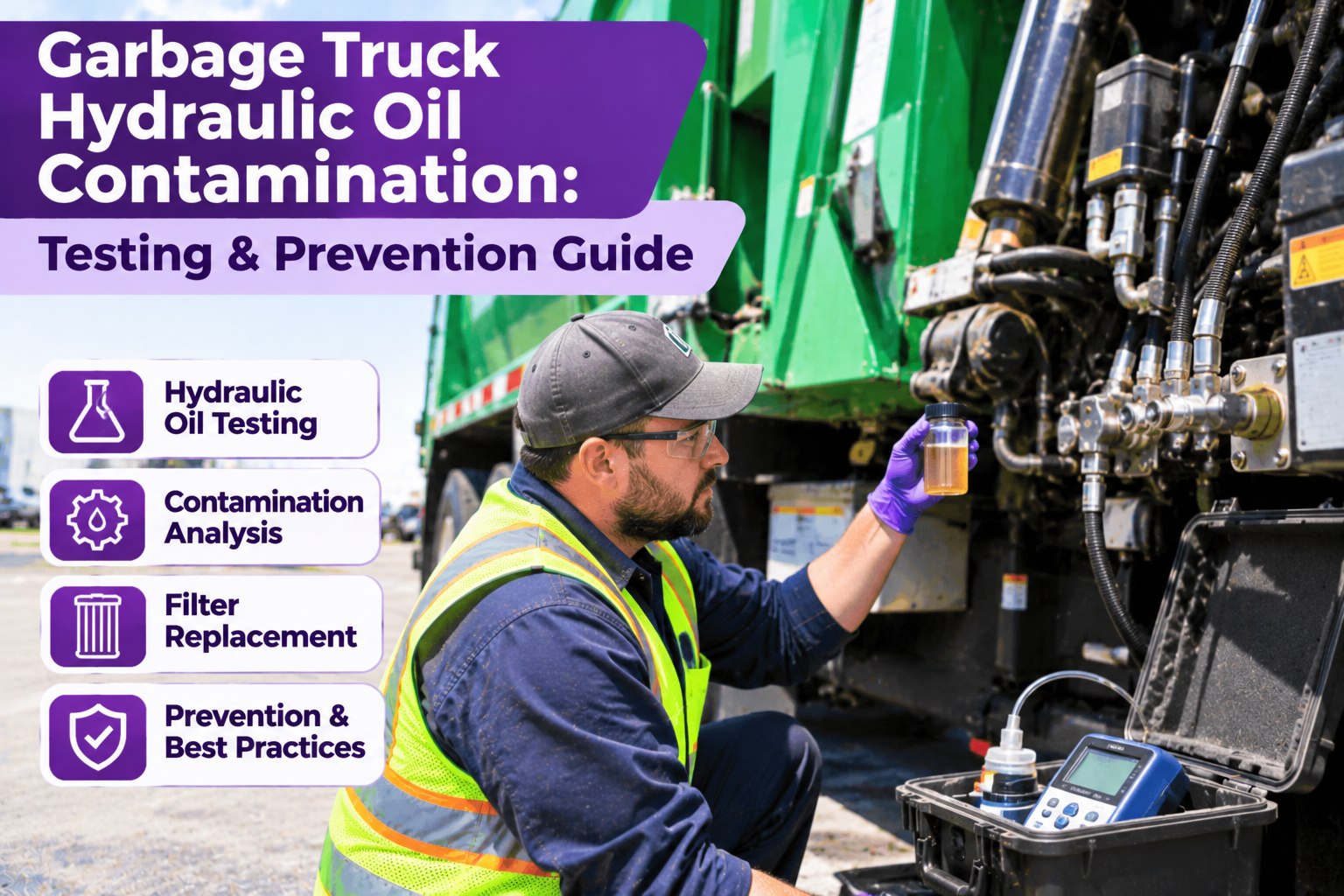
A refuse truck's hydraulics never rest — the packer, lift arms and ejector blade cycle hundreds of times a shift, in a world of landfill dust, washdown water and constant heat. Contamination is the single biggest cause of hydraulic failure, and here's the trap: you can't see it. Oil that looks perfectly clean can sit ten times over the wear threshold, and fresh fluid straight from the drum is often dirtier than your target. So you don't judge hydraulic oil by looks — you test it. Start free and put oil analysis on every refuse truck.
Garbage Truck Hydraulic Oil Contamination: Testing & Prevention Guide
Why Refuse Hydraulics Contaminate So Fast
A garbage truck is close to a worst-case environment for hydraulic fluid. Three forces work against cleanliness at once, and they all run every single route.
The Trap: Clean-Looking Oil Is Already Dirty
The particles that do the most damage are the ones you'll never see. Silt-sized grit between 2 and 5 microns is invisible to the eye, yet it's exactly the size that slips into the tight clearances of a pump or valve and grinds them away. That's why eyeballing the dipstick tells you almost nothing — and why even new oil needs checking.
How to Read the ISO 4406 Code
ISO 4406 is a three-number cleanliness code — the standard, auditable way to state how dirty hydraulic oil is. A particle counter measures the number of particles per millilitre at three sizes, and each number is the range code for that size. The scale is logarithmic: every code up is double the particle count.
Set a target code for the system — 18/16/13 is a sound baseline for mobile hydraulics — then sample and hold to it. Clean up by one code and contamination-sensitive parts like pumps and valves can last 10 to 30% longer; that's the whole payoff of testing. Book a demo to trend cleanliness codes across your fleet.
The Three Things You Actually Test For
Field Screen Versus Lab Analysis
You need both: quick in-yard checks that flag trouble between services, and the lab numbers that confirm it and set the trend. Screen often, send out when a screen trips.
A Number Only Helps If You Trend It
One particle count is a snapshot. The same point sampled every service, logged against the truck's VIN, turns three numbers into an early-warning curve — so a rising code flags a filter or a seal before the pump pays for it.
Prevention: Keep It Out, Filter What Gets In
Testing tells you where you stand; prevention is how you stay there. Contamination control on a refuse truck comes down to blocking ingression and filtering the fluid that's already in the loop.
Each of these is a task with an interval, an owner and a record — exactly the kind of recurring work that slips when it lives in a driver's head instead of a schedule. Start free and schedule every breather, filter and sample.
Sample It Right, or the Number Lies
A cleanliness code is only as good as the sample behind it. Pull it wrong and you'll chase contamination that came from the bottle, not the truck.
Why Refuse Fleets Run Oil Analysis in Software
Frequently Asked Questions
Not by looking — the most damaging particles are invisible and water can be dissolved. A particle count gives an ISO 4406 code, a crackle or Karl Fischer test finds water, and trending both against the truck shows contamination climbing before a component fails. Book a demo to see contamination trending in action.
18/16/13 is a sound baseline for mobile hydraulic systems, and tighter if the truck runs sensitive servo valves. Because every code up doubles the dirt, holding to target — rather than letting it drift to 20/18/15 or worse — is what protects the pump. Book a demo to set target codes per truck.
The crackle test is a quick field screen — a bead on a hot plate crackles if water is present — while Karl Fischer titration is the precise lab measurement. Cloudy oil already signals free water, the most harmful form, so it warrants action, not just a note. Book a demo to schedule water testing by truck.
Sample on a regular interval tied to the truck's duty cycle so the trend stays meaningful, and pull extra samples after any repair that opened the system. Consistency — same point, same cadence — matters more than frequency alone. Book a demo to build a sampling schedule.
Stop Letting Invisible Dirt Take Out Your Hydraulics
Truck Inspection & Maintenance Management Software logs every oil analysis under the truck's VIN, trends the ISO cleanliness code, and turns a failed sample into a scheduled repair before a pump ever fails.