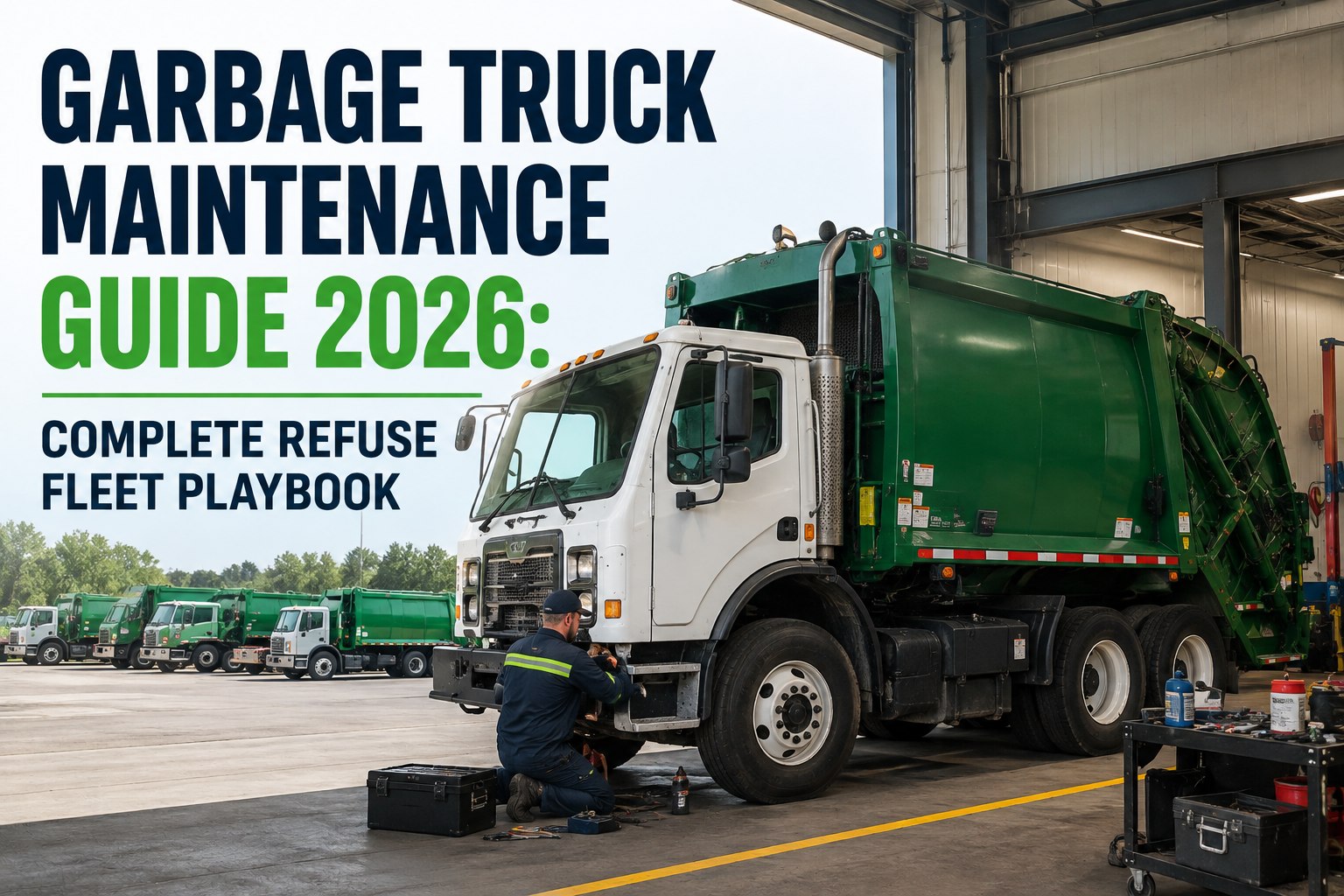
A garbage truck runs the harshest duty cycle in commercial trucking. On a typical residential route, the packer blade cycles 800–1,200 times, the tailgate opens and closes 200+ times, the tipper arms grab and lift another 800 containers, the compactor system runs at 150–160°F under peak load pressure, and the truck itself stops and starts every 30 seconds for eight hours straight. Hydraulic components on a refuse truck fail at roughly three times the rate of equivalent systems on a line-haul tractor. Brake wear runs 2–3× normal because every pickup is a full-stop, full-start event. Frame stress from wet-load weight distribution loosens body-to-chassis mounting bolts faster than any other truck type in the fleet. The odometer barely moves — 20,000–30,000 miles per year is typical — but the engine burns through 1,500–2,000 operating hours in that same window. A refuse fleet manager tracking only mileage-based PM is missing 60% of the actual wear. A refuse fleet manager tracking mileage + hours + hydraulic cycle counts catches everything and reports the lowest cost-per-truck in the industry. That is the difference this guide is built around. Below you will find the eight critical systems that make refuse trucks unique, the cycle-triggered PM matrix that catches hydraulic wear before it becomes a $4,200 pump failure, the six most common breakdown modes with prevention playbooks, cold-weather protocols that stop January killing your fleet, and how the free Truck Inspection & Maintenance app runs cycle-triggered PMs alongside mileage and calendar so no dimension of wear ever goes untracked. Sign up free for up to 3 vehicles or contact our team for larger refuse fleet rollouts.
Garbage Truck Maintenance Guide 2026 — Complete Refuse Fleet Playbook
The harshest duty cycle in trucking. The most specialized PM requirements. The playbook that keeps every packer, hoist, and cylinder running.
Why Standard PM Schedules Fail Refuse Trucks
A mileage-only PM schedule built for line-haul tractors misses most of what actually breaks on a garbage truck. Three data points explain why:
Refuse hydraulic systems fail at three times the rate of equivalent line-haul systems due to daily cycle counts on packers, tippers, and tailgates.
A refuse truck at 25,000 miles has actually seen 79,000 mile-equivalents of engine hour wear plus 240,000+ hydraulic cycles. Mileage-only PM misses two-thirds of it.
A hydraulic fluid flush at 15,000 cycles prevents a pump failure that averages $4,200 plus two days of collection downtime. 15× ROI on cycle-triggered PM.
The 8 Critical Refuse Truck Systems
A refuse truck is not one machine — it is a chassis carrying a specialized body full of high-stress systems that a generic PM schedule never sees. Track each of these separately:
Hydraulic Pump & Reservoir
The heart of the packer body. Feeds every cylinder. Runs at 150–160°F under peak load. Fluid degrades far faster than a line-haul hydraulic system — flush by hours, not miles.
Packer Cylinder
Highest cycle count on route. 800–1,200 compression events per day. Cylinder rod scoring from contamination is the #1 seal-failure cause. Inspect rods daily.
Tipper / Lift Arm
Grabs and lifts 800+ containers per shift. Grip pad wear drops containers — liability + service failure. Inspect pads weekly; replace at 50% wear.
Ejector Cylinder
Long-stroke telescopic design pushes compacted load out at landfill. Damage from foreign objects wedged in load. Inspect after every dump.
Tailgate & Cam Lock
200+ open/close cycles per shift. Cam lock failure mid-route = load spillage + road hazard incident. Weekly lock cycle test required.
Brake System
Wears at 2–3× line-haul rate from 900+ full-stop events per shift. Slack adjusters, drum wear, and pad thickness need bi-weekly inspection.
Engine & DPF
1,500–2,000 hrs/year of stop-and-go regen conditions. DPF cleaning every 150K–200K miles. Track hours, not miles, for oil service.
Body-to-Chassis Mounts
Wet-load weight cycling loosens mounting bolts faster than any vehicle type. Torque-check monthly. Loose mounts destroy frames.
The Cycle-Triggered PM Matrix
Standard PM tracks mileage and calendar. Refuse trucks need a third trigger: hydraulic cycle count. This is the matrix that top-performing refuse fleets run — each PM tier fires on whichever trigger hits first:
The 6 Most Common Breakdowns — And How to Prevent Them
Every refuse fleet manager has watched the same six failures repeat across their fleet. All six are preventable with targeted PM. Below is the pattern + the prevention playbook:
Hoses degrade from constant flexing near packer/tailgate joints. Rupture mid-route contaminates the entire system with debris + fluid loss.
Weekly visual inspection at joint bends. Replace at first sign of abrasion or bulging. Never wait for external leak. Cost: $200 vs $8,000+ rupture event.
Contamination scores the rod surface. Seals fail on every subsequent stroke. Packer blade drifts down without command. Oil pools under truck.
Wipe cylinder rods clean daily. Inspect for scoring before each shift. Rebuild on schedule — do not wait for visible external leak.
900+ full-stop events per shift chew through pads, drums, and slack adjusters at 2–3× line-haul rate. Runs to OOS threshold silently.
Bi-weekly slack adjuster + pad thickness check. Drum inspection at every PM-A. Never let refuse trucks stretch to 25K-mile brake intervals.
Worn pads drop containers on residential curbs — customer complaint + potential liability incident + missed route completion.
Weekly visual pad inspection. Replace at 50% wear indicator. Track cycle count per tipper — replace before failure, not after.
Wet-load weight cycling loosens mounting bolts. Frame flex accelerates. Silent until the body shifts noticeably on chassis — by then, frame damage is done.
Monthly torque check on every body-to-chassis mount. Log torque values per bolt over time to catch loosening trends before failure.
Cam lock fails mid-route → tailgate opens on the road → load spillage + road hazard incident + potential citation + shipper liability.
Weekly cam lock cycle test. Cannot be skipped. Grease lock mechanism monthly. Replace worn cam parts before the lock feels loose.
The Winter Rule — Never Cycle Cold Hydraulic Fluid at Full Speed
When temperatures drop below 25°F, hydraulic fluid thickens dramatically. Firing up the truck and immediately cycling the packer at full speed forces thick fluid through lines and valves that cannot handle the flow — the result is seal blowouts, pump cavitation, and cylinder damage that no PM schedule saves you from. Every cold-morning startup needs 5–10 minutes of warm-up idle before any full-speed packer cycle. Post the rule in every shop. Enforce it in every driver briefing. Winter destroys more refuse hydraulic systems than every other cause combined.
Daily / Weekly / Monthly Inspection Cadence
Three tiers of driver + shop inspection catch the wear before it becomes a breakdown. The cadence matters — cycle-triggered wear does not wait for the next quarterly PM:
Pre-Trip & Post-Trip
- Wipe cylinder rods clean, inspect for scoring
- Look for oil pooling under truck
- Verify packer + tailgate cycle smoothly
- Check hydraulic reservoir level
- Confirm tipper grip pads intact
- Standard DVIR walkaround (11 FMCSA categories)
25-Point Weekly Inspection
- Hydraulic hose visual at joint bends
- Packer/ejector/tailgate cylinder rod inspection
- Tailgate cam lock cycle test
- Slack adjuster + brake pad thickness
- Tipper grip pad wear check
- Undercarriage visual for debris + damage
Deep Inspection
- Body-to-chassis bolt torque check + log
- Frame stress point visual inspection
- Hydraulic fluid sample for analysis
- Tailgate hinge + cam lock grease
- Air brake system leak-down test
- Full electrical harness + light check
Track hydraulic cycles, engine hours, and mileage in one system — first-to-occur.
Truck Inspection & Maintenance runs cycle-triggered PMs alongside mileage and calendar for every refuse truck in the fleet. Hydraulic pump flush fires at 1,000 hours OR 15,000 cycles OR annually — whichever comes first. Weekly 25-point inspections run on driver phones with photo verification. Cam lock cycle tests logged with pass/fail per truck per week. Free forever for up to 3 vehicles. Create your free account in 10 minutes or talk to our refuse fleet team for a customized rollout.
Refuse Truck Body Types — Different PMs, Different Failures
Not every garbage truck is the same. Body configuration dictates which components fail first and which PMs matter most:
Frequently Asked Questions
Why do refuse trucks need different PM schedules than line-haul trucks?
Because refuse trucks generate wear that mileage cannot see. A typical residential route puts 800–1,200 packer cycles, 800 tipper lifts, and 200+ tailgate cycles on the truck — while the odometer barely moves. Hydraulic systems fail at 3× the rate of equivalent line-haul systems, brakes wear at 2–3× normal rate from 900+ full-stop events per shift, and the engine burns through 1,500–2,000 operating hours in 25,000 miles. Mileage-only PM misses 60% of the actual wear. Cycle-triggered + engine-hour PM catches everything.
How often should hydraulic fluid be flushed on a garbage truck?
Every 1,000–1,500 operating hours or 15,000 hydraulic cycles, whichever comes first, with an annual maximum regardless of hours. The system runs at 150–160°F under peak load, and the fluid degrades chemically far faster than a line-haul hydraulic system. A $280 flush at 15,000 cycles prevents an average $4,200 pump failure and two days of collection downtime — a 15× ROI on the most cost-effective PM in refuse. Contamination from packer cylinder debris is the primary degradation pathway; flushing on schedule is non-negotiable.
What is the most common breakdown on a refuse truck?
Hydraulic hose rupture, followed closely by packer cylinder seal failure. Both stem from the same root cause: constant cycling under heat and contamination. A hose degrades from repeated flexing at packer or tailgate joints; a cylinder seal fails when contamination scores the rod surface. The prevention is identical for both — weekly visual inspection at every joint, daily rod wipe-down, and rebuild before external leaks appear. A $200 hose caught at weekly walkaround stays a $200 fix; the same hose ruptured mid-route becomes an $8,000+ event with contaminated downstream components, towing, customer credits, and a route nobody finished.
How do I handle cold-weather startup on refuse hydraulics?
Never cycle cold hydraulic fluid at full speed. Below 25°F, hydraulic fluid thickens dramatically — forcing it through lines and valves at full flow rate blows seals, cavitates pumps, and damages cylinders. Every cold-morning startup needs 5–10 minutes of warm-up idle before any full-speed packer cycle. This single rule prevents more winter refuse hydraulic damage than every other cause combined. Post it in every shop bay; enforce it in every driver briefing; make it non-negotiable operating procedure through January and February.
What is the annual maintenance cost for a garbage truck?
Substantially higher than most operators budget for — typical costs run 40–60% above equivalent line-haul tractor maintenance due to the hydraulic system, compactor mechanism, and brake wear factors unique to refuse operations. Well-managed refuse fleets running structured cycle-triggered PM typically spend $18,000–$32,000 per truck per year fully-loaded (parts + labor + downtime). Poorly-managed fleets running mileage-only PM often exceed $50,000 per truck due to unplanned breakdowns, emergency road-call vendors, and rushed rebuilds. The math on cycle-triggered PM investment is straightforward for any refuse fleet. Talk to our team for a fleet-specific cost model.
How does Truck Inspection & Maintenance support refuse fleet operations?
Truck Inspection & Maintenance runs cycle-triggered PMs alongside mileage, engine hours, and calendar for every refuse truck. Hydraulic pump flush fires at first-to-occur across 1,000 hours OR 15,000 cycles OR annually. Weekly 25-point inspections run on driver phones with photo verification for hoses, cylinders, cam locks, and grip pads. Cam lock cycle tests log with pass/fail per truck per week. Body-to-chassis bolt torque tracking catches loosening trends. Free forever for up to 3 vehicles. Sign up in 10 minutes.
Refuse trucks earn their maintenance schedule the hard way. Track every dimension of wear or watch cylinders fail on schedule.
Every day a refuse fleet runs on mileage-only PM, hydraulic cycles accumulate silently, packer seals score, brakes wear beyond spec, and the next $8,000 breakdown gets closer. Truck Inspection & Maintenance runs cycle + hours + mileage + calendar in parallel with first-to-occur triggers built for refuse operations. Free forever for up to 3 vehicles. No hardware, no contract, no credit card to start.