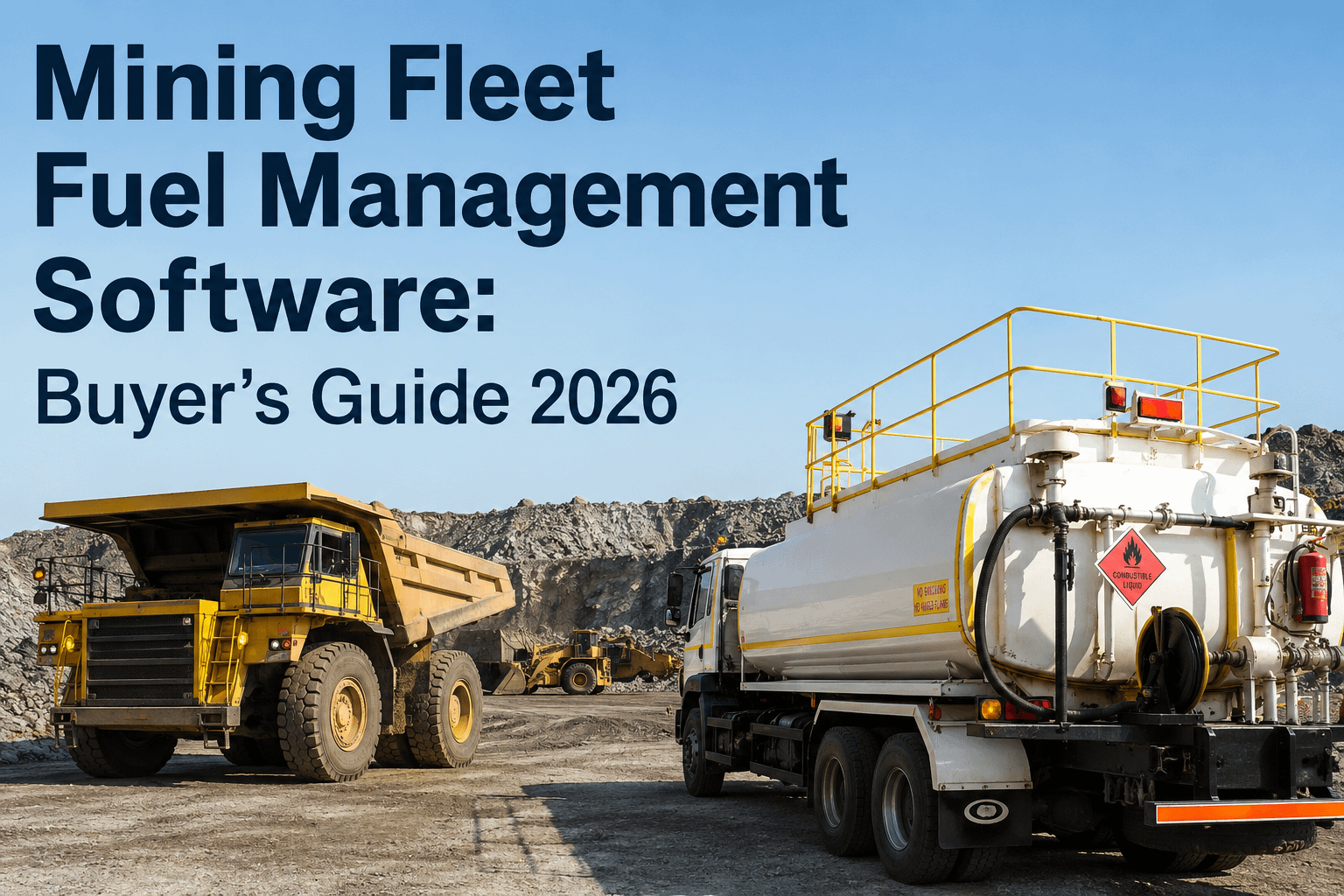
On a mine site, fuel isn't bought at a pump down the road — it's trucked in by the thousands of gallons, stored in bulk bunkers, and dispensed on-site to haul trucks, excavators, loaders, and dozers that burn diesel by the hour, not the mile. That changes everything about how you manage it. Generic highway fuel software, built around fuel cards and over-the-road routing, simply doesn't fit a remote pit where the real questions are: how much is in the bunker, who drew it, did every gallon delivered actually arrive, and which machine is burning more than it should. The stakes are enormous — fuel is one of mining's largest operating costs, and a single high-idle haul truck wastes tens of thousands of gallons a year. This buyer's guide breaks down what mining fuel software must do differently, the must-have features, the hardware reality, and how to choose. Truck Inspection & Maintenance covers the equipment-health side that protects fuel burn. Talk to our team for a tailored walkthrough.
Mining Fleet Fuel Management Software
Bulk bunkers, on-site dispensing, and per-hour burn — fuel software built for the pit.
Why Mining Fuel Is a Different Problem
Highway fuel management is about fuel cards and miles per gallon. Mining is about bulk inventory and on-site control — and that's a fundamentally different software requirement. The fuel lives in your own bunkers and bowsers, gets dispensed by your own crews to machines that never leave the lease, and is measured in liters-per-hour of engine run time. Three realities define the mining fuel challenge, and a platform that ignores them won't fit.
Bulk & bunker storage
Fuel arrives by tanker and sits in on-site bulk storage. The core question is reconciliation: did every gallon on the delivery docket actually make it into the tank?
On-site dispensing
Crews dispense from fixed pedestals and mobile fuel trucks — not retail pumps. Access control and accurate per-transaction capture are everything.
Per-hour consumption
A haul truck's wear and burn track engine hours, not odometer miles. Fuel-per-hour by machine and engine type is the real efficiency metric.
The 6 Must-Have Features
Once you're evaluating mining-capable platforms, these six features separate a true mine-site fuel system from a repackaged highway tool. Score every option against them. Start a free account to test the equipment-health side on your own machines.
Bulk tank monitoring
IoT tank-level sensors and dispensing logs track bunker inventory continuously — catching meter drift, unauthorized withdrawals, and discrepancies before losses escalate.
Dispenser access control
Auto-ID, RFID, or PIN at every pump and mobile bowser, so each gallon is tied to a specific machine and operator — no unauthorized draws.
Per-hour consumption by machine
Fuel burn per engine hour, by equipment type and location — the metric that flags an excavator or haul truck running rich.
Delivery reconciliation
Match tanker delivery dockets against actual tank-level rise, so you know the fuel you paid for is the fuel you received.
Theft & idle detection
Flag siphoning, off-pattern draws, and high-idle units — one idling haul truck can waste 29,000+ gallons a year.
Maintenance-MPG link
Poor maintenance degrades fuel efficiency 5–15%. Tie PM, inspections, and fuel-per-hour together so a sick machine is caught early.
Protect fuel burn at the source: equipment health
A well-maintained haul truck burns less — and Truck Inspection & Maintenance keeps every machine in peak shape with hour-based PM, MSHA-style inspections, and defect-to-work-order routing, so no unit quietly burns 5–15% extra. No hardware to start, no contracts. Sign up free and protect efficiency where it begins.
The Hardware Question
Unlike highway fuel software, mining systems usually involve on-site measurement hardware — and understanding the stack helps you scope cost and installation. The data chain runs from sensors at the tank to dashboards in the office. Reach our team to think through what your site actually needs.
Capacitive probes suit high-precision needs and calibrate to irregular tank shapes; ultrasonic sensors enable non-intrusive installs. The software-only maintenance layer needs no new hardware to begin.
The Mobile Fueling Payoff
One mining-specific lever deserves its own mention: bringing fuel to the fleet with mobile service trucks instead of sending machines to a fixed station. The productivity math is striking — taking fuel to the equipment saves an average of 43 productive hours per day, the equivalent of adding two extra haul trucks to the pit working full time. Tracking those mobile dispensing transactions accurately is exactly what mine-grade fuel software is built to do.
Frequently Asked Questions
Why can't I use regular fleet fuel software for mining?
Because mining fuel is bulk and on-site, not card-and-pump. Highway software is built around fuel cards, retail networks, and miles-per-gallon. A mine site stores fuel in its own bunkers, dispenses it from fixed pedestals and mobile trucks to machines that never leave the lease, and measures burn in liters-per-hour of engine run time. You need bulk-tank monitoring, dispenser access control, and delivery reconciliation — features highway tools simply don't have. Start a free account to add the equipment-health layer.
Should mining fuel be tracked per mile or per hour?
Per engine hour. Haul trucks, excavators, and loaders accumulate wear and burn fuel by run time, not distance — many barely change location. Fuel-per-hour by machine and engine type is the metric that reveals an excavator or dozer running rich, a developing mechanical issue, or an operator with poor habits. Mileage-based tracking misses nearly all of it on a mine site.
How does the software stop fuel theft and loss?
Several layers. Continuous bulk-tank monitoring via IoT sensors catches meter calibration drift, unauthorized withdrawals, and sudden inventory discrepancies before they escalate. Dispenser access control (Auto-ID, RFID, or PIN) ties every gallon to a machine and operator. And delivery reconciliation matches tanker dockets against actual tank-level rise — so you know the fuel you paid for arrived. Together they close the gaps spreadsheets never see. Talk to our team about reconciliation.
Do I need hardware to get started?
For full bulk-tank and dispenser monitoring, yes — capacitive or ultrasonic sensors, flow meters, and Auto-ID readers, plus telematics gateways that forward data over cellular or satellite from remote sites. But the maintenance-and-inspection layer that protects fuel efficiency runs software-only on existing data and mobile devices. A sensible path is to start with equipment-health and fuel-per-hour tracking, then add dispensing hardware as ROI justifies. Sign up free to begin with no hardware.
How much can a mine save on fuel?
Meaningful amounts — fuel is one of mining's largest operating costs, and connected systems target reductions around 25%. The savings come from catching theft and loss at the bunker, eliminating high-idle waste (a single idling haul truck can burn 29,000+ gallons a year), reconciling deliveries, and keeping machines maintained. Mobile fueling alone can recover 43 productive hours a day. Contact us to model your site's numbers.
Does equipment maintenance affect mining fuel cost?
Significantly. Poor maintenance degrades fuel efficiency by 5–15% — and on a fleet of machines burning diesel by the hour, that compounds fast. Underinflated tires, clogged filters, and out-of-tune engines all burn extra. Tying preventive maintenance and inspections to fuel-per-hour data catches a degrading machine early, protecting both production uptime and fuel burn at once. Sign up free to link maintenance and fuel.
A fuel-efficient pit starts with well-maintained machines.
Truck Inspection & Maintenance keeps every haul truck, excavator, and loader in peak condition with hour-based PM, mobile inspections, and live equipment health — protecting the 5–15% of fuel efficiency poor maintenance silently burns. Free for up to 3 vehicles, no hardware, no contracts.