Every fleet manager knows the shop's version of a productive PM day: 30 trucks pulled from rotation, 30 PM-A oil services completed, 30 work orders closed by end of shift. Every driver knows their version: their truck pulled at 2pm on a Tuesday, six hours of dead time on the clock, a 14-hour window that just got blown, and a load that missed its Wednesday delivery because the mechanics kept them past 5pm. Both versions are true. Both are the wrong answer. Scheduling PMs without regard to driver Hours-of-Service windows is one of the most expensive silent inefficiencies in trucking — it burns driver goodwill, wastes 60/70-hour weekly bank, triggers HOS violations when tired drivers try to make up delivery windows the PM stole, and paradoxically drives PM compliance rates DOWN because drivers start hiding trucks from the shop schedule. The fix is not complicated: PMs get scheduled INTO existing legal off-duty windows — inside a 10-hour rest period, during a 34-hour restart, or in a bookend to the sleeper berth cycle — instead of being carved out of prime driving hours. Fleets that align their shop schedule to their drivers' HOS clocks cut unplanned downtime 30–50%, hit 95%+ PM compliance without dispatch fights, and eliminate the "surprise PM" that ambushes a driver 40 miles into their 14-hour window. This guide walks through the 2026 FMCSA HOS framework in plain English, maps every PM tier to its optimal HOS insertion point, gives you the dispatch playbook for aligning shop days to driver rest, breaks down the 34-hour restart as the single most valuable PM window in trucking, and shows how the free Truck Inspection & Maintenance app pulls each driver's ELD clock into the PM schedule so PMs get slotted into legal off-duty windows automatically. Sign up free for up to 3 vehicles or talk to our fleet team for larger rollouts.
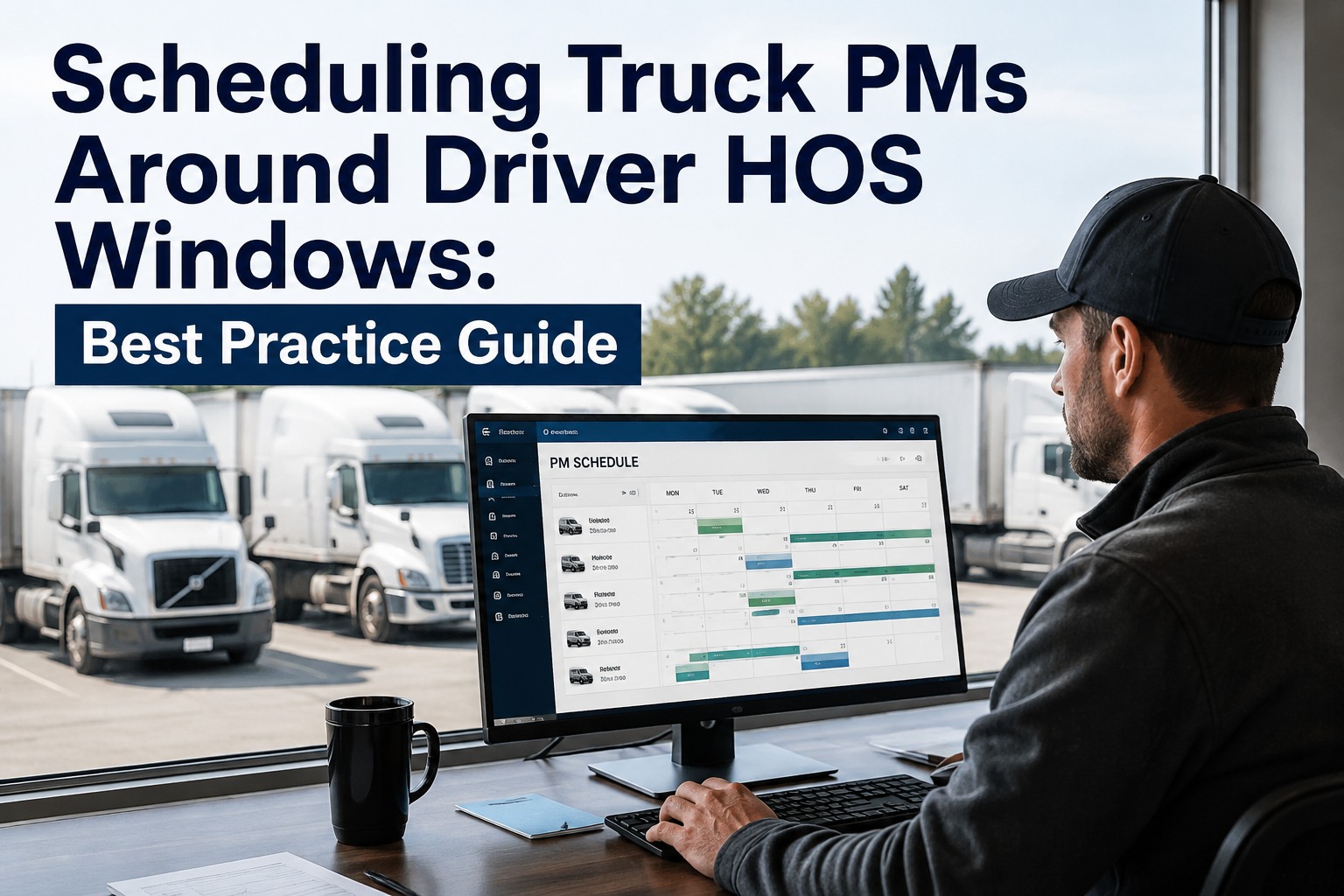
Scheduling Truck PMs Around Driver HOS Windows — Best Practice Guide
Align shop days to legal rest periods. Stop burning driver 14-hour windows. Hit 95%+ PM compliance without dispatch fights.
The HOS Framework in 5 Numbers
Before scheduling PMs around HOS, every dispatcher and shop manager should know these five numbers cold. They govern every legal on-duty and off-duty window in the driver's week:
Max driving time per shift after 10 consecutive hours off duty. Cannot be extended.
Total working window from clock-in. Off-duty breaks inside the window do not extend it.
Off-duty period that resets the 60/70-hour weekly cap. The most valuable PM window in trucking.
Max on-duty over 7 days (non-daily carriers) or 8 days (daily carriers). Rolling calculation.
Consecutive off-duty required between shifts. Restarts the 11-hour driving clock.
What Happens When PMs Ignore HOS
Three failure modes cost fleets millions per year — and all three are direct consequences of scheduling PMs without regard to the driver's clock:
Burned 14-Hour Windows
Driver arrives at 8am, PM takes until 2pm, driver only has 6 hours of the 14-hour window left. The load that needed 8 hours of drive time either misses its delivery or forces the driver into an HOS-adjacent gray zone.
HOS Violations to Make Up Time
Driver tries to recover the delivery, drives past the 11-hour limit or blows the 14-hour window. HOS violation penalties reach $17,062 per driver per event under the 2026 FMCSA schedule — plus 24-month CSA percentile damage.
PM Compliance Rate Collapse
Drivers learn the shop schedule steals their week. They start hiding trucks from the maintenance queue, deferring PMs, "forgetting" the appointment. PM compliance rate drops below 80% — exactly when CSA and DOT audits check for compliance discipline.
Map Each PM Tier to the Right HOS Window
Different PM tiers take different amounts of time — and each fits cleanly into a specific type of HOS off-duty window. Match the tier to the window and PMs stop stealing driving hours:
The 34-Hour Restart Is the Money Window
Every fleet running long-haul or regional loads has a repeating structure: drivers hit the 60/70-hour weekly cap, take a 34-hour restart, and start the new week with a full bank. That restart is the single most valuable PM opportunity in trucking:
Why Fleets Live for Saturday PMs
A driver ending Friday at 6pm and restarting Sunday at 4am satisfies the full 34-hour restart requirement. The truck sits idle for those 34 hours anyway. The shop schedules a Saturday PM in that window: driver loses zero drive time, dispatch keeps every planned load, and the truck rolls Sunday with fresh oil and a clean DVIR.
The Dispatch Playbook for HOS-Aligned PMs
Aligning shop days to driver clocks is an operational discipline, not a policy statement. Six moves that separate fleets doing it well from fleets talking about it:
Read the ELD Clock Before Scheduling
Every PM appointment request starts with a look at the target driver's ELD: hours remaining in the current 14-hour window, hours on the 60/70-hour bank, days since last 34-hour restart. Never schedule a PM into a driver's productive hours if a rest window fits.
Publish the Weekend PM Calendar Two Weeks Out
Drivers plan personal life around home-time weekends. Publishing the PM calendar 14+ days ahead lets drivers coordinate their 34-hour restart WITH the shop, not against it. Surprise PMs are the friction; scheduled ones are welcomed.
Extend Shop Hours on Weekends
The shop has to be open when drivers are off-duty. Fleets doing this well run a Saturday shift specifically for PM throughput. The premium labor cost is more than covered by protected driving hours and restored dispatch capacity.
Use the Split Sleeper Berth Wisely
Sleeper berth splits (8+2 or 7+3) create off-duty windows that don't count against the 14-hour clock. A 3-hour split at a shop location during a scheduled PM can preserve dispatch productivity in trucks where a full 34-hour is not available.
Batch PMs by Regional Cluster
Group trucks whose drivers naturally restart in the same terminal. A 6-truck Saturday PM batch at Terminal X is one shop day; the same 6 PMs spread across 6 days is 6 disrupted dispatch cycles. Batch and align.
Coordinate Two-Driver Team Rotations
Team-driven trucks have essentially no HOS downtime. Coordinate PM windows with team rotation points — the natural handoff period when one driver has restarted and the other is coming off shift. The truck was going to be stationary anyway.
PMs slotted into legal off-duty windows automatically — no more clock fights.
Truck Inspection & Maintenance pulls each driver's ELD clock into the PM schedule. When a PM comes due on a truck, the system finds the driver's next 10-hour reset, 34-hour restart, or home-time window and books the PM inside it. Weekend shop calendar publishes 14 days out. Fleet dashboards surface trucks whose next PM will collide with a productive 14-hour window before it happens. Free forever for up to 3 vehicles. Create your free account in 10 minutes or talk to our expert team for a full fleet walkthrough.
Common HOS-PM Scheduling Mistakes
Even fleets that understand the theory make the same operational mistakes rolling out HOS-aligned PMs. Five to watch:
Scheduling PMs Without Checking the Driver's ELD
Shop schedules by mileage due date without confirming the driver has an off-duty window available. Result: PM books into productive time, driver argues, dispatch adjusts, everyone loses.
Assuming All Drivers Restart on Weekends
Team drivers, regional operations, and drop-and-hook models have restart cadences that don't align to Sat/Sun. Building the entire shop schedule around a weekend-restart assumption strands weekday-restart drivers with no PM window.
Letting a PM Run Long into the 14-Hour Window
Shop estimates 4 hours, takes 7. Driver was ready to start their 14-hour window at noon; the 3pm handoff means the window closes before the load is delivered. Buffer PM estimates by 25% or hold drivers off-duty until confirmed complete.
Ignoring That Restart Time Must Be Truly Off-Duty
Under 49 CFR Part 395, the 34-hour restart must be spent off-duty — no work-related activities, including driving the CMV for personal conveyance or performing maintenance on the truck. A driver "helping" during the PM invalidates their restart.
Forgetting to Communicate Schedule Changes
PM gets rescheduled from Saturday to Wednesday, driver doesn't hear about it until they show up Saturday and truck is not in the bay. Communication cadence is the difference between a driver-friendly program and a driver-hostile one.
Frequently Asked Questions
Why is HOS-aligned PM scheduling worth the operational complexity?
Because misaligned PM scheduling costs more than the alignment work saves. Every PM that burns a driver's 14-hour window costs a delivery, or triggers an HOS violation attempt to make up the time. HOS violations under the 2026 FMCSA schedule carry penalties up to $17,062 per driver per event, plus 24-month CSA percentile damage that affects insurance premiums and shipper relationships. Fleets that align PM schedules to legal off-duty windows report 30–50% reductions in unplanned downtime and PM compliance rates above 95%, versus below 80% for fleets that ignore driver clocks.
What is the 34-hour restart and why is it the best PM window?
The 34-hour restart is an optional off-duty period that resets a driver's 60- or 70-hour weekly cap under 49 CFR Part 395. A driver ending work Friday evening and remaining off-duty until Sunday morning satisfies the requirement. During those 34 hours the driver cannot perform any work-related activities — including operating the CMV or performing maintenance. From a PM scheduling perspective, this is a 34-hour window when the truck is guaranteed idle regardless of what the shop does with it. Every PM-B, PM-C, and many PM-D events can fit inside a 34-hour restart with zero impact on driver dispatch productivity.
Can drivers perform maintenance during their 34-hour restart?
No. Under 49 CFR Part 395, the 34-hour restart must be spent completely off-duty. Any work-related activity — including driving the CMV for personal conveyance, loading or unloading, or performing maintenance on the truck — invalidates the restart and forces the driver to start the 34-hour period over. Drivers can drop the truck off at the shop as part of their normal on-duty time, but they cannot be involved in the maintenance work itself during the restart window. Shop technicians handle everything; drivers stay off-duty.
How do we schedule PMs for team drivers who never really stop?
Team-driven trucks have essentially continuous productivity, so the natural PM windows are the handoff transitions between drivers or the coordinated home-time weekends. Coordinate PM appointments with team rotation points — the periods when Driver A is coming off shift and Driver B is starting their 10-hour reset. The truck is stationary for the handoff anyway. For longer PM tiers (PM-C or PM-D), coordinate with both drivers' PTO or home-time cycles simultaneously so the truck is offline when neither driver would have been productive.
What if a truck needs an unplanned repair during a driver's active window?
Safety-critical Tier 1 defects that meet CVSA Out-of-Service Criteria must be repaired immediately regardless of HOS impact — the truck cannot legally operate until fixed. Document the impact on driver hours so dispatch can adjust delivery commitments. For Tier 2 defects that affect safe operation but do not meet OOS thresholds, the repair can be scheduled at the driver's next off-duty period. Emergency road-call vendors are the right escalation for Tier 1 defects that hit mid-route; scheduled shop time is right for Tier 2 defects caught during a normal DVIR. Contact our team to design your emergency vs scheduled escalation path.
How does Truck Inspection & Maintenance align PMs to HOS windows automatically?
Truck Inspection & Maintenance pulls each driver's ELD clock into the PM scheduling engine. When a PM comes due on a truck, the system reads the assigned driver's remaining hours in the current 14-hour window, days since last 34-hour restart, and next planned home-time period. The PM gets slotted into the nearest off-duty window automatically — Saturday restart for PM-B and PM-C, next 10-hour reset for PM-A, home-time cycle for PM-D. Fleet dashboards surface trucks whose next PM will collide with productive driving time before it happens, so dispatch can adjust routing 10–14 days ahead. Free forever for up to 3 vehicles with no hardware. Sign up in 10 minutes.
Stop stealing driver hours. Start slotting PMs into the windows the clock already gives you.
Every day a fleet schedules PMs by mileage-due date without looking at driver clocks, someone loses — the driver, dispatch, the shop, or all three. Truck Inspection & Maintenance reads each driver's ELD, finds the next legal off-duty window, and books PMs inside it automatically. Weekend calendars publish 14 days out. HOS conflicts surface before they happen. Free forever for up to 3 vehicles. No hardware, no contract, no credit card to start.