The traditional fleet PM model looks like this: shop foreman prints a spreadsheet Monday morning listing every truck due for PM this week, dispatch tries to match those trucks against tomorrow's routes, drivers show up for a slot they didn't pick, half don't show, the other half arrive at 7am for a 10am appointment. PM compliance sits stuck at 72%. Meanwhile the drivers who did arrive on time watch their trucks sit idle because the shop double-booked two lifts. The fleets running above 95% PM compliance in 2026 flipped this entire model — instead of the shop scheduling drivers, drivers book their own PM slots inside a mobile app the same way people book a haircut. No-show rates drop below 5%, shop utilization climbs above 85%, and drivers actually feel ownership of their trucks' maintenance for the first time. Below is the complete blueprint for the driver-booked same-day PM model: how the booking flow works, the shop-side tuning that makes it fit, the KPIs that prove it's working, and how Truck Inspection & Maintenance runs the whole model. Sign up free or contact our team.
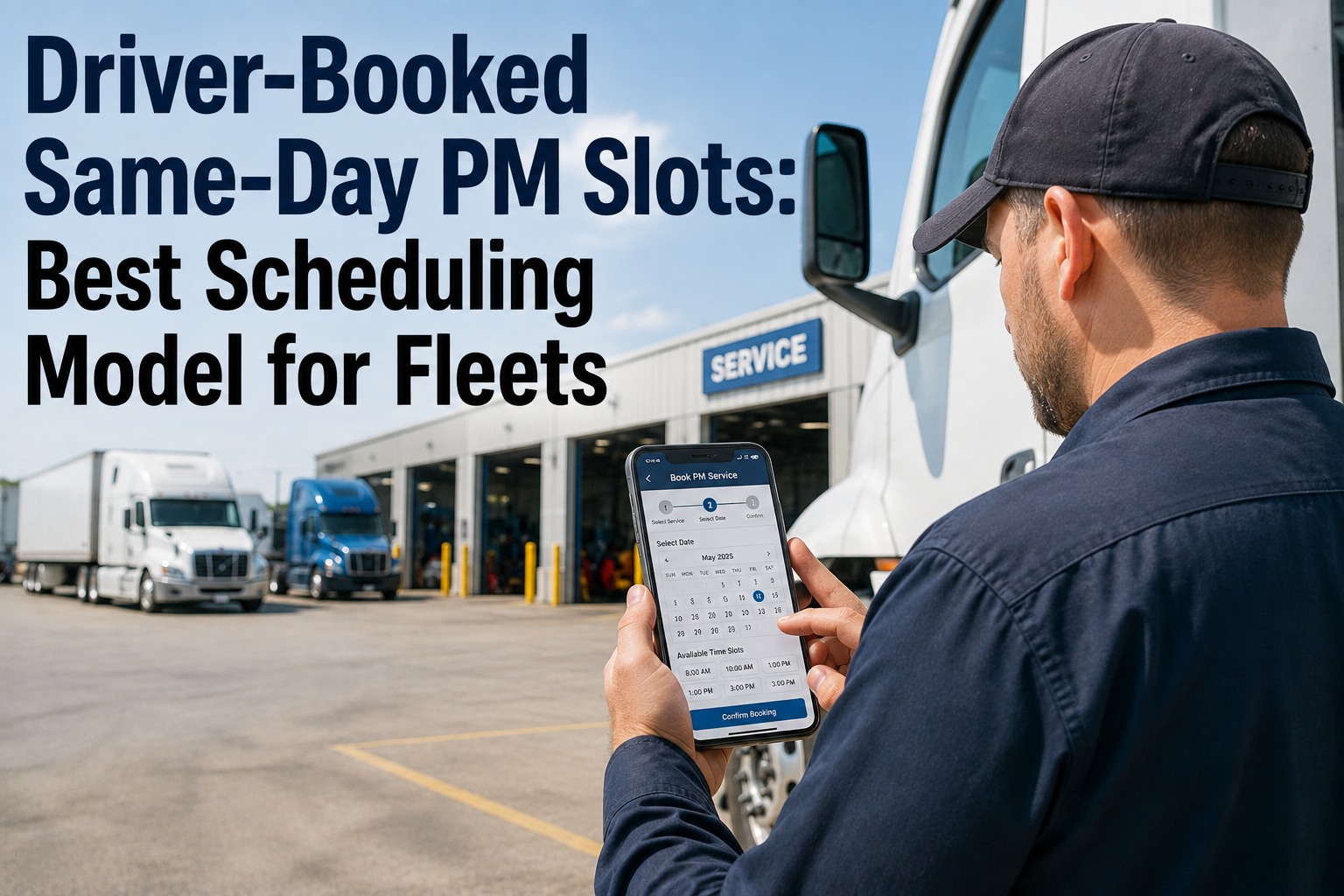
Driver-Booked Same-Day PM Slots — Best Scheduling Model for Fleets
Stop assigning slots drivers didn't pick. Let them book their own — like a haircut — and watch no-shows disappear.
Why Traditional PM Scheduling Fails
The shop-assigns-drivers model has three built-in failure modes that no amount of yelling at drivers can fix. All three go away when the driver is the one picking the slot:
When drivers didn't pick the slot, they don't own it. Route runs late, driver skips PM to make delivery, no-show cascades into next-day rescheduling that misses that day too.
Shop staff staring at empty lifts because a driver didn't show, then swamped with three drivers arriving unannounced. Utilization stuck in the low 60s on the traditional model.
Fleets on shop-assigned scheduling run 2.4× more PMs past their due date than driver-booked fleets. Overdue PMs directly correlate with breakdown rate and CSA score.
Stuck at 72% compliance with the traditional model? Start a free account and flip the first 5 drivers to the driver-booked model this week.
The Driver Booking Flow — 5 Steps on a Phone
The mechanic of the model is simple: the driver's phone shows available slots, driver picks one, the shop confirms. Here's the exact flow:
Driver Gets a PM-Due Notification
Push notification on driver's phone at end of shift: "Truck 4412 has PM-A due within 7 days. Tap to book a slot." No paper form, no dispatch call, no shop email.
App Shows Real-Time Available Slots
Driver opens app, sees a calendar of the next 7 days with 30-min or 60-min slots based on shop bay availability. Green = open, gray = booked, red = shop closed.
Driver Taps a Slot That Works
Driver picks the slot that fits their route schedule — usually early morning before dispatch or late afternoon after delivery. Slot confirms instantly, calendar updates.
Shop Sees the Booking Immediately
Shop foreman's dashboard updates in real time. Tech assigned to the slot, parts pre-pulled based on truck's next scheduled PM tier. No manual scheduling on the shop side.
Reminder + Check-In
Driver gets 24-hr and 1-hr reminders. On arrival, checks in via app — shop knows the driver is here, tech starts the work order. No paperwork handoff. No waiting at the counter.
Want to see the booking flow live on a demo fleet? Contact our team for a 15-minute walkthrough.
The 4 Slot Types Every Fleet Needs
Not every PM takes the same time. The booking calendar needs four slot types drivers can choose from based on what's actually due:
Oil sample, fluid top-ups, quick visual, tire pressures. In and out. Perfect for drivers between morning dispatch and first stop.
Full inspection, oil & filter, brake check, air filter, DEF fill, minor adjustments. The workhorse slot type — 60% of all bookings.
Comprehensive PM plus wear-item replacement (belts, hoses, filters), fluid analysis, chassis lube, alignment check. Bookable at half-day slots only.
DOT-required 396.17 annual inspection. Drivers book at least 7 days out. Auto-blocks other bookings for that truck on the same day.
Slot types configure per shop and per fleet size — sign up free and set up your first slot template in under 10 minutes.
Shop-Side Tuning — 6 Rules That Make It Work
Driver-booked scheduling only works if the shop side is tuned to receive it. These six rules separate fleets running the model at 95%+ compliance from fleets that tried and failed:
Cap Slots at 80% of Capacity
Leave 20% of bay capacity unbooked for walk-ins, defect repairs, and overruns. A shop that books 100% of slots collapses on the first no-show or overrun.
Pre-Pull Parts Based on Truck History
When a driver books a slot for truck 4412, parts tech pulls oil, filters, and any known-due wear items before the truck arrives. Cuts service time by 40%.
Standardize Slot Times to the Minute
30-minute PM-A slots take 30 minutes, not "about a half hour." Standardization is what allows drivers to trust the calendar. Track actual vs booked time weekly.
Assign One Tech to One Slot
Every slot has a named tech, not "shop." Driver arrives, tech is already at the bay. No hand-off, no bystander delay. Cuts perceived wait time to zero.
Allow Driver Preferences to Stick
If a driver always books early morning, the app suggests early morning slots first next time. Small friction removal drives long-term compliance.
Auto-Assign If Driver Doesn't Book
If driver ignores 3 push notifications and PM window closes to 48 hours, system auto-assigns a slot and notifies dispatch. Compliance never dependent on driver alone.
Need help tuning your shop side to receive driver bookings? Get in touch for a free shop-flow audit.
The One Rule That Makes Drivers Actually Book — The Calendar Must Show Real Availability, Not Placeholders
The moment a driver taps a "available" slot and finds out the shop is actually full when they arrive, driver-booked scheduling is dead for that driver forever. The calendar must reflect real-time shop capacity — not last week's plan, not "usually available", not aspirational. Every booking that gets rejected or rescheduled after the driver committed erodes the trust that makes the model work. Bay capacity, tech availability, parts availability all need to flow into what the driver sees. Start a free account and get real-time slot availability driven by actual shop capacity.
The KPI Dashboard — 6 Numbers That Prove the Model Works
Any fleet manager considering the switch should track these six metrics before and after rollout. All six move measurably in the first 60 days when the model is correctly implemented:
Scheduled PMs completed within window. Traditional 72% → driver-booked 95%+ within 60 days.
Bookings not honored. Traditional 28% → driver-booked under 5% (drivers own their bookings).
Bay hours in service vs available. Traditional 62% → driver-booked 85%+ from 80% booking cap + <5% no-shows.
Time from driver notification to booked slot. Should trend under 24 hours as drivers get comfortable with the flow.
Tech starts work order within 5 min of scheduled slot. Requires shop-side tuning discipline.
In-app rating on the booking experience. Below 4.0 means friction somewhere — investigate before compliance drops.
Give drivers the booking calendar. Watch compliance climb, no-shows disappear, and shop utilization jump.
Driver mobile booking, real-time shop capacity, auto-assigned parts and tech, and full KPI dashboard. Free forever for up to 3 vehicles — create your free account or talk to our team.
Rolling It Out — 3-Phase Plan
Fleets that succeed with driver-booked scheduling roll it out in three phases over 60 days. Trying to flip the whole fleet at once is the #1 reason implementations fail:
Pick 5 volunteer drivers with different route types. Turn on booking for them only. Shop side runs both models in parallel — booked for the 5, traditional for the rest. Track KPIs weekly.
Expand to next 20–25% of drivers, prioritizing routes and drivers most similar to the successful pilot. Shop hires or trains parts tech dedicated to pre-pull based on bookings.
Enable driver-booked scheduling for the whole fleet. Retire traditional shop-assigned scheduling except for federal annual inspections and unplanned defect repairs.
Day 1 of the 60-day rollout starts with a free account and 5 volunteer drivers — create yours in 10 minutes and kick off the pilot this week.
Frequently Asked Questions
What is driver-booked PM scheduling?
Driver-booked PM scheduling is a maintenance model where individual drivers pick their own PM slots inside a mobile app instead of the shop assigning slots to drivers. When a truck approaches its PM due date, the driver gets a push notification, opens the app to see available slots on the shop calendar, and picks the one that fits their route schedule. The shop confirms in real time. This flips the traditional model where shop foremen assign slots that drivers may or may not honor.
Why do driver-booked PM slots reduce no-shows?
Ownership. When a driver picks their own slot, they own the commitment — no-show rates drop from a typical 28% under shop-assigned scheduling to under 5% under driver-booked. Drivers pick slots that actually fit their route schedule (early morning before dispatch, late afternoon after delivery), reducing the conflict that causes most no-shows. And because the slot is in their calendar on their phone with their reminders, they're accountable for it in a way that a shop email or paper spreadsheet never achieves.
How does driver-booked scheduling improve PM compliance?
Three ways compound. First, lower no-show rates mean more bookings actually happen. Second, drivers book earlier in their PM window (average lead time under 24 hours) rather than waiting to be told, so PMs land inside window more consistently. Third, the auto-assign safety net catches the small percentage who don't book — the app assigns a slot when the window closes to 48 hours, so compliance is never fully dependent on driver initiative. Fleets typically move from 72% compliance to 95%+ within 60 days of rollout.
Do all PMs need to be driver-bookable?
No. The four typical slot types (Express 30 min, Standard 60 min, Deep 2 hr, Federal Annual half day) cover roughly 90% of scheduled PMs. Federal annual inspections and known long-duration jobs may still be shop-assigned or require driver booking further in advance. Unplanned defect repairs from DVIRs bypass the driver-booking flow entirely — those are shop-directed since the truck is already grounded. Driver-booked works best as the primary scheduling model with specific exception categories preserved.
How long does driver-booked PM rollout take?
60 days for full rollout in three phases: days 1–20 pilot with 5 volunteer drivers running parallel to traditional scheduling for the rest of the fleet, days 21–40 scale to 25% of the fleet with shop-side parts pre-pull discipline, days 41–60 full fleet enablement. Trying to flip the whole fleet at once is the #1 implementation failure — the shop needs the phased ramp-up to tune bay capacity, tech assignment, and parts pre-pull to the new flow.
How does Truck Inspection & Maintenance run driver-booked PM scheduling?
Truck Inspection & Maintenance provides the full driver-booked scheduling stack on one platform. Drivers get push notifications when PM is due, see real-time available slots by shop and slot type, and confirm bookings in taps. Shop foremen see all bookings on one dashboard with automatic tech assignment and parts pre-pull triggered by booking. The 6 KPIs (PM compliance, no-show rate, bay utilization, lead time, on-time start, app rating) all track in real time. Free forever for up to 3 vehicles. Sign up in 10 minutes or contact our team for larger fleets.
Drivers don't miss their haircut appointments. They shouldn't miss their PM slots either.
Real-time booking calendar on driver phones. Parts pre-pulled, tech assigned, PM done. Free forever for up to 3 vehicles — no hardware, no contract, no credit card.