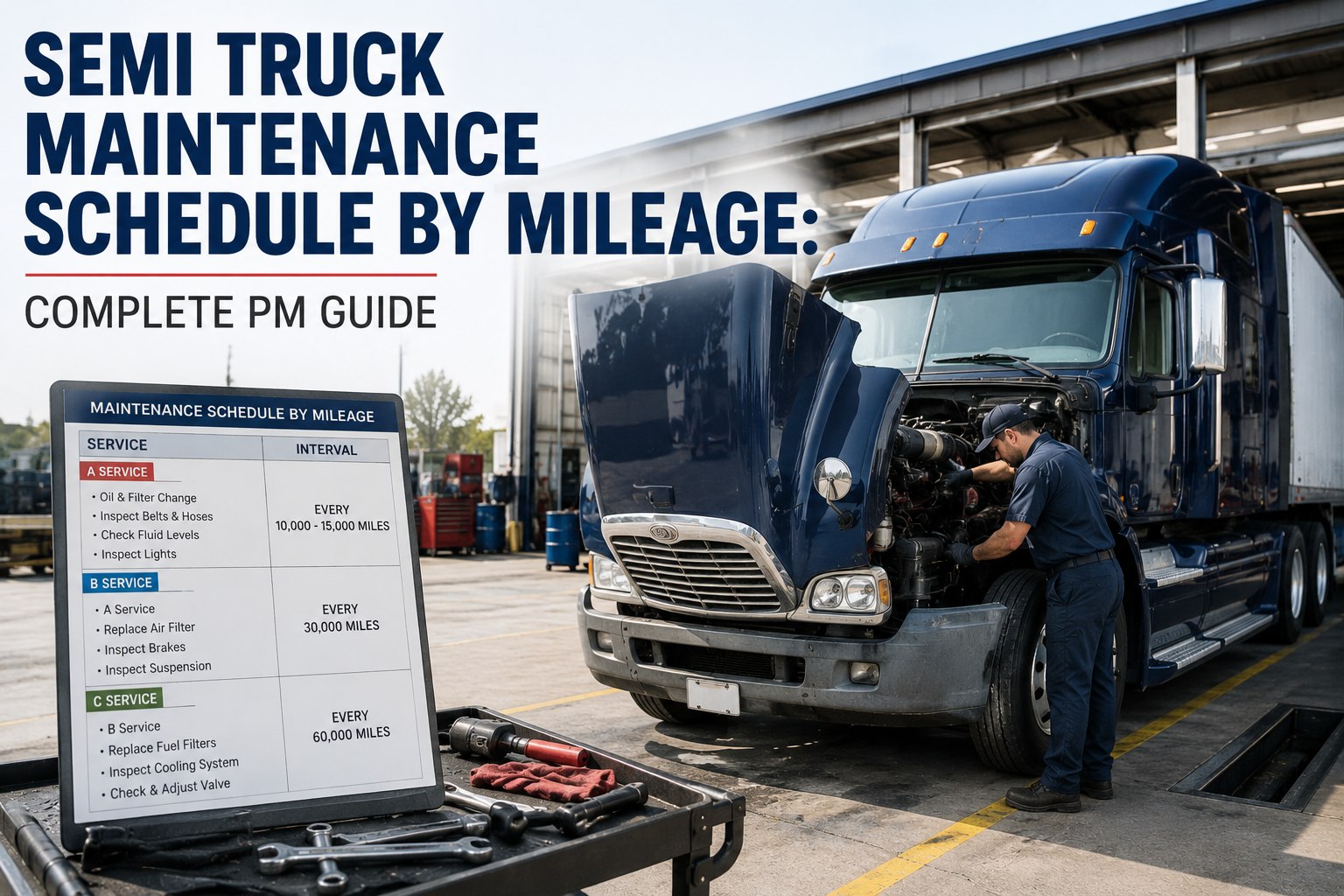
Preventive maintenance is not the interesting part of running a fleet. It's the profitable part. Every documented study of commercial truck economics reaches the same conclusion: planned PM costs 4.8× less than reactive roadside repair, every $1 spent on preventive maintenance saves $4–$8 in emergency repairs, towing, and downtime, and consistent PM prevents approximately 80% of roadside breakdowns while extending truck life by 200,000+ miles. Yet the biggest failure mode across the industry isn't lack of PM budget — it's lack of a structured schedule. Fleets that "do maintenance when the truck comes in" spend 3–5× more than fleets that follow tiered mileage intervals, because the truck comes in when something breaks, not when a component was due. The fix is the tiered PM system that every serious fleet uses: PM-A basic service every 10,000–15,000 miles, PM-B intermediate every 25,000–30,000 miles, PM-C comprehensive every 50,000–60,000 miles, and PM-D major service every 100,000 miles or annually. Each tier includes everything from the lower tiers plus additional deeper items — and when a higher tier comes due, it supersedes the lower ones for that shop visit, maximizing efficiency. This guide walks through the complete A/B/C/D service tier structure, the exact intervals for every major component (oil, fuel filters, air filters, brakes, tires, cooling system), severe duty adjustments, cost economics of PM vs reactive, and how Truck Inspection & Maintenance tracks mileage and alerts you before trucks are due — free forever for up to 3 vehicles.
Semi Truck Maintenance Schedule by Mileage: Complete 2026 PM Guide
The A/B/C/D tier structure that turns $1 of preventive maintenance into $4–$8 of prevented breakdown cost.
The Tiered PM Philosophy
Every serious fleet organizes preventive maintenance into escalating tiers keyed to mileage. Each tier includes everything below it plus additional deeper items. When a higher tier comes due, it supersedes the lower tiers for that shop visit — the truck gets all included items at once, maximizing shop efficiency and minimizing downtime:
Basic Service
The foundation. Oil change, filter replacements, chassis lube, fluid top-offs, DVIR review, visual inspection. Every truck's most frequent shop visit.
Intermediate Service
PM-A plus deeper powertrain work. Fuel filter change, brake inspection with pushrod measurement, tire rotation, cooling system pressure test.
Comprehensive Service
PM-B plus major fluids and structural inspection. Coolant flush, transmission service, differential fluid, driveline inspection, exhaust aftertreatment check.
Major Service
PM-C plus overhauls. Wheel bearings, complete brake system, kingpin bushings, DPF service, DOT annual inspection integrated at this level.
How Nesting Works
When a truck hits 50,000 miles and a PM-C comes due, it INCLUDES the A and B items — everything gets done in one shop visit. The A and B interval clocks then reset from the C-service completion date. A modern CMMS handles this nesting automatically. Paper systems require manual tracking, which is where fleets lose intervals.
PM-A Basic Service — What's Included
The workhorse of your PM program. Every 10,000–15,000 miles depending on manufacturer spec and duty cycle. Standard synthetic oil trucks push toward 15K; severe duty pulls it back to 10K:
Engine Oil & Filter
Drain, refill with manufacturer-spec synthetic (typically 15W-40 or 10W-30). Replace oil filter. Send oil sample for analysis on trucks approaching high mileage.
Chassis Lubrication
All grease fittings: fifth wheel plate (critical), driveshaft slip joints, U-joints, steering linkage, spring shackles. Wet grease at every fitting until it purges clean.
Fluid Levels & Top-Off
Coolant, power steering, windshield washer, transmission fluid check (deep dip). Any low fluid gets diagnosed for source before topping off blindly.
Lights & Electrical
All headlights, marker lamps, brake lights, turn signals, trailer connection points. Battery terminal cleaning and load-test if approaching 3+ years.
Tire Inspection
Tread depth measurement all positions (4/32" steer, 2/32" others). Air pressure check with calibrated gauge. Sidewall inspection for damage or bulges.
DVIR Review
Review all driver DVIRs since last PM. Address any deferred defects. Note recurring complaints — pattern of same issue across shifts signals developing problem.
PM-B Intermediate Service — Added Items
Every 25,000–30,000 miles. Includes everything from PM-A above, PLUS these additional deeper items. Fleets typically stagger PM-A and PM-B so A happens between B visits:
Fuel Filter Change
Primary fuel filter every 25,000–30,000 miles. Secondary/water separator on same schedule for contaminated fuel conditions. Prime fuel system after change.
Brake Inspection
Full pushrod travel measurement at 90–100 PSI application. Brake shoe/pad thickness measurement. Drum condition inspection. Slack adjuster verification.
Tire Rotation
Rotate to equalize wear patterns. Steer to drive, drive positions shuffled. Balance if vibration present. Alignment check if uneven wear pattern detected.
Cooling System Test
Pressure test to spec. Coolant condition check (freeze point, pH, corrosion inhibitor level). Hose inspection for bulging or softening at fittings.
Air Filter Check
Restriction gauge reading. Replace if in red zone or every 50,000 miles clean highway / 15,000 miles dusty duty. Dirty filter cuts fuel economy 5–10%.
Air System Check
Governor cut-out and cut-in pressures verified. Air compressor discharge line inspection. Air dryer service. Wet tank drain and inspection.
PM-C Comprehensive Service — Deeper Systems
Every 50,000–60,000 miles. Includes PM-A and PM-B items PLUS these major fluid and system services. This is where the big cost items live — but skipping them is where the really big cost items originate:
Transmission Service
Drain and refill with manufacturer-spec fluid. Filter replacement where applicable. Manual transmissions typically 100K interval, automatics 50K–75K.
Differential Service
Drive axle differential fluid drain and refill. Inspection for metal shavings on drain plug magnet. Rear axle typically at 60K–100K depending on duty.
Driveline Inspection
U-joint condition, driveshaft phasing, carrier bearing inspection, slip yoke condition. Any looseness or excessive play flagged for immediate service.
Aftertreatment Check
DPF regeneration history, SCR/DEF system function, DOC condition, sensor readings. Manual DPF regeneration if backpressure trending high.
Full Alignment Check
Front and drive axle alignment. Uncorrected misalignment kills tires 30–50% faster. Toe, camber, caster measurements. Adjust to manufacturer spec.
Suspension Inspection
Air bag condition, height control valve function, leaf spring inspection (broken leaves, worn shackles), shock absorber leak check. U-bolt torque verification.
Interval Quick-Reference Chart
Component-level schedule at a glance. Use this as your fleet maintenance planning reference — adjust intervals based on manufacturer specs, duty cycle, and oil analysis results:
Stop losing PM intervals — get alerted before trucks are due
Truck Inspection & Maintenance tracks mileage across every vehicle in your fleet and automatically alerts you before PM-A, PM-B, PM-C, and PM-D services come due. Nesting is handled automatically — when PM-C is due, all A and B items are included in the generated work order. Driver DVIRs feed into the same system, so deferred defects get addressed at the next PM. Sign up free for up to 3 vehicles.
Severe Duty Adjustments
Standard intervals assume standard duty. Severe duty cycles — construction, heavy haul, mountain routes, urban stop-and-go — shorten every interval. Here are the multipliers to apply:
Construction / Off-Road
Dusty conditions, rough terrain, heavy loading. Air filter every 15K instead of 50K. Chassis lube every 5K. Full inspection every 30 days regardless of mileage.
Heavy Haul / Mountain
Grade brake usage kills brake life. Brake inspection every 10K. Cooling system stressed hard — coolant condition testing every PM-A.
Urban Stop-and-Go
Delivery routes hammer brakes and drivetrain. Brake pads wear 2–3× faster than highway. Idle time inflates engine hours vs mileage — check both meters.
Extreme Climate
Deep cold (below -20°F) or extreme heat (above 100°F). Battery load test every 3 months instead of 6. Extra attention to cooling and starting systems.
PM Economics — Why This Matters
The financial case for structured PM isn't marginal — it's overwhelming. Every credible study reaches the same conclusion. Here's the math that convinces even the tightest CFO:
Saved per $1 PM Spent
Industry consensus across FMCSA, ATA, and TMC studies. Every dollar in preventive maintenance saves $4 to $8 in reactive repair, towing, and downtime costs.
Reactive Cost Multiplier
Planned maintenance costs 4.8× less than reactive roadside repair. Same repair — but with towing, wait time, driver detention, and rush-order parts included.
Breakdowns Preventable
Consistent PM prevents approximately 80% of roadside breakdowns. The 20% that remain are typically random failures (impacts, fluke component defects).
Life Extension
Trucks on documented PM programs consistently exceed manufacturer expected life by 200,000+ miles. Well-maintained tractors reaching 1M+ miles is routine.
DOT Annual Inspection — Integration
The FMCSR 396.17 annual inspection is a fixed 12-month regulatory requirement running parallel to your mileage-based PM. Best practice: align it with your PM-D service. One shop visit, one downtime event, both requirements met:
Annual Inspection Requirement
FMCSR requires every CMV to receive a comprehensive annual inspection by a qualified inspector. Certificate must be on file. Cannot be operated without valid annual inspection certification.
Qualified Mechanic Required
Inspections must be performed by a mechanic with training and experience in the relevant CMV systems. Fleet operators document technician qualifications for audit purposes.
1-Year Retention Minimum
FMCSA requires one year minimum retention of maintenance records, repair records, and parts documentation for each vehicle. Digital records make audit preparation dramatically faster.
Align with PM-D Service
Best-practice fleets schedule the DOT annual to coincide with PM-D. Alerts fire at 90/60/30 days before expiration. One shop visit accomplishes both — minimizing downtime.
Frequently Asked Questions
What's the difference between PM-A, B, C, and D services?
PM-A (10,000–15,000 miles) is basic service: oil change, filter replacements, chassis lube, fluid top-offs, DVIR review. PM-B (25,000–30,000 miles) includes A items plus fuel filter, brake inspection, tire rotation, and cooling system testing. PM-C (50,000–60,000 miles) includes B items plus transmission service, differential service, driveline inspection, and aftertreatment checks. PM-D (100,000 miles or annual) includes C items plus major overhauls, wheel bearings, complete brake system, and DOT annual inspection integrated. Higher tiers supersede lower ones — when C is due, the truck gets everything in A, B, and C in one shop visit.
How often should I change oil in a semi truck?
Modern semi trucks with synthetic oil typically go 15,000–25,000 miles between oil changes, with severe duty pulling that back to 10,000 miles. Follow manufacturer recommendations — Cummins ISX, Detroit DD15, Volvo D13, and Cat C15 each have specific intervals. Consider both mileage and engine hours: a truck under mileage threshold but with accumulated engine hours (heavy idling) may need service earlier. Best practice: oil analysis on trucks approaching high mileage lets you extend or shorten intervals based on actual condition rather than schedule alone.
Do all PM intervals reset when a higher tier is done?
Yes. This is called "nesting" and it's how tiered PM programs stay efficient. When a truck hits 50,000 miles and PM-C comes due, the shop performs all PM-A and PM-B items along with the C-specific items in one visit. The interval clocks for A and B reset from the C-service completion date. Modern CMMS platforms handle this automatically — paper systems require manual tracking, which is where fleets lose intervals and end up doing redundant or missed services.
How do severe duty conditions change the schedule?
Standard intervals assume standard duty. Severe duty conditions require multipliers: construction/off-road (0.6× normal intervals due to dust and rough terrain), heavy haul/mountain routes (0.7× due to brake and cooling stress), urban stop-and-go (0.7× due to accelerated brake and drivetrain wear), extreme climate (0.8× due to battery and thermal stress). A truck normally due for PM-A at 15,000 miles under highway duty should get PM-A at 9,000 miles under construction duty. Adjust based on operating conditions, not calendar.
What's the ROI of preventive maintenance on semi trucks?
Industry consensus is 4–8× return: every $1 spent on PM saves $4–$8 in emergency repairs, towing, downtime, and driver detention. Planned maintenance costs 4.8× less than reactive roadside repair for the same underlying work. Consistent PM prevents approximately 80% of roadside breakdowns and extends truck life 200,000+ miles beyond manufacturer expectations. The single highest-ROI activity in commercial fleet management is systematic PM compliance. Talk to our team about mileage-based PM alerts.
How does Truck Inspection & Maintenance handle PM scheduling?
Truck Inspection & Maintenance tracks mileage across every vehicle in your fleet and automatically alerts you before PM-A, PM-B, PM-C, and PM-D services come due. Nesting is handled automatically — when PM-C is due, all A and B items are included in the generated work order and the interval clocks reset from the C-service completion date. Driver DVIRs feed into the same system, so deferred defects get addressed at the next scheduled PM. Free forever for up to 3 vehicles. Sign up in 10 minutes.
Stop losing PM intervals in spreadsheets. Every truck's schedule managed automatically.
Truck Inspection & Maintenance tracks mileage across every truck in your fleet, auto-alerts at 90/60/30 days before PM-A, PM-B, PM-C, and PM-D services come due, and handles the nesting logic automatically. DVIRs, PM work orders, and DOT annual inspection tracking all in one system. Free forever for up to 3 vehicles with no hardware and no contracts. Set it up in 10 minutes.