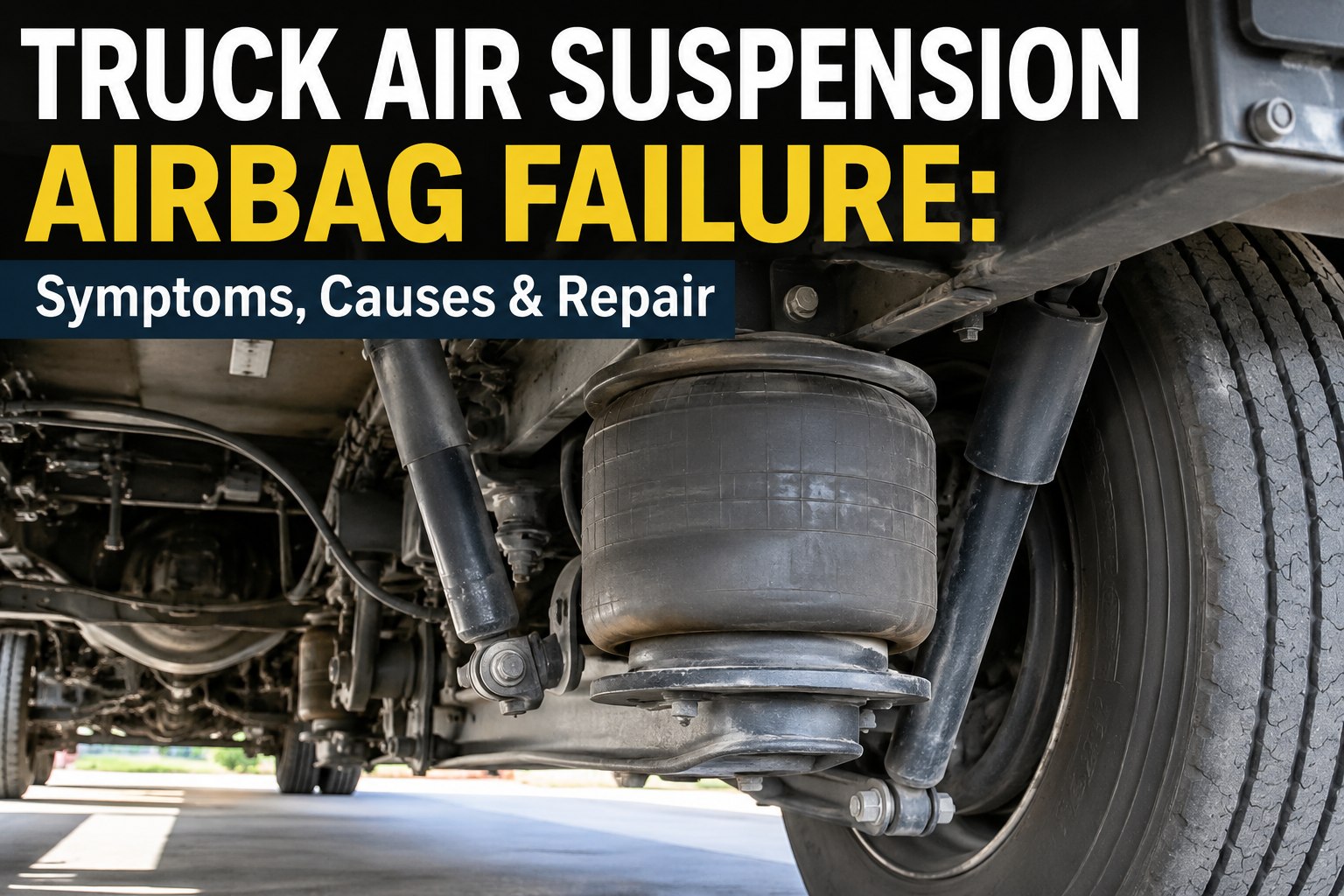
Air suspension isn't just about ride comfort — it's what keeps a loaded semi-trailer level over uneven pavement, protects cargo from shock damage, and lets a fleet run 400,000+ miles without the metal fatigue that eventually breaks conventional leaf springs. At the center of every air suspension system sits a rubber-and-fabric bellows called an airbag (or air spring) that inflates and deflates via the ride-height control valve to keep the truck at a consistent frame height regardless of load. When one airbag fails, the truck sags on that corner, throws off weight distribution across the remaining axles, over-stresses the shocks and the ride-height valve, and eventually turns a $250–$500 airbag replacement into a $2,500–$5,000 cascade of secondary damage. This guide walks through how air suspension actually works, the six symptoms that flag a failing airbag, the four root causes worth preventing first, the shop-floor diagnostic flow, repair cost by component, and the maintenance rhythm that keeps ride-height systems healthy across a fleet. Automate air suspension inspection tracking on our fleet maintenance platform, or reach out to our support team for a walkthrough.
Truck Air Suspension Airbag Failure: Symptoms, Causes & Repair
Rubber bellows holding up 40,000 pounds at 100 PSI. When they fail, the ride-height cascade begins — here's how to catch it early and stop the damage at the airbag.
How Air Suspension Actually Works
Six components, one job: keep the frame at a constant height above the axle regardless of load. Understanding the loop is what makes symptom diagnosis intuitive — track every one of these components per truck across your fleet.
The 6 Symptoms of a Failing Airbag
Airbags rarely fail all at once. They give six early warnings — if any of them show up on a pre-trip inspection, get the truck into the shop before the cascade begins.
The 4 Root Causes: Where Airbags Actually Fail
Most airbag failures trace back to four specific mechanisms. Understanding which one you're seeing determines both the fix and the prevention.
Age & UV Degradation
Rubber compound degrades over time — sun exposure, ozone, temperature cycles all attack the material. Cracks develop on outer sidewalls. 5–10 years is typical service life; more in favorable climates, less in extreme UV or Northeast winters.
Physical Damage
Road debris punctures. Contact with drivetrain or exhaust components after a repair. Improper jack points during service. Even a small nail hole is enough to fail the airbag. Inspect the outer surface at every PM.
Ride-Height Valve Failure
The valve sticks in fill or dump position. Airbag over-inflates and blows the bead seal, or under-inflates and folds during travel. Not an airbag problem — but always causes airbag damage.
Fitting & Bead Leaks
Airbag itself is fine — leak is at the mounting flange, upper bead, or air-line fitting. Common after airbag installation done without proper torque. Diagnostic distinguishes this from actual airbag failure.
Diagnostic Flow: Finding the Actual Failure
Sagging suspension isn't always the airbag. Follow this six-step diagnostic and you'll find the real cause before replacing parts unnecessarily.
Catch airbag failures at pre-trip, not roadside
Digital DVIR with ride-height photo capture, per-corner tracking, and auto-flagged sag alerts. Every driver becomes the first line of defense against a $5,000 cascade failure.
Repair Cost Breakdown
Not every air suspension repair is the same. Here's what fleets should expect to pay in 2026 for each type of fix — and why waiting always costs more.
The Field Replacement Procedure
Here's the shop procedure for a single-airbag replacement. Deviate from this sequence and you'll be back for a second attempt within a week.
Prevention: The Habits That Extend Airbag Life to 10+ Years
Same truck, same routes — one fleet gets 4 years out of airbags, another gets 10. The difference is a handful of specific practices applied consistently.
Drain Air Tanks Daily
Moisture in the compressed air system attacks rubber from the inside. Daily manual tank drains — or automatic drain valves that actually work — extend airbag life by 30–50%.
Inspect Every PM
10-second visual per corner: cracks, chafe marks, contact with drivetrain, uneven ride height. Small issues caught in the bay never become road failures.
Clean the Airbag Surface
Road grime holds moisture against the rubber. Quarterly cleaning with mild soap and water — never petroleum solvents — removes it and extends life.
Replace Height Valves Preventively
At 400,000–500,000 miles, replace ride-height valves regardless of symptom. A stuck valve destroys airbags — and a $150 valve is cheaper than a $500 airbag replaced early.
Fix Air Leaks Immediately
Any leak causes the compressor to run more — heat, moisture, and wear all accumulate. Chase small leaks the day they appear, not the day the truck sags.
Match Load to Rated Capacity
Chronic overload compresses airbags beyond design limits, accelerating fatigue. Load rating on the truck door frame isn't a suggestion — it's the number that determines airbag life.
Frequently Asked Questions
Typical service life is 5–10 years or 300,000–500,000 miles, whichever comes first. Well-maintained fleets in favorable climates see 10+ years; fleets in harsh UV, cold climates, or high-load operations see closer to 4–6 years. Age-based replacement plans keep failures preventable. Track airbag age per truck on our fleet platform.
A single airbag replacement runs $250–$500 in parts and labor. Combined with a height valve replacement, expect $450–$850. If neglected until cascade damage occurs — multiple airbags, shocks, valve, air lines — total cost jumps to $2,500–$5,000. Early response is always cheaper than late response by 5–10x.
Not for long, and not safely. A failed airbag shifts weight to remaining suspension components, over-stresses the ride-height valve, degrades handling, and often triggers cargo damage claims from harsh ride. Roadside inspectors can also flag visible sag as an unsafe condition, leading to out-of-service orders. Get it into the shop before the cascade begins — talk to our team about mobile-repair coordination.
Four primary causes: age-related rubber degradation (40% of failures), physical damage from debris or drivetrain contact (25%), ride-height valve failure that over- or under-inflates the bag (20%), and mounting flange or fitting leaks that get misdiagnosed as bag failures (15%). Proper diagnosis identifies the actual failure before replacing parts.
Park level, measure ride height at each corner with a tape measure, wait 8 hours, then re-measure. Any corner that dropped more than 1/2" is losing air. Confirm with a soap-water spray on the suspected airbag surface, mounting flange, and fitting — bubbles reveal the exact leak location. Track this test at every DVIR on our maintenance software.
Same-axle pair replacement is best practice — when one airbag on an axle fails, the other is close behind, and matched service life keeps ride characteristics balanced. Cost is roughly $400–$800 for a matched pair vs $250–$500 for a single, and you avoid a second shop visit. For older units nearing end-of-life, fleets often replace all four at PM interval instead of chasing individual failures.
Turn air suspension care into a repeatable process
Ride-height inspection built into digital DVIR. Per-corner sag alerts from driver reports. Automatic PM triggers at 400,000-mile height-valve replacement intervals. Airbag age tracked per vehicle. Repair history archived by VIN. Cascade failures become preventable, not surprising.