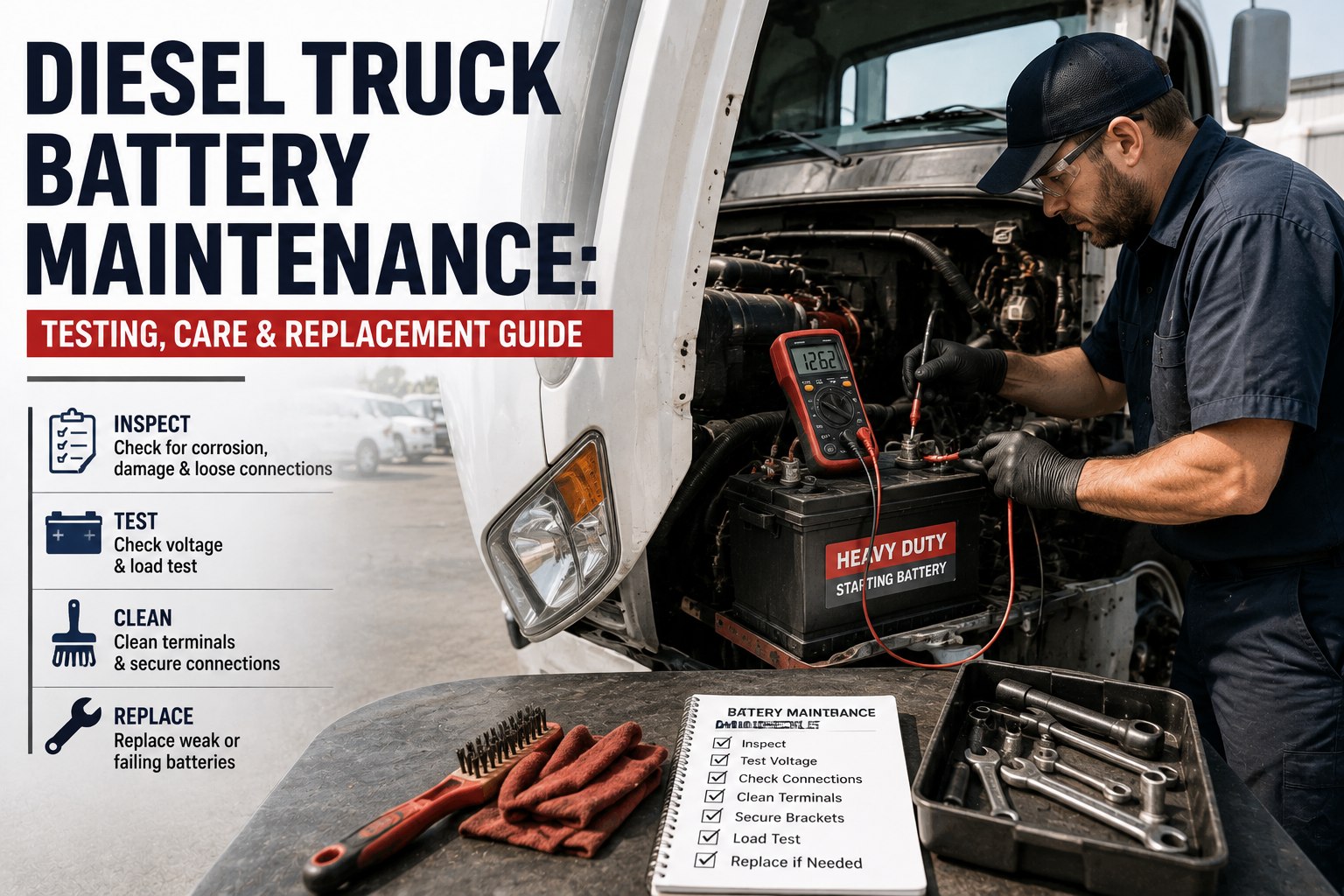
Battery failure is the number one cause of preventable no-starts on heavy-duty diesel trucks — and yet it's one of the easiest failures to predict and prevent. The reason it keeps happening comes down to how different diesel truck battery systems are from anything a passenger-vehicle mechanic ever encounters. Diesel engines have compression ratios exceeding 16:1, meaning the starter has to overcome enormous cylinder pressure to crank the engine — which is why commercial batteries deliver 1,000 to 1,800 CCA compared to 400 to 600 CCA for passenger vehicles. Most Class 8 trucks run 4 to 6 batteries in parallel banks, and the single most misunderstood fact about those banks is that one weak battery drags down every other battery in the system. A truck with one healthy 800 CCA battery and one degraded 500 CCA battery does not have 1,300 CCA available — it has less effective cranking power than either rating suggests, because the healthy battery continuously depletes itself compensating for the weak one. That's why the industry rule is: replace ALL batteries in a bank when any one fails. Miss that rule and you'll be back in the shop within 90 days when the next battery fails, then the next. Beyond bank management, proper maintenance stretches battery life from the typical 2–3 years to 4–5 years — saving $400–$800 per battery per replacement cycle across fleets with hundreds of trucks. This guide walks through diesel battery architecture, voltage benchmarks, the 6 warning signs of impending failure, the load test procedure that actually predicts remaining life, battery type comparison (Flooded vs AGM vs TPPL), maintenance schedule, and how Truck Inspection & Maintenance tracks battery testing intervals and voltage trends across your fleet — free forever for up to 3 vehicles.
Diesel Truck Battery Maintenance: The Complete 2026 Testing & Care Guide
The load test procedure, bank management rules, and voltage benchmarks that turn 2-year batteries into 5-year batteries.
Why Diesel Battery Systems Are Different
Diesel truck batteries are their own category — nothing like the single battery in a passenger vehicle. Three specific attributes drive every maintenance decision that follows:
16:1 Compression Ratio
Diesel engines compress air to over 16:1 for compression ignition. The starter must overcome that pressure — demanding 3–4× the cranking amps of a gasoline engine. This is why commercial batteries carry 1,000–1,800 CCA vs 400–600 for cars.
Multi-Battery Parallel Bank
Most Class 8 trucks run 4–6 batteries wired in parallel to deliver combined cranking amperage. All batteries share positive and negative bus bars. One weak battery drags down the entire bank — no exceptions.
Hotel Load Discharge
Sleeper trucks with DC-to-AC inverters, urban delivery trucks with anti-idle regulations, and long-haul rigs powering HVAC overnight all deep-discharge batteries. Deep discharge kills battery life faster than any other factor.
The Battery Bank Rule — Match or Fail
This is the single most important concept in fleet battery management. Ignore it and you'll fight the same battery problems repeatedly for years. Follow it and battery costs drop dramatically:
Why the Math Doesn't Add Up
Batteries in parallel share the same voltage bus. The healthy 800 CCA battery continuously depletes itself trying to bring the weak 500 CCA battery up to voltage. Result: the healthy battery ages 2–3× faster than it should, and combined cranking power is worse than the sum suggests. Two rules follow: (1) Replace ALL batteries in a bank simultaneously when any one fails. (2) Always charge or maintain the entire bank together — never one battery alone.
Voltage Benchmarks — What The Numbers Mean
Every diagnosis starts with a voltage reading. Learn these benchmarks by heart. They're the difference between accurate diagnosis and replacing parts that were never the problem:
Fully Charged at Rest
Ideal reading after truck sat at least 2 hours. Every cell contributing full voltage. Ready for full cranking demand.
Partially Discharged
Needs recharging. Not necessarily failed — could be parasitic drain or short-trip use. Investigate before condemning.
Capacity Loss
Battery holding a partial charge but not returning to full. Approaching end of service life. Load test to confirm.
Under Load Failure
Drops below 9.6V at 70°F under 50% CCA load for 15 seconds = failed load test = replace. Non-negotiable.
The 6 Warning Signs of Battery Failure
Failing diesel truck batteries announce themselves clearly if you know what to look for. Recognizing these six symptoms in order lets you replace proactively — before the truck strands a driver at 4 AM in January:
Slow Cranking on Cold Starts
Truck cranks more slowly on cold mornings than warm afternoons. Not yet a starting failure — but battery capacity has declined and cold demand exceeds warm demand. Test now, not after the failure.
Dim Interior & Dash Lights
Lights dim visibly when cranking or when accessories draw. Battery voltage sagging under load. Common early sign — often ignored because "the truck still starts."
Clicking Without Cranking
Solenoid clicks but engine doesn't crank. Insufficient current to engage starter. Battery bank cannot deliver adequate cranking amperage. Emergency territory — get it started with a jump and go straight to the shop.
Swollen or Bulging Case
Battery case appears distorted or swollen. Internal damage from overcharging or extreme heat. Immediate replacement — swollen batteries can rupture or leak acid, creating safety hazard.
Corrosion & Sulfation
White or greenish deposits on terminals. Increases resistance, reduces effective CCA, and signals internal chemistry problems. Clean terminals immediately; test battery capacity.
Random Electrical Faults
ECM warning lights, radio resets, gauge glitches, sensor errors. Low voltage causes electronic modules to misbehave. Frequently misdiagnosed as expensive electrical repairs when the root cause is a weak battery.
The Load Test Procedure — Step by Step
Static voltage alone doesn't reveal capacity. A battery reading 12.6V at rest can still fail under load. The load test is the definitive capacity check. Do it every 6 months, before winter, and any time symptoms appear:
Disconnect & Isolate
Turn off all electrical loads. If testing bank, disconnect batteries from each other — each battery tested individually. Battery must be at rest for at least 30 minutes before test.
Verify Charge State
Measure resting voltage. Below 12.4V = charge first, then test. Testing a discharged battery gives false failure readings. Fully charge to 12.6V+ before proceeding.
Set Load to 50% CCA
On an 800 CCA battery, set load tester to 400 amps. On 1,000 CCA, set to 500 amps. Half the CCA rating is the standard load test spec.
Apply Load 15 Seconds
Watch voltage on tester display. Must maintain 9.6V or higher at 70°F for full 15 seconds. Drops below 9.6V = failed test = replace. Drops below 9.0V = replace immediately with no reservation.
Document Result
Record voltage under load, ambient temperature, and battery age. Trend across quarterly tests reveals degradation rate. Predictable replacement timing beats emergency replacement every time.
Battery Type Comparison
Three battery technologies dominate heavy-duty diesel trucks. Choose based on duty cycle, maintenance capacity, and total-cost-of-ownership horizon rather than upfront price alone:
Lead-Acid Flooded
Budget deployments where upfront cost matters most. Requires disciplined maintenance to reach rated life.
Absorbed Glass Mat
The mainstream choice for modern commercial fleets. Zero maintenance, better vibration resistance, deep-discharge tolerance.
Thin Plate Pure Lead
Premium choice for high-value trucks. Often lasts the truck's first-owner service window — net cost savings vs multiple replacements.
Track load test intervals, voltage trends, and replacement forecasts across every truck
Truck Inspection & Maintenance tracks battery age, load test results, and voltage trends per vehicle — with 6-month test alerts, pre-winter testing reminders, and replacement forecasting based on degradation curves. Replace batteries when the data says so, not when a driver strands on a cold morning. Sign up free for up to 3 vehicles.
Maintenance Schedule at a Glance
Consistent maintenance stretches diesel truck battery life from the typical 2–3 years to 4–5 years. Six intervals cover everything you need — schedule them once, follow them religiously:
Cranking Observation
Driver notes cranking speed. Any change from normal — slower, hesitation, clicking — gets logged on the DVIR. Trends catch problems weeks before failure.
Terminal Cleaning
Clean terminals every 30 days or at fuel stops on high-mileage routes. Corrosion increases resistance, reduces effective CCA, and hides charging faults.
Electrolyte Level (Flooded)
Serviceable flooded batteries need water level check every 90 days. Low levels expose plates to air, causing permanent 25%+ capacity loss. Distilled water only.
Load Test All Batteries
Test each battery individually — never trust the bank reading. Schedule for late summer before cold weather. Predictable replacement beats emergency replacement.
Terminal Torque Check
Diesel vibration loosens terminals over time. Torque every PM-A (10K–15K mi). Loose connections cause charging faults, false CCA loss, and mysterious electrical problems.
Battery Maintainer
Any diesel truck sitting more than 2 weeks needs a maintainer connection. Parasitic drain from ECM, telematics, and clocks deep-discharges batteries — killing life dramatically.
Replacement Cost Economics
Cost of good maintenance vs cost of neglect. The math is stark — and once you see it, the case for a proper testing program is undeniable:
Unmaintained Life
Flooded batteries with no maintenance discipline. Typical fleet reality. Constant replacement cycle.
Maintained Life
Same flooded batteries with quarterly cleaning, 6-month load testing, and PM-integrated terminal checks. Life doubles.
Full Bank Replacement
4–6 batteries at $400–$800 each. Every 2–3 years unmanaged. Every 4–5 years with maintenance discipline.
Roadside Failure Cost
Tow bill, emergency service call, driver detention time, missed delivery penalties, dispatcher time. All from a battery that could have been replaced proactively.
Frequently Asked Questions
How long should a diesel truck battery last?
Flooded lead-acid batteries typically last 2–3 years in commercial diesel service. AGM batteries last 3–5 years. TPPL AGM batteries can reach 30–60 months (2.5–5 years) and often survive the first owner's service window. Life depends heavily on maintenance discipline, duty cycle, climate, and whether batteries have been deep-discharged. Fleets that follow structured maintenance (quarterly cleaning, 6-month load testing, terminal torque at every PM) consistently stretch battery life 50–100% beyond unmaintained baseline.
How do I load test a diesel truck battery?
Charge battery fully first (must read 12.6V+ at rest). Disconnect batteries from each other if testing bank (each battery tested separately). Set load tester to 50% of CCA rating (400 amps for 800 CCA battery). Apply load for 15 seconds while watching voltage. Battery must maintain 9.6V or higher at 70°F for the full 15 seconds. Below 9.6V = failed test, replace battery. Below 9.0V = replace immediately, no reservation. Record results and ambient temperature to track degradation trends.
Do I need to replace all batteries at once?
Yes — always. Batteries in a parallel bank share the same voltage bus. Any weak battery pulls current from stronger batteries, forcing them to deplete themselves trying to bring the weak one up to voltage. Result: a bank with one bad battery destroys good batteries within months. Replace all 4–6 batteries in the bank simultaneously when any one fails, and always charge or maintain the entire bank together. Never charge one battery in a bank while leaving the others disconnected — current bleeds through the interconnect wire, uneven charging results.
What voltage should a healthy truck battery show?
12.6V or higher at rest (measured after truck sat at least 2 hours with all electrical loads off) indicates a fully charged, healthy battery. 12.4–12.6V indicates partial discharge — needs charging or investigation. 12.0–12.4V indicates degraded capacity, load test to confirm. Below 12.0V indicates significant capacity loss or discharge, load test required. Under load, the battery must maintain 9.6V minimum at 70°F while supplying 50% of its CCA rating for 15 seconds. Below 9.6V under load = replace.
When should I use AGM vs flooded batteries?
Flooded lead-acid batteries cost less upfront ($150–$300) but need quarterly water level checks and last only 2–3 years. Best for budget deployments with strong maintenance discipline. AGM batteries cost more ($250–$500) but require zero maintenance, tolerate deep discharge better, and handle diesel vibration far better — reaching 3–5 year service life. TPPL AGM ($400–$800) can last 30–60 months and often outlives the first owner's service window. For most modern fleets, AGM or TPPL AGM delivers lower total cost of ownership despite higher upfront price. Talk to our team about battery TCO tracking.
How does Truck Inspection & Maintenance handle battery maintenance?
Truck Inspection & Maintenance tracks battery age, load test results, voltage readings, and replacement history for every vehicle in your fleet. Automated alerts fire at 6-month load-test intervals, pre-winter testing reminders, and forecasted replacement dates based on degradation trends. Driver DVIRs capture cranking observations that feed into the battery health record. Replace batteries when the data says so — not when a driver strands on a cold morning. Free forever for up to 3 vehicles. Sign up in 10 minutes.
Battery load test alerts, voltage trends, and replacement forecasts — for every truck in your fleet.
Truck Inspection & Maintenance tracks battery age, 6-month load test intervals, voltage trends, and replacement forecasts across every vehicle. Pre-winter testing alerts. Driver cranking observations captured on DVIRs. Terminal torque checks integrated with PM schedules. Never replace batteries reactively after a strand — replace them proactively when the data trends say to. Free forever for up to 3 vehicles with no hardware and no contracts. Set it up in 10 minutes.