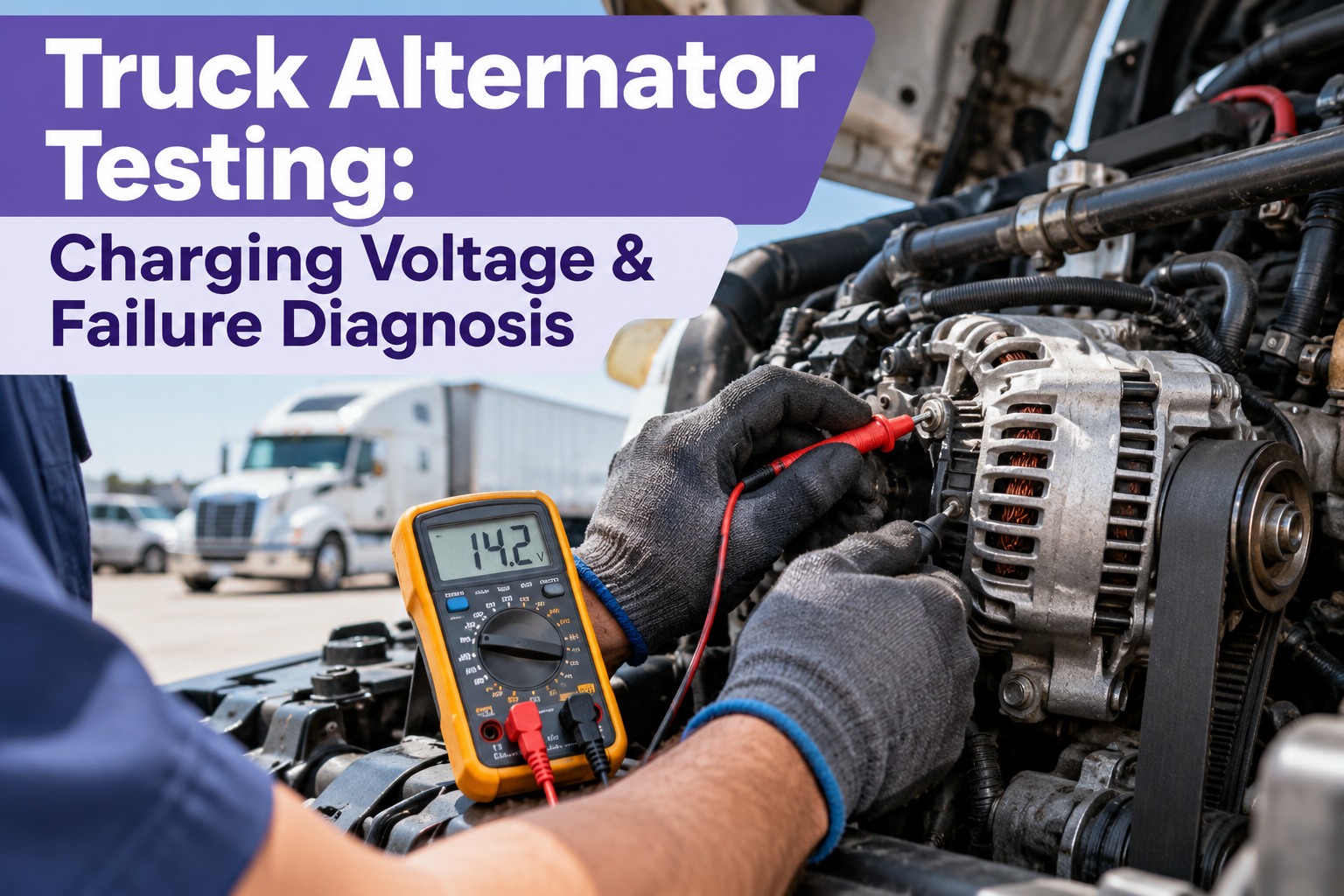
When a truck keeps killing batteries, the battery usually isn't the problem. It's the part that's supposed to keep it charged. A failing alternator can undercharge a battery for weeks, or overcharge it until it swells, and the first sign most fleets see is a dead truck. A proper alternator test takes a few minutes with a multimeter and a clear idea of what to look for: charging voltage, output under load, AC ripple and voltage drop in the cables and grounds. This guide shows how to read each result, which symptoms point to a charging fault, and how Truck Inspection & Maintenance Management Software keeps readings per truck so a slow decline shows up before the next no-start. Start free and log charging-system tests per truck.
Truck Alternator Testing: Charging Voltage & Failure Diagnosis
One bad reading doesn't tell you much. A trend does. Truck Inspection & Maintenance Management Software lets technicians record charging voltage and test results on a PM checklist, keeps the history for each truck, and creates a work order when a reading falls outside the range you set.
Read the Charging Voltage
With the engine running, the alternator should hold system voltage above resting battery voltage. For a typical 12V system, this gauge shows the general zones. Your OEM's specification is the final word.
The 4-Point Alternator Test
Build the Trend, Not Just the Test
Record idle voltage, loaded voltage and ripple at each PM. The software keeps the history by truck, so a reading that drifts down across several PMs is visible before the alternator fails. Set your range once and out-of-range results become work orders. Free for up to 3 trucks.
Symptoms: Is It Undercharging or Overcharging?
- Slow crank or repeated dead batteries
- Dim or flickering lights
- Battery or charging warning light
- Low-voltage fault codes
- Whining or grinding from the alternator
- Bulbs burning out frequently
- Battery hot, swollen or venting
- Strong sulfur smell near batteries
- Electronics acting erratically
- Voltage reading high at idle
Before You Replace the Alternator
A low reading doesn't automatically mean a bad alternator. Rule these out first:
| Check | When | Why |
|---|---|---|
| Visual: belt, wiring, terminals | Every pre-trip and PM | Catches wear and corrosion early |
| Charging voltage reading | Every PM | Builds a trend per truck |
| Output and ripple test | Periodically or on symptoms | Confirms the alternator itself |
| Voltage drop test | When readings are low | Finds hidden connection losses |
Frequently Asked Questions
Know Your Charging System Before It Fails
Charging readings on your PM checklist, history stored per truck, and out-of-range results sent to a work order. Start free to try it on your own trucks, or contact us and we'll help set it up.