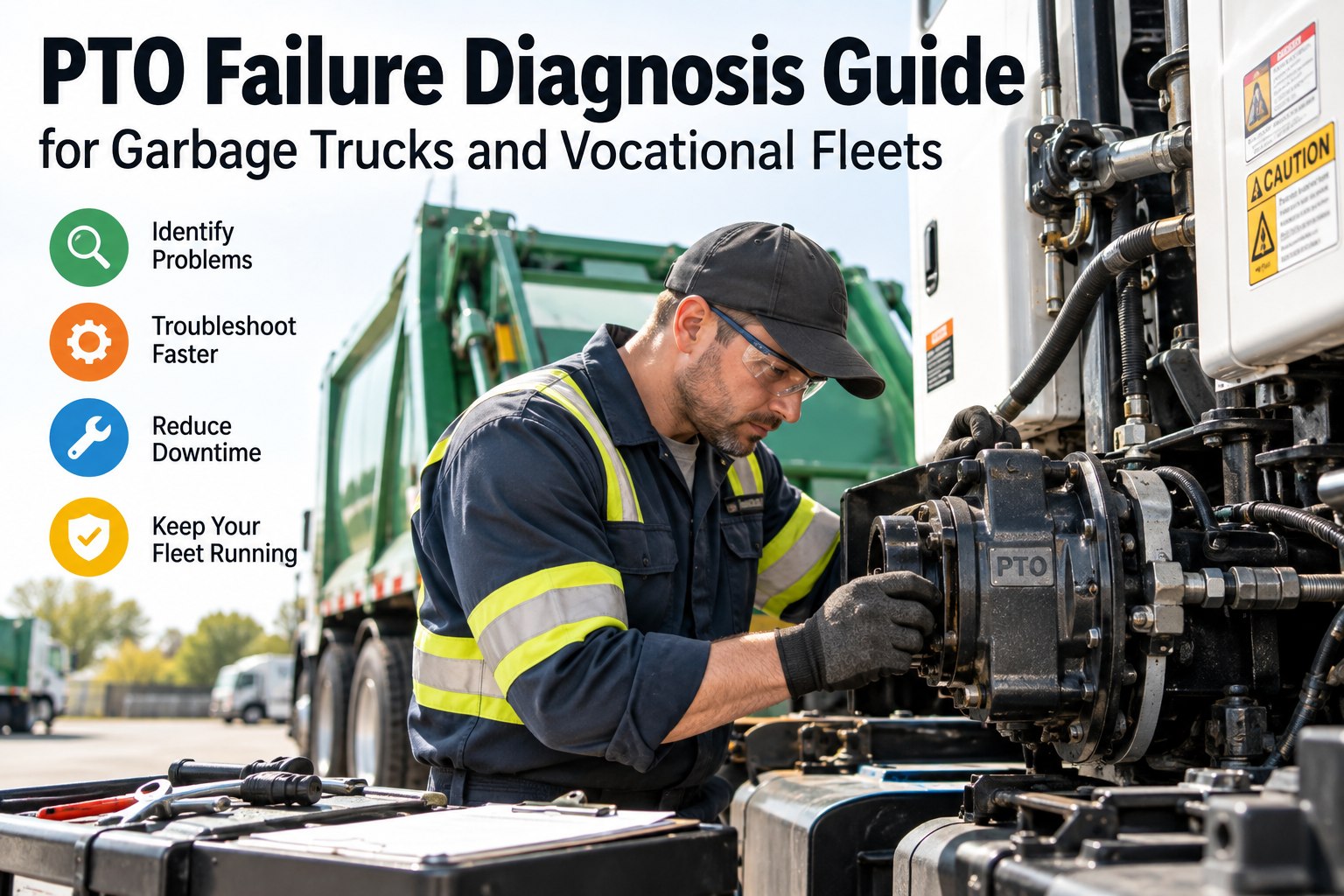
When the packer slows to a crawl, whines on every cycle, or won't engage at all, the whole truck stops earning — a garbage truck with a dead PTO is a very expensive way to drive an empty body around a route. And here's the trap that turns a cheap fix into a catastrophe: the natural reaction is to keep cycling the PTO switch to force it, which burns out solenoids and can turn a $300 repair into a $3,000 transmission rebuild. PTO problems aren't random; each symptom points at a specific cause, and a disciplined air-then-electrical-then-mechanical check pinpoints it in under 30 minutes without ever forcing the unit. This guide is that diagnostic method — the symptom decoder, the ordered check sequence, the numbers that separate a good PTO from a failing one, and the one rule that keeps a small problem small.Start a free trial and log every PTO symptom and fix against the truck.
Diagnose PTO Failures in Under 30 Minutes
A whine, a slow packer, a no-engage — each PTO symptom points at a specific cause, and forcing it turns a $300 fix into a $3,000 rebuild. Truck Inspection & Maintenance Management Software puts the symptom decoder, the diagnostic sequence, and every unit's PTO history in one place — so drivers flag the signal, the shop pinpoints the cause fast, and no truck sits dead on a route. Set it up free in minutes — tap the button below and stop guessing at PTO failures.
The Symptom Decoder: What the PTO Is Telling You
The fastest diagnosis starts with the signal. A PTO announces its problem through noise, speed, and heat — and each pattern narrows the cause before you touch a tool. Match the symptom, then run the checks it points to.Ask how driver-reported symptoms become a guided shop diagnosis.
The 30-Minute Diagnostic Sequence
Once the symptom points you at engagement or power loss, run the checks in this order — cheapest and most common first, deepest and rarest last. Following the sequence is what keeps you from pulling a transmission for a $12 fuse.Start free and build the air-electrical-mechanical sequence into a checklist.
Most engagement problems are air. Confirm activation pressure at the switch port — roughly 150 psi for hydraulically-shifted units, 70 psi for air-shifted — and that system air holds above 90 psi under load. Look for leaks, moisture, and sticking valves before anything else.
If air is good, check the electrical side: fuses (commonly a 5-amp and a 40-amp), the solenoid coil voltage, ground, and continuity, plus switches, relays, and connectors for corrosion. A PTO indicator light that won't illuminate usually means the solenoid isn't getting correct voltage or ground.
Only after air and electrical check out do you go internal — shift forks, valve body, gear condition, bearing end play (typically 0.002–0.006 in), and backlash (around 0.006–0.012 in). This is where the expensive repairs live, which is exactly why it's the last stop, not the first.
Turn Every PTO Symptom Into a Tracked, Solvable Ticket
A driver hears a whine or watches the packer slow, flags it on a mobile inspection with the exact symptom, and it routes to the shop as a work order carrying that unit's full PTO history. The tech runs the air-electrical-mechanical sequence from a guided checklist, logs the fix, and the record shows whether this PTO is a repeat offender heading for overhaul. No symptom gets lost between the route and the bay — and no truck sits dead while someone guesses.
The One Rule: Don't Force It
Every expensive PTO story starts the same way — a unit that wouldn't engage, and an operator who kept hitting the switch to make it. This is the single most costly mistake in PTO maintenance, and it's entirely avoidable.
Repeatedly cycling the switch to force a stubborn PTO burns out solenoids, melts wiring, and can drive an unseated gear into internal damage — turning a $300 electrical or air fix into a $3,000 transmission rebuild.
Stop at the first refusal, run the sequence, and find the cheap cause that's almost always behind it. The discipline of not forcing is worth thousands per event on a fleet that runs PTOs hard.
Why Refuse PTOs Fail Faster
A refuse PTO doesn't live the life the spec sheet assumes. Understanding the duty cycle is half of preventing the failures in the first place.
A packer PTO can run well over 4 hours a shift — continuous-duty service that demands a higher-grade gear oil (typically SAE 80W-90 GL-5) and shorter service intervals than intermittent use. Spec the oil and interval for how it actually runs.
Hundreds of engage-and-load cycles a day wear gears, bearings, and clutches on a clock the odometer never sees. Track PTO service by hours and cycles, not truck mileage.
Contaminated hydraulic fluid delays engagement and destroys pumps; grit and heat accelerate everything. Fluid cleanliness and cooling are frontline PTO defenses, not afterthoughts.
Frequently Asked Questions
Keep Every Packer Cycling and Every Route Earning
Give dispatch, drivers, and the shop one system for PTO health — driver-flagged symptoms routed to work orders, a guided air-electrical-mechanical diagnostic checklist, hours-and-cycles service scheduling, and per-unit history that catches a repeat offender before it cracks a case. Stop losing a truck to a PTO problem that a 30-minute diagnosis would have solved.