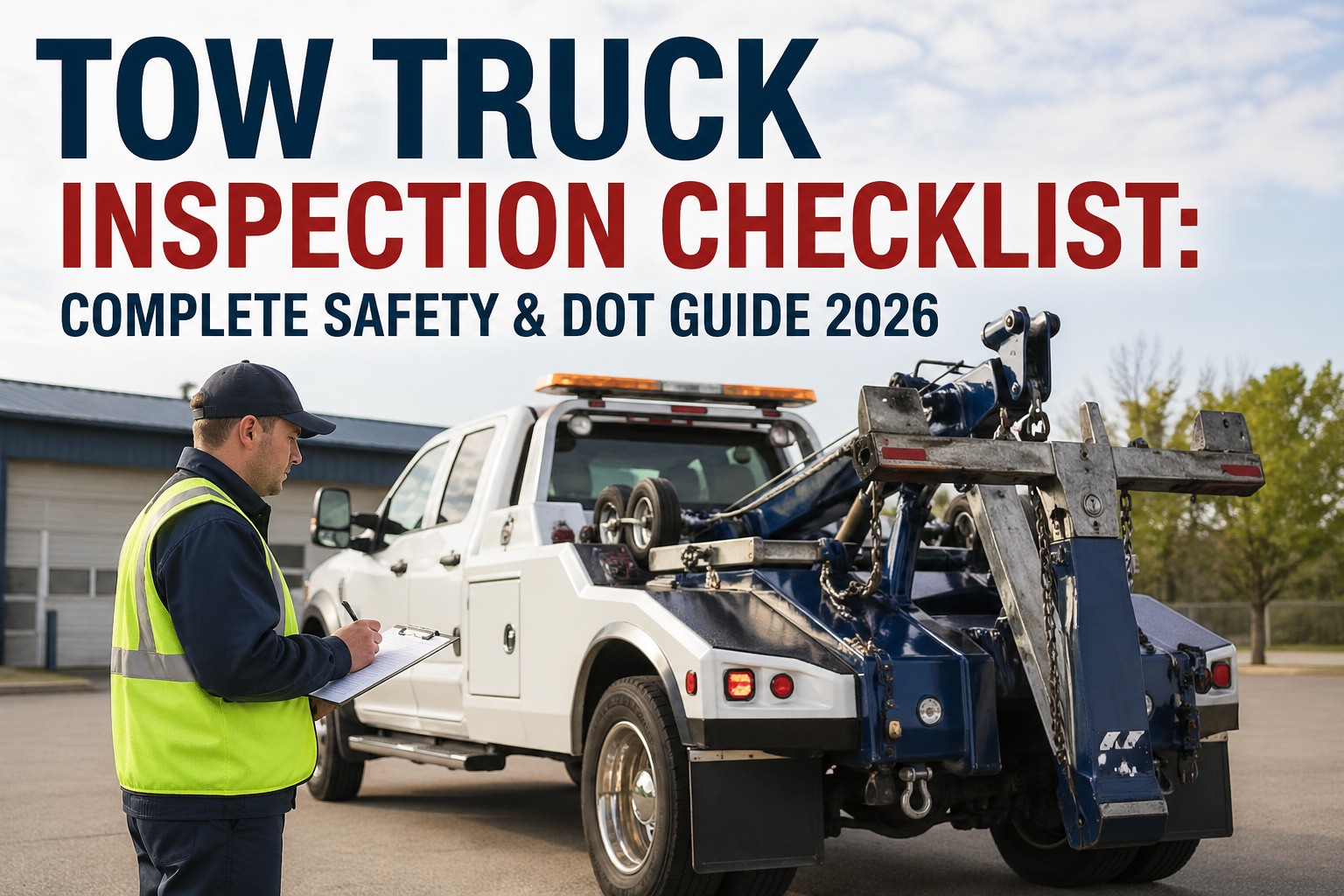
Rigging Inspection Checklist for Tow Truck Operators
By William Jerry on October 14, 2026
Every tow and heavy recovery runs on the weakest piece of gear in the kit. A frayed sling, a bent hook throat, a cracked snatch-block cheek — any one of them turns a routine recovery into a fatality. This is the hardware-by-hardware inspection to run before every recovery and formally on a documented schedule. Contact our team to put the full rigging file on our software.
ASME B30 Series · OSHA 1910.184 · Pre-Use + Periodic
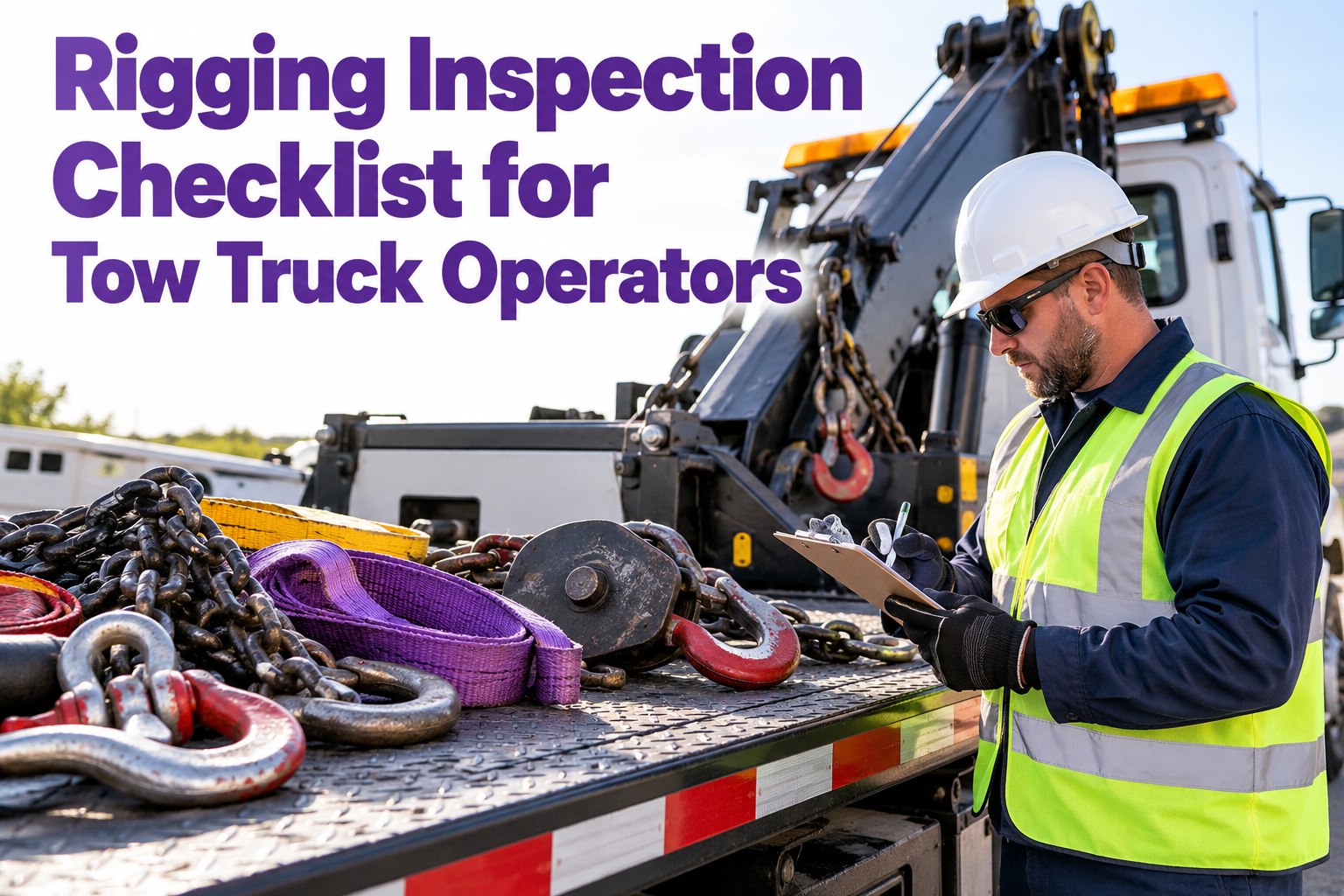
Rigging Inspection Checklist for Tow Truck Operators.
A tow operator's rigging kit is a chain of load-rated hardware — slings, hooks, chains, snatch blocks, wire rope, shackles — where the lowest-rated or most-worn piece is the one that fails. Our Truck Inspection & Maintenance Management Software gives every operator a guided, photo-backed rigging check on their phone, logs the result against the kit and the operator, and flags any item that hits a remove-from-service criterion before it leaves the yard.
◉Pre-UseEvery shift, every piece of gear going on the truck
⬢MonthlyDocumented inspection of slings, chains, hooks, blocks
◆AnnualQualified-person periodic inspection with records
The ASME B30 series and OSHA 1910.184 list specific conditions that mean "tag the gear out, do not use, do not repair in the field." If any item below is true for any piece of rigging on your truck, that piece is out of service — not until the shop looks at it, not until the next job, now. Our software records the tag-out, locks the item out of the active kit, and routes it to the shop for disposition.
Any missing or illegible identification tag or capacity marking
Visible cuts, snags, holes, burns, chemical damage on a sling
Hook throat opening greater than 15% over the original — bent/sprung
Chain link stretched > 3% elongation or wear ≥ 10% of original diameter
Wire rope with 6 broken wires in one lay, or 3 in one strand in one lay
Any cracked, deformed, or heat-damaged shackle, hook, or snatch block
The Rigging Kit — Six Hardware Classes to Inspect
A tow and recovery kit is six distinct hardware classes, each with its own wear mode, its own code reference, and its own retire-at threshold. Our Truck Inspection & Maintenance Management Software gives each class its own check on the operator's phone — one scan covers the whole kit.
The Checklist — Six Hardware Sections, Every Box Required
Run this before every recovery, and formally once a month with sign-off. Each item is a native checkbox: tick it as you confirm it, and anything unticked is a reason to tag the piece out before the truck rolls.
Working Load Limit — The Number That Ends Arguments
Every piece of rigging has a WLL stamped on it, and the lowest-WLL item in the assembly is the whole assembly's rating. Our software stores every item's WLL in the kit record so an operator can see at a glance whether the gear going on the truck will handle the recovery weight.
Hardware
WLL marker
Reduce WLL when
Our software records
Chain sling
Grade + reach + WLL on tag
Angle < 60° from horizontal — basket/choke configurations
Grade, length, WLL, last inspection date, operator sign-off
Synthetic sling
Capacity on sewn tag
Choker hitch (~75%), basket hitch (2× vertical, if load clears)
WLL values and reduction factors shown are typical patterns from ASME and manufacturer references — always use the actual stamped WLL on your gear and the manufacturer's reduction tables. Not legal rigging advice.
Where Rigging Failures Actually Come From
Catastrophic rigging failures almost never come from using gear that was obviously destroyed. They come from gear that was slightly over its limit, or had a small defect nobody wrote down, used one job too many. Our software is built to catch each pattern.
01
Unknown or missing WLL
Tag worn off, nobody re-stamped. Our software requires a WLL on every kit item or the item cannot be checked out.
02
Sling with hidden cuts
Jacket intact, core yarns cut on a previous job. Our software demands a core-yarn exposure check and photo on every monthly inspection.
03
Bent hook throat used anyway
Hook looked "pretty close". Our software records throat opening in mm and flags any growth > 15% as out of service.
04
Snatch block undersized for line
Sheave groove too small for the wire rope, cuts the wires on first pull. Our software links each block to its compatible line sizes.
05
Side-loaded shackle
Pulled sideways instead of in-line, capacity dropped by half. Our software records load direction on the pre-recovery brief.
06
Gear with no inspection history
Nobody can say when it was last looked at. Our software tags every item with a last-inspection date and locks overdue items out of the kit.
Every Piece. Every Shift. Signed Off on One Phone.
Our Truck Inspection & Maintenance Management Software gives every tow operator a 42-item rigging check — slings, hooks, chains, blocks, wire rope, shackles — on the phone before the truck rolls. Every WLL recorded, every throat opening measured, every tag-out locked out of the kit until the shop clears it. A recovery fleet whose gear is as audit-ready as its paperwork.
Six jobs that turn a laminated clipboard into a per-item, per-operator record of every piece of rigging that has ever gone on your trucks.
01Our software holds the kit logEvery sling, hook, chain, block, line, and shackle tagged with WLL, serial, inspection date, operator history
02Our software runs the pre-use checkOperator walks the kit on the phone before every recovery — 44 items, one scan, timestamped and signed
03Our software records measurementsThroat opening in mm, broken-wire count per lay, link elongation % — not a yes/no, a measured value
04Our software tags out failuresAny remove-from-service criterion hit = item locked out of the active kit until the shop clears it
05Our software schedules periodicMonthly documented inspections and annual qualified-person checks — fired per item, not per truck
06Our software holds the proofPhotos, measurements, operator signatures per inspection — full file ready for OSHA, insurer, or incident review
Expert Review
Reviewed forTow and heavy recovery operators, fleet managers at light/medium/heavy-duty towing companies, and safety directors responsible for rigging kits across multi-truck recovery fleets
Sources checkedOSHA 29 CFR 1910.184 (Slings) covering sling markings, inspection, and remove-from-service criteria; ASME B30.9 (Slings), B30.10 (Hooks), B30.26 (Rigging Hardware), and B30.30 (Ropes) for inspection intervals and retire-at thresholds; manufacturer inspection literature from major tow and recovery hardware makers; and the Towing & Recovery Association of America (TRAA) operator training patterns
RecommendationRun the full 42-item check before every recovery and a documented monthly inspection by a qualified person — annually by someone outside the daily-use rotation. The three failure patterns worth special attention are hook throat growth, hidden sling core-yarn cuts, and side-loaded shackles. Confirm every WLL and reduction factor against the stamped values on your specific gear and the manufacturer's charts
Frequently Asked Questions
How often should a tow truck rigging kit be inspected?
Three cadences. Pre-use: every piece on the kit before every recovery, by the operator who will use it. Monthly: a documented inspection of all slings, chains, hooks, and blocks by a competent person. Annually: a periodic inspection by a qualified person per the ASME B30 series and OSHA 1910.184. Our Truck Inspection & Maintenance Management Software runs all three automatically on every item in the kit. Start free and set up the three cadences on your gear.
What are the OSHA remove-from-service criteria for a sling?
Under 29 CFR 1910.184, a sling (synthetic or wire rope) must be removed from service for: missing or illegible identification; cuts, snags, or holes on the surface; burns or heat damage; chemical attack or discolouration; broken wires beyond the standard's limits for wire rope; distortion of fittings; and any condition that causes doubt about its safety. Our software records each of these as a yes/no on every inspection, with photos.
When is a hook considered unusable?
ASME B30.10 criteria: throat opening more than 15% larger than the original (bent or sprung), twist of more than 10° out of plane, cracks or nicks in the saddle or throat area, latch missing or non-functional on a latching hook, excessive wear, heat damage, or any field-weld repair. Our software records the throat measurement at every inspection and compares against the original, flagging drift before it reaches the limit.
Do I have to keep rigging inspection records?
OSHA 1910.184 requires records of initial, periodic (annual), and repair inspections of slings, retained for the inspection period. The ASME B30 series calls for documented inspections at designated intervals. Our Truck Inspection & Maintenance Management Software stores every inspection — pre-use, monthly, annual — tied to the specific item, with the inspector's signature and any photos, retrievable per item or per date for an OSHA request or an insurer review.
What's the fastest way to make a rigging program audit-ready?
Three steps. Catalogue every piece of gear with WLL, serial, and purchase date in one kit log. Replace the clipboard inspection with a per-item digital check that captures measurements and photos. Lock any failed item out of the active kit until the shop clears it. Our software does all three in one app, every day, on every truck. Contact our team to catalogue your kit on our software.
Our Truck Inspection & Maintenance Management Software gives every tow operator the full 42-item rigging check on their phone before every recovery, records every WLL and measurement per item, tags failed gear out of the active kit automatically, and keeps the full inspection file ready for OSHA, your insurer, or an incident review.
No credit card required. Reflects OSHA 1910.184 + ASME B30 series as commonly applied — confirm every WLL and threshold against the stamped values on your own gear and the manufacturer's documentation. Not rigging advice.