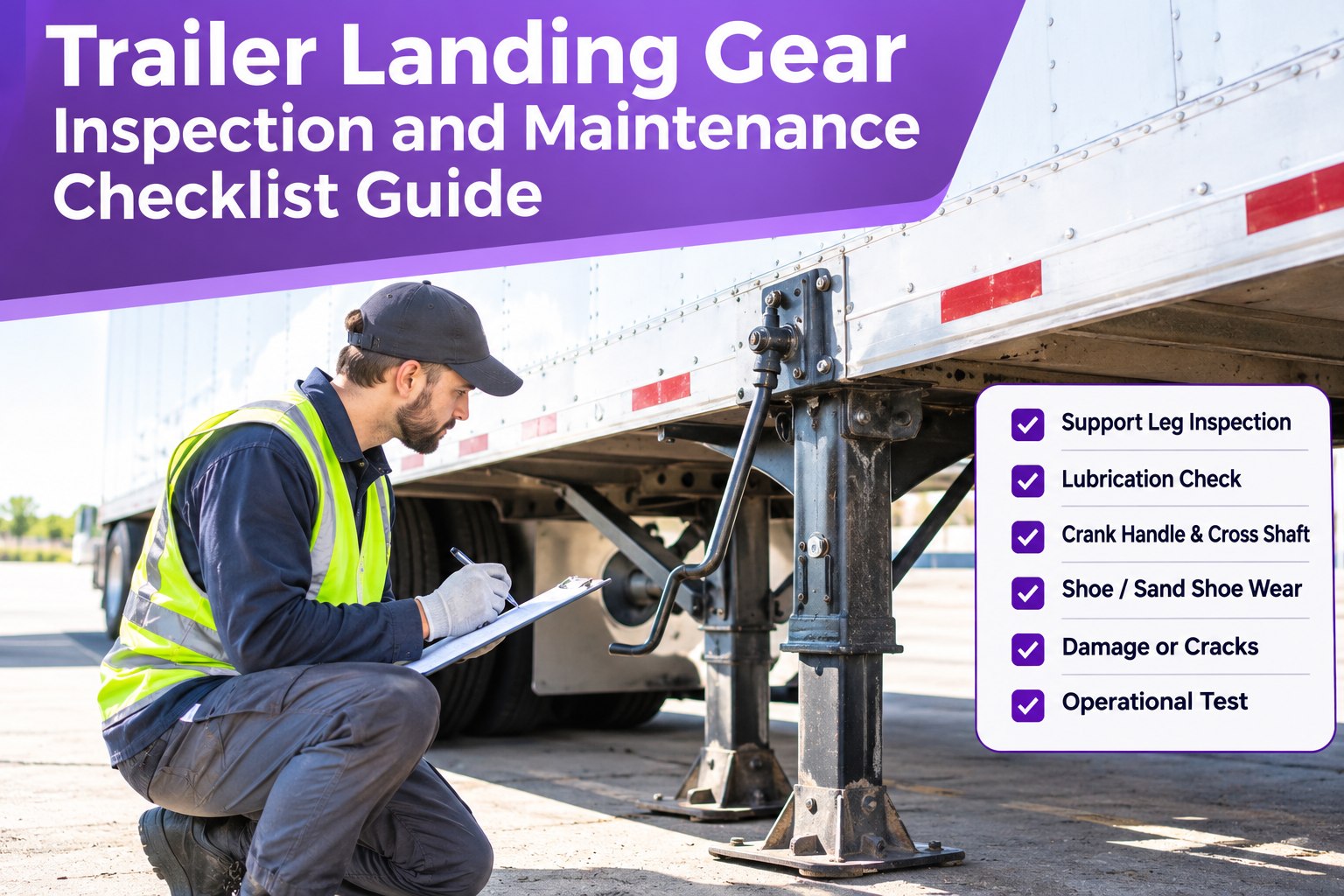
The driver drops a loaded trailer at a customer's dock, cranks the landing gear down and walks away. An hour later one leg gives way, the nose sinks, and a trailer that cost a day of freight is now a damaged load, a repair bill and an incident report. Landing gear rarely fails without warning. It gets stiff, notchy or crooked first, usually after months without grease. This guide gives you a landing gear inspection checklist, a simple lubrication routine, a crank-feel troubleshooting chart and the safe operating rules. It also shows how Truck Inspection & Maintenance Management Software keeps the grease interval and every bent-leg finding on the trailer's record. Start free and schedule landing gear PM.
Inspect · Grease · Flag Defects · Close the Repair
Trailer Landing Gear Inspection and Maintenance Checklist Guide
A grease gun and thirty seconds of attention prevent most landing gear failures. Truck Inspection & Maintenance Management Software puts the landing gear checks in your trailer inspections, schedules the lubrication on a recurring PM, and keeps photos of every bent leg or worn gearbox on that trailer's record.
No credit card required. Free for up to 3 trucks.
1InspectLegs, crank, cross shaft and feet on every trailer.
2Flag with a photoA bent leg or worn gearbox is logged as a defect.
3Work orderRepair or replace, with parts and labor recorded.
4Lube on scheduleRecurring PM keeps the grease interval from slipping.
The Force Path: Where Landing Gear Fails
Landing gear carries load along one path, from your hand to the ground. A problem at any point shows up somewhere along the line, so inspect the whole path in order.
1 · CrankHandle and shaft: bent, loose or hard to turn.
2 · GearboxHigh and low gears: worn gearboxes cause rough cranking.
3 · Cross shaftLinks both legs: bent, binding or loose bolts.
4 · LegsLift screws and tubes: bent, wobbling or seized.
5 · FeetPads or sand shoes: missing, crushed or cracked.
The Crank-Feel Test
Your hands are the best sensor you have. Crank the legs up and down in both high and low gear and match what you feel.
What you feelLikely causeWhat to do
Smooth in both gearsHealthy gearKeep to the grease schedule
Stiff or hard to turnLack of grease, over-tight cross shaft bolts or misaligned legsGrease it, check cross shaft and leg alignment
Notchy, irregular or grindingWorn gearbox, the most common gear failureFlag it. Usually the leg needs replacing.
Wobbling or twisting legBent leg or lift screw, often from impactTake it out of use and replace the damaged part
Legs uneven or one lagsMisalignment, or a bent cross shaftInspect the cross shaft and leg height
Follow your landing gear maker's manual for exact specifications, such as crank effort limits and alignment checks.
The Grease Routine in 5 Steps
Landing gear needs lubrication whether or not it gets used. SAF-HOLLAND recommends every six months, or more often with heavy use, and says to follow your gear maker's instructions.
1
Set up safelyCouple the trailer to a tractor with the brakes set, so it cannot move while you work.
2
Fully retract, then extend a few turnsUse high gear to bring the legs to the position your manual shows for reaching each grease fitting.
3
Grease every fittingLift screws, gearbox and bevel gear each have fittings. Use the grease and amounts your manufacturer specifies.
4
Cycle it through both gearsRaise and lower the legs fully in low and high gear. This spreads grease along the screw and through the gearbox.
5
Wipe, record and set the next dateClean up excess grease, log the service on the trailer and schedule the next lube.
Choose the right greaseSAF-HOLLAND advises an extreme-pressure grease with a low-temperature rating, and warns against lubricants containing Teflon. Always match your maker's recommendation, especially in cold climates.
Safe Operating Rules
Do
- Raise and lower a trailer that is carrying weight in low gear only
- Use high gear only to bring legs to the ground
- Fully retract the legs before moving the trailer
- Park on firm, level ground
Don't
- Shift gears while the gear is under load
- Lift or lower a loaded trailer in high gear
- Drag extended legs or hit obstacles
- Over-tighten cross shaft bolts
⚠️
Support the trailer before repairsLanding gear work should only be done with the trailer properly blocked and supported, and ideally coupled to a tractor with the brakes set. Legs that wobble, bend or will not hold are not safe to use.
Tap-to-Tick Landing Gear Checklist
Cross shaft and alignment
Rebuild, Replace or Keep?
Gear with excessive play should be rebuilt or replaced. A worn gearbox usually means a new leg, while braces and the cross shaft can often be reused if they are straight and sound.
ReplaceWorn gearbox, bent leg or bent lift screwThese are the damage types that cause collapse under load.
Often reusableBraces and cross shaftIf they are straight, undamaged and the bolts are replaced with new self-locking nuts.
Grease on Time. Catch Damage Early.
Recurring PM for landing gear lube, defects logged with photos and every repair on the trailer's record. Start with up to 3 trucks free.
How the Software Keeps Landing Gear in Check
Trailer inspectionsAdd landing gear items to your trailer inspection checklist.
Photos on defectsAttach a picture of a bent leg or worn gearbox to the trailer's record.
Recurring PMSchedule the lube interval so it comes due without anyone remembering.
Repair historySee which trailers keep having gear trouble.
Frequently Asked Questions
How often should trailer landing gear be lubricated?
SAF-HOLLAND recommends every six months, or more often if needed, and says to follow your landing gear maker's instructions. Heavy use calls for shorter intervals.
Start free and set a recurring lube PM.
Why is my landing gear hard to crank?
Common causes are lack of grease, over-tight cross shaft bolts, misaligned legs, a bent shaft or a worn gearbox. Start with lubrication and the cross shaft.
Can I raise a loaded trailer in high gear?
No. Raise and lower a trailer with weight on the legs in low gear only, and never shift gears under load. High gear is for running the legs to the ground.
How does software help with landing gear maintenance?
Inspect · Grease · Repair · Record
Don't Let a Dry Gearbox Drop Your Next Load
Put landing gear checks and lube intervals on a schedule, and keep a clean record for every trailer.
No credit card required. Free for up to 3 trucks.