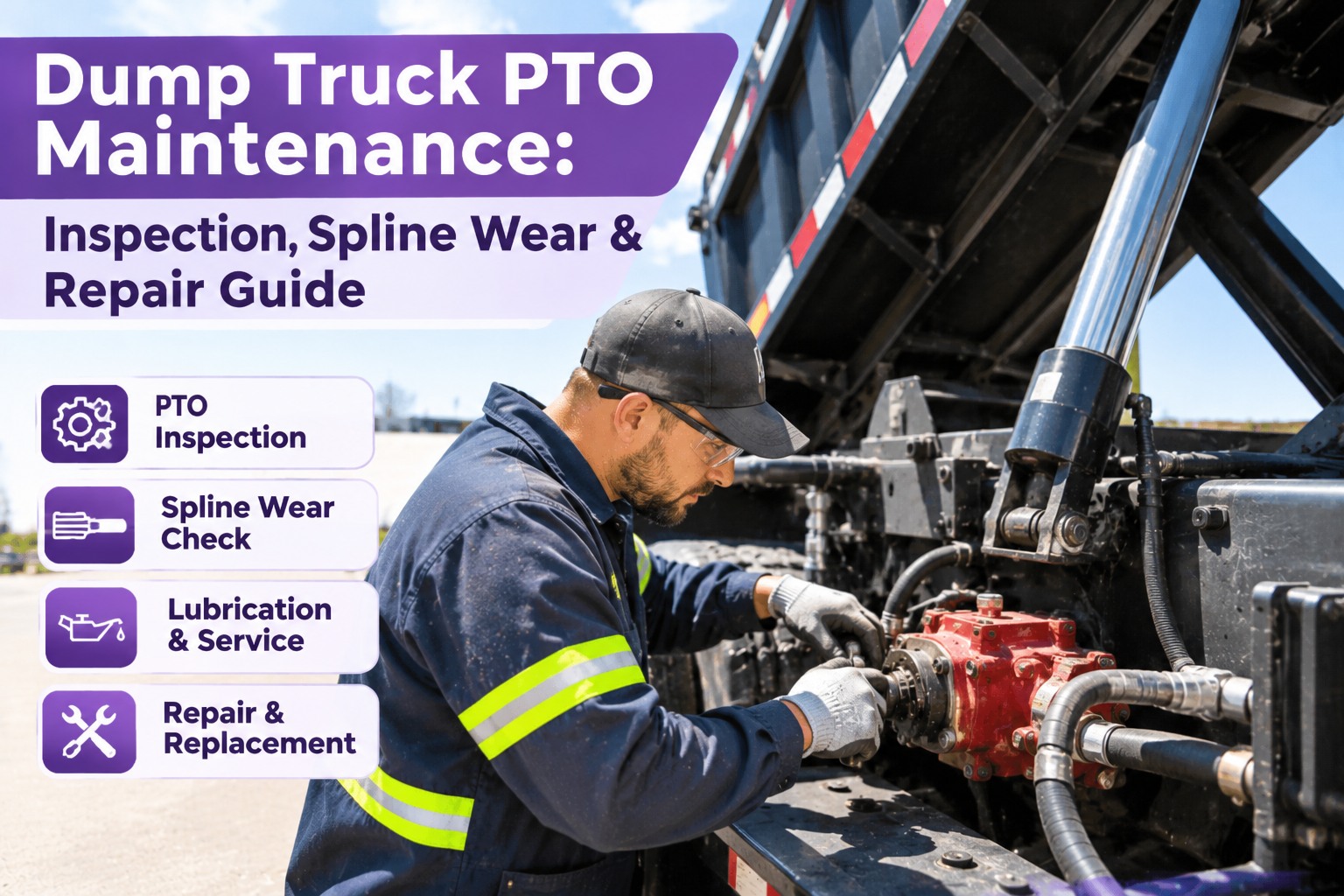
A dump truck's power take-off is the smallest part moving the most power. It taps engine torque off the transmission and turns it into the hydraulic force that raises the body — and when its splines round off or the pump drifts out of alignment, you don't lose the truck, you lose the dump, often with a load still in it. PTO wear is quiet: a worn spline or a mis-set relief valve doesn't announce itself until the body won't lift or the shaft lets go. This guide walks what wears, how to read the warning signs, and how Truck Inspection & Maintenance Management Software keeps the PTO on a maintenance clock that matches how hard it actually works. Start free and keep every dump body lifting.
When a PTO fails, a loaded body stops moving. Our software puts the PTO on a duty-cycle PM clock, checks the splines, engagement and oil on the dump pre-trip, and routes a whining gear or a slow lift to a work order before the shaft gives out — so the power take-off doesn't strand a truck that's already full.
The PTO taps power off the transmission and turns it into hydraulic lift — and the splines are where the wear transfers.
What the PTO Actually Does
The power take-off bolts onto the side of the transmission, meshes a gear with the transmission's drive gear, and sends that power through a driveshaft into a hydraulic pump. The pump raises the body. On a dump truck that's the whole job — no PTO, no lift.
Units engage by air, electric, or mechanical shift, and each is either a hot-shift design (engages on the move) or a cold-shift one that needs the clutch in. Matching the engagement to how the unit is built matters: trying to hot-shift a cold-shift PTO throws symptoms that look mechanical but aren't. Book a demo to put PTO checks on the dump pre-trip.
Five Ways a PTO Wears Out
A PTO rarely fails from one dramatic event. It wears from the inside out, and the five paths below cover nearly all of it.
01Spline wearSplines round off or twist from overload, misalignment and dry engagement. A worn shaft transmits power unevenly — and it doesn't happen overnight.
02Engagement mechanismAir pressure, a solenoid, or a cable that's out of adjustment leaves the unit partially engaged — and partial engagement stresses gears, shafts and seals.
03LubricationThe PTO shares the transmission's oil. Low or degraded oil starves the gears and builds heat; the pump pilot and slip-joint need grease of their own.
04Heat buildupOil temperature shouldn't run high. Low oil, a closed shut-off valve, wrong pump rotation, or a mis-set relief valve all cook the unit.
05Pump alignmentAn unsupported direct-mount pump twists the PTO as it runs; a shaft that's off its centerline puts angled force on the bearings and splines.
Catch the Spline Before the Shaft Lets Go
Spline wear, engagement slip and heat checked on a guided dump pre-trip, with the oil check, bolt torque and grease logged to the unit — so the PTO is on a maintenance record, not a guess.
The headline wear point — the splines — mostly comes down to how the unit is engaged and how it's greased. Splines round off when they slide dry under load, and they twist when the shaft runs off its plane.
Why splines round offDry engagement, over-torque, and a shaft that isn't aligned to the pump — metal grinding on metal with no film between.
How to engage rightClean mating parts, grease the pump pilot and slip-joint, and engage smoothly at low rpm — don't force a misaligned shaft on.
When the shaft is doneRust, cracks, and bent or twisted splines mean the shaft is transmitting power unevenly — repair before it strands a load.
Service Intervals That Match the Duty
There's no single federal interval for a PTO — the right cadence depends on load and application. Two rules carry most fleets.
Tie it to oil serviceThe PTO shares the transmission's oil, so check it every time the truck is in for a regular oil change or lube.
Count hours, not milesA body that cycles all day works the PTO far harder than road miles suggest — severe-duty units earn an early physical check.
Re-check a new installImproper installation and wrong gear backlash are a leading cause of failure, so a new or rebuilt PTO deserves early follow-ups.
Every PM, the short list is the same: oil level and condition, mounting-bolt torque, grease at the pilot and slip-joint, and a listen at engagement. Logged to the unit, those four build the history that catches a trend. Start free and track PTO service by the unit.
Why Dump Fleets Run It in Software
A PTO's warning signs are small and easy to miss on a busy yard. Keeping them on the truck's record is what turns a noise into a scheduled repair instead of a roadside failure.
Duty-cycle PMScheduled on how hard the body works, not just odometer miles.
Splines on the pre-tripSpline, engagement and oil checks built into the dump walkaround.
Symptom to work orderA whine or a slow lift routes to the shop before the shaft goes.
Torque & grease loggedBolt torque and lube captured so nothing is left to memory.
One record per unitOil, engagement and repair history on a single PTO file.
Catch the trendA pitch change or a creeping lift time flagged while it's cheap.
Dry engagement, over-torque and misalignment. When splines slide without grease, run under heavy load, or sit on a shaft that's off its centerline, they round off or twist and start transmitting power unevenly. Book a demo to catch spline wear early.
2Why won't my PTO engage?
On air or electric units it's usually low air pressure, a weak solenoid, or a wiring fault; on mechanical units, a misadjusted cable or gear backlash that's too tight. First confirm the unit is a hot-shift or cold-shift design and engaged the right way. Book a demo to log engagement checks.
3How often should a dump truck PTO be serviced?
There's no fixed standard — it depends on load and application. Check it with every transmission oil service since they share the same oil, and give severe-duty units an early physical inspection. Hours of body cycling matter more than road miles. Book a demo to set a duty-based interval.
4What does PTO overheating mean?
Heat points to low oil, a closed shut-off valve, the wrong pump rotation, or a relief valve set wrong — anything that makes the unit work against itself. A hot PTO or a burnt smell is a stop-and-check, not a run-it-out. Book a demo to flag heat before it spreads.
Splines · Engagement · Lube · Alignment
Keep the Power Take-Off Taking Power
Truck Inspection & Maintenance Management Software puts the PTO on a duty-cycle PM clock, builds the spline, engagement and oil checks into the dump pre-trip, and files torque and grease to the unit — so a worn power take-off is a scheduled repair, not a loaded truck that won't lift.