Every commercial driver on the road today operates against four clocks running simultaneously — the 11-hour driving limit, the 14-hour on-duty window, the 30-minute break trigger at 8 hours of driving, and the 60/70-hour weekly cumulative cap. Federal Motor Carrier Safety Administration regulation 49 CFR Part 395 defines each of these limits, sets the sleeper-berth rules that let drivers pause the clock, and specifies the 34-hour restart that resets the weekly cycle. Get any of these wrong and it's not just a fine — most core HOS violations trigger immediate out-of-service orders at roadside, plus CSA point hits that stay on the carrier's record for 24 months. This guide breaks down the four core limits with plain-English explanations, walks through the sleeper-berth splits that give drivers real flexibility, covers the exemptions that legitimately apply to specific operations, and lists the violations that generate the most citations in 2026. Track driver HOS compliance alongside DVIR and PM on our fleet software, or reach out to our support team for a walkthrough.
FMCSA 49 CFR Part 395 Guide
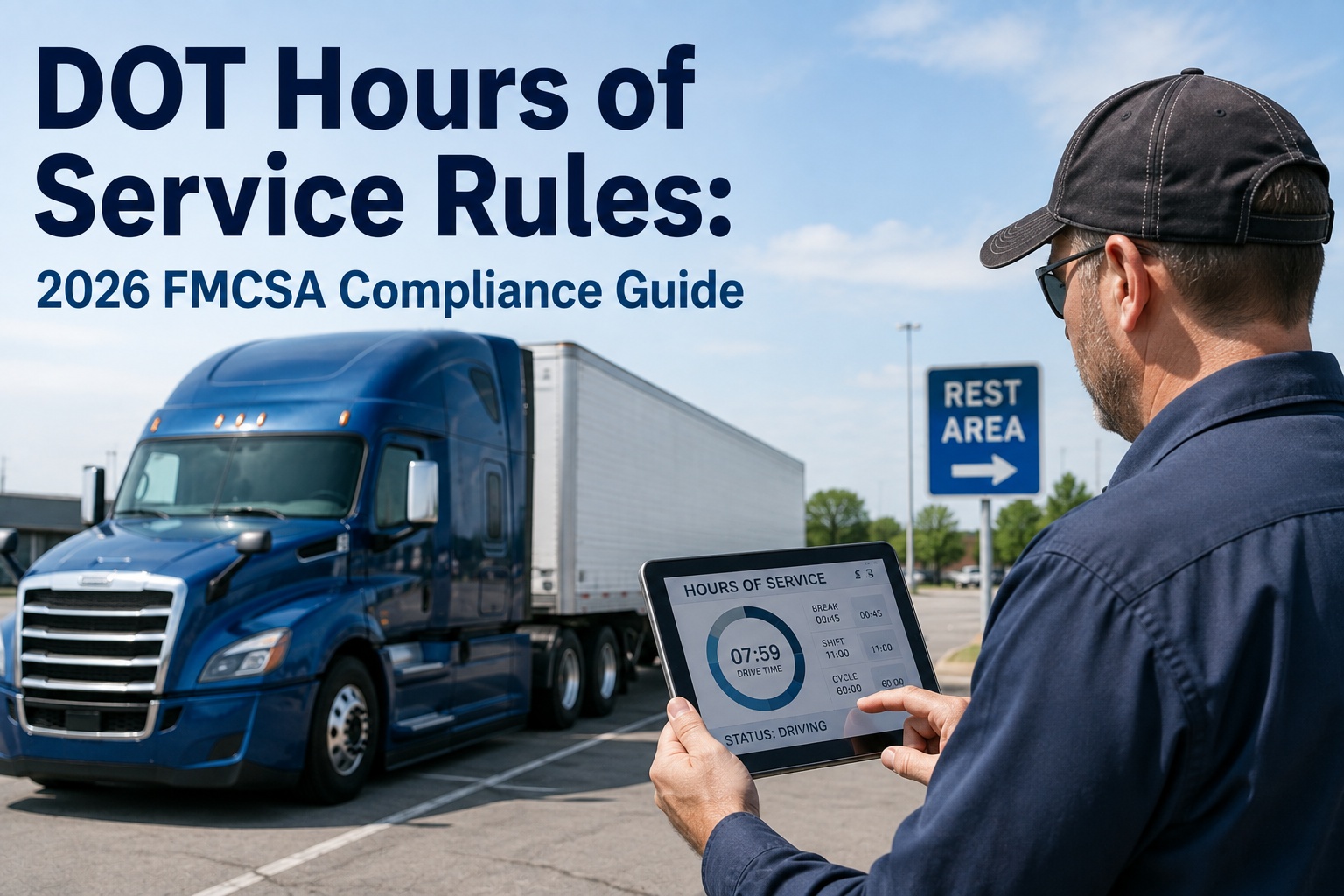
DOT Hours of Service Rules: 2026 FMCSA Compliance Guide
Four clocks, one driver. The complete breakdown of the 11-hour, 14-hour, 30-minute, and 60/70-hour rules — with sleeper berth splits, exemptions, and the violations that put trucks OOS at roadside.
The 4 Core Rules Every Driver Runs On
Federal HOS regulation reduces to four inter-locking rules. Every dispatch decision, every log entry, every roadside interaction traces back to these. Master these first — everything else builds on them.
RULE 1
11-Hour Driving Limit
Maximum driving time allowed after 10 consecutive hours off duty. This is the foundational rule that every other HOS provision builds around. Cannot be exceeded, cannot be waived except in narrow adverse-conditions cases.
Trigger: 10 consecutive hours off duty must precede
RULE 2
14-Hour On-Duty Window
Driving is not allowed after the 14th consecutive hour following coming on duty. On-duty time includes driving plus loading, paperwork, inspections, fueling — anything but off-duty rest. Clock keeps running whether you drive or not.
Trigger: Clock starts on coming on duty, doesn't pause
RULE 3
30-Minute Break Requirement
Required after 8 cumulative hours of driving without a qualifying interruption. As of the 2020 final rule, the break can be satisfied by 30 minutes off-duty, sleeper berth, or on-duty not-driving time — no need to go fully off-duty.
Trigger: 8 cumulative hours of drive time without a 30-min break
RULE 4
60/70-Hour Weekly Limit
Cumulative on-duty time capped at 60 hours in any 7-day period, or 70 hours in any 8-day period. Rolling window — each day the oldest day drops off and the current day is added. Reset with a 34-hour restart.
Trigger: Rolling 7 or 8 consecutive days on-duty accumulation
The Driver's Day: What a Compliant Shift Looks Like
Here's how the 11-hour and 14-hour rules interact across a full shift. This is the visual most dispatchers and drivers need to see once and never forget.
Coming on duty
30-min break at 8 hrs driving
14-hr window closes
11.0 hrs driving (at limit)
14.0 hrs total on-duty window
30 min qualifying break
10 hrs off before restart
CriticalThe 14-hour window does not pause for loading, paperwork, meals, or delays. Once you go on duty, the clock runs. This is why sitting at a shipper for 4 hours can burn half your driving window before you've moved a wheel.
The Sleeper Berth Split: Real Flexibility for Long Days
The sleeper berth split lets drivers divide the required 10 hours off into two periods — with neither period counting against the 14-hour window. This is the tool that saves long haulers stuck at overloaded shippers.
8/2 SPLIT
8 hrs SLEEPER
2 hrs OFF/BERTH
8 consecutive hours in sleeper berth + 2 consecutive hours off-duty or sleeper. The longer period pauses the 14-hour window.
Most common
7/3 SPLIT
7 hrs SLEEPER
3 hrs OFF/BERTH
7 consecutive hours in sleeper berth + 3 consecutive hours off-duty or sleeper. Same qualifying effect as 8/2 — both count as taking 10 hours off.
Alternative
Split ruleNeither period must be less than 2 hours (short leg) or less than 7 hours (long leg). Both periods paired together must total at least 10 hours. Neither period counts against the 14-hour driving window — this is the mechanism that lets drivers legally pause the clock during long dock delays.
The 60/70-Hour Weekly Cycle
The daily rules cap what a driver can do in one shift. The weekly rules cap what a driver can do across a rolling 7 or 8-day period. Both apply — you must stay within both simultaneously.
60-HOUR / 7-DAY RULE
For carriers that don't operate every day of the week
Maximum 60 hours of on-duty time in any rolling 7 consecutive days. Common for local delivery, regional carriers with dedicated home time, and drivers on 5-day schedules.
70-HOUR / 8-DAY RULE
For carriers that operate 7 days a week
Maximum 70 hours of on-duty time in any rolling 8 consecutive days. Standard for long-haul operations, dedicated fleets, and carriers running Sunday–Saturday continuously.
34-HOUR RESTART
The weekly reset mechanism
34 consecutive hours off duty resets the weekly clock to zero. As of current FMCSA rules, no specific time-window restrictions apply. Drivers begin accumulating hours fresh after the restart.
The 5 Duty Statuses Every Driver Uses
Every minute of a driver's day falls into one of five statuses. The ELD tracks them automatically, but understanding which is which — and which counts against which clock — is the driver's responsibility.
1
Off Duty
Free of any work obligation. Counts toward the 10-hour reset. Does not count toward 14-hour or 60/70-hour clocks.
2
Sleeper Berth
In the sleeper berth of a CMV. Counts toward the 10-hour reset. Qualifies for sleeper berth split calculations.
3
Driving
Behind the wheel with the vehicle in motion. Counts against the 11-hour driving limit, the 14-hour window, and the 60/70-hour weekly cap.
4
On Duty, Not Driving
Loading, fueling, inspection, paperwork, waiting at a shipper. Counts against the 14-hour window and 60/70-hour cap. Can satisfy the 30-min break.
5
Personal Conveyance
Off-duty use of the CMV for personal purposes (moving to a rest area, restaurant). Counts as off duty if used correctly. Frequently audited.
Keep HOS compliance connected to DVIR and PM
ELD sync, DVIR routing, PM cadence — all on one platform. When a driver logs off, the maintenance queue for that vehicle is already ready.
The Exemptions That Actually Apply
HOS exemptions are commonly misunderstood. Only specific, narrowly-defined operations qualify. Here are the ones drivers most frequently ask about — and the boundaries you cannot cross without violating.
Short-Haul (150-Air-Mile)
Property-carrying CMV drivers operating within a 150-air-mile radius of the normal work reporting location, returning to that location within 14 hours, at least 10 hours off duty between shifts.
No ELD required; time cards satisfy record-keeping. Increased from 100 air miles in the 2020 final rule.
Adverse Driving Conditions
Weather, road, or traffic conditions the driver could not have known about at dispatch. Extends the 11-hour driving limit by up to 2 hours (to 13) and the 14-hour window by up to 2 hours (to 16).
Cannot be pre-planned. Must be an actual unexpected condition, not a forecast delay. Requires documentation.
Agricultural Operations
Transport of agricultural commodities within a 150-air-mile radius during planting or harvest seasons. HOS rules do not apply within this radius during qualifying periods.
State-defined harvest window. Very specific commodity list. Common source of misapplication and violations.
Emergency Declarations
FEMA-declared emergencies, disaster relief operations, restoration of essential services. Provides temporary HOS relief for drivers directly supporting the emergency response.
Very narrowly defined by FMCSA regional office. Requires official declaration, not just personal judgment.
The 5 Most-Cited HOS Violations in 2026
FMCSA CSA data identifies specific violations that generate the majority of HOS-related roadside citations. Preventable — every one of them.
#1
Driving beyond 11 hours
Operating after accumulating 11 hours of drive time. Often results from miscounted hours, late dispatch, or delivery pressure.
7 CSA points, immediate OOS
#2
Beyond 14-hour window
Operating beyond the 14th consecutive hour after coming on duty. Common when on-duty not-driving time consumes the driving window.
7 CSA points, immediate OOS
#3
60/70-hour weekly exceedance
More than 60 hours in 7 days or 70 in 8 days without a qualifying 34-hour restart. Common in dispatch-driven operations during peak demand.
7 CSA points, immediate OOS
#4
False logs / ELD tampering
Intentionally misrepresenting duty status, drive time, or rest periods. 2026 Roadcheck focus area with intensified enforcement.
Up to 10 CSA points, most severe
#5
Missing 30-minute break
Operating past 8 cumulative driving hours without a qualifying 30-minute interruption. Preventable with ELD alerts.
3 CSA points, plus fine
Fines run to $19,246 per violation for general HOS infractions and up to $23,048 for violations triggering out-of-service orders. Multiple violations on a single truck can be cited independently — a single stop can generate five-figure fines. CSA hits stay on the carrier's record for 24 months.
ELD Requirements: What the Device Records
Under 49 CFR Part 395 Subpart B, most commercial drivers must use an Electronic Logging Device. Here's what the ELD tracks and what it must transmit.
AUTOMATIC CAPTURE
Duty status (driving, on-duty not driving, off-duty, sleeper)
Driving time synced with engine control module
Vehicle motion, speed, and location every 60 minutes
Engine start/stop events
DRIVER ENTRY REQUIRED
Duty status changes not automatic (loading, meals, break)
Trip start and pre-trip inspection completion
Personal conveyance status (with reason)
Yard-move status when applicable
TRANSFER FORMATS
Wireless web services (primary)
Bluetooth to inspector device (secondary)
USB transfer (fallback)
Email transmission (backup)
RETENTION
Driver retains 8 days of records on device
Carrier retains 6 months in back office
Supporting documents (BOLs, receipts) 6 months
Available for FMCSA audit at any time
Frequently Asked Questions
What is the 11-hour rule?
A property-carrying commercial driver can drive a maximum of 11 hours after taking 10 consecutive hours off duty. This is the foundational HOS driving limit under 49 CFR 395.3. Operating beyond 11 hours triggers an immediate out-of-service order at roadside inspection. Track driver hours automatically with our fleet compliance software.
How does the 14-hour window work?
Once a driver comes on duty, they have 14 consecutive hours in which driving is permitted. The clock does not pause for loading, paperwork, or off-duty breaks (except through the sleeper berth split). At the 14th hour, all driving must stop — regardless of how much driving time remains under the 11-hour rule.
When is the 30-minute break required?
After 8 cumulative hours of driving time without a qualifying interruption. Under the 2020 final rule, the break can be satisfied by 30 consecutive minutes of off-duty time, sleeper berth time, or on-duty not-driving time (like loading or a shop delay). No need to go fully off-duty.
What is the sleeper berth split?
A provision that lets drivers divide the required 10 hours off into two periods — 8/2 or 7/3 — with neither period less than 2 hours (short) or 7 hours (long). Both periods together must total at least 10 hours. Neither period counts against the 14-hour window, giving drivers real flexibility during long dock delays. For help configuring split-sleeper logic in your ELD workflow, reach out to our support team.
How does the 34-hour restart work?
34 consecutive hours off duty resets the weekly clock to zero. After the restart, the driver begins accumulating hours fresh from the start of the 60-hour or 70-hour window. As of current rules, no time-window restrictions apply — the restart can occur anytime.
What are the penalties for HOS violations?
General HOS violations run up to $19,246 per infraction. Violations triggering an out-of-service order can reach $23,048. Multiple violations on a single truck during one inspection are cited separately. CSA points from HOS violations stay on the carrier record for 24 months, affecting rates and audit selection. Prevent violations at the source with automatic hour-cycle projection and break alerts on our compliance platform.
Purpose-built for commercial fleets
Keep HOS, DVIR, and PM compliance on one platform
ELD sync for real-time duty-status monitoring. Automatic 30-minute break alerts. Weekly hour-cycle projection. Driver assignment to compliant vehicles only. Audit archive for all 6-month retention requirements. Everything an FMCSA auditor could ask for — one workflow.
No credit card required • 49 CFR Part 395 aligned • Trusted by fleets across North America